AI提升生产力

Search documents
能源-商品板块轮动的下一站
2026-02-03 02:05
Summary of Key Points from Conference Call Records Industry Overview - The commodity market is currently influenced more by supply-side risks than demand-side drivers, indicating that a supercycle is not present [1][4] - The energy sector is experiencing relative oversupply, while non-ferrous and precious metals still hold investment value for 2026 [1][5] Core Insights and Arguments - **Commodity Price Dynamics**: The recent significant pullback in commodity prices, especially in precious metals, is attributed to market adjustments to new Federal Reserve policies and cooling market sentiment [2] - **Gold Price Influences**: Gold prices are under pressure from tightening monetary policy, easing inflation, and expectations of central bank gold sales. The market has already reacted to these factors, leading to a reasonable pullback in gold prices, although overall support levels remain high [6][7] - **Copper and Oil Supply/Demand**: Copper supply is constrained due to insufficient new capacity, supporting prices in the long term, but previous high prices have already been reflected. Oil supply is gradually improving from previous oversupply conditions, suggesting potential price recovery [8][9] - **OPEC+ Supply Uncertainty**: OPEC+ has seen a decline in actual production increase rates, with geopolitical tensions affecting oil supply from countries like Russia and Iran. This uncertainty is expected to persist throughout 2026 [9][10] Additional Important Content - **Natural Gas Market Trends**: The U.S. natural gas market is expected to see a price increase due to rising LNG exports and reduced associated gas supply. European markets are facing low inventory levels, necessitating increased LNG imports [3][15] - **Investment Strategy for 2026**: Investors are advised to focus on timing and specific commodities rather than simply following trends. The anticipated copper shortage from 2025 to 2026 contrasts with the gradual narrowing of oil oversupply [5][8] - **Future Oil Price Projections**: Oil prices are expected to stabilize between $60 and $70 per barrel in the first half of 2026, with potential for a rise to $70-$80 in the latter half as supply-demand dynamics improve [13] Conclusion - The current commodity market is characterized by significant volatility, with specific sectors like precious metals and energy showing distinct trends. Investors should remain vigilant about timing and market signals to capitalize on emerging opportunities while navigating the inherent risks associated with geopolitical factors and supply chain dynamics.
无惧高盛流动性警告,华尔街坚持押注小盘股!
Xin Lang Cai Jing· 2026-01-28 12:23
Core Viewpoint - The mainstream view on Wall Street suggests that as expectations for Federal Reserve interest rate cuts rise and the U.S. economy approaches a "soft landing," funds are shifting from tech giants to lower-valued small-cap stocks, indicating a broadening market rally [1][7]. Group 1: Market Dynamics - Small-cap stocks have recently concluded the longest winning streak against large-cap stocks since 1996, highlighting their deep ties to business and credit cycles [1][7]. - Historical data warns that extreme outperformance in similar past scenarios often fails to endure over time, yet strategists remain optimistic about small-cap stocks as a sign of a broader bull market [1][7]. - The core logic for bullish sentiment on small-cap stocks is based on expectations of accelerated earnings growth, driven by declining interest rates and economic growth [1][7]. Group 2: Economic and Regulatory Factors - Factors such as regulatory easing, narrowing credit spreads, and anticipated interest rate cuts are expected to provide strong tailwinds for high-beta stocks [1][7]. - T. Rowe Price's Chief Investment Officer, Sebastien Page, notes that a "strong but not overheating" economic growth, combined with declining interest rates, will support small-cap stock performance for at least six months [1][7]. Group 3: Investment Sentiment - Despite acknowledging the risks associated with small-cap stocks, Page maintains an "overweight" rating, with many investors and strategists expecting small-cap stocks to outperform large-cap counterparts after a brief pullback [2][8]. - BTIG's Chief Market Technician, Jonathan Krinsky, anticipates further pullbacks but believes small-cap stocks will regain market leadership [2][8]. Group 4: Sector Focus - 22V Research's President, Dennis DeBusschere, highlights that small-cap stocks benefit from both macroeconomic and fundamental factors, particularly if AI significantly enhances productivity, with low-earning companies likely to benefit the most [2][8]. - DeBusschere recommends focusing on regional banks, transportation stocks (excluding airlines), and non-essential consumer goods sectors [2][8]. Group 5: Fiscal Stimulus Impact - Investors are betting that fiscal stimulus measures, including last year's tax reform, will boost small-cap stocks in the fiscal year 2026 [3][9]. - Argent Capital's small-cap portfolio manager, Peter Roy, describes small-cap stocks as "the most American assets" due to their revenue being more domestically sourced compared to multinational giants [3][9]. Group 6: Liquidity Risks - As large institutional investors begin to shift from large-cap to small-cap stocks, liquidity risks become a concern, with potential for significant volatility due to the lower liquidity of small-cap stocks [4][10]. - Horizon Investments' research director, Michael Dickson, warns that large inflows into small-cap stocks could lead to pronounced market fluctuations, which may become the norm rather than the exception [4][10]. - A striking comparison shows that the market capitalization of any single company like Apple, Google, or Nvidia exceeds the total market cap of the Russell 2000 index, which comprises 2,000 small-cap stocks valued at approximately $3.6 trillion [4][11].
一个Bug改通宵,用AI写超50%代码,只有32%资深开发者敢这么干
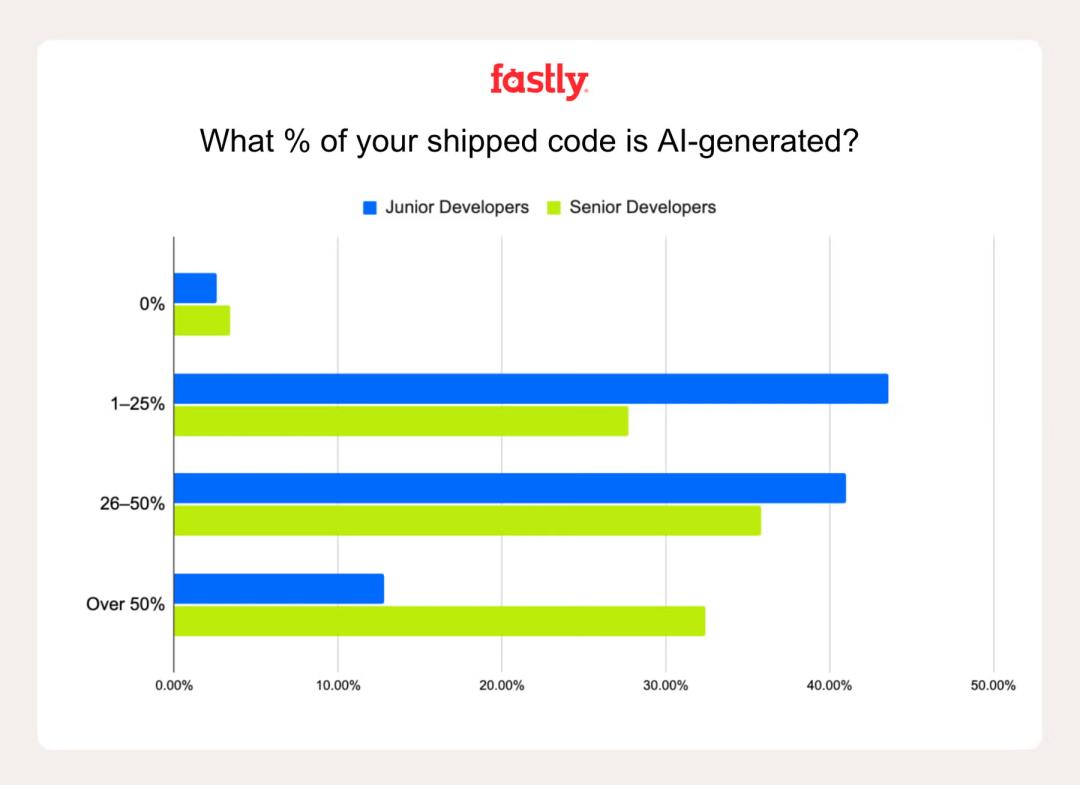
3 6 Ke· 2025-09-02 02:28
Core Insights - Fastly conducted a survey revealing that senior developers use AI-generated code 2.5 times more than junior developers, with about one-third of senior developers reporting that over 50% of their code is AI-generated [1][2][9] - The survey highlights the "hidden costs" of AI coding, particularly the time spent identifying and fixing AI-generated errors, which can negate productivity gains [1][11][14] Group 1: Developer Experience and AI Usage - Senior developers (10+ years of experience) are more optimistic about AI's role in coding, with 59% believing AI tools help them deliver code faster, compared to 49% of junior developers [7][8] - Only 13% of junior developers reported using AI for over 50% of their code, while this figure rises to 32% for senior developers, indicating that experience influences AI adoption [9][10] - The survey found that 26% of senior developers felt AI made them "much faster," compared to only 13% of junior developers [7][8] Group 2: Perceived Productivity and Challenges - Nearly 30% of senior developers reported spending more time modifying AI outputs, which offsets time savings, while only 17% of junior developers felt the same [11][12] - Despite the challenges, over half of the developers still believe that tools like Copilot, Gemini, or Claude make them overall faster [11][12] - The phenomenon of "false progress" is noted, where initial speed gains from AI usage are often lost due to frequent modifications and debugging [13][14] Group 3: Emotional and Environmental Considerations - AI tools provide emotional value, with nearly 80% of developers stating that AI makes programming more enjoyable by reducing repetitive tasks and providing instant code generation [14][15] - The survey also assessed awareness of green coding practices, showing that over 56% of junior developers consider energy consumption, while this figure approaches 80% for mid to senior developers [15] - Approximately two-thirds of developers recognize the carbon emissions associated with AI tools, indicating that green coding is becoming part of developer culture [15]