小盘股投资

Search documents
无惧高盛流动性警告,华尔街坚持押注小盘股!
Xin Lang Cai Jing· 2026-01-28 12:23
Core Viewpoint - The mainstream view on Wall Street suggests that as expectations for Federal Reserve interest rate cuts rise and the U.S. economy approaches a "soft landing," funds are shifting from tech giants to lower-valued small-cap stocks, indicating a broadening market rally [1][7]. Group 1: Market Dynamics - Small-cap stocks have recently concluded the longest winning streak against large-cap stocks since 1996, highlighting their deep ties to business and credit cycles [1][7]. - Historical data warns that extreme outperformance in similar past scenarios often fails to endure over time, yet strategists remain optimistic about small-cap stocks as a sign of a broader bull market [1][7]. - The core logic for bullish sentiment on small-cap stocks is based on expectations of accelerated earnings growth, driven by declining interest rates and economic growth [1][7]. Group 2: Economic and Regulatory Factors - Factors such as regulatory easing, narrowing credit spreads, and anticipated interest rate cuts are expected to provide strong tailwinds for high-beta stocks [1][7]. - T. Rowe Price's Chief Investment Officer, Sebastien Page, notes that a "strong but not overheating" economic growth, combined with declining interest rates, will support small-cap stock performance for at least six months [1][7]. Group 3: Investment Sentiment - Despite acknowledging the risks associated with small-cap stocks, Page maintains an "overweight" rating, with many investors and strategists expecting small-cap stocks to outperform large-cap counterparts after a brief pullback [2][8]. - BTIG's Chief Market Technician, Jonathan Krinsky, anticipates further pullbacks but believes small-cap stocks will regain market leadership [2][8]. Group 4: Sector Focus - 22V Research's President, Dennis DeBusschere, highlights that small-cap stocks benefit from both macroeconomic and fundamental factors, particularly if AI significantly enhances productivity, with low-earning companies likely to benefit the most [2][8]. - DeBusschere recommends focusing on regional banks, transportation stocks (excluding airlines), and non-essential consumer goods sectors [2][8]. Group 5: Fiscal Stimulus Impact - Investors are betting that fiscal stimulus measures, including last year's tax reform, will boost small-cap stocks in the fiscal year 2026 [3][9]. - Argent Capital's small-cap portfolio manager, Peter Roy, describes small-cap stocks as "the most American assets" due to their revenue being more domestically sourced compared to multinational giants [3][9]. Group 6: Liquidity Risks - As large institutional investors begin to shift from large-cap to small-cap stocks, liquidity risks become a concern, with potential for significant volatility due to the lower liquidity of small-cap stocks [4][10]. - Horizon Investments' research director, Michael Dickson, warns that large inflows into small-cap stocks could lead to pronounced market fluctuations, which may become the norm rather than the exception [4][10]. - A striking comparison shows that the market capitalization of any single company like Apple, Google, or Nvidia exceeds the total market cap of the Russell 2000 index, which comprises 2,000 small-cap stocks valued at approximately $3.6 trillion [4][11].
ASX small cap vs large cap investing: where returns are really made
Rask Media· 2026-01-26 23:21
Core Viewpoint - The debate between small cap and large cap investing highlights that both can be advantageous at different times, suggesting that investors may benefit from incorporating both into their strategies. Small Cap Companies - Small cap companies are generally defined as those outside the ASX 100, with market capitalizations ranging from approximately $300 million to $2 billion [4] - These companies are often in earlier stages of growth, characterized by lower liquidity and a reliance on capital markets for funding, which can lead to shareholder dilution if growth expectations are not met [5] Performance Drivers for Small Caps - Small caps can outperform due to their smaller revenue and profit bases, where incremental improvements can significantly impact earnings [6] - Successful execution in gaining contracts or improving operations can lead to rapid profit growth and potential share price re-ratings [6][7] - They can benefit from a dual advantage of earnings growth and valuation expansion, allowing for agility in market expansion or acquisitions [7] Challenges for Small Caps - Small caps are more vulnerable during periods of tight capital, as they depend heavily on equity raises or debt, have less diversified revenue, and can face liquidity issues [8] - In adverse conditions, large caps may appear safer, attracting capital due to their stronger balance sheets and liquidity [9] Large Cap Companies - Large caps typically outperform when investors seek certainty, as they often have predictable earnings and more analyst coverage, which boosts investor confidence [10][11] - They provide greater liquidity and stable dividends, making them attractive during risk-off periods [11] Investment Strategy - A balanced investment approach is recommended, where large caps serve as a stable foundation while small caps offer potential for higher returns through disciplined position sizing [13] - Small caps can create significant wealth but require careful research and execution to avoid substantial losses from poor position sizing [14]


Vanguard Russell 2000 ETF: A Smart Small-Cap Play Right Now?
The Motley Fool· 2026-01-25 16:15
Core Viewpoint - Small-cap stocks, represented by the Russell 2000 index, have started 2026 strongly, outperforming the S&P 500 by over 8% year to date, suggesting a potential resurgence in this market segment [1][2]. Group 1: Market Performance - The Russell 2000 index has not outperformed the S&P 500 in a full calendar year since 2020, indicating a long-term trend that may be reversing [2]. - The Vanguard Russell 2000 ETF has a price-to-earnings ratio of 17.5, suggesting that there is significant value to be unlocked in small-cap stocks [2]. - The early part of 2026 shows a rotation from tech stocks to cyclicals, benefiting sectors like industrials, energy, and materials, which aligns well with small-cap performance [5][6]. Group 2: Sector Composition - The Vanguard Russell 2000 ETF's top three sector exposures are industrials, healthcare, and financials, with technology being a smaller component at around 12% [6]. - This sector composition allows small-caps to potentially benefit from economic growth without the premium valuations associated with tech stocks [5][6]. Group 3: Investment Risks - Approximately 40% of companies in the Russell 2000 are unprofitable, which poses a risk during market corrections or earnings downturns [7]. - While current economic indicators appear strong, a significant slowdown in the labor market raises concerns about the sustainability of small-cap performance [8].

标普红利ETF(562060):攻守兼备的底仓配置利器
Xin Lang Ji Jin· 2025-11-21 09:52
Core Insights - The article emphasizes the importance of dividend-paying companies as a foundation for investment portfolios, providing steady cash flow and resilience against market volatility [3] - The S&P Dividend ETF is highlighted as a unique offensive dividend product, combining characteristics of "dividend + small-cap + industry diversification," offering both growth potential and defensive high-yield assets [4] Summary by Categories Dividend Performance - The latest dividend yield of the index is 5.18%, which is higher than mainstream dividend indices, indicating a focus on dividend stability and profitability [7] - The S&P A-Share Dividend Opportunity Index has achieved a year-to-date increase of nearly 15%, ranking first among mainstream dividend indices in the A-share market [8] Industry Insights - The top three industries contributing to the index are: - Banking: 16.58% - Machinery: 11.02% - Light Industry Manufacturing: 8.68% [5] Comparative Analysis - The article provides a comparative analysis of various dividend indices, showing the S&P A-Share Dividend Index with a yield of 5.18% and a year-to-date return of 14.95%, alongside other indices like the Central Enterprise Dividend Index and the CSI 300 Dividend Index [9][10]

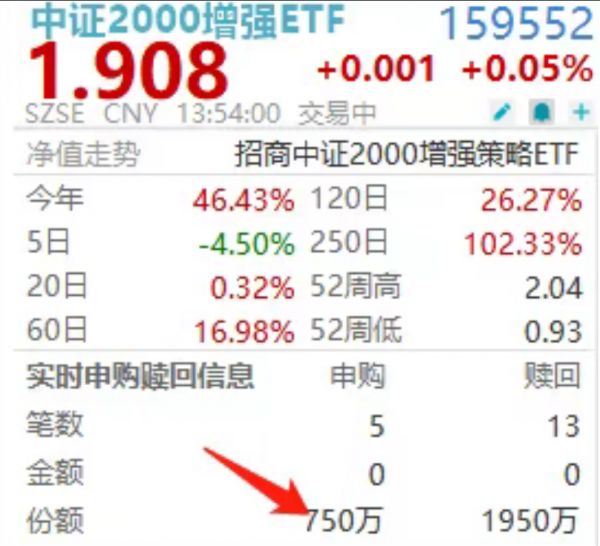
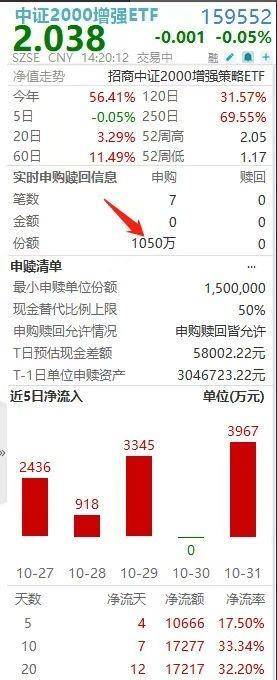
年内超额逾23%引领两市!中证2000增强ETF(159552)盘中再获2100万元资金净流入
Sou Hu Cai Jing· 2025-11-03 08:08
Core Viewpoint - The small-cap style continues to show strong performance, with the CSI 2000 Enhanced ETF (159552) achieving a year-to-date increase of 56.56%, outperforming its benchmark by 23.57%, indicating robust investor confidence in its enhanced strategy [1][3]. Group 1: Fund Performance - As of November 3, the CSI 2000 Enhanced ETF (159552) recorded a 0.05% increase, with a net inflow of approximately 21 million yuan, reflecting ongoing investor interest [1]. - The fund has achieved a stable excess return of over 23% this year, demonstrating its stock selection capability in the small-cap sector [3]. - The fund's performance metrics include a 120-day increase of 31.57% and a 60-day increase of 11.49%, showcasing its resilience in a fluctuating market [2]. Group 2: Market Environment - The current market environment, driven by economic recovery and industrial upgrades, is favorable for small-cap stocks, which typically exhibit higher earnings elasticity during recovery cycles [2]. - Supportive policies for specialized and innovative enterprises are creating a conducive development environment for small and medium-sized enterprises, offering rich opportunities for stock selection [2]. - The CSI 2000 index, which the ETF closely tracks, consists of high-growth and high-elasticity stocks, reinforcing the fund's investment strategy [3].
小盘股热度回归:短期领跑,大盘仍是长期赢家?
Jin Shi Shu Ju· 2025-10-20 10:29
Core Insights - Small-cap stocks, represented by the Russell 2000 index, are experiencing a resurgence in 2025, but they are unlikely to catch up with the S&P 500 index, which has historically outperformed them [1][2] - The Russell 2000 index has risen approximately 10% year-to-date, while the S&P 500 has increased over 13% during the same period [1] - Despite a recent rally, small-cap stocks have not outperformed large-cap stocks in a calendar year since 2020, when the Russell 2000 rose 18.4% compared to the S&P 500's 16.3% [1] Performance Analysis - The current bull market has significantly favored large-cap stocks, with the S&P 500 continuously setting new records since early 2024 [2] - Small-cap stocks are benefiting from a favorable economic environment characterized by lower interest rates and robust economic growth, but their recent performance is driven more by optimism than by solid earnings [2][5] Earnings and Valuation - A significant portion of the Russell 2000 consists of companies with poor or no earnings records, with 43% of its constituents not reporting positive earnings [3] - Stocks without reliable earnings in the Russell 2000 have surged by 55% year-to-date, while profitable stocks have only increased by 8% [3] - Analysts expect small-cap stocks to achieve stronger earnings growth in 2025, with an estimated EPS growth of 26.5% for the Russell 2000 compared to 10.3% for the Russell 1000 [5] Market Dynamics - The rebound in small-cap stocks is largely attributed to expectations of improved earnings driven by lower interest rates, which allow these companies to refinance more easily [5][6] - The trend of private equity and venture capital keeping high-growth potential companies private has contributed to the underperformance of small-cap stocks over the past decade [6] - Recent regulatory changes allowing ordinary investors to invest in private equity may further impact the availability and performance of small-cap stocks [6] Investor Sentiment - Despite challenges, long-term investors focused on small-cap stocks remain optimistic, viewing them as a sustainable asset class [7] - There is a trend of financially sound small-cap companies acquiring their portfolios from private equity, providing liquidity to these firms [7]
美联储降息东风至 小盘股重回市场焦点 上演“后巨头时代”的主升浪
Zhi Tong Cai Jing· 2025-09-18 00:29
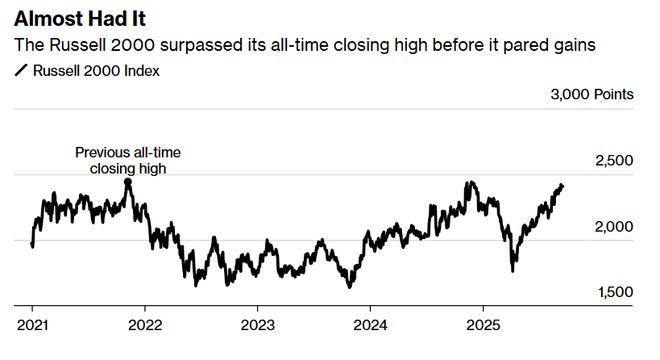
Core Viewpoint - The Russell 2000 index has shown signs of recovery and potential for growth as the Federal Reserve's interest rate cut expectations rise, indicating a shift in market sentiment towards small-cap stocks after a prolonged period of underperformance compared to the S&P 500 index [1][4][8]. Group 1: Market Performance - The Russell 2000 index rose by 2.1% to 2453.36 points during trading, briefly surpassing its historical closing high for the first time since November 2021, before retracting some gains to close up 0.2% [1][4]. - Since the low point in April, the Russell 2000 index has rebounded over 36%, reflecting a significant recovery from previous market fears [9][12]. Group 2: Federal Reserve Actions - The Federal Reserve cut the benchmark interest rate by 25 basis points, marking its first rate cut in nine months, with plans for potentially two more cuts this year [4][5]. - The Fed's policy statement shifted focus from a strong labor market to concerns about slowing job growth and rising unemployment, indicating a new phase of monetary easing [5][11]. Group 3: Investor Sentiment - There is a growing optimism among investors regarding small-cap stocks, as they are seen as undervalued compared to large-cap stocks, particularly in light of the Fed's easing policies [7][10]. - Analysts predict that small-cap stocks may outperform large-cap stocks, especially if the economy avoids recession and enters a period of declining interest rates [9][11]. Group 4: Earnings and Valuation - Small-cap companies have reported better-than-expected earnings in the second quarter, which has contributed to a more favorable outlook for their future performance [10][12]. - The expectation of lower interest rates is anticipated to significantly reduce interest expenses for small-cap firms, potentially enhancing their profitability and stock valuations [13].
安本投资:美联储降息周期下小盘股迎新机遇
Xin Hua Cai Jing· 2025-09-17 08:01
Group 1 - The Federal Reserve is expected to initiate a new round of interest rate cuts, which may lead to a reallocation of international funds, particularly towards emerging markets like China [1] - The Chinese stock market has shown an upward trend, with various indices reaching new highs for the year [1] - Kirsty Desson, head of global small-cap stock investment at Aberdeen Investment, believes that the weak dollar cycle will benefit RMB assets, highlighting potential global investment targets in sectors like biotechnology, consumer applications, and AI in healthcare [1] Group 2 - Since 2025, small-cap stocks have outperformed large-cap stocks, with the Russell 2000 index rising 4.83% in the past month, compared to the S&P 500's 2.1% increase [2] - The MSCI global small-cap index has seen a cumulative increase of 3.67% over the past month and over 11% in three months [2] - Small-cap stocks represent about 15% of the global market capitalization but account for approximately 70% of the total number of listed companies globally [2] Group 3 - The large number of small-cap stocks across various industries provides abundant opportunities for global investors, but selecting quality stocks remains a challenge [3] - The investment philosophy focuses on three key aspects: quality, growth, and momentum [3] - High-quality small-cap stocks can be assessed based on competitive advantages, management capabilities, and financial stability [3] Group 4 - Small-cap stocks are generally more sensitive to interest rate changes, with historical data indicating that they tend to outperform large-cap stocks during the early stages of a rate-cutting cycle [4] Group 5 - There has been a continuous increase in net inflows into emerging market equity funds this year, with a significant rise in funds allocated to Chinese stocks [5] - The A-share market has shown a strong upward trend, with high trading volumes and record inflows from foreign investors [5] Group 6 - The current scale of the Chinese market is relatively small, and many foreign investors are still unfamiliar with it [6] - The shift in global investment patterns from dollar-dominated assets to emerging markets, particularly China, is expected to continue [6] - The "Shanghai-Hong Kong Stock Connect" and "Shenzhen-Hong Kong Stock Connect" have provided effective platforms for foreign investors, enhancing their understanding of the Asian market [6] Group 7 - External factors such as the weakening dollar and geopolitical tensions are prompting investors to reassess their asset allocation strategies [7] - Internal factors like policy adjustments, liquidity improvements, and stronger economic fundamentals are expected to support the Chinese market [7] - The valuation of the A-share market remains attractive, with the CSI 300 index's price-to-earnings ratio around 14 times, still below its five-year average [7] Group 8 - The Chinese capital market is witnessing a revaluation in sectors such as biotechnology, consumer applications, and AI in healthcare [7] - The focus on domestic demand and self-sufficiency is becoming increasingly clear, with innovative Chinese companies, including promising small-cap firms, emerging in the capital market [7] Group 9 - There is an expectation for further favorable policies that will provide more signals regarding growth priorities and consumer orientation, which will bolster market confidence and predictability of corporate earnings [8]
近10%涨幅只是开胃菜?华尔街看好小盘股还能再涨20%!
智通财经网· 2025-09-12 11:14
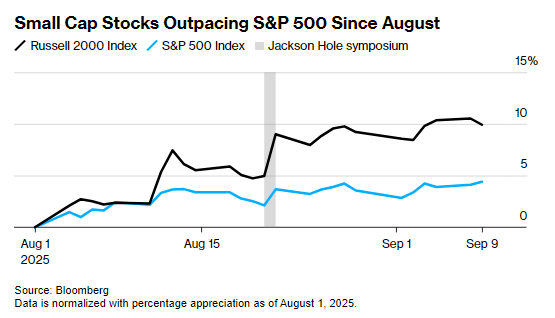
Core Viewpoint - The Russell 2000 index, which includes some of the riskiest stocks in the market, has seen a significant surge recently, with multiple Wall Street strategists believing that this rally is just beginning [1] Group 1: Market Performance - The Russell 2000 index has risen nearly 10% since the end of July, outpacing the S&P 500 index by two times [1] - Analysts predict that the Russell 2000 index could rise another 20% over the next year, while the S&P 500 index is expected to increase by 11% [1] - Despite the recent surge, the Russell 2000 index's cumulative gain in 2025 still lags behind that of the S&P 500 index [1] Group 2: Economic Factors - The anticipated interest rate cuts by the Federal Reserve are expected to significantly lower the financing costs for companies within the Russell 2000 index, thereby enhancing their profit margins [1] - The recent inflation and employment data have reinforced optimistic sentiments, leading investors to believe that the Federal Reserve will initiate interest rate cuts soon [2] Group 3: Analyst Insights - Morgan Stanley's Michael Wilson noted that the Fed's rate cuts could propel the bull market into its "next phase," benefiting small-cap stocks [5] - Over 60% of companies in the Russell 2000 index exceeded earnings expectations for Q2 2024, with average revenue surpassing expectations by 130 basis points [5] - Analysts from Manulife John Hancock Investments highlighted that small-cap stocks have been undervalued compared to other stock categories [5] Group 4: Valuation and Investor Sentiment - The Russell 2000 index's price-to-earnings ratio is slightly above its long-term average, but still presents a lower valuation pressure compared to large-cap stocks [6] - The options market indicates increasing investor confidence in the continued rise of small-cap stocks, with a more bullish positioning compared to the S&P 500 index [6] - Passive funds have started to flow into U.S. small-cap stocks, although there is a caution that signs of economic recovery are needed for sustained growth [6] Group 5: Strategic Recommendations - Barclays analysts recommend prioritizing investments in technology and small-cap stocks due to their strong earnings momentum, suggesting that small-cap stocks are facing significant opportunities [7]
大逆转?中证2000增强ETF(159552)盘中再迎超千万资金流入!
Xin Lang Cai Jing· 2025-09-04 07:01
Core Viewpoint - The resurgence of small-cap stocks is evident, with the China Securities 2000 Enhanced ETF (159552) seeing a reversal in net outflows as funds begin to enter the market at lower prices [1][2]. Group 1: Market Dynamics - Small-cap stock valuations have become significantly more attractive after previous adjustments, leading to a technical indication that the stage of adjustment may be complete, attracting funds that are optimistic about their potential [2][3]. - The market's expectations for a potential interest rate cut by the Federal Reserve are rising, which could ease funding pressures in emerging markets and enhance risk appetite, particularly benefiting small-cap stocks that are more sensitive to liquidity [2][3]. - Historically, healthy bull markets are characterized by a rotation between large-cap and small-cap stocks, suggesting that after large-cap value stocks stabilize the index, small-cap growth stocks are likely to take the stage, promoting a broader and more sustainable market rally [2][3]. Group 2: Investment Strategy - The current activity in small-cap stocks enhances market profitability and vitality, indicating that investment opportunities are expanding beyond a few leading companies to include more quality small and mid-sized firms that are entering a favorable valuation range [3]. - Investors are encouraged to focus on medium to long-term strategies, balancing high-dividend assets while exploring small-cap stocks with genuine growth potential and technological advantages to capitalize on market rotation opportunities [3]. - The China Securities 2000 Enhanced ETF (159552) is highlighted as a potentially superior choice for generating excess returns in this environment [3].