AI融合定位算法

Search documents
人形机器人:中美军备竞赛下的国产机器人
2026-02-25 04:13
Summary of Conference Call on Humanoid Robots and the Domestic Robotics Industry Industry Overview - The discussion centers around the domestic robotics industry, particularly humanoid robots, in the context of the US-China arms race in technology [1][7] - The competition is seen as a strategic battleground, with both countries having distinct advantages: the US in algorithms and chips, and China in supply chains, data, and engineering talent [7] Key Insights Performance of Humanoid Robots - The humanoid robots showcased during the Spring Festival were highlighted, particularly the performance of Yushu, which demonstrated advanced capabilities such as smooth movements and complex actions like backflips and jumps [1] - The hardware requirements for these robots are significant, particularly in terms of shock resistance and lightweight construction [1][2] Power Systems - The discussion emphasized the importance of the power systems in robots, noting that electric-driven robots need to achieve high instantaneous power output to perform complex movements [2][3] - The integration of AI algorithms for autonomous control and coordination among multiple robots was also discussed, showcasing the need for decentralized algorithms for task allocation and path planning [3][4] Adaptive Control - The need for adaptive joints and control systems was emphasized, allowing robots to respond to varying external forces and improve operational robustness [5][6] - The potential for these technologies to transition into industrial applications, such as inspection, sorting, and assembly, was noted as a significant opportunity [6] Market Outlook Domestic Robotics Market - The domestic robotics market is expected to see growth, with several companies like Zhiyuan, Yushu, Leju, and Ubtech projected to deliver thousands of units this year [8] - The Spring Festival performance has boosted confidence in the capabilities of domestic robots, indicating a promising outlook for the sector [8] Investment Opportunities - The report suggests investing in both the core robotics companies and their component suppliers, as the latter may offer better growth potential due to lower costs and higher scalability [8][17] - Specific companies mentioned as potential investment opportunities include: - **Zhongcheng Technology**: Specializes in low-voltage frequency converters and servo systems, with a stable business model [9][10] - **Leisai Intelligent**: Engaged in key components for humanoid robots, with expected revenues exceeding 300 million in 2026 [14][15] Conclusion - The domestic robotics industry is viewed as a collective entity with various companies specializing in different aspects, from data collection to hardware development [17] - The anticipated IPOs of several companies in the sector may lead to market volatility, suggesting a strategic approach to investment in component suppliers may be prudent [17][18]


揭秘春晚宇树人形机器人背后的“黑科技”
Xin Jing Bao· 2026-02-17 09:10
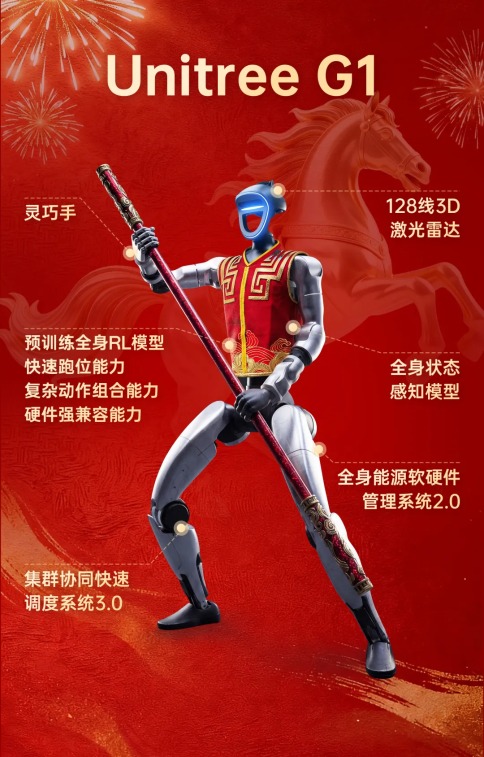
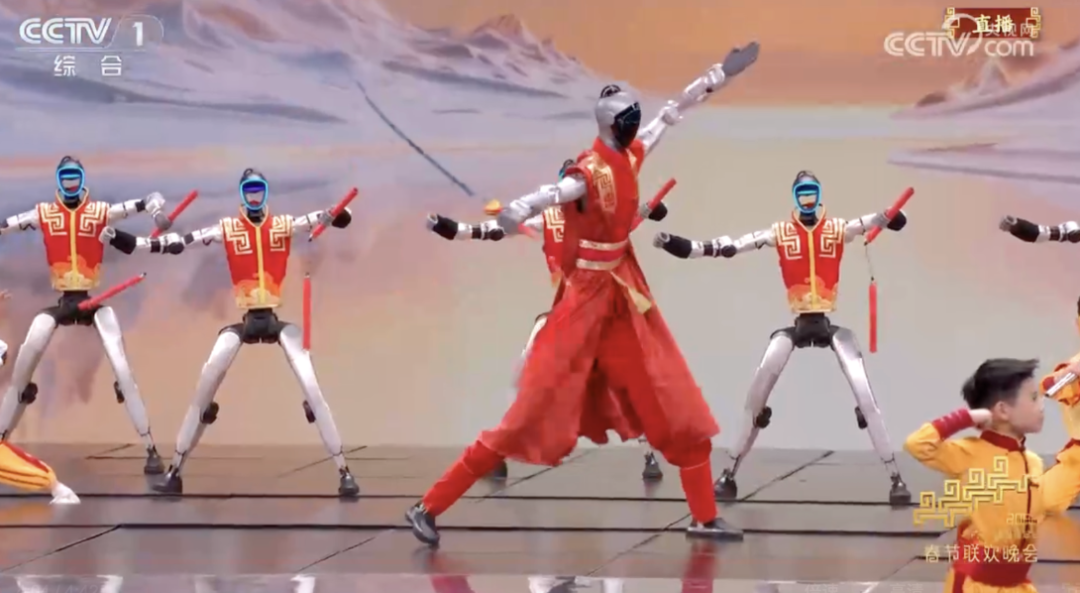
Core Viewpoint - The performance of humanoid robots by Yushu Technology at the 2026 CCTV Spring Festival Gala showcased groundbreaking advancements in robotics, achieving multiple global firsts in autonomous capabilities and complex movements [1][11]. Group 1: Technical Achievements - Yushu Technology's humanoid robots executed several unprecedented high-difficulty actions, including parkour, flips exceeding 3 meters in height, and complex weapon maneuvers [3][5]. - The robots demonstrated advanced environmental interaction capabilities, overcoming challenges in high-speed movement and dynamic adjustments to obstacles through extensive simulation training [3][5]. - The performance involved a combination of hardware upgrades, motor optimization, and advanced control algorithms, enabling precise landing control after flips [5][10]. Group 2: Collaborative Control System - The performance relied on a newly upgraded high-concurrency cluster control system, allowing multiple robots to perform complex formations and interactions seamlessly [8][10]. - The system utilized 3D LiDAR for real-time scanning and positioning, ensuring each robot was aware of its location and could execute commands accurately [8][10]. - The AI fusion positioning algorithm processed environmental data rapidly, maintaining precise localization even during dynamic movements [10]. Group 3: Industrial Applications - The technologies demonstrated in the performance have potential applications in industrial settings, such as multi-robot collaborative inspections, warehouse sorting, and assembly lines [11]. - The ability to handle external disturbances while manipulating objects can be valuable in precision assembly and service industries [11]. - The robots' dynamic judgment and gait adjustment capabilities align with real-world tasks, enhancing operational efficiency and adaptability in various environments [11].

宇树科技春晚节目技术难点解析
天天基金网· 2026-02-17 07:30
Core Viewpoint - The article highlights the technological advancements and performance of Yushu Technology's humanoid robots, particularly during their martial arts performance at the 2026 Spring Festival Gala, showcasing multiple global firsts in robotic capabilities [5][14]. Group 1: Technological Innovations - Yushu Technology's robots achieved several global firsts, including continuous parkour flips and advanced martial arts maneuvers, demonstrating significant improvements in motion performance compared to previous performances [5][6]. - The company upgraded its algorithms, hardware, and systems to enhance the robots' capabilities, including a reinforced learning framework for complex martial arts actions and improved hardware for dynamic movements [8][14]. - The core technology enabling these performances is the fully autonomous cluster control system, allowing multiple robots to perform without external positioning assistance, relying solely on onboard sensors [14][16]. Group 2: Performance Challenges - The most challenging actions in the performance included weapon interaction, environmental interaction, and extreme ground maneuvers, each presenting unique technical barriers that required advanced sensing and adaptive control [9][10]. - The robots demonstrated skills such as using weapons and executing complex movements, which required real-time perception and adjustment to external forces [10][15]. - The performance's success relied on the robots' ability to maintain precise positioning and dynamic adjustments during high-speed actions, showcasing their advanced control systems [10][16]. Group 3: Real-World Applications - The technologies developed for the performance have clear applications in real-world scenarios, such as multi-robot collaboration in industrial settings, enhancing operational efficiency and adaptability [15][16]. - Techniques for handling external forces and dynamic positioning can be applied to tasks like precision assembly, heavy lifting, and service robotics, improving robustness in various operational environments [15][16]. - The advancements in robotic capabilities during the performance are expected to facilitate the deployment of robots in complex real-world tasks, enhancing their operational efficiency and environmental adaptability [16].
宇树科技春晚节目技术难点解析
Shang Hai Zheng Quan Bao· 2026-02-17 01:54
Core Viewpoint - Yushu Technology showcased its advanced capabilities in robotics during the 2026 Spring Festival Gala with the world's first fully autonomous humanoid robot martial arts performance, "Wu BOT," achieving multiple global technical breakthroughs [3][16]. Group 1: Technical Innovations - The performance featured several unprecedented robotic maneuvers, including continuous trick flips, aerial flips exceeding 3 meters in height, and complex movements like single-leg flips and wall jumps [3][6]. - Yushu Technology upgraded its algorithms, hardware, and systems to enhance performance, including a reinforced learning framework for complex martial arts movements and improved positioning technology to address drift during high-speed movements [6][7]. - The hardware improvements included increased power density for core joint motors and optimized body structure to support dynamic actions, while a new cluster control system was developed for real-time coordination of multiple robots [7][14]. Group 2: Performance Challenges - The most challenging actions in the performance involved real-time interaction with objects, precise environmental navigation during high-speed movements, and extreme ground maneuvers, all requiring advanced sensing and adaptive control capabilities [8][9]. - The robots were equipped with a new dexterous hand for quick tool changes and stable gripping, enhancing their ability to perform complex tasks [9][10]. Group 3: Product Development - The H2 model, which is 40% taller and twice as heavy as the G1 model, demonstrated impressive capabilities, showcasing the challenges in algorithm and hardware performance required for executing similar actions [12][13]. - The performance highlighted the core technology of fully autonomous cluster control, allowing multiple robots to operate without external positioning assistance, relying solely on onboard sensors [13][14]. Group 4: Real-World Applications - The technologies developed for the performance have clear applications in real-world scenarios, such as multi-robot collaboration in industrial settings, precision assembly, and dynamic environment navigation [15][16]. - The cluster control system and adaptive control technologies can be applied to tasks like warehouse sorting and assembly lines, enhancing operational efficiency and adaptability in various environments [15][16].