H2

Search documents
127亿真不贵,王兴兴藏在宇树招股书里的资本故事
创业邦· 2026-03-21 15:57
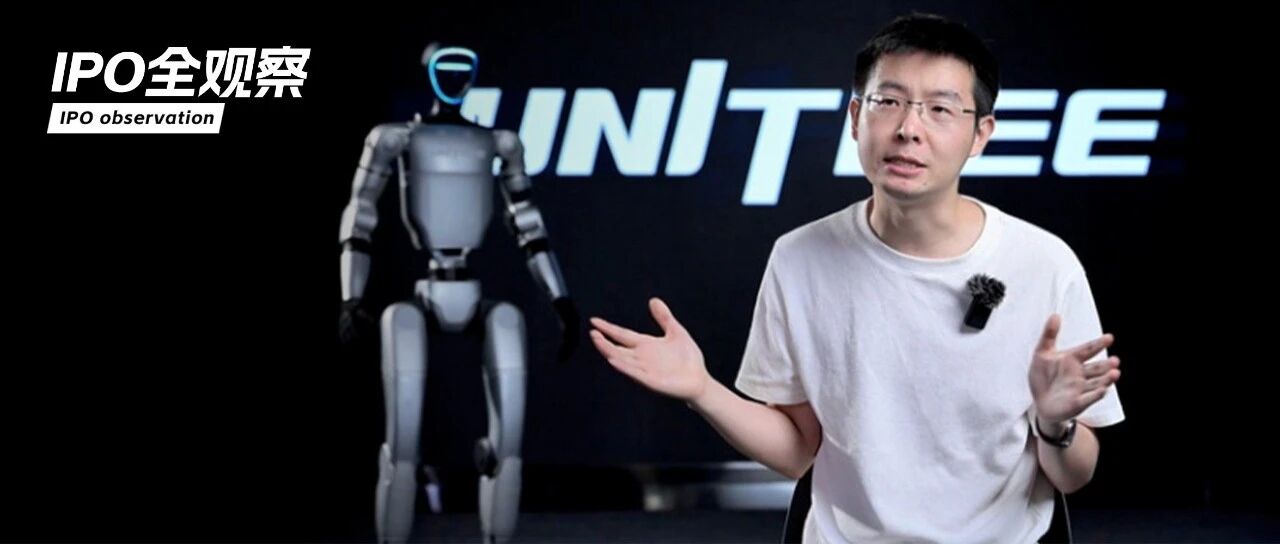
从200元手搓机器狗,到全球人形机器人出货量第一,宇树科技正式开启IPO,这个"偏科少年"用10年 证明了一件事:技术偏执者,也能成功。上市前127亿估值,在今天的一级市场,真不贵,这是一张 通往未来机器人世界的船票。上船的天使、VC、大厂与国资,很开心。 作者丨 薛皓皓 编辑丨巴里 图源 丨宇树科技 2026年3月20日,宇树科技股份有限公司的科创IPO申请获得上海证券交易所正式受理。 公司在2024年营收达3.92亿元,2025年预测营收更是暴增335%至17.08亿元,连续2年保持盈利。 在行业普遍深陷"烧钱造梦"泥潭的当下,宇树科技凭借全栈自研与极致降本,不仅将四足机器人卖到了全球,出货量保持全球第一,更在2025年实现了人 形机器人出货量超5500台。 早在2016年公司成立仅三个月时,个人投资者尹方鸣便成为第一个入股的"伯乐";2018年,极客公园相关的变量资本和Arm旗下的安创加速器也向宇树伸出援 手。 随着宇树在四足机器人领域的崭露头角,由腾讯联合创始人曾李青创立的德迅投资,以及红杉中国、顺为、经纬创投等顶级VC机构接踵而至。 在战略投资方阵营中,上市前,美团系合计持股超9.6%,稳居最大外部 ...

最新!宇树受理了
是说芯语· 2026-03-20 10:13
近日,宇树科技股份有限公司(以下简称"宇树科技")披露首次公开发行股票并在科创板上市招股说明书(申报稿),拟公开发行不低于4044.6434万 股,占发行后总股本比例不低于10%,募集资金将用于智能机器人模型研发、机器人本体研发、新型智能机器人产品开发及智能机器人制造基地建设四大 项目,总投资金额42.02亿元。 宇树科技成立于2016年8月26日,注册地址位于浙江省杭州市滨江区,法定代表人为王兴兴,主营业务为高性能通用人形机器人、四足机器人、机器人组 件及具身智能模型的研发、生产和销售。公司在全球率先实现高性能四足机器人公开销售及行业落地,人形机器人与四足机器人近年来全球销量保持领 先,产品被国内外众多知名高校、科研机构、科技企业及全球开发者广泛使用。 产品方面,公司构建了丰富的产品矩阵。人形机器人领域,已推出H1、G1、R1、H2及G1-D等系列产品,其中G1是2024年至2025年全球最畅销的人形机 器人,R1被《时代周刊》评为2025年度最佳发明;四足机器人领域,先后研发量产Laikago、AlienGo、A1、Go1、B1、Go2、B2、B2-W、A2等多款产 品,覆盖消费级与行业级应用场景;机器人 ...

王兴兴:“如何迈过具身智能的ChatGPT时刻”?
阿尔法工场研究院· 2026-03-19 04:06
宇树科技已经推出了多款代表性机器人产品,包括"G1"(一款小巧、高性价比、高自由度的经典机 器人)、AA2(中型工业级机器狗)、H2(1.8米大尺寸、适合体力劳动的人形机器人)以及AS2 (负载能力强、防水的小型机器狗)。 目前,宇树科技已经在机器人软件算法上取得了显著进步,例如实现了任意姿态下的摔倒自恢复能 力,以及高成功率的全身动作控制(如后空翻)。2026年(去年)还在AI方面进行了多项升级,包 括更复杂的运动能力和操作技能;其产品与团队获得了包括《时代周刊》在内的重要认可,并在 2026年央视春晚上展示了机器人表演中国传统武术的节目,广受好评。 #机器人 #宇树科技 #王兴兴 #具身智能 #英伟达 所谓"具身智能的ChatGPT时刻",即机器人能够在80%左右的陌生场景中,通过语言或文字指令,完 成80%左右的任务,无需预先针对该场景进行训练或数据采集。他认为这是行业质变的临界点。 当前面临的核心问题: 一是模型表达能力不足:现有模型难以生成和执行丰富、复杂、实时的动作数据稀缺与利用率低:相 比语言模型,机器人领域的真机数据稀缺。王兴兴主张提高对多元数据(如互联网视频、仿真数据) 的利用率,减少对海量 ...

大佬的2025:王兴兴拒绝捧杀
3 6 Ke· 2026-02-27 12:58
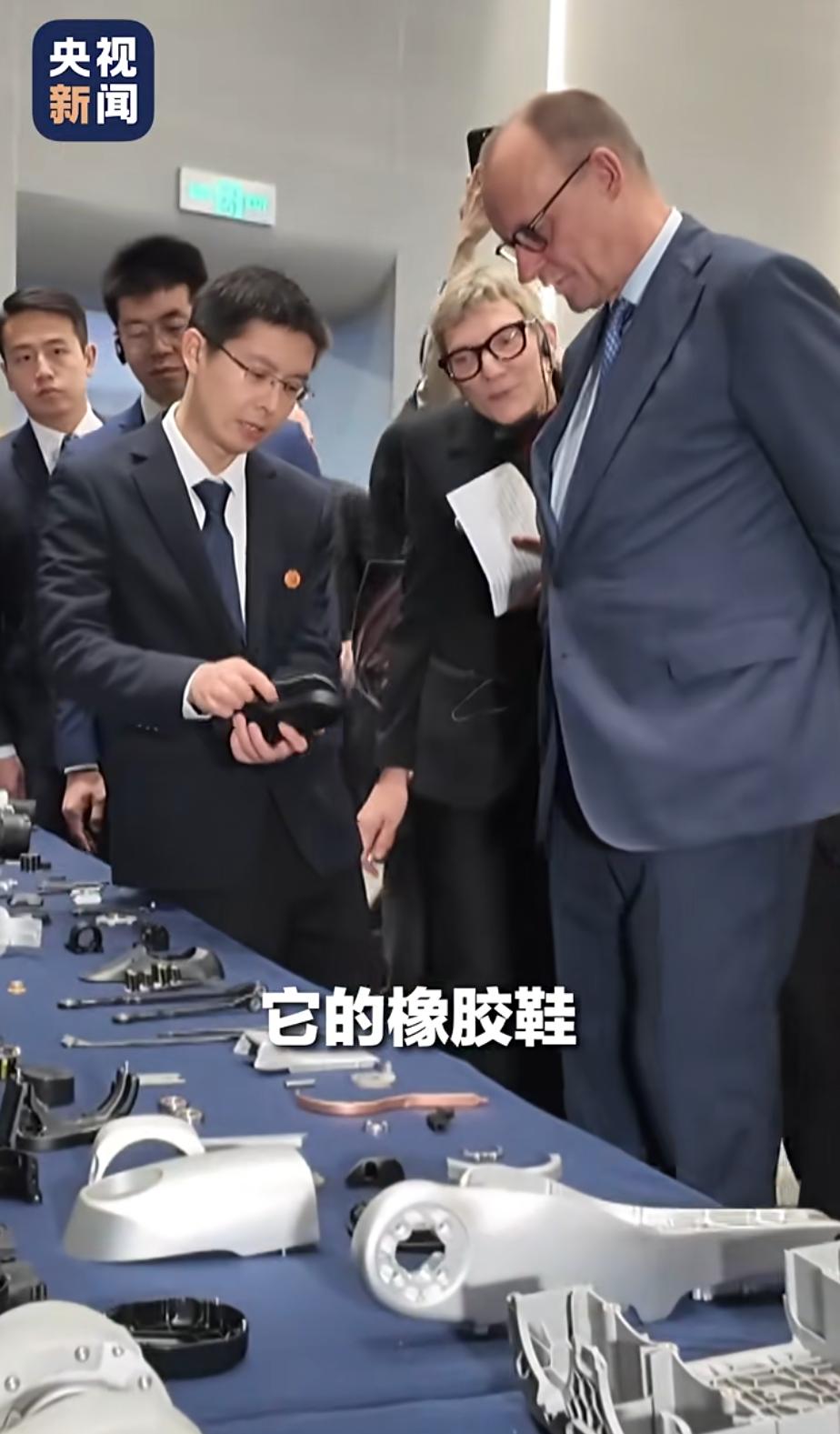
2025年,又是极具变化的一年。 那些互联网江湖中熟悉的名字,依然在各自的赛道上绽放光彩。不同的是,他们面对的已不再是高速增长的顺风局,而是一场更考验判断力与 耐力的长跑。 而这其中,他们所做的动作,所面对的处境,所应对的策略,足够轰动,足够真实,背后都映射着时代局面的转变。 在这个阶段,如果要观察科技、互联网与新消费,绕不开这些关键人物。他们的每一步,都揭示了行业的趋势方向。 AI蓝媒汇特别推出《大佬的2025》系列专题,围绕大佬们,以具体事件与公开表达为线索,尝试理解他们当下在做什么,为什么,以及意味 着什么。 本文为系列第四篇。 2月26日,杭州,宇树科技的展厅内,德国总理默茨驻足观看数台人形机器人腾挪闪转、凌空翻跃,完成一套完整的中国功夫表演。期间,默茨频频点 头,并竖起大拇指称赞。 这位就任后首次访华的德国领导人,将此次中国之行最重要的一站,留给了中国机器人创业公司宇树科技。 如果要在2025年的中国科技界寻找一个现象级人物,宇树科技创始人王兴兴绝对是一个绕不开的名字。 这一年,他执掌的宇树科技被公认为"杭州六小龙"之一,其人形机器人在央视春晚的舞台上大放异彩。 他本人,不仅以67亿元身家首次登上《 ...
未知机构:长城机械宇树今日总结1人形第一文旅展览和-20260227
未知机构· 2026-02-27 02:50
Summary of Conference Call for Changcheng Machinery Industry Overview - The company operates in the robotics industry, focusing on humanoid robots and robotic dogs, with applications in various sectors including cultural tourism, education, and industrial automation [1][2]. Key Points and Arguments 1. **Market Segmentation**: - The humanoid robot market is segmented into three main areas: - Cultural tourism, exhibitions, and rental market: 50% market share, with a price range of hundreds of thousands per unit and a gross margin of 50% [1]. - Research and education market: 20% market share, primarily using the G1 model, priced similarly, with a gross margin of 60%-70% [1]. - Industrial applications: More challenging due to high reliability, stability, assembly yield, and consistency requirements, with a gross margin of around 30% [1]. 2. **Robotic Dog Market**: - The robotic dog market is divided as follows: - Industrial applications: 50% market share. - Research and education: 20% market share. - Performance and other applications: 20% market share (10% each for performance and TOC) [1]. - Pricing for robotic dogs ranges from 80,000 to 100,000 for TOC models, while educational models are priced around 50,000 [1]. 3. **Production and Capacity**: - The company aims to achieve an annual production capacity of 40,000 to 50,000 robotic dogs and 20,000 humanoid robots by 2026 [2]. - Estimated revenue for 2025 is projected to be in the range of 2 to 3 billion, with a gross margin of 50% and a net profit margin of 25%-30%, translating to a profit of approximately 600 to 700 million [2]. 4. **Research and Development**: - The company develops its own actuators and control algorithms, with a focus on proprietary software and algorithms [1][2]. - The dexterous hand features 20 degrees of freedom, with a cost structure that includes expensive components such as motors and actuators [1]. 5. **IPO Progress**: - The company is progressing normally towards an IPO, with no green channel application planned, and aims to complete the IPO process in the first half of the year [2]. Additional Important Information - The company utilizes cloud computing resources from Alibaba for computational needs [1]. - The production of structural and injection molded parts is outsourced, with the company designing the molds [2]. - The company has set ambitious targets for 2026, aiming to double both sales and profits [2].
宇树科技,重磅发布
Zhong Guo Ji Jin Bao· 2026-02-24 22:44
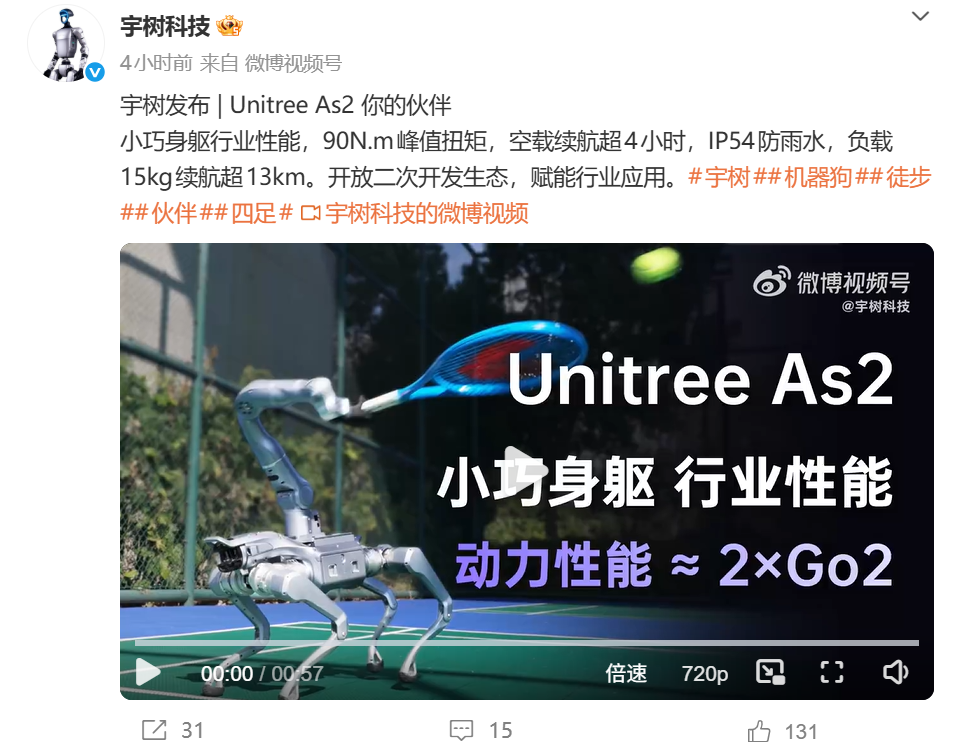
Core Viewpoint - Unitree As2 is a highly advanced quadruped robot designed for various applications, showcasing impressive speed, load capacity, and adaptability to complex environments [2][5][7]. Group 1: Product Features - The Unitree As2 can reach a maximum speed of 5 m/s and is equipped with a bionic embodiment model, allowing it to navigate complex terrains and harsh environments [2][7]. - It features a powerful motor with a maximum joint torque of approximately 90 N·m and a torque-to-weight ratio of about 5 N·m/kg, with a total weight of 18 kg [5]. - The robot is powered by a 648 Wh (15000 mAh) battery, providing over 4 hours of runtime when unloaded and over 2.5 hours with a 15 kg load, enabling it to travel more than 13 km continuously [5][7]. - The design includes IP54 water resistance, allowing stable operation in various weather conditions, and it can perform actions such as running, climbing, and jumping [7]. Group 2: Technological Advancements - The Unitree As2 is equipped with an 8-core high-performance CPU and upgraded ISS 3.0 intelligent accompanying system, enabling centimeter-level high-precision positioning and stable following capabilities [7]. - It offers a friendly secondary development interface, supporting the integration of AI large models for embodied intelligent interaction and autonomous decision-making [7]. Group 3: Market Position and Applications - Unitree Technology's product lineup includes consumer and research quadruped robots such as As2, Go2, Go1, and A1, as well as industry-grade robots like A2, B2, B2-W, and Aliengo [11]. - In 2024, the revenue structure for Unitree Technology's products is projected to be 65% from quadruped robots, 30% from humanoid robots, and 5% from components, with approximately 80% of quadruped robots used in research, education, and consumer fields [14]. - The company gained significant attention during the 2023 CCTV Spring Festival Gala, showcasing its G1 and H2 humanoid robots in a world-first fully autonomous martial arts performance [14][16].
宇树科技,重磅发布!
Zhong Guo Ji Jin Bao· 2026-02-24 15:19
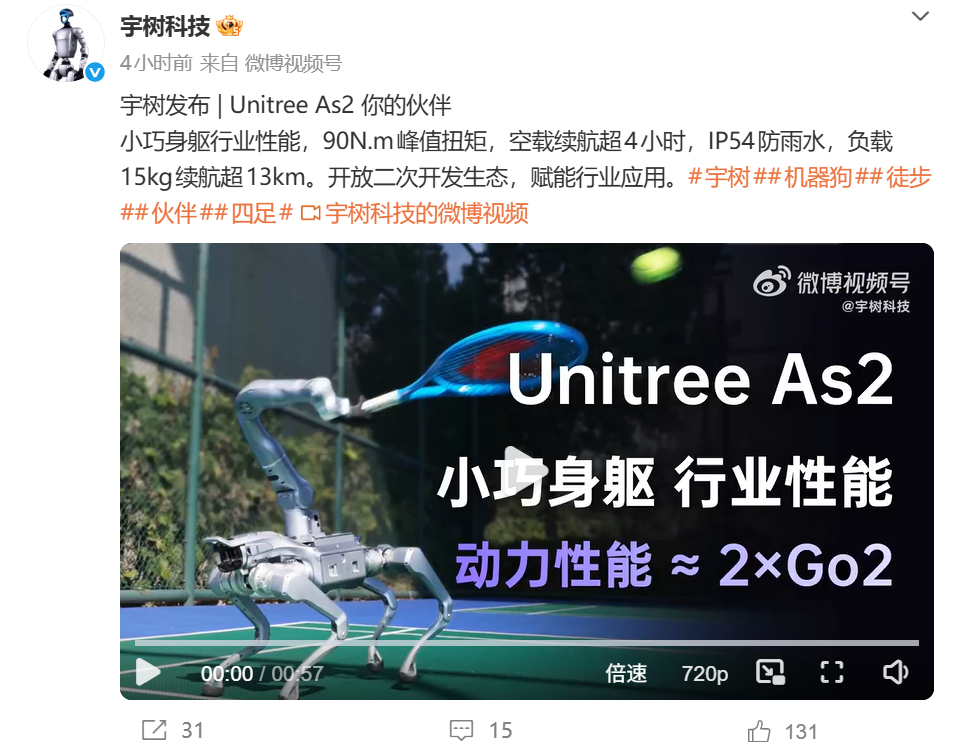
Core Insights - Unitree Technology has officially announced the launch of its quadruped robot, Unitree As2, on February 24 [1] Group 1: Product Features - The Unitree As2 can reach a maximum speed of 5 m/s and is designed to navigate complex terrains and harsh environments with ease [3] - It features a powerful motor with a maximum joint torque of approximately 90 N·m and a torque-to-weight ratio of about 5 N·m/kg, with a total weight of 18 kg [6] - The robot is equipped with a 648 Wh (15000 mAh) battery, providing over 4 hours of operation without load and over 2.5 hours with a 15 kg payload, allowing it to travel more than 13 km continuously [6][8] - The Unitree As2 has an IP54 rating for water resistance, enabling stable operation in various weather conditions [8] - It incorporates an 8-core high-performance CPU and the upgraded ISS 3.0 intelligent accompanying system for centimeter-level high-precision positioning and stable following capabilities [8] Group 2: Additional Features and Accessories - The robot supports various accessories, including a 7-axis dexterous robotic arm, high-definition cameras, speakers, microphones, and multiple external interfaces [9] - It offers a friendly secondary development interface, allowing for the integration of AI models for intelligent interaction and autonomous decision-making [8][9] Group 3: Market Position and Performance - Unitree Technology's revenue structure for 2024 indicates that quadruped robots will account for 65% of total revenue, humanoid robots for 30%, and components for 5% [14] - Approximately 80% of quadruped robots are utilized in research, education, and consumer sectors, while the remaining 20% are used in industrial applications such as inspection and firefighting [14] - The company has gained significant attention by showcasing its robots during major events, including a performance at the CCTV Spring Festival Gala, featuring the G1 and H2 humanoid robots [14][16]
人形机器人跟踪:春晚舞台见证人形机器人“脑:体”双突破
GF SECURITIES· 2026-02-23 07:52
Group 1 - Industry investment rating: Buy [2] - Core viewpoint: The humanoid robot industry has made significant advancements, as showcased during the 2026 Spring Festival Gala, highlighting the capabilities of domestic manufacturers in various applications [6][6][6] - Investment suggestion: The humanoid robot sector is well-prepared for mass production, with expected exponential growth in product delivery in 2026 compared to 2025 [6] Group 2 - Key company performance: The Spring Festival Gala led to a 150% increase in robot orders, with a surge in search volume and customer inquiries [6] - Notable company showcases: Multiple companies demonstrated their robots' capabilities, including 松延动力's elderly care applications, 宇树科技's high-dynamic control, and 魔法原子’s group control of 100 robots [6] - Recommended companies for investment: Focus on 恒立液压, 浙江荣泰, and others for specific components like planetary roller screws and dexterous motors [6]
“还以为人在扮演机器人”,时隔一年,中国具身智能发生了什么?
Sou Hu Cai Jing· 2026-02-20 17:48
Core Insights - The 2026 CCTV Spring Festival Gala showcased humanoid robots from four domestic companies, highlighting the diverse technological advancements in China's robotics industry [3] - The performance demonstrated the rapid iteration capabilities and increasingly complete domestic supply chain in the humanoid robotics sector [3][12] Group 1: Performance Highlights - Songyan Power showcased high dynamic motion control with continuous jumps and flips in the skit "Grandma's Favorite" [3] - Galaxy General presented the Galbot G1 robot in a micro-movie, demonstrating its strong model generalization capabilities in new retail scenarios [3] - Yushu Technology displayed an upgraded version of "Cyber Kung Fu," featuring various martial arts skills [3] - Magic Atom's humanoid robots exhibited excellent balance and collaborative control, showcasing group intelligence effects [3] Group 2: Market Response - During the two-hour broadcast of the Spring Festival Gala, JD.com saw a search volume increase of over 300% for robots, with customer inquiries up 460% and order volume up 150% [6] - JD.com launched several robot products, including "Spring Festival Gala models," which sold out within minutes, indicating strong consumer demand [6][7] - The robots sold by JD.com cover various applications, including companionship, education, and industrial use, with prices ranging from tens of thousands to hundreds of thousands of yuan [7] Group 3: Technological Innovations - The performance featured significant technological breakthroughs, such as the first global side flip by a humanoid robot and the largest embodied intelligent dataset [10] - The robots utilized advanced algorithms for motion control and navigation, ensuring precise positioning even during intense movements [11] - A new high-concurrency cluster control system was employed for real-time coordination of multiple robots, applicable to industrial tasks like inspection and assembly [11] Group 4: Industry Growth and Future Outlook - China's robotics industry has experienced explosive growth, with over 140 complete machine enterprises and more than 330 product launches in the past year [12] - The market for embodied intelligence in China is projected to reach 400 billion yuan by 2030, contingent on practical applications in real-world scenarios [12] - The industry faces challenges in bridging the gap between mechanical capabilities and intelligent applications, necessitating ongoing technological collaboration [12]


美媒英媒报道了:西方还停留在中世纪?中国人形机器人闪耀全球
Sou Hu Cai Jing· 2026-02-18 07:45
Core Viewpoint - The rapid advancement of humanoid robot technology in China was showcased during the Spring Festival Gala, highlighting significant innovations and capabilities that have surpassed previous expectations [1][5][10]. Company Highlights - Yushutech presented their humanoid robots G1 and H2, performing complex martial arts moves, including the world's first continuous table-flipping parkour and multiple air flips, after extensive training on a simulation platform [3][10]. - Songyan Power collaborated with celebrity Cai Ming to create a skit featuring a robot, which required over 300 iterations of algorithms and 21 versions of dance training to enhance interaction and expression [3][10]. - Magic Atom's MagicBot Z1 executed a 360° stunt during the opening performance, marking it as the first humanoid robot to achieve this feat within its size category [3][10]. - Galaxy General's Galbot G1 demonstrated practical skills by performing tasks like cleaning up broken cups and handling food, showcasing its autonomous decision-making capabilities [3][10]. Industry Trends - International media attention has surged, with reports indicating that by 2025, approximately 13,000 humanoid robots will be shipped globally, with 90% expected to come from Chinese companies [5][7]. - Morgan Stanley predicts that humanoid robot sales in China will double by 2026, reaching 28,000 units, indicating a strong growth trajectory [5][7]. - The number of humanoid robot companies in China has exceeded 140, supported by a robust supply chain and a rich talent pool, facilitating large-scale production and application in various sectors [7][8]. - China's humanoid robot industry is becoming a market leader, driven by cost efficiency and production capabilities, with government support and a strong technical workforce fostering innovation [8][10].