宇树H2人形机器人

Search documents
揭秘春晚宇树人形机器人背后的“黑科技”
Xin Jing Bao· 2026-02-17 09:10
Core Viewpoint - The performance of humanoid robots by Yushu Technology at the 2026 CCTV Spring Festival Gala showcased groundbreaking advancements in robotics, achieving multiple global firsts in autonomous capabilities and complex movements [1][11]. Group 1: Technical Achievements - Yushu Technology's humanoid robots executed several unprecedented high-difficulty actions, including parkour, flips exceeding 3 meters in height, and complex weapon maneuvers [3][5]. - The robots demonstrated advanced environmental interaction capabilities, overcoming challenges in high-speed movement and dynamic adjustments to obstacles through extensive simulation training [3][5]. - The performance involved a combination of hardware upgrades, motor optimization, and advanced control algorithms, enabling precise landing control after flips [5][10]. Group 2: Collaborative Control System - The performance relied on a newly upgraded high-concurrency cluster control system, allowing multiple robots to perform complex formations and interactions seamlessly [8][10]. - The system utilized 3D LiDAR for real-time scanning and positioning, ensuring each robot was aware of its location and could execute commands accurately [8][10]. - The AI fusion positioning algorithm processed environmental data rapidly, maintaining precise localization even during dynamic movements [10]. Group 3: Industrial Applications - The technologies demonstrated in the performance have potential applications in industrial settings, such as multi-robot collaborative inspections, warehouse sorting, and assembly lines [11]. - The ability to handle external disturbances while manipulating objects can be valuable in precision assembly and service industries [11]. - The robots' dynamic judgment and gait adjustment capabilities align with real-world tasks, enhancing operational efficiency and adaptability in various environments [11].


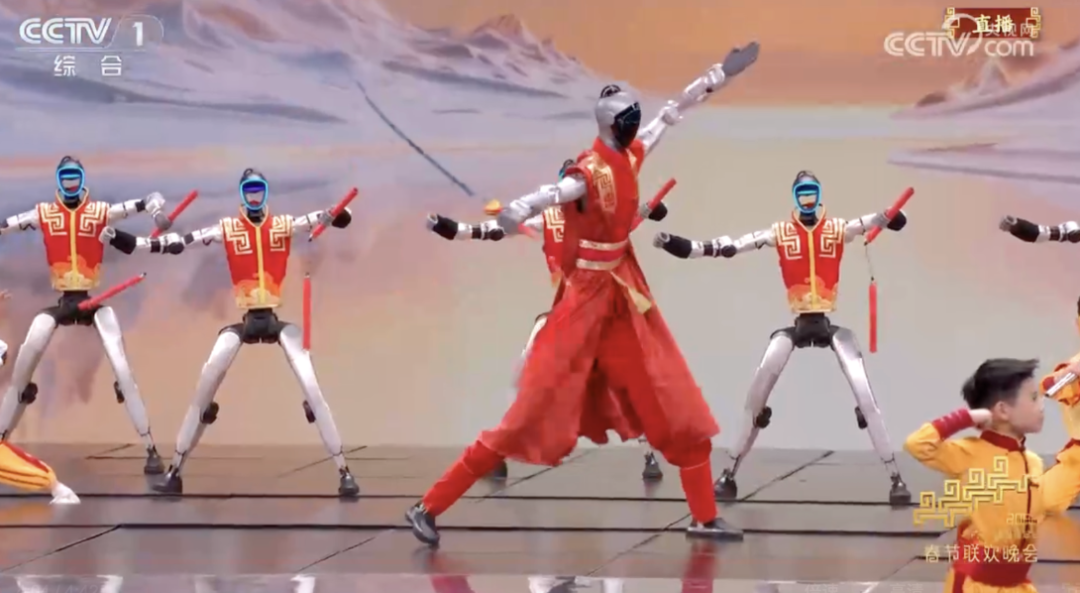
赛博真功夫!揭秘春晚宇树人形机器人武术表演背后的“黑科技”
Bei Ke Cai Jing· 2026-02-17 04:01
Core Viewpoint - The performance of humanoid robots by Yushu Technology at the 2026 CCTV Spring Festival Gala showcased groundbreaking advancements in robotics, featuring the world's first fully autonomous humanoid robot martial arts performance, "Wu BOT" [1]. Group 1: Technical Achievements - Yushu Technology's humanoid robots executed several globally unprecedented high-difficulty actions, including parkour, flips, and weapon handling, demonstrating significant advancements in motion performance [3][6]. - The robots achieved a maximum flip height exceeding 3 meters and performed complex maneuvers such as continuous flips and wall jumps, showcasing their advanced capabilities [3]. - The performance involved three categories of challenging actions: object interaction (e.g., weapon handling), environmental interaction (e.g., parkour), and ground extreme actions (e.g., aerial rotations) [3][6]. Group 2: Control Systems - The performance relied on Yushu's newly upgraded high-concurrency cluster control system, enabling dozens of robots to perform complex formations and interactions in real-time [10]. - The system utilized 3D laser radar for real-time scanning and positioning, allowing each robot to accurately determine its location and execute commands effectively [10][11]. - The AI fusion positioning algorithm processed environmental data rapidly, ensuring precise localization even during high-dynamic movements, which is crucial for maintaining performance continuity [11]. Group 3: Industrial Applications - The technologies demonstrated in "Wu BOT" have potential applications in various industries, such as multi-robot collaborative inspection, warehouse sorting, and assembly lines, enhancing operational efficiency [12]. - The ability to handle external disturbances and perform precise movements can be applied in fields like precision assembly, heavy lifting, and domestic services, showcasing the versatility of these robotic systems [12]. - The advancements in relative positioning and environmental interaction capabilities align closely with real-world tasks, such as navigating tight spaces and performing complex logistics operations [12].
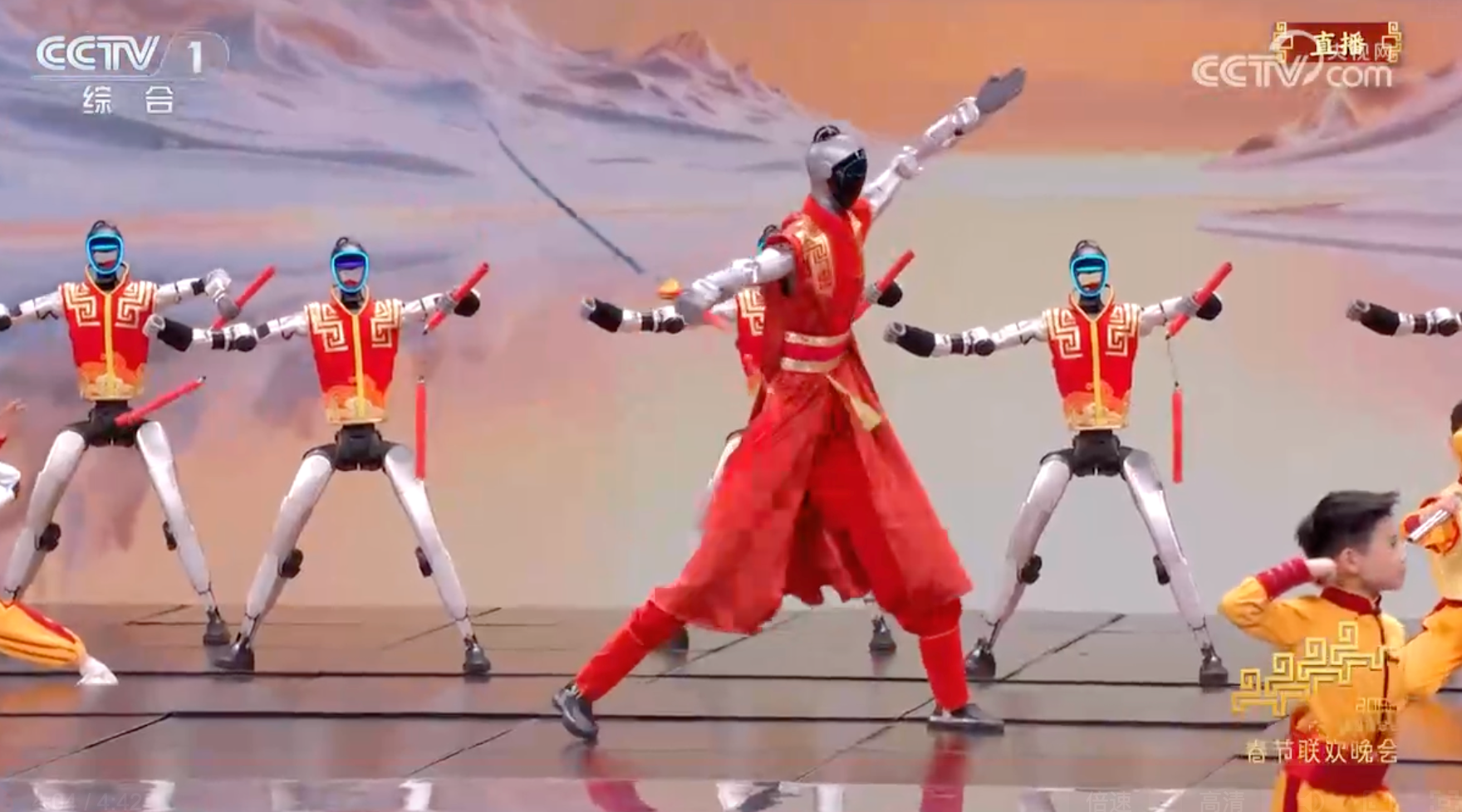
宇树科技《武BOT》节目揭秘,8个问题带你了解春晚表演为何如此惊艳
Xin Lang Cai Jing· 2026-02-17 03:36
Core Insights - The performance of Yushu Technology's robots at the Spring Festival Gala showcased advanced capabilities, including high-difficulty martial arts routines and dynamic coordination, marking a significant technological leap compared to previous performances [1][14][15]. Group 1: Performance Highlights - The robots G1 and H2 executed complex martial arts routines, including staff techniques, swordplay, and acrobatics, demonstrating fluid movements and precise execution [1][14]. - The performance included several global firsts, such as continuous parkour flips and aerial maneuvers exceeding 3 meters in height, showcasing unprecedented athletic performance [1][15]. Group 2: Technical Innovations - Yushu Technology's founder highlighted the debut of high-dynamic, high-coordination cluster control technology, which is practical for future applications in various robotic scenarios [1][14]. - The preparation for the performance began in November, involving extensive software development, algorithm validation, and collaboration with martial arts actors for real-world testing [3][16]. Group 3: Challenges and Solutions - The team faced significant technical challenges, including control algorithm design and model training, which were addressed through extensive data training and iterative testing [4][17]. - Navigation and trajectory tracking were optimized through laser positioning algorithms, ensuring high precision even under dynamic conditions [5][18]. Group 4: Applications and Future Prospects - The technologies developed for the performance have clear applications in industrial settings, such as multi-robot coordination for inspection, sorting, and assembly tasks [9][22]. - The performance's inspiration stemmed from a tribute to traditional Chinese martial arts, merging cultural heritage with modern technology, and reflecting Yushu's core competencies in autonomous control and motion technology [12][24].
沈腾只能当配角!宇树科技、松延动力、魔法原子、银河通用四家机器人谁赢了?
Xin Lang Cai Jing· 2026-02-17 03:20
Core Insights - The 2026 Spring Festival Gala showcased a high density of robotics, with companies like Yush Robot, Songyan Power, Magic Atom, and Galaxy General demonstrating significant technological advancements in humanoid robots [3][24] - The performances led to a surge in robot sales, with JD.com reporting a 300% increase in search volume, a 460% increase in customer inquiries, and a 150% increase in order volume within two hours of the gala [2][23] - The event highlighted the integration of AI, new energy, and low-altitude economy technologies, marking a shift from mere display to active participation in the gala's core [2][23] Robotics Showcase - Yush Robot's performance included high-difficulty martial arts routines, showcasing their G1 and H2 humanoid robots, which demonstrated advanced dynamic coordination and cluster control technology [3][24][26] - Songyan Power's humanoid robots made their debut in a language program, achieving a 1:1 replica of a human performer, which involved overcoming significant technical challenges [10][31][33] - Magic Atom and Galaxy General also contributed to the gala, with Magic Atom's robot performing a unique stunt and Galaxy General's robot showcasing practical skills like folding clothes [34] AI Integration - The gala featured a historic high concentration of AI, with ByteDance's Seedance 2.0 model serving as the technical core, enabling real-time generation of visuals during performances [35][38] - The Ant Group's AI health application, Aifu, gained significant traction during the event, becoming the top downloaded app on the App Store for three consecutive days [38] Industry Impact - The event acted as a "super roadshow" for Chinese technology companies, with a focus on the practical application of showcased technologies in the market [20][41] - Companies like Yush Robot and Songyan Power are drawing attention in the capital markets, with their stocks becoming focal points for investors [20][41] - The 2026 gala is seen as a pivotal year for humanoid robots and AI technologies transitioning from performance to practical applications [20][41]
芯片巨头集体站台联想,苏妈亲自彩排!FIFA主席为中企赴会,中国机器人军团出海
Xin Lang Ke Ji· 2026-01-09 03:19
Core Insights - Las Vegas serves as a significant hub for global exhibitions, hosting over 22,000 commercial events annually, contributing to more than $10 billion in revenue [1] - The Consumer Electronics Show (CES) has evolved over the years, showcasing major technological trends and innovations, with a notable shift towards embodied AI and humanoid robots in recent years [2][3] Industry Trends - The 2010s saw a clear focus on PCs and smartphones at CES, with major players like Intel and Samsung dominating the scene [2] - The rise of consumer drones and smart home technology marked significant trends from 2013 to 2018, although many faced market corrections due to regulatory and practical challenges [2] - The current CES highlights a transition from novelty to serious commercial applications in embodied AI and humanoid robotics, indicating a maturation of market expectations [3][18] Chinese Companies' Growth - Chinese exhibitors have significantly increased their presence at CES, with over 1,300 companies participating this year, making China the largest foreign contingent [5][7] - The quality of Chinese products has improved, with over 40% of the CES 2026 Innovation Awards going to Chinese companies, reflecting a shift from assembly to core technology output [7] - Major Chinese firms like Lenovo and Hisense are now competing at the forefront of technology, showcasing advanced products and securing partnerships in global events like the FIFA World Cup [13][16] Robotics Industry Developments - Humanoid robots are becoming commercially viable, with costs dropping to around $20,000, indicating readiness for market deployment [18] - Chinese robotics companies are increasingly showcasing their products at CES, with 21 out of 38 exhibitors being from China, demonstrating a shift towards commercial readiness and market integration [21][22] - The focus of the robotics industry is shifting from mere functionality to long-term operational stability, with Chinese firms emphasizing their comprehensive self-research capabilities [24]


这一脚艺术成分极高,宇树H2人形机器人战力升级,身高1.8米起跳空翻踢爆西瓜
Xin Lang Cai Jing· 2026-01-06 16:24
Group 1 - The article presents a personal viewpoint of the author, which does not represent the stance of Sina.com [1]
宇树、智元人形优美舞姿背后密码
机器人大讲堂· 2025-10-26 10:03
Core Viewpoint - Motion capture technology is a crucial support for humanoid robots, enabling them to learn and assess their movements, thus facilitating their transition from experimental prototypes to industrial products [1][3][24]. Group 1: Role of Motion Capture Technology - Motion capture serves as a "coach" for humanoid robots, helping them establish movement intelligence, which is essential for their basic survival capabilities [3][4]. - The technology aids in training robots to perform tasks like dancing or jumping by capturing human joint movement data and replicating it in robots [3][4]. - Motion capture also plays a role in assessing robots' performance, acting as a "examiner" to ensure safety and efficiency in their movements [7][8]. Group 2: Training and Assessment - The training process involves two main aspects: movement intelligence and operational intelligence, which are further divided into three levels: movement, task, and interaction intelligence [3][4]. - Operational intelligence focuses on the robot's ability to perform tasks, such as using dexterous hands to manipulate objects with precision [4][6]. - Assessment involves evaluating robots' movements against human standards to identify and correct any anomalies, enhancing their performance [7][8]. Group 3: Innovations in Motion Capture - The introduction of the "optical-inertial hybrid motion capture solution" addresses traditional motion capture issues like occlusion and drift, significantly improving accuracy and reliability [9][11]. - This hybrid solution combines high precision from optical capture with the continuity of inertial capture, allowing for real-time calibration and enhanced data quality [11][13]. - The use of active light-emitting markers helps mitigate interference from reflective surfaces, ensuring accurate data collection even in challenging environments [14][16]. Group 4: Data Requirements for Humanoid Robots - Humanoid robots require extensive and high-quality data to function effectively, with data needs surpassing those of other AI applications like ChatGPT and autonomous driving [18][19]. - The establishment of a high-quality humanoid robot dataset is underway, focusing on multi-modal data that includes motion, tactile, environmental, and object property information [18][21]. - Ensuring data accuracy and real-time usability is critical, as traditional data collection methods often fall short in providing the necessary quality for effective robot training [21][22]. Group 5: Future Directions - The future of humanoid robots involves a phased approach, starting with factory settings, progressing to healthcare, and eventually reaching home environments, all supported by motion capture technology [24]. - As motion capture technology evolves, it is expected to transform humanoid robots from mere tools into educators, capable of teaching humans through precise demonstrations of tasks [22][24].