G1

Search documents
宇树科技:史上“最奇怪”的IPO公司
水皮More· 2026-03-23 10:34
Core Viewpoint - The article highlights the paradoxical business model of a leading Chinese robotics company, which achieves high growth and profitability with low marketing and R&D expenditures, indicating a unique market positioning and brand strength in an immature industry [7][28]. Group 1: Revenue Growth - The company's revenue surged to 17.08 billion in 2025, reflecting a staggering growth of approximately 341% compared to previous years [8][9]. - The primary revenue sources are quadruped and humanoid robots, with humanoid robots becoming the largest revenue contributor at 5.95 billion, accounting for 51.53% of total revenue [12][13]. - The growth strategy involved reducing prices to increase sales volume, with the average price of humanoid robots dropping from 593,400 to 167,600, a decrease of about 71.7% [15][16]. - Sales volume of humanoid robots increased dramatically from 5 units in 2023 to 3,551 units in the first three quarters of 2025 [16][17]. - The company also experienced a significant increase in brand recognition, with domestic revenue share rising from 44.3% to 60.8% after a high-profile marketing event [24][25]. Group 2: Profitability - The company achieved a net profit margin of approximately 35% in 2025, comparable to established consumer brands, despite being in a nascent industry [30][31]. - The gross profit margin improved from 56.41% to 59.45% between 2024 and the first three quarters of 2025, indicating effective cost management [36]. - The company maintains low marketing and R&D expenses, with sales costs at only 6.51% of revenue and R&D spending under 100 million [42].


最新!宇树受理了
是说芯语· 2026-03-20 10:13
近日,宇树科技股份有限公司(以下简称"宇树科技")披露首次公开发行股票并在科创板上市招股说明书(申报稿),拟公开发行不低于4044.6434万 股,占发行后总股本比例不低于10%,募集资金将用于智能机器人模型研发、机器人本体研发、新型智能机器人产品开发及智能机器人制造基地建设四大 项目,总投资金额42.02亿元。 宇树科技成立于2016年8月26日,注册地址位于浙江省杭州市滨江区,法定代表人为王兴兴,主营业务为高性能通用人形机器人、四足机器人、机器人组 件及具身智能模型的研发、生产和销售。公司在全球率先实现高性能四足机器人公开销售及行业落地,人形机器人与四足机器人近年来全球销量保持领 先,产品被国内外众多知名高校、科研机构、科技企业及全球开发者广泛使用。 产品方面,公司构建了丰富的产品矩阵。人形机器人领域,已推出H1、G1、R1、H2及G1-D等系列产品,其中G1是2024年至2025年全球最畅销的人形机 器人,R1被《时代周刊》评为2025年度最佳发明;四足机器人领域,先后研发量产Laikago、AlienGo、A1、Go1、B1、Go2、B2、B2-W、A2等多款产 品,覆盖消费级与行业级应用场景;机器人 ...

王兴兴:“如何迈过具身智能的ChatGPT时刻”?
阿尔法工场研究院· 2026-03-19 04:06
宇树科技已经推出了多款代表性机器人产品,包括"G1"(一款小巧、高性价比、高自由度的经典机 器人)、AA2(中型工业级机器狗)、H2(1.8米大尺寸、适合体力劳动的人形机器人)以及AS2 (负载能力强、防水的小型机器狗)。 目前,宇树科技已经在机器人软件算法上取得了显著进步,例如实现了任意姿态下的摔倒自恢复能 力,以及高成功率的全身动作控制(如后空翻)。2026年(去年)还在AI方面进行了多项升级,包 括更复杂的运动能力和操作技能;其产品与团队获得了包括《时代周刊》在内的重要认可,并在 2026年央视春晚上展示了机器人表演中国传统武术的节目,广受好评。 #机器人 #宇树科技 #王兴兴 #具身智能 #英伟达 所谓"具身智能的ChatGPT时刻",即机器人能够在80%左右的陌生场景中,通过语言或文字指令,完 成80%左右的任务,无需预先针对该场景进行训练或数据采集。他认为这是行业质变的临界点。 当前面临的核心问题: 一是模型表达能力不足:现有模型难以生成和执行丰富、复杂、实时的动作数据稀缺与利用率低:相 比语言模型,机器人领域的真机数据稀缺。王兴兴主张提高对多元数据(如互联网视频、仿真数据) 的利用率,减少对海量 ...

全球实体 AI- 产业规模化启动:执行经济性将决定赢家_ Global Physical AI - Industrial scaling begins_ Execution economics will decide the winners
2026-03-01 17:23
Summary of Key Points from the Conference Call Industry Overview - The humanoid robotics industry is transitioning from technical demonstration to early commercialization, driven by advances in physical AI, declining component costs, and expanding industrial deployment [3][13][67]. - Execution economics, including manufacturing scale, supply-chain integration, and deployment readiness, will determine the winners in the market, favoring system integrators over pure-play technology innovators [3][13]. Competitive Landscape - The market is evolving along three distinct paths: 1. Automotive OEMs leveraging EV/ADAS overlaps and internal factories as deployment testbeds. 2. Chinese manufacturers scaling through price competitiveness and policy-backed domestic rollout. 3. Humanoid specialists focusing on frontier AI and control innovation [7][18]. - The competitive landscape is expected to consolidate around platforms that secure system-level integration, manufacturing discipline, and deployment ecosystems [7][19]. Company Insights Hyundai Motor Group (HMG) - HMG has a vertically integrated humanoid ecosystem, internalizing the humanoid value chain across hardware, software/system integration, deployment, and logistics [8][24]. - The anticipated IPO of Boston Dynamics in 2027-28 is seen as a strategic catalyst for HMG, potentially providing liquidity for governance restructuring [25][26]. Kia Corp - Kia is preferred over Hyundai Motor due to its lower valuation and greater upside leverage from robotics [15][10]. - Target price raised to 240,000 KRW with a 40% upside [10]. Hyundai Motor - Hyundai Motor is strategically positioned with superior ecosystem depth but is less favored than Kia on valuation grounds [15][10]. - Target price raised to 650,000 KRW with a 28% upside [10]. Hyundai Mobis - Preferred among Korean component suppliers due to its system-level exposure and balance between robotics optionality and core automotive earnings visibility [16][10]. - Target price raised to 570,000 KRW with a 29% upside [10]. Orbbec - Top pick in China, benefiting from rapid volume growth in domestic humanoid models [17][10]. - Target price raised to 115 CNY with a 19% upside [10]. Shuanghuan Driveline - Maintains a positive view for medium-term content expansion in global supply chains [17][10]. - Target price raised to 50 CNY with a 17% upside [10]. Economic Insights - Humanoid economics are execution-heavy, with actuators and motion systems accounting for approximately 50% of the hardware bill of materials (BOM) [9][21]. - The long-term value proposition is shifting towards a 50/50 hardware-software model, with the rise of Robot-as-a-Service (RaaS) models allowing manufacturers to monetize software through ongoing updates [22][21]. Stock Implications - Preference order for stocks: KIA (Buy) > HMC (Buy) > Mobis (Buy) > Orbbec (Buy) > Shuanghuan Driveline (Buy) [14][10]. - The early humanoid product cycle favors OEMs over component suppliers, with value creation driven by system integration and deployment access [14][15]. Additional Insights - The competitive landscape is characterized by distinct player groups: automotive OEMs, Chinese robot manufacturers, and humanoid specialists, each with unique strengths and constraints [34][36]. - The transition from prototype to mass deployment is less about technological novelty and more about manufacturing discipline and cost-down execution [49]. Conclusion - The humanoid robotics industry is poised for significant growth, with key players like HMG, Kia, and Orbbec leading the charge. The focus on execution economics and strategic positioning will be critical for success in this evolving market.

未知机构:长城机械宇树今日总结1人形第一文旅展览和-20260227
未知机构· 2026-02-27 02:50
Summary of Conference Call for Changcheng Machinery Industry Overview - The company operates in the robotics industry, focusing on humanoid robots and robotic dogs, with applications in various sectors including cultural tourism, education, and industrial automation [1][2]. Key Points and Arguments 1. **Market Segmentation**: - The humanoid robot market is segmented into three main areas: - Cultural tourism, exhibitions, and rental market: 50% market share, with a price range of hundreds of thousands per unit and a gross margin of 50% [1]. - Research and education market: 20% market share, primarily using the G1 model, priced similarly, with a gross margin of 60%-70% [1]. - Industrial applications: More challenging due to high reliability, stability, assembly yield, and consistency requirements, with a gross margin of around 30% [1]. 2. **Robotic Dog Market**: - The robotic dog market is divided as follows: - Industrial applications: 50% market share. - Research and education: 20% market share. - Performance and other applications: 20% market share (10% each for performance and TOC) [1]. - Pricing for robotic dogs ranges from 80,000 to 100,000 for TOC models, while educational models are priced around 50,000 [1]. 3. **Production and Capacity**: - The company aims to achieve an annual production capacity of 40,000 to 50,000 robotic dogs and 20,000 humanoid robots by 2026 [2]. - Estimated revenue for 2025 is projected to be in the range of 2 to 3 billion, with a gross margin of 50% and a net profit margin of 25%-30%, translating to a profit of approximately 600 to 700 million [2]. 4. **Research and Development**: - The company develops its own actuators and control algorithms, with a focus on proprietary software and algorithms [1][2]. - The dexterous hand features 20 degrees of freedom, with a cost structure that includes expensive components such as motors and actuators [1]. 5. **IPO Progress**: - The company is progressing normally towards an IPO, with no green channel application planned, and aims to complete the IPO process in the first half of the year [2]. Additional Important Information - The company utilizes cloud computing resources from Alibaba for computational needs [1]. - The production of structural and injection molded parts is outsourced, with the company designing the molds [2]. - The company has set ambitious targets for 2026, aiming to double both sales and profits [2].
宇树科技,重磅发布
Zhong Guo Ji Jin Bao· 2026-02-24 22:44
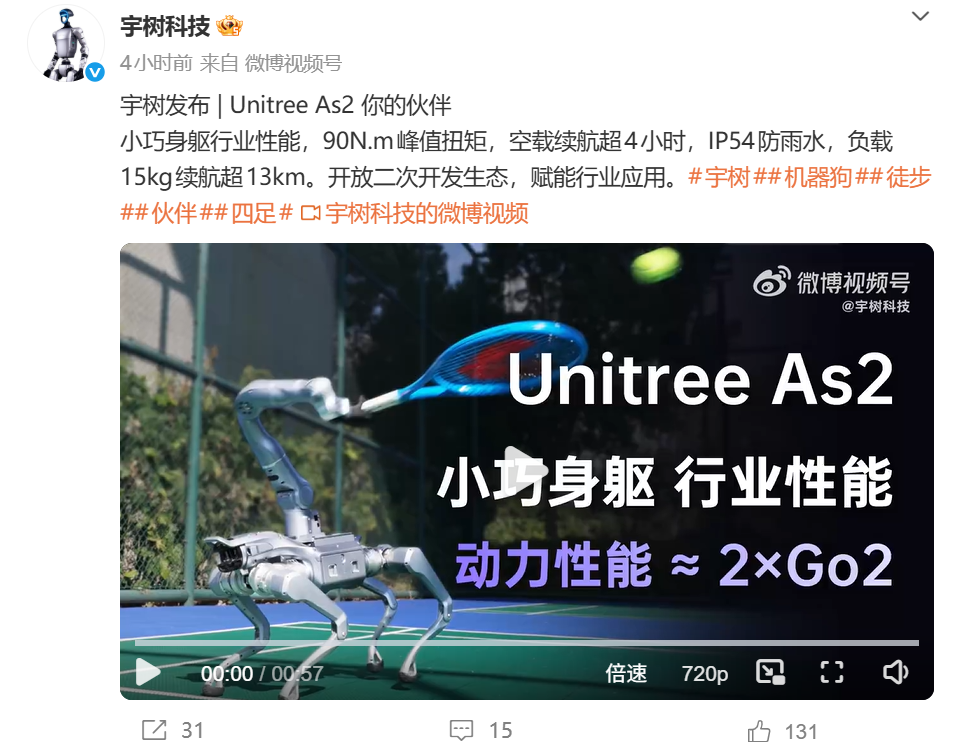
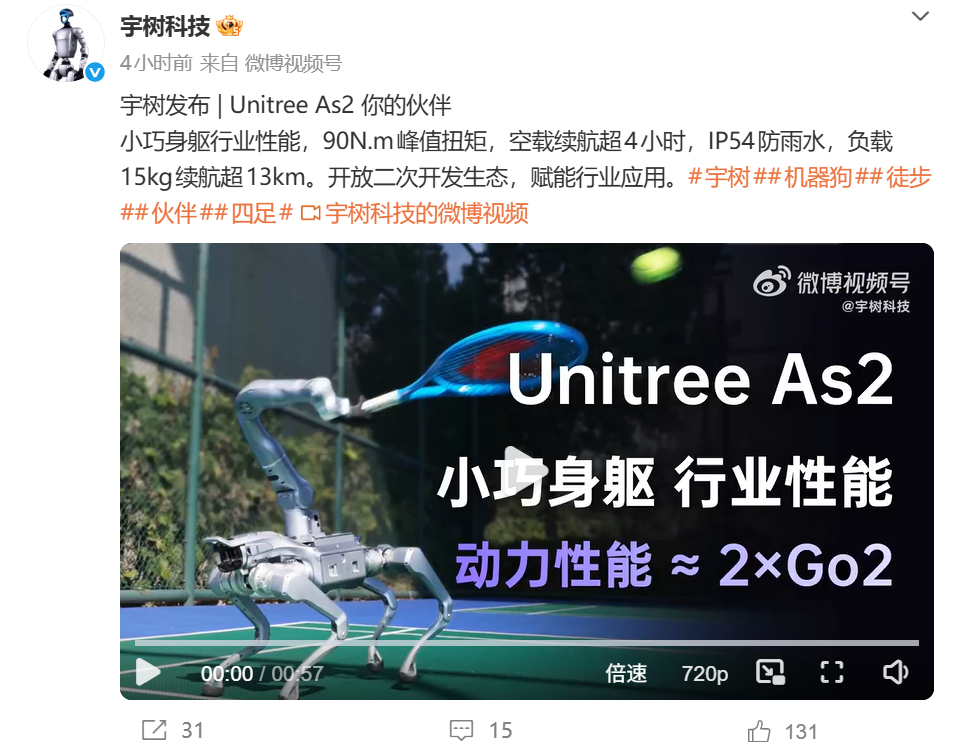
Core Viewpoint - Unitree As2 is a highly advanced quadruped robot designed for various applications, showcasing impressive speed, load capacity, and adaptability to complex environments [2][5][7]. Group 1: Product Features - The Unitree As2 can reach a maximum speed of 5 m/s and is equipped with a bionic embodiment model, allowing it to navigate complex terrains and harsh environments [2][7]. - It features a powerful motor with a maximum joint torque of approximately 90 N·m and a torque-to-weight ratio of about 5 N·m/kg, with a total weight of 18 kg [5]. - The robot is powered by a 648 Wh (15000 mAh) battery, providing over 4 hours of runtime when unloaded and over 2.5 hours with a 15 kg load, enabling it to travel more than 13 km continuously [5][7]. - The design includes IP54 water resistance, allowing stable operation in various weather conditions, and it can perform actions such as running, climbing, and jumping [7]. Group 2: Technological Advancements - The Unitree As2 is equipped with an 8-core high-performance CPU and upgraded ISS 3.0 intelligent accompanying system, enabling centimeter-level high-precision positioning and stable following capabilities [7]. - It offers a friendly secondary development interface, supporting the integration of AI large models for embodied intelligent interaction and autonomous decision-making [7]. Group 3: Market Position and Applications - Unitree Technology's product lineup includes consumer and research quadruped robots such as As2, Go2, Go1, and A1, as well as industry-grade robots like A2, B2, B2-W, and Aliengo [11]. - In 2024, the revenue structure for Unitree Technology's products is projected to be 65% from quadruped robots, 30% from humanoid robots, and 5% from components, with approximately 80% of quadruped robots used in research, education, and consumer fields [14]. - The company gained significant attention during the 2023 CCTV Spring Festival Gala, showcasing its G1 and H2 humanoid robots in a world-first fully autonomous martial arts performance [14][16].
宇树科技,重磅发布!
Zhong Guo Ji Jin Bao· 2026-02-24 15:19
Core Insights - Unitree Technology has officially announced the launch of its quadruped robot, Unitree As2, on February 24 [1] Group 1: Product Features - The Unitree As2 can reach a maximum speed of 5 m/s and is designed to navigate complex terrains and harsh environments with ease [3] - It features a powerful motor with a maximum joint torque of approximately 90 N·m and a torque-to-weight ratio of about 5 N·m/kg, with a total weight of 18 kg [6] - The robot is equipped with a 648 Wh (15000 mAh) battery, providing over 4 hours of operation without load and over 2.5 hours with a 15 kg payload, allowing it to travel more than 13 km continuously [6][8] - The Unitree As2 has an IP54 rating for water resistance, enabling stable operation in various weather conditions [8] - It incorporates an 8-core high-performance CPU and the upgraded ISS 3.0 intelligent accompanying system for centimeter-level high-precision positioning and stable following capabilities [8] Group 2: Additional Features and Accessories - The robot supports various accessories, including a 7-axis dexterous robotic arm, high-definition cameras, speakers, microphones, and multiple external interfaces [9] - It offers a friendly secondary development interface, allowing for the integration of AI models for intelligent interaction and autonomous decision-making [8][9] Group 3: Market Position and Performance - Unitree Technology's revenue structure for 2024 indicates that quadruped robots will account for 65% of total revenue, humanoid robots for 30%, and components for 5% [14] - Approximately 80% of quadruped robots are utilized in research, education, and consumer sectors, while the remaining 20% are used in industrial applications such as inspection and firefighting [14] - The company has gained significant attention by showcasing its robots during major events, including a performance at the CCTV Spring Festival Gala, featuring the G1 and H2 humanoid robots [14][16]
人形机器人跟踪:春晚舞台见证人形机器人“脑:体”双突破
GF SECURITIES· 2026-02-23 07:52
Group 1 - Industry investment rating: Buy [2] - Core viewpoint: The humanoid robot industry has made significant advancements, as showcased during the 2026 Spring Festival Gala, highlighting the capabilities of domestic manufacturers in various applications [6][6][6] - Investment suggestion: The humanoid robot sector is well-prepared for mass production, with expected exponential growth in product delivery in 2026 compared to 2025 [6] Group 2 - Key company performance: The Spring Festival Gala led to a 150% increase in robot orders, with a surge in search volume and customer inquiries [6] - Notable company showcases: Multiple companies demonstrated their robots' capabilities, including 松延动力's elderly care applications, 宇树科技's high-dynamic control, and 魔法原子’s group control of 100 robots [6] - Recommended companies for investment: Focus on 恒立液压, 浙江荣泰, and others for specific components like planetary roller screws and dexterous motors [6]
美媒英媒报道了:西方还停留在中世纪?中国人形机器人闪耀全球
Sou Hu Cai Jing· 2026-02-18 07:45
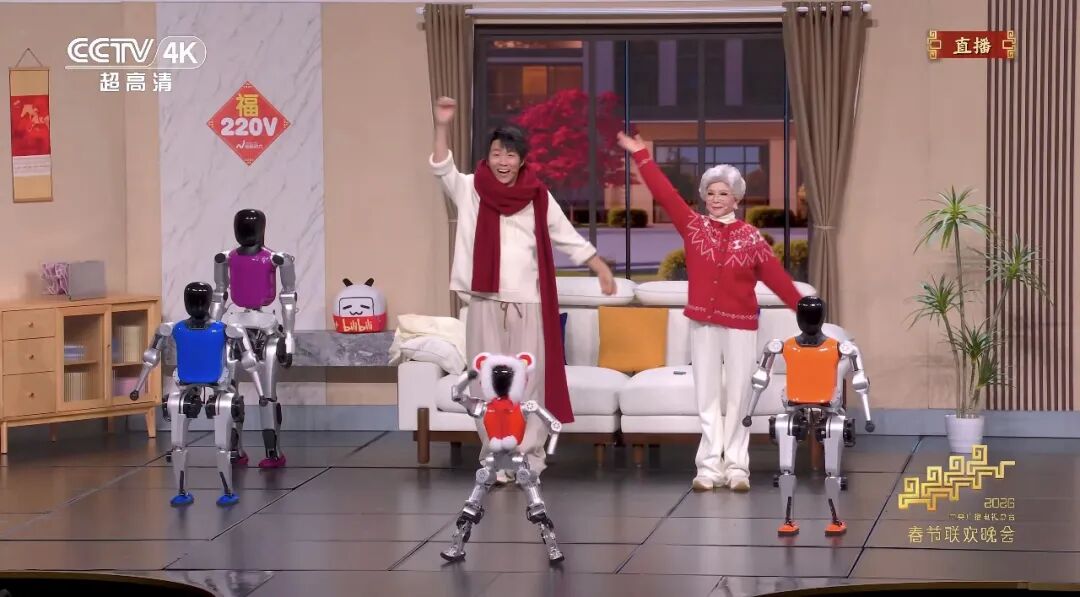
Core Viewpoint - The rapid advancement of humanoid robot technology in China was showcased during the Spring Festival Gala, highlighting significant innovations and capabilities that have surpassed previous expectations [1][5][10]. Company Highlights - Yushutech presented their humanoid robots G1 and H2, performing complex martial arts moves, including the world's first continuous table-flipping parkour and multiple air flips, after extensive training on a simulation platform [3][10]. - Songyan Power collaborated with celebrity Cai Ming to create a skit featuring a robot, which required over 300 iterations of algorithms and 21 versions of dance training to enhance interaction and expression [3][10]. - Magic Atom's MagicBot Z1 executed a 360° stunt during the opening performance, marking it as the first humanoid robot to achieve this feat within its size category [3][10]. - Galaxy General's Galbot G1 demonstrated practical skills by performing tasks like cleaning up broken cups and handling food, showcasing its autonomous decision-making capabilities [3][10]. Industry Trends - International media attention has surged, with reports indicating that by 2025, approximately 13,000 humanoid robots will be shipped globally, with 90% expected to come from Chinese companies [5][7]. - Morgan Stanley predicts that humanoid robot sales in China will double by 2026, reaching 28,000 units, indicating a strong growth trajectory [5][7]. - The number of humanoid robot companies in China has exceeded 140, supported by a robust supply chain and a rich talent pool, facilitating large-scale production and application in various sectors [7][8]. - China's humanoid robot industry is becoming a market leader, driven by cost efficiency and production capabilities, with government support and a strong technical workforce fostering innovation [8][10].


“硅基生命”霸屏!宇树科技等揭秘春晚表演……
Jin Rong Shi Bao· 2026-02-18 03:39
Core Insights - The 2026 Spring Festival Gala showcased humanoid robots from four companies, marking a significant advancement in robot capabilities and their integration into human narratives [1][3][11] Group 1: Technological Advancements - The performances demonstrated significant upgrades in action complexity, choreography logic, and human-robot interaction methods [2] - The humanoid robots exhibited unprecedented dynamic capabilities, including complex movements such as parkour and aerial flips, pushing the boundaries of robotic performance [5][7] - The robots utilized advanced autonomous control technologies, allowing them to operate without external positioning aids and adapt to environmental changes in real-time [9][12] Group 2: Market Impact - The Spring Festival Gala serves as a major media event, providing robots with extensive exposure to millions of viewers, which can lead to increased commercial inquiries and orders [15] - Following the gala, companies like JD.com quickly launched sales pages for the showcased robots, indicating immediate market responsiveness [16] - The pricing strategy varied from affordable consumer-grade robots to high-end models, catering to different market segments and demonstrating the diverse landscape of the robotics industry [19] Group 3: Industry Trends - The global humanoid robot market is projected to grow significantly, with an expected shipment of approximately 18,000 units in 2025, reflecting a 508% year-on-year increase [19] - Chinese manufacturers are positioned to dominate the market due to their robust manufacturing systems and rapid iteration capabilities [21][22] - The industry is transitioning from hardware sales to service-oriented models, emphasizing the importance of technology depth, service capabilities, and ecosystem development [22][23]