
AI Agent(人工智能代理)

Search documents
存储芯片价格失控!华尔街再调预期:2026年DRAM或暴涨88%
Hua Er Jie Jian Wen· 2026-01-12 23:22
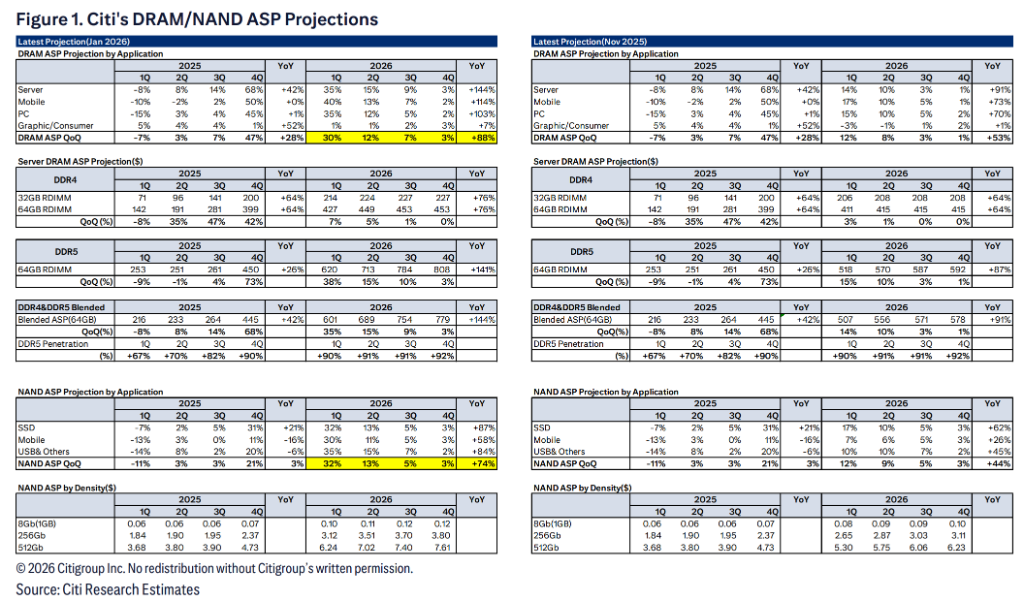
Core Viewpoint - Citi warns of a "severe supply shortage" in the global storage chip market by 2026, driven by the proliferation of AI agents and a surge in AI CPU memory demand, leading to a significant increase in storage chip prices [1][2]. Pricing Power Shift - The pricing power in the storage memory market is expected to shift entirely to sellers, with a structural data growth driving this change. Citi has revised its 2026 DRAM average selling price (ASP) growth forecast from +53% to +88% [2]. Server DRAM Price Surge - Server DRAM prices are projected to skyrocket by 144% in 2026, up from a previous forecast of +91%. For instance, the price of the mainstream 64GB DDR5 RDIMM is expected to reach $620 in Q1 2026, a 38% increase from the earlier estimate of $518 [3]. NAND Flash Market Outlook - In the NAND flash sector, Citi has raised its 2026 ASP growth forecast from +44% to +74%, with enterprise SSD ASP expected to increase by 87%. This indicates a highly aggressive seller's market, with pricing power firmly in the hands of major storage players like Samsung [8]. Samsung Electronics Profit Forecast - Due to favorable pricing conditions, Citi has significantly revised its profit outlook for Samsung Electronics, projecting an operating profit of 155 trillion KRW in 2026, a 253% increase year-on-year, compared to a previous estimate of 115 trillion KRW. Consequently, the target price for Samsung has been raised from 170,000 KRW to 200,000 KRW [8]. Divergence in Market Predictions - There is a notable divergence between Citi and Nomura regarding market predictions. Nomura anticipates a 46% increase in DRAM prices and a 65% increase in NAND prices for 2026, while Citi's forecasts are much more aggressive at 88% and 74%, respectively. This difference stems from varying interpretations of demand dynamics, particularly the impact of AI agents on data generation [9]. Supply Chain Constraints - The supply side is facing significant physical limitations, particularly due to a shortage of cleanroom availability, which is constraining supply expansion in the global storage industry. Even if manufacturers decide to increase production, substantial supply growth will be limited until mid-2027 [10][11]. Long-term Supply Bottlenecks - The transition to advanced manufacturing processes, such as moving to 1C-nanometer technology, is expected to reduce wafer production capacity by 10% to 15% initially, further complicating the supply situation. This mismatch between supply and demand underpins Citi's bold predictions for DRAM price increases [12].

地平线陈黎明:智驾业硬件和软件将进一步集成
Guo Ji Jin Rong Bao· 2025-07-11 12:58
Core Insights - The 15th China Automotive Forum was successfully held in Shanghai from July 10 to 12, where Horizon Robotics' President Chen Liming delivered a keynote speech on the latest trends in the intelligent driving industry and the company's technological innovations [1]. Group 1: Industry Trends - Intelligent driving technology is at a critical development stage, with a potential for rapid growth as it has reached an inflection point [1]. - The growth is supported by three factors: the integration of intelligent driving in China's new energy vehicle strategy, the expansion of Navigate on Autopilot (NOA) features from high-end to mid-range vehicles, and consumer preference for intelligent features in electric vehicles, especially among premium brands [1]. Group 2: Challenges in Intelligent Driving - Despite the promising outlook, intelligent driving faces challenges, particularly with urban NOA, which is still in a "usable" stage due to complex traffic conditions leading to safety issues [2]. - Current systems have limited Operational Design Domain (ODD) and weak generalization capabilities, which restrict their usage areas [2]. - High-performance systems are costly, hindering widespread adoption [2]. Group 3: Technological Innovations by Horizon - Horizon has developed the Vision Mamba algorithm, which addresses computational and visual challenges, enhancing performance with linear complexity and global perception [2]. - The Senna architecture combines end-to-end models with Visual Language Models (VLM), improving generalization and decision-making capabilities while reducing planning errors and collision rates [2]. - The Journey 6 series chips cover a range of intelligent driving applications, with the Journey 6P chip set to debut in Chery vehicles this year [2]. Group 4: Future Outlook - Horizon supports domestic manufacturers in producing intelligent driving systems and collaborates with international companies, including strategic partnerships with Bosch and Denso announced at the Shanghai Auto Show [3]. - The future of the intelligent driving industry is expected to see further integration of hardware and software, leading to the development of a unified AI Agent for distributed control [3]. - Horizon aims to collaborate with partners across the industry chain to create user-friendly intelligent driving products that deliver real value to consumers [3].