
三重超级周期

Search documents
存储芯片价格失控!华尔街再调预期:2026年DRAM或暴涨88%
Hua Er Jie Jian Wen· 2026-01-12 23:22
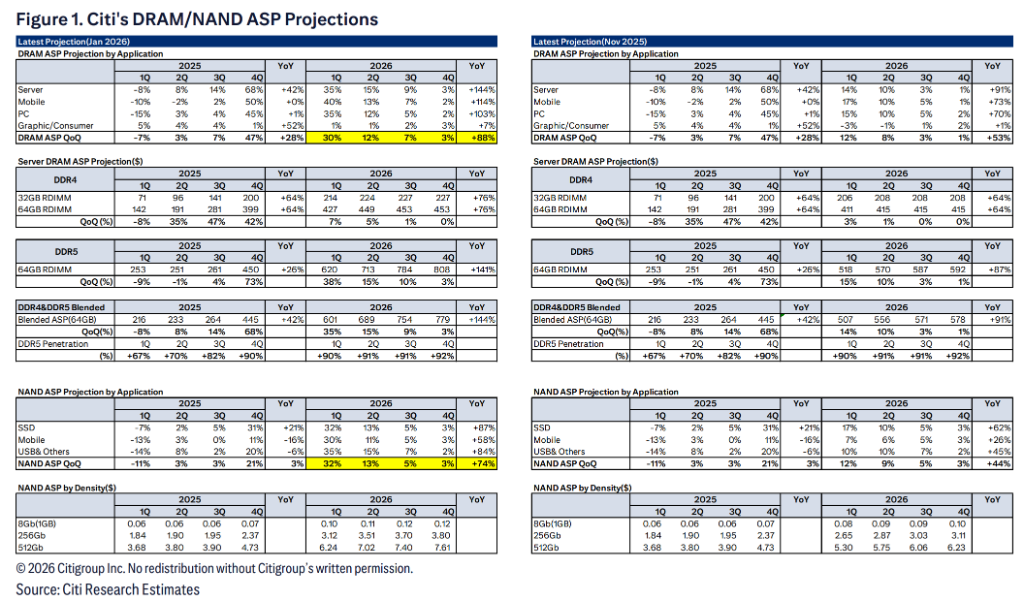
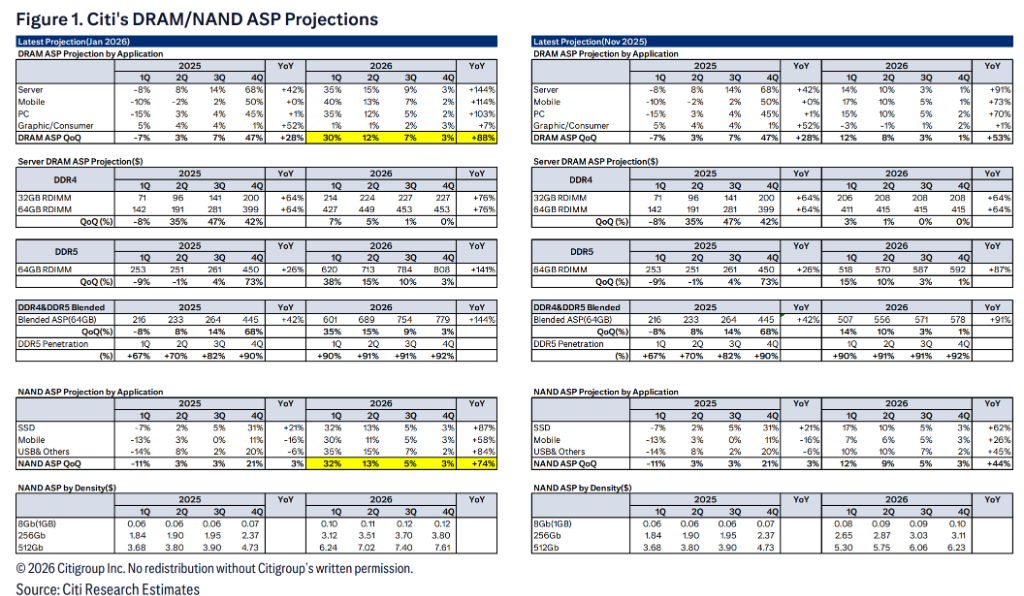
Core Viewpoint - Citi warns of a "severe supply shortage" in the global storage chip market by 2026, driven by the proliferation of AI agents and a surge in AI CPU memory demand, leading to a significant increase in storage chip prices [1][2]. Pricing Power Shift - The pricing power in the storage memory market is expected to shift entirely to sellers, with a structural data growth driving this change. Citi has revised its 2026 DRAM average selling price (ASP) growth forecast from +53% to +88% [2]. Server DRAM Price Surge - Server DRAM prices are projected to skyrocket by 144% in 2026, up from a previous forecast of +91%. For instance, the price of the mainstream 64GB DDR5 RDIMM is expected to reach $620 in Q1 2026, a 38% increase from the earlier estimate of $518 [3]. NAND Flash Market Outlook - In the NAND flash sector, Citi has raised its 2026 ASP growth forecast from +44% to +74%, with enterprise SSD ASP expected to increase by 87%. This indicates a highly aggressive seller's market, with pricing power firmly in the hands of major storage players like Samsung [8]. Samsung Electronics Profit Forecast - Due to favorable pricing conditions, Citi has significantly revised its profit outlook for Samsung Electronics, projecting an operating profit of 155 trillion KRW in 2026, a 253% increase year-on-year, compared to a previous estimate of 115 trillion KRW. Consequently, the target price for Samsung has been raised from 170,000 KRW to 200,000 KRW [8]. Divergence in Market Predictions - There is a notable divergence between Citi and Nomura regarding market predictions. Nomura anticipates a 46% increase in DRAM prices and a 65% increase in NAND prices for 2026, while Citi's forecasts are much more aggressive at 88% and 74%, respectively. This difference stems from varying interpretations of demand dynamics, particularly the impact of AI agents on data generation [9]. Supply Chain Constraints - The supply side is facing significant physical limitations, particularly due to a shortage of cleanroom availability, which is constraining supply expansion in the global storage industry. Even if manufacturers decide to increase production, substantial supply growth will be limited until mid-2027 [10][11]. Long-term Supply Bottlenecks - The transition to advanced manufacturing processes, such as moving to 1C-nanometer technology, is expected to reduce wafer production capacity by 10% to 15% initially, further complicating the supply situation. This mismatch between supply and demand underpins Citi's bold predictions for DRAM price increases [12].

存储芯片价格失控!华尔街再调预期:2026年DRAM或暴涨88%,NAND涨74%
华尔街见闻· 2026-01-08 12:18
Core Viewpoint - Citi's latest outlook presents a more aggressive bullish stance compared to Nomura, predicting a significant price surge in storage chips driven by the proliferation of AI Agents and a surge in AI CPU memory demand, with DRAM average selling prices (ASP) expected to rise by 88% and NAND by 74% by 2026 [1][2]. Group 1: Price Projections - Citi forecasts a "severe supply shortage" in the commodity memory market by 2026, driven by structural data growth rather than temporary supply chain disruptions [2]. - The ASP for server DRAM is projected to skyrocket by 144% in 2026, significantly up from a previous estimate of 91%, with the price of mainstream 64GB DDR5 RDIMM expected to reach $620 in Q1 2026, a 38% increase from earlier predictions [3]. - In the NAND sector, Citi has raised its ASP growth forecast from 44% to 74%, with enterprise SSD ASP expected to increase by 87% [4]. Group 2: Company Impact - Based on these aggressive price forecasts, Citi has significantly revised its earnings outlook for Samsung Electronics, projecting an operating profit of 155 trillion KRW in 2026, a staggering 253% increase year-over-year, up from a previous estimate of 115 trillion KRW [5]. - Citi has raised Samsung's target price from 170,000 KRW to 200,000 KRW, reflecting the expected strong profitability due to rising DRAM and NAND prices [5]. Group 3: Market Dynamics - Nomura's report introduced the concept of a "triple super cycle" in the global storage market, predicting a 98% growth to $445 billion by 2026, although their price increase estimates are lower than Citi's [6][8]. - The divergence in price predictions stems from differing interpretations of demand, with Nomura focusing on the dual resonance of AI servers and general servers, while Citi emphasizes the explosive data generation from AI Agents [9]. - A critical supply constraint is the shortage of cleanroom availability, which limits the ability of manufacturers to expand production, thereby exacerbating the supply-demand mismatch and supporting Citi's bold price predictions [12].

存储芯片价格失控!华尔街再调预期:2026年DRAM或暴涨88%,NAND涨74%
Hua Er Jie Jian Wen· 2026-01-07 09:03
Core Viewpoint - Citigroup warns of a "severe supply shortage" in the global storage chip market by 2026, driven by the surge in AI-related memory demand, leading to significant price increases for DRAM and NAND chips [1][2]. Price Projections - Citigroup has revised its 2026 average selling price (ASP) forecast for DRAM from a 53% increase to an 88% increase, while NAND's forecast has been adjusted from 44% to 74% [1][2]. - Specifically, the ASP for server DRAM is expected to skyrocket by 144% year-on-year, with the price of a 64GB DDR5 RDIMM projected to reach $620 in Q1 2026, a 38% increase from previous estimates [2]. Market Dynamics - The report indicates that the pricing power has shifted entirely to sellers, with a structural data growth driving the anticipated supply shortage rather than temporary supply chain disruptions [2]. - Citigroup emphasizes that the market will enter a highly seller-dominated environment, with major players like Samsung gaining significant pricing power [4]. Company Impact - Citigroup has significantly upgraded its profit outlook for Samsung Electronics, predicting an operating profit of 155 trillion KRW in 2026, a 253% increase year-on-year, up from a previous estimate of 115 trillion KRW [4]. - The favorable pricing environment for DRAM and NAND is expected to enhance Samsung's profitability, leading to an increase in its target price from 170,000 KRW to 200,000 KRW [4]. Comparative Analysis - Nomura Securities previously projected a "super cycle" in the storage market, estimating a 98% growth in market size to $445 billion by 2026, but their price increase forecasts are significantly lower than Citigroup's [5]. - Nomura anticipates a 46% increase in DRAM prices and a 65% increase in NAND prices, highlighting a fundamental difference in demand understanding compared to Citigroup's more aggressive forecasts [5]. Supply Constraints - The shortage of cleanroom availability is identified as a long-term bottleneck for supply expansion, limiting the ability of manufacturers to respond quickly to the anticipated demand surge [8]. - Even if manufacturers decide to expand production, significant supply-side growth is expected to be constrained until mid-2027 due to cleanroom shortages and technological transitions that may reduce wafer capacity [8].
中泰期货晨会纪要-20251209
Zhong Tai Qi Huo· 2025-12-09 01:21
Report Industry Investment Rating The provided content does not mention the report industry investment rating. Core Viewpoints of the Report - Based on fundamental analysis, various commodities are classified into trend - bearish, oscillating - bearish, oscillating, oscillating - bullish, and trend - bullish categories [5]. - Based on quantitative indicators, commodities are divided into bearish, oscillating, and bullish groups [9]. - The macro - economic situation shows that China's trade data is good, and policies are expected to be more proactive and moderately loose. The global economic situation also has an impact on the market [11]. - Different trading strategies are proposed for various commodities in different sectors such as macro - finance, black, non - ferrous, agricultural products, and energy - chemical industries [16][20][27]. Summary by Relevant Catalogs 1. Macro Information - The Politburo meeting emphasizes a proactive fiscal policy and a moderately loose monetary policy in 2026, focusing on domestic demand [11]. - China's trade data from January to November 2025 shows a 3.6% year - on - year increase in total import and export value, with exports up 6.2% and imports up 0.2%. In November, the growth rate rebounded [11]. - Experts expect China to continue an expansionary fiscal policy in 2026, with a fiscal deficit rate no lower than 4% and an increase in new government debt [11]. - There are discussions about "relaxing restrictions on brokers", and the industry's leverage will be kept within a reasonable range [12]. - The November 2025 passenger car market retail shows a decline in fuel - powered cars and an increase in new energy vehicles. The 2026 car market may face great pressure [12]. - The global storage market is expected to enter a "triple super - cycle" in 2026, with a 98% year - on - year growth in market size [12]. - The Fed is likely to cut interest rates, and the market is highly concerned about the Fed's meeting [12]. - Trump plans to sign an AI regulatory order and launch an agricultural aid program. The US Labor Bureau will delay the release of October PPI data [13]. - Japan's Q3 GDP is revised downwards, and the selling of Japanese government bonds is accelerating [13][14]. 2. Macro - Finance 2.1 Stock Index Futures - The strategy is to adopt a wide - range oscillating approach. A - shares rose with increased trading volume, and various sectors showed different performances. Policy factors and market data affect the market [16]. 2.2 Bond Futures - If the consensus on the decline of the capital - market center is reached, medium - and short - term bonds may stabilize and rebound, while ultra - long - term bonds are neutral in the short term and cautious in the medium term [18]. 3. Black 3.1 Steel and Iron Ore - Policy - wise, focus on the Central Economic Work Conference and the Ministry of Industry and Information Technology's deployment. Fundamentally, steel demand is weak in the building materials sector but better in the coil sector. Supply may decline, and inventory is high. The medium - to - long - term trend is bearish [20]. 3.2 Coking Coal and Coke - Short - term prices are expected to oscillate weakly. Supply may contract due to safety regulations, and demand is affected by the steel industry's profit. There may be a rebound in the far - month 05 contract, but the space is limited [22]. 3.3 Ferroalloys - For silicon iron, a bullish view is maintained; for manganese silicon, a bearish view is held in the medium term. The market is affected by ore supply and production capacity [23]. 3.4 Soda Ash and Glass - For soda ash, a wait - and - see approach is recommended; for glass, a long - position can be considered after the market stabilizes. Supply and demand factors affect the prices [25]. 4. Non - Ferrous and New Materials 4.1 Zinc - Zinc prices are expected to oscillate widely. Domestic inventory is decreasing, and factors such as production reduction and macro - policies affect the price [27][28]. 4.2 Lead - Lead prices may stop falling and rise in December. Supply is tight in some areas, and demand from battery factories may increase [29][30]. 4.3 Lithium Carbonate - Prices may oscillate widely in the short term. Supply is increasing, but long - term demand is strong [31]. 4.4 Industrial Silicon - Affected by the new delivery brands of polysilicon, industrial silicon may adjust weakly. Downward space is limited, and short - term long - positions can be considered after an over - decline [32]. 4.5 Polysilicon - There may be a correction due to new delivery brands. Low - buying opportunities can be considered after the correction [33]. 5. Agricultural Products 5.1 Cotton - Short - term supply pressure is high, and demand is not yet strong. Low - buying opportunities can be sought [36]. 5.2 Sugar - Domestic sugar prices are expected to oscillate downward. Supply is increasing, and cost provides some support [38]. 5.3 Eggs - Near - month contracts may oscillate. Far - month contracts may be supported by the expected decline in inventory but are under pressure due to high valuations [40]. 5.4 Apples - Prices are expected to oscillate. Sales are affected by the supply of other fruits [42]. 5.5 Corn - For the 03 contract, a short - position can be considered. The market is affected by supply - demand mismatch and inventory changes [43]. 5.6 Red Dates - A long - position can be considered for far - month contracts. Prices in production and sales areas are stable [44]. 5.7 Pigs - The spot market is bearish. Supply is increasing, and demand is not strong enough. Short - positions can be held for near - month contracts [45]. 6. Energy - Chemical 6.1 Crude Oil - Supply is in excess. The end of the conflict may lead to a decline in geopolitical premiums. Prices are expected to oscillate [47]. 6.2 Fuel Oil - Prices follow the trend of crude oil. Supply is abundant, and demand is weak. The focus is on geopolitical factors [48]. 6.3 Plastics - Polyolefins have high supply pressure and weak demand. A bearish - oscillating approach is recommended [49]. 6.4 Rubber - The ru - nr spread may weaken. Prices are expected to oscillate. Supply and demand are relatively balanced [50]. 6.5 Synthetic Rubber - Prices are expected to oscillate in the short term. Cost and demand affect the market [52]. 6.6 Methanol - Near - month contracts may oscillate weakly, and far - month contracts can be considered for long - positions after de - stocking [53]. 6.7 Caustic Soda - A short - term oscillating approach is recommended. Spot prices are weak, and futures contracts are affected by inventory and demand [55]. 6.8 Asphalt - Demand is approaching the end - stage, and the focus is on the winter - storage price bottom. Prices are affected by crude oil and market expectations [56]. 6.9 Polyester Industry Chain - Terminal demand is weak. Opportunities in PTA - ethylene glycol spreads and ethylene glycol backwardation can be considered [57]. 6.10 Liquefied Petroleum Gas - Prices may turn weak after a high - level period. Supply and demand factors affect the market [58]. 6.11 Offset Printing Paper - A bearish approach is recommended. Supply is in excess, and cost provides some support [59]. 6.12 Pulp - Prices may oscillate weakly. Import volume is increasing, and spot trading is weak [60]. 6.13 Logs - The market is bearish. Inventory is expected to increase, and prices are under pressure [61]. 6.14 Urea - Spot prices may oscillate weakly. Futures prices are affected by spot trading and coal prices [62].
三重超级周期!野村:明年DRAM、NAND和HBM需求同时爆发,有望推动存储市场翻倍
Hua Er Jie Jian Wen· 2025-12-08 10:46
Core Insights - The global storage market is entering an unprecedented "Triple Super-Cycle," with demand for DRAM, NAND, and HBM expected to surge simultaneously by 2026 [1] - The market size is projected to grow by 98% year-on-year to $445 billion in 2026, further expanding to $590 billion in 2027, driven by AI infrastructure and a recovery in traditional server investments [1] - This super-cycle is anticipated to last until 2027, fueled by strong demand growth and limited supply expansion, leading to significant price increases for storage products [1] Demand Drivers - Strong demand from AI servers and a recovery in the general server market are key drivers [2] - The demand for general server-related memory (like DDR4 and DDR5) is expected to grow by approximately 50% in 2026 due to large tech companies resuming traditional cloud server investments [2] - The increase in AI inference workloads is driving demand for high-performance storage, with enterprise SSD (eSSD) demand expected to double next year [2] Market Dynamics - The core of this super-cycle is the dual resonance of AI and general server demand, with HBM4 demand expected to ramp up in 2026 [3] - Major tech companies are projected to increase investments in traditional DRAM products by 20% to 30% in 2026, tightening supply [3] - The shortage of commodity DRAM is expected to push operating profit margins to around 70% between 2026 and 2027 [3] NAND and eSSD Market Growth - eSSD is becoming a major growth engine in the NAND sector, expected to account for about 40% of total NAND demand by 2026 [4] - The shift from HDD to SSD is accelerating due to increased demand for high-performance storage, with eSSD demand projected to grow over 100% [4] - NAND industry operating profit margins are expected to improve significantly, reaching 30% to 40% by 2026 [4] Supply Constraints - Supply expansion in the global storage industry will be limited due to a shortage of cleanroom availability until mid-2027 [5] - DRAM spot prices have surged by 200% to 300% since October, while NAND wafer spot prices have increased by 140% [5] - The transition to advanced technology nodes is expected to reduce wafer capacity by 10% to 15%, further constraining supply [6] Impact on Downstream Markets - The rising prices of storage chips will significantly increase BOM costs for PC and smartphone manufacturers, leading to potential profit compression or price hikes [7] - Global PC shipments are projected to decline by 2.8% year-on-year in 2026, while smartphone shipments may decrease by 1.7% [7] - Mid-range smartphones will be more affected due to higher storage cost proportions, while Apple is expected to remain relatively insulated due to its strong profit margins and supply agreements [7]