IP生态运营

Search documents
2026泡泡玛特国产品牌购物中心门店杂货与潮玩业态
Sou Hu Cai Jing· 2026-02-07 04:46
Core Insights - The report analyzes the contrasting business models of the grocery and trendy toy sectors in Chinese shopping centers, highlighting their unique consumer engagement strategies and market positioning [1][10]. Grocery Sector - The grocery sector, represented by brands like Miniso, focuses on a scalable and efficient supply chain, emphasizing "extreme cost-performance" and frequent product launches to attract a broad family customer base across all age groups [1][6]. - Product design in this sector prioritizes functionality and scenario-based usage, with store layouts designed for practicality and efficient movement [1][6]. - Brands enhance user loyalty through localized product strategies and community activities, with a core competitive focus on supply chain cost control and digital operational capabilities [1][6]. Trendy Toy Sector - In contrast, the trendy toy sector, led by Pop Mart, builds its business logic around IP ecosystems, achieving high premiums through design, production, sales, and community engagement [2][6]. - Pop Mart's profitability heavily relies on the emotional value and collectible nature of its IP, with limited edition strategies and hidden variants driving social sharing and collector enthusiasm [2][6]. - The target demographic primarily includes Generation Z and young women, with consumption motivations extending beyond practicality to emotional attachment and social currency [2][6]. Store Layout and Experience - Pop Mart's store distribution creates a dual-core structure within shopping centers, with first-floor stores enhancing brand image and attracting high-end traffic, while B1 level stores capitalize on young consumer flow and trendy atmospheres [3][30]. - The synergy of Pop Mart's store ecosystem is evident, with B1 level stores collaborating closely with fast fashion, trendy accessories, and food courts to share a young "shopping" customer base [3][30]. - The first floor leverages luxury goods and beauty brands to elevate brand tone, while the second floor connects with children's entertainment and family education sectors to deepen family consumption scenarios [3][30]. Market Competition - Pop Mart faces competition not only from direct rivals like TOP TOY and 52TOYS but also from international IP giants like LEGO and Bandai, as well as other entertainment and leisure sectors that may divert customer traffic [3][10]. - Competitive focus areas include IP attractiveness, price range, experiential innovation, and channel cost control [3][10]. Future Trends - Both grocery and trendy toy sectors are expected to face challenges related to experience upgrades and boundary integration, with grocery brands exploring trendy toy elements and beauty experiences, while trendy toy brands seek global IP expansion and scenario-based extensions [4][10]. - The evolution of offline channels will continue towards refined strategies for "full-scale coverage and full-scenario reach," emphasizing the importance of creating unique value and effectively connecting with target customer groups [4][10].



“电子木鱼”火爆全网,泡泡玛特止跌了吗?
Zhong Guo Zheng Quan Bao· 2026-01-25 12:13
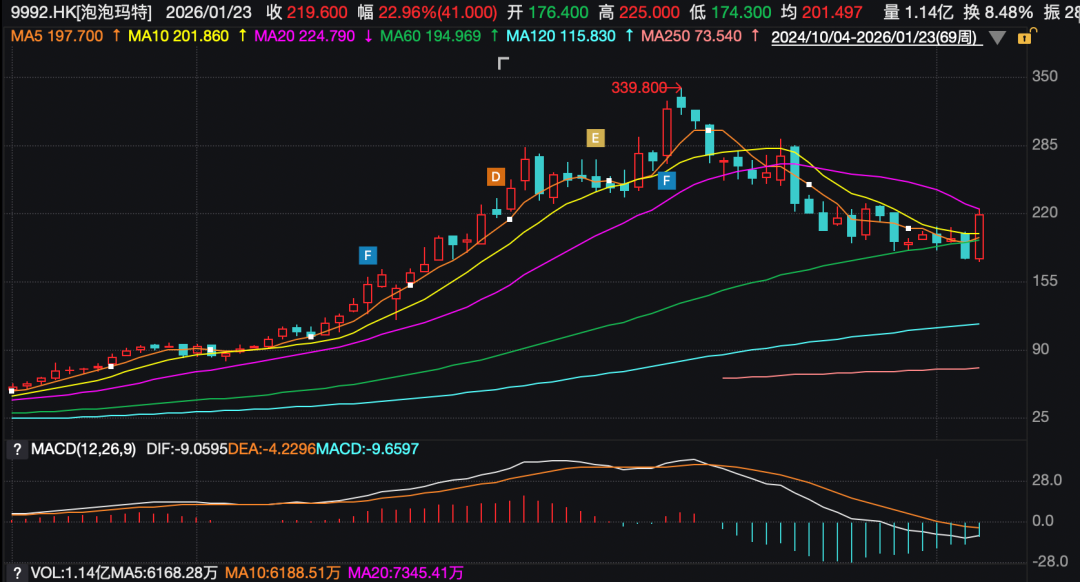
Group 1 - After four consecutive months of decline, Pop Mart experienced a strong rebound, with its stock price rising nearly 23% from January 19 to 23, bringing its total market value back to HKD 294.6 billion [1] - The stock price of Pop Mart reached a historical high of HKD 339.8 per share at the end of August 2025, with a total market value exceeding HKD 400 billion, but subsequently fell nearly 30% in the fourth quarter of 2025 due to concerns over the decline in IP popularity [3] - Institutional funds significantly reduced their holdings in Pop Mart in the fourth quarter of 2025, with the number of shares held by public funds decreasing from 43.82 million at the end of the third quarter to 34.25 million at the end of the fourth quarter, a reduction of 9.57 million shares [4] Group 2 - Despite the reduction in institutional holdings, some funds increased their positions in Pop Mart during the fourth quarter of 2025, such as Ruiyuan Fund and Invesco Great Wall, which added 2.45 million and over 230,000 shares respectively [4] - The founder of Pop Mart, Wang Ning, emphasized that the company is an IP company, and the blind box concept is merely an enhancement, with the core value lying in aesthetics and emotional connection rather than practicality [6] - Investment institutions remain optimistic about the new consumption sector, with expectations that companies like Pop Mart will evolve into IP ecosystem operators, focusing on diversified IP development and expansion into overseas markets by 2026 [8] Group 3 - The Hong Kong stock market is currently at a historically low valuation, providing a safety margin for both non-essential and essential consumer sectors, which are expected to attract investment as economic recovery continues [9] - The sentiment in the market is cautious, with a longer observation period required for transformation companies, which has affected the valuation recovery process [8] - The overall outlook for the new consumption sector is positive, with potential for long-term value release over the next two years as the macroeconomic environment stabilizes [8][9]
城市传媒:IP矩阵赋能文化新消费 跨界融合构建产业新生态
Zhong Guo Zheng Quan Bao· 2026-01-25 03:28
Core Viewpoint - The collaboration between the IP "I Am Not Eating for Free" and Qingdao Publishing under Urban Media marks a significant upgrade in their partnership, focusing on educational comic series aimed at youth, indicating a deeper integration of IP ecosystem operations by Urban Media [1] Group 1: IP Development and Strategy - Urban Media has shown a strong commitment to developing its own IP, with the "Youth Reading" cultural IP celebrating its 10th anniversary in 2025, having expanded from a single series to a matrix of 64 books across 20 categories, achieving over 10 million copies sold and nearly 300 million yuan in sales [2] - The "Youth Reading" brand aligns with national educational reforms, utilizing a unique strategy of "big authors writing small books" to cater to different age groups, thus enhancing both classic literature appreciation and character development [2][3] Group 2: Cross-Industry Collaboration - Urban Media's project "I Am Not Eating for Free" exemplifies a successful transition from traditional publishing to a full industry chain ecosystem, focusing on K12 education by integrating anime with subjects like physics and chemistry, achieving over 1.8 million copies printed and over 100 million yuan in sales by the end of 2025 [4] - The project has expanded its product matrix with new series and collaborations with other leading science IPs, enhancing its content ecosystem [4] Group 3: Digital Transformation and Technological Integration - Urban Media is pursuing a "culture + technology" integration strategy, digitizing traditional content and creating a diverse range of digital cultural products, including animated adaptations that have reached millions of families [5][6] - The company has developed immersive experiences like "Life Journey," which combines VR and AI technologies to transform abstract scientific knowledge into interactive learning experiences, breaking the limitations of traditional education [6] Group 4: Future Directions - Urban Media plans to continue deepening its IP strategy, focusing on original content, copyright operations, and cross-industry collaboration to build a more creative and interconnected ecosystem across cultural, educational, and technological fields [7]

天机控股升11% 公司加快构建全球化IP合作生态 未来业绩具倍数增长空间
Zhi Tong Cai Jing· 2025-12-16 07:08
Core Viewpoint - Tianji Holdings (01520) has seen a stock price increase of 11%, currently trading at 1.1 HKD with a transaction volume of 4.2356 million HKD, indicating strong market interest in the company's IP-related services [1] Group 1: Business Overview - Tianji Holdings focuses on providing comprehensive IP ecosystem construction and operation services for various IP holders and brands, with three core business areas: IP digitization, secondary trading of IP products, and IP ecosystem operation [1] - The company has established a joint venture with West Foot Chain Technology to engage in new consumption operations for sports IP under the Web3.0 model, including products like star cards and figurines [1] Group 2: Strategic Partnerships - In the industrial IP sector, Tianji Holdings has formed a strategic partnership with the Saudi Ministry of Industry and Mineral Resources to assist in the national-level industrial IP development under Saudi Arabia's Vision 2030 [1] Group 3: Future Growth Potential - The company is set to launch the official LaLiga app, which will provide members with ticket purchasing and merchandise redemption services, leveraging the inherent fan base of each IP [1] - Tianji Holdings plans to operate through fan communities, offering various products such as blind boxes, star meet-and-greets, and offline experiences, indicating a diversified approach to monetization [1] - The company anticipates significant growth potential in its IP business over the next one to two years, with expectations of rapid replication and scale expansion once the business model is validated [1]
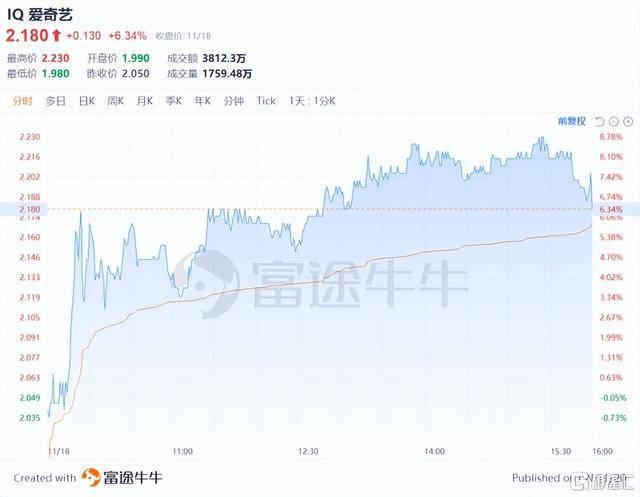
海外爆发、AI落地、体验延伸,长视频龙头爱奇艺的Q3新答卷
Sou Hu Cai Jing· 2025-11-20 16:15
Core Insights - The article highlights the transition of long video platforms from scale competition to value realization, driven by the dual backdrop of intensified competition between long and short videos and the explosive growth of micro-dramas [1][2]. Financial Performance - In Q3 2025, the company reported total revenue of 6.68 billion RMB, with membership services leading the revenue structure, showing a 3% quarter-on-quarter increase to 4.21 billion RMB. Online advertising services generated 1.24 billion RMB, while content distribution and other business revenues totaled 1.23 billion RMB [3]. - The total cost decreased by 3% year-on-year to 5.47 billion RMB, indicating effective revenue and cost management [3]. Growth Drivers - The company identified three core growth drivers: explosive overseas business performance, deep integration of AI technology, and accelerated layout of experiential business [3][5]. - In Q3, the international version of the platform achieved record-high daily membership numbers, with membership revenue growing over 40% year-on-year, marking the highest revenue growth in nearly two years [5][6]. Overseas Expansion - The overseas business has become a significant performance increment, with membership revenue in key regions like Brazil, Mexico, and Indonesia seeing over 100% year-on-year growth [5][6]. - The dual strategy of "mainland IP going global + local content creation" has been effective, with localized productions resonating well with regional audiences [6][8]. AI Integration - AI technology is reshaping the content ecosystem, with the global AI video market expected to reach 218 billion RMB by 2025, with China accounting for 42% of this market [10]. - The company has implemented AI across the content creation process, significantly reducing production costs by 40% to 50% [11][13]. IP and Experiential Business - The company is expanding its IP value beyond online content to offline experiences, with significant growth in IP consumer products and experiential businesses [15][18]. - The transition from "single licensing" to a "self-operated + licensed" model has resulted in over 100% year-on-year revenue growth in the IP consumer products sector [18][20]. Conclusion - The company's Q3 performance and positive market response reflect its commitment to quality content, technological empowerment, and global expansion. The CEO emphasized the focus on high-quality content and IP while actively investing in overseas and AI sectors, indicating a shift from a traditional content platform to a global IP ecosystem operator [20].