Memory shortage

Search documents
Jim Cramer on Micron: “I Think It’ll Prove to Be a More Meaningful Position as It Goes Down”
Yahoo Finance· 2026-03-25 17:19
Micron Technology, Inc. (NASDAQ:MU) is featured in Mad Money’s latest recap as Jim Cramer shared his buy, sell, or hold verdict. A caller expressed interest in adding to their position in the stock following the company’s latest quarterly earnings report and asked whether it still has “room to grow.” Cramer commented: Okay, so Micron is digesting that huge move. That’s what happens after you have just a gigantic increase in value to the company that is almost $500 billion. I think you have to let it churn ...

SK 海力士:花旗韩国科技之旅核心要点
花旗· 2026-03-17 02:07
Flash | 13 Mar 2026 09:14:02 ET │ 10 pages SK Hynix (000660.KS) Key Takeaways from Citi Korea Tech Tour CITI'S TAKE During Citi's Korea Tech Tour, we hosted a mgmt. meeting with Hynix. Hynix shared its outlook that the global memory shortage is likely to be more severe in 2027E vs 2026E. On the supply side, Hynix shared it will prioritize adding HBM/DRAM capacity over NAND capacity, with the phase 1 of Y1 planned to be fully allocated for DRAM. For NAND, Hynix remained cautious about adding new NAND green-f ...
Jim Cramer Says Micron Could Be “Bought on a Big Move Down Because of Oil”
Yahoo Finance· 2026-03-13 15:16
Group 1 - Micron Technology, Inc. is experiencing a significant memory shortage that is expected to persist longer than anticipated, as confirmed by HP Enterprise [1][3] - The company develops memory and storage solutions, including DRAM, NAND, and SSD products, and is facing unprecedented demand for data storage due to the proliferation of data centers [3] - Micron's CEO, Sanjay Mehrotra, is actively working to alleviate the shortage by expanding production capabilities, although the complexity and time required to build new foundries pose challenges [3] Group 2 - Despite the potential of Micron as an investment, certain AI stocks are considered to offer greater upside potential with less downside risk [4]
HP Enterprise confirms memory shortage will last longer than expected
247Wallst· 2026-03-13 12:03
Group 1 - HP Enterprise (HPE) confirms that the global memory shortage will last longer than previously expected, impacting the tech supply chain significantly [1] - HPE reported Q1 FY2026 revenue of $9.30 billion, an 18% year-over-year increase, but its server segment declined by 2.7% due to memory constraints [1] - Micron Technology (MU) echoed HPE's concerns, with CEO Sanjay Mehrotra stating that order books extend into 2027, and reported Q1 FY2026 revenue of $13.64 billion, up 56.6% year-over-year [1] Group 2 - The memory shortage is driving investment opportunities in semiconductor equipment makers such as Applied Materials, Lam Research, and KLA, which benefit from increased capital investment without direct exposure to memory pricing [1] - Applied Materials reported record DRAM revenue, with DRAM now making up 34% of its Semiconductor Systems segment, up from 27% a year ago [1] - Analysts suggest that investors should consider semiconductor capital equipment makers over commodity memory stocks, which have already priced in much of the good news [1]



HPE CEO Antonio Neri on Q1 earnings: 'Our strategy is paying off'
CNBC Television· 2026-03-10 15:44
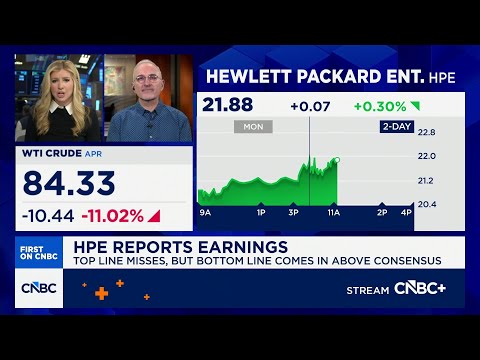
Welcome back. Take a look at shares of HPE off session lows after reporting fiscal Q1 earnings, revenue coming in lower than expected, but reporting a beat on the bottom line and raising guidance for the year ahead. Also pointing to doubledigit memory cost inflation in 2026.Joining us now first on CNBC, HPE CEO Antonio Ner. Welcome back. Good to have you.>> Good morning, S. >> Good morning. So there's a lot to get to in including some of your strategy here, but just overall in the environment.What what with ...
内存供应挑战持续:IDC大幅下调今年智能手机全球出货量,同比下滑近13%
Sou Hu Cai Jing· 2026-02-27 09:17
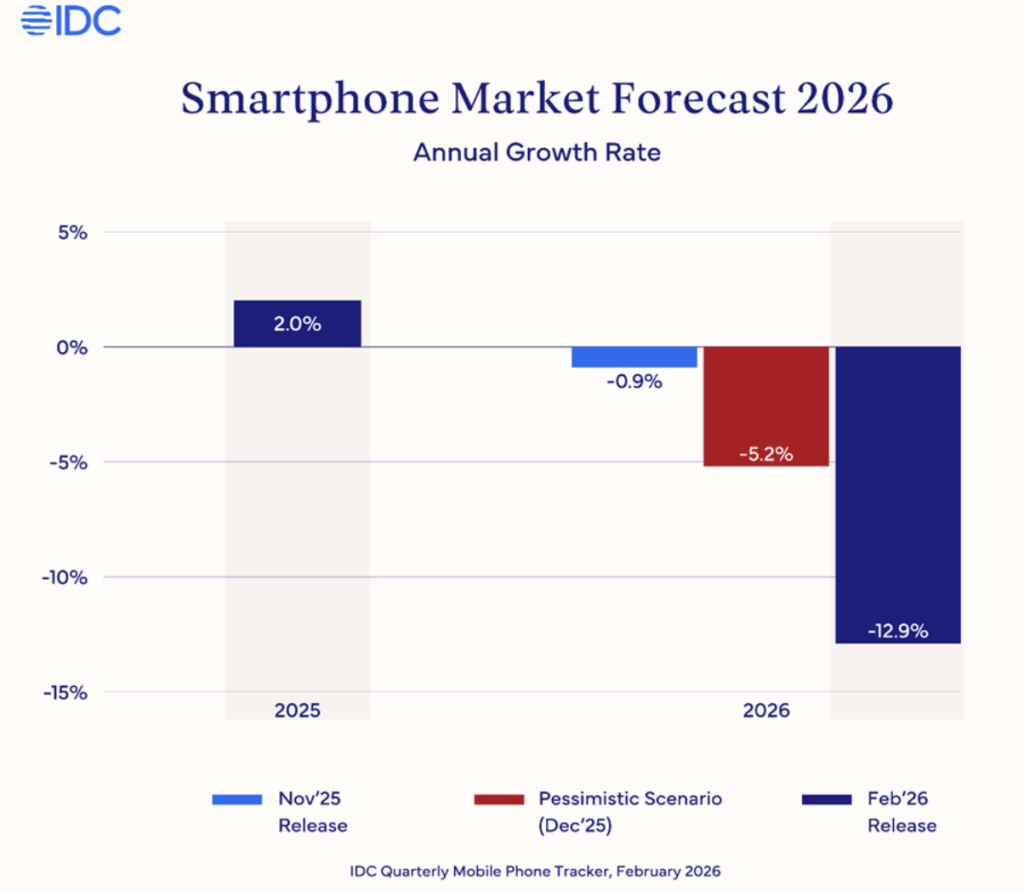
Core Insights - IDC has significantly revised down its forecast for global smartphone shipments in 2026 to approximately 1.1 billion units, a decrease from 1.26 billion units in the previous year, indicating a rare year-on-year decline of nearly 13% in the smartphone market [1] Group 1: Smartphone Market Outlook - The smartphone market is expected to decline by 12.9% in 2026, with a slight revenue decrease of 0.5%. A modest growth of 1.9% is anticipated in 2027, followed by a strong rebound of 5.2% in 2028 [4] - The ongoing memory supply challenges are projected to persist until at least 2026, potentially extending into 2027, with memory prices expected to remain elevated and not return to 2025 levels [4][5] Group 2: Memory Supply Crisis - The structural factors causing the memory shortage include surging demand for AI infrastructure and competition for DRAM and NAND flash capacity from consumer electronics [5] - IDC's Senior Research Director, Nabila Popal, emphasized that the current memory crisis is more significant than previous challenges such as tariffs and pandemic impacts, predicting a dramatic transformation in the smartphone market's scale, average selling price, and competitive landscape by mid-2027 [5] Group 3: Broader Market Implications - The crisis is expected to reshape not only the smartphone market but also the personal computer market, as well as the competitive dynamics of tablets, XR headsets, wearables, and gaming consoles [6]
Here's how Apple's stock can surge in the face of rising memory costs
MarketWatch· 2026-02-10 17:08
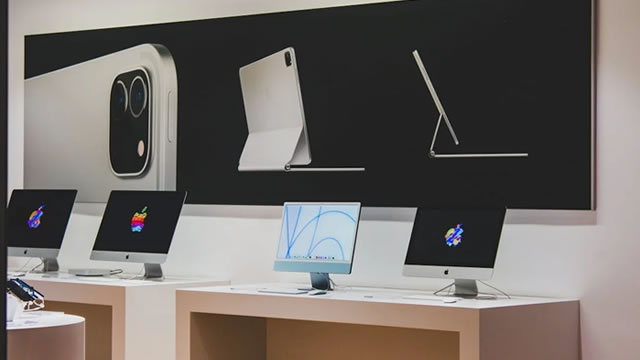
Core Viewpoint - The global memory shortage should not overshadow the anticipated launch of Apple Intelligence, as highlighted by Bernstein [1] Group 1 - The memory shortage is a significant issue affecting various sectors, but it is essential to focus on Apple's upcoming product launch [1] - Bernstein emphasizes that the launch of Apple Intelligence could present substantial investment opportunities despite the prevailing memory market challenges [1]

GPUs are cooked
Matthew Berman· 2026-02-08 19:41
These things might be worth more than diamonds soon. For the last few months, they have been skyrocketing in price. GPUs might be doubling and even tripling in cost.That means their latest generation RTX 5090 might be $5,000 soon. Let me put this down. Because all of us are feeling this memory shortage, so is Nvidia.Look at how the prices for memory has increased over the last few months. And Nvidia is considering a wild solution to this problem. the RTX 3000 series, the 4000 series, and most recently the 5 ...


Is There a Light at the End of the Tunnel for Qualcomm Stock? What Options Data, Technicals Tell Us.
Yahoo Finance· 2026-02-05 20:22
Qualcomm (QCOM) stock is slipping on Feb. 5, after the semiconductor giant issued disappointing Q2 guidance, citing a global memory shortage it believes will remain an overhang on smartphone production in 2026. At the time of writing, QCOM shares sit decisively below their key moving averages (MAs), signaling the downward pressure is unlikely to subside anytime soon. More News from Barchart Still, the relative strength index (RSI) and options data warrants buying Qualcomm stock, now down 25% versus its ...

Qualcomm, Arm bear brunt of memory shortage as smartphone chip sales disappoint
Reuters· 2026-02-05 03:02
Core Viewpoint - Memory shortages are expected to constrain cell phone sales for an extended period, negatively impacting demand for companies in the chip industry, including Qualcomm and Arm Holdings, as indicated by disappointing results reported by both companies [1] Group 1: Industry Impact - The ongoing memory shortages are anticipated to limit the sales of cell phones, which will subsequently affect the overall demand for the chip industry [1] - Executives and analysts have highlighted that these shortages will have a prolonged effect on the market dynamics within the chip sector [1] Group 2: Company Performance - Qualcomm and Arm Holdings reported results that fell short of investor expectations, reflecting the challenges posed by the current market conditions [1] - The disappointing financial results from these companies underscore the adverse effects of supply chain constraints on their performance [1]