
PPI改善叠加广谱反内卷

Search documents
有机硅、磷化工爆发 清水源2连板 闻泰科技尾盘逼近涨停
2 1 Shi Ji Jing Ji Bao Dao· 2025-11-07 08:01
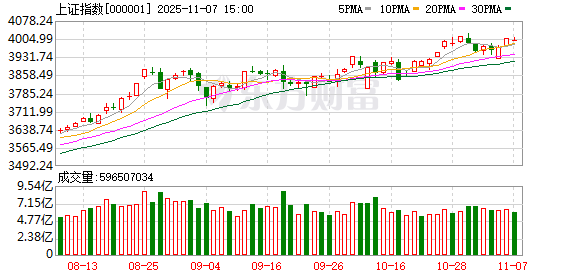
Market Overview - On November 7, A-shares experienced a pullback after an initial rise, with the Shanghai Composite Index down 0.25%, Shenzhen Component down 0.36%, and ChiNext down 0.51% [2] - The total market turnover exceeded 2 trillion, with over 3,100 stocks declining [2] Sector Performance - Lithium battery electrolyte and phosphorus chemical sectors continued to surge, with stocks like Furui and Qingshuiyuan hitting the daily limit [2] - The Fujian sector showed strong activity, with Zhangzhou Development achieving a rapid limit-up, marking three limit-ups in four days [2] - The organic silicon sector also performed well, with Dongyue Silicon Material and Hesheng Silicon Industry hitting the daily limit [2] - Conversely, the robotics sector faced declines, with stocks like Lixing and Zhejiang Rongtai experiencing significant drops [5] Future Market Outlook - Multiple institutions predict that the A-share market will continue a slow bull trend into 2026, driven by three core factors: the deepening asset replacement logic, capital market reforms, and enhanced economic transformation [7] - The asset replacement logic indicates a shift from real estate to equity markets as the primary investment venue for residents [7] - Capital market reforms, initiated by the new "National Nine Articles," are expected to improve the market's investability and resilience against risks [7] - Economic transformation is anticipated to inject growth momentum, with new technologies and industries emerging to drive capital expenditure [7] Profit Recovery Expectations - Analysts from Huatai Securities expect the profit cycle to enter a recovery phase in the first half of next year, with a focus on companies expanding overseas [8] - Open Source Securities predicts a "factory-shaped" recovery in profit, with the bottom likely occurring between late 2025 and early 2026 [8] - The A-share market is projected to transition from an "asset revaluation" phase to a "profit recovery" phase, characterized by a slow bull trend rather than a sharp rise [8] Investment Strategies - Analysts suggest focusing on four main investment lines: technology growth with self-control (computing power, semiconductors, AI applications), PPI improvement alongside broad anti-involution (non-ferrous metals, chemicals, building materials), global competitiveness enhancement (automobiles, electronics, machinery), and domestic demand transformation with consumption recovery (low-altitude economy, retail, food) [9] - Emphasis is also placed on new energy strategies, particularly in new energy storage, hydrogen energy, and nuclear fusion [9]


有机硅、磷化工爆发,清水源2连板,闻泰科技尾盘逼近涨停
2 1 Shi Ji Jing Ji Bao Dao· 2025-11-07 07:46
Core Viewpoint - The A-share market is expected to experience a "slow bull" trend in 2026, driven by asset replacement logic, capital market reforms, and enhanced economic transformation dynamics [4]. Market Performance - On November 7, A-share indices experienced a pullback, with the Shanghai Composite Index down 0.25%, the Shenzhen Component down 0.36%, and the ChiNext Index down 0.51%. The total market turnover exceeded 2 trillion, with over 3,100 stocks declining [1]. - Notable sectors included lithium battery electrolyte and phosphorus chemicals, with stocks like Fujian Development and Dongyue Silicon Material hitting the daily limit [1][2]. Sector Analysis - The robotics sector faced declines, with companies like Lixing Co. and Zhejiang Rongtai experiencing significant drops [3]. - The technology sector is highlighted as a key investment area, focusing on self-controlled growth in areas such as computing power, semiconductors, and AI applications [6][7]. Economic Outlook - The capital market is expected to benefit from ongoing reforms, which enhance its investment appeal and resilience against risks [4]. - Analysts predict that the earnings recovery cycle may begin in the first half of 2026, transitioning from an "asset revaluation" phase to a "profit recovery" phase [5]. Investment Strategies - Institutions suggest focusing on four main investment lines: technology growth, PPI improvement, global competitiveness, and domestic consumption recovery [6]. - Emphasis is placed on new energy strategies, particularly in emerging fields like new energy storage, hydrogen energy, and nuclear fusion [7].