盈利修复

Search documents
昇兴股份:出海高增、盈利修复,利润中枢改善可期-20260319
Xinda Securities· 2026-03-19 10:25
Investment Rating - The investment rating for the company is not explicitly stated in the provided documents, but the report suggests a positive outlook for future performance based on expected revenue growth and profit recovery [1]. Core Views - The company reported a total revenue of 7.174 billion yuan in 2025, reflecting a year-on-year growth of 0.6%, while the net profit attributable to shareholders decreased by 27.4% to 307 million yuan [1][2]. - The report anticipates steady recovery in profitability driven by product structure optimization, with expectations for revenue growth in Q1 2026 due to seasonal demand shifts and price increases [2]. - The company is focusing on expanding its overseas operations, with domestic and overseas revenues for H2 2025 reported at 3.336 billion yuan and 613 million yuan, respectively, indicating a year-on-year decline of 1.3% and an increase of 16.1% [2]. Financial Performance Summary - The gross margin for Q4 2025 was reported at 13.43%, showing a year-on-year decrease of 1.43 percentage points but a quarter-on-quarter increase of 3.96 percentage points [3]. - The net profit margin for Q4 2025 was 4.31%, reflecting a year-on-year increase of 0.58 percentage points and a quarter-on-quarter increase of 0.56 percentage points [3]. - The company’s operating cash flow for Q4 2025 was 15 million yuan, an increase of 53 million yuan year-on-year, indicating stable cash flow and operational efficiency [3]. Profit Forecast - The forecast for net profit attributable to shareholders for 2026, 2027, and 2028 is projected to be 445 million yuan, 551 million yuan, and 642 million yuan, respectively, with corresponding P/E ratios of 14.1X, 11.4X, and 9.8X [3].

昇兴股份(002752):出海高增、盈利修复,利润中枢改善可期
Xinda Securities· 2026-03-19 09:34
Investment Rating - The investment rating for the company is not explicitly stated in the provided documents, but the report indicates a positive outlook for future performance, suggesting a potential "Buy" or "Hold" rating based on expected revenue growth and profit recovery. Core Insights - The company reported a total revenue of 7.174 billion yuan in 2025, reflecting a year-on-year increase of 0.6%, while the net profit attributable to shareholders decreased by 27.4% to 307 million yuan [1][2] - The fourth quarter of 2025 saw a revenue of 2.104 billion yuan, down 1.5% year-on-year, but net profit increased by 13.8% to 91 million yuan, indicating a recovery trend [1][2] - The company is expected to benefit from an optimized product structure and increased market share, particularly in overseas markets, with a projected revenue growth in Q1 2026 due to seasonal demand shifts [2][3] Financial Performance Summary - For the second half of 2025, domestic and overseas revenues were 3.336 billion yuan and 613 million yuan, respectively, showing a year-on-year decline of 1.3% and an increase of 16.1% [2] - The gross margin for Q4 2025 was 13.43%, a decrease of 1.43 percentage points year-on-year, while the net margin improved by 0.58 percentage points to 4.31% [3] - The company forecasts net profits of 445 million yuan, 551 million yuan, and 642 million yuan for 2026, 2027, and 2028, respectively, with corresponding P/E ratios of 14.1X, 11.4X, and 9.8X [3][5]
分红率提升,期待26年盈利修复——华利集团点评报告
ZHESHANG SECURITIES· 2026-03-12 10:25
Investment Rating - The investment rating for the company is "Buy" [5] Core Insights - The company anticipates a profit recovery in 2026, with a projected increase in profit margins as new factories ramp up efficiency and customer demand stabilizes [4] - The company reported a revenue of 24.98 billion yuan for 2025, a year-on-year increase of 4.1%, but a decline in net profit by 16.5% to 3.21 billion yuan, indicating pressure on profit margins [1][4] - The company is expanding its production capacity with new factories in Vietnam, Indonesia, and China, which is expected to support long-term growth [3] Summary by Sections Financial Performance - For 2025, the company expects revenue of 24.98 billion yuan and a net profit of 3.21 billion yuan, with a net profit margin of 12.8%, down 3.2 percentage points year-on-year [1] - In Q4 2025, revenue was 6.3 billion yuan, a 3.0% year-on-year decrease, with net profit declining by 22.7% to 770 million yuan [1] Customer Orders and Market Dynamics - The company sold 227 million pairs of sports shoes in 2025, a 1.6% increase year-on-year, with an average selling price of approximately 110 yuan per pair [2] - There is a divergence in customer orders, with some established clients experiencing order declines due to demand pressures, while new clients are showing significant growth [2] Production Capacity and Efficiency - The company has launched several new factories, with output from new facilities in Vietnam, Indonesia, and China reaching 373, 199, and 67 thousand pairs respectively in the first half of 2025 [3] - The operating profit margin for Q4 2025 improved to 17.0%, reflecting a recovery trend as new factories begin to achieve profitability [3] Dividend and Future Projections - The company plans to distribute a total cash dividend of 2.45 billion yuan for the mid-year and annual reports in 2025, with a dividend payout ratio of 76%, up from 70% in 2024 [4] - Revenue projections for 2025-2027 are 24.98 billion yuan, 26.66 billion yuan, and 29.42 billion yuan, with corresponding net profits of 3.21 billion yuan, 3.57 billion yuan, and 4.11 billion yuan [4]
华利集团(300979):4Q25营收利润不及预期,2026年盈利修复可期
Haitong Securities International· 2026-03-11 23:30
Investment Rating - The report maintains an "Outperform" rating for Huali Industrial Group, with a target price of RMB 56.50, indicating a potential upside of 17.6% from the current price of RMB 48.05 [2][3]. Core Insights - Huali Group experienced intensified short-term revenue pressure in 4Q25, with revenue of RMB 6.3 billion, down 3.0% year-on-year, and net profit attributable to shareholders declining 22.6% year-on-year to RMB 770 million. However, there are early signs of operational recovery as margins improved sequentially, with the operating margin at 17.0%, reflecting a recovery in operational efficiency [3][8]. - The company reported a total revenue of RMB 24.98 billion for 2025, a 4.1% increase year-on-year, but below the forecast of 4.9%. The net profit attributable to shareholders for 2025 was RMB 3.21 billion, down 16.5% year-on-year [3][8]. - The management has increased the payout ratio to 76% for 2025, up from 70% in 2024, demonstrating a commitment to shareholder returns [3][8]. Financial Summary - Revenue projections for Huali Group are expected to grow from RMB 25.17 billion in 2025 to RMB 27.11 billion in 2026, reflecting a year-on-year growth of 8% [2][3]. - The net profit is projected to recover to RMB 3.88 billion in 2026, representing a 15% increase from 2025 [2][3]. - The diluted EPS is expected to increase from RMB 2.90 in 2025 to RMB 3.33 in 2026, indicating a positive trend in earnings per share [2][3]. Market Outlook - Looking ahead to 2026, the visibility of net margin improvement has increased, with expectations that earnings elasticity will be gradually released as customer destocking ends and the ramp-up of new factories is completed [4][9]. - Key customers such as Adidas, On, and New Balance are expected to drive growth, while smaller clients like Asics and Anta may provide new incremental sources of revenue [4][9]. - The company anticipates a significant reduction in disruptions from new capacity additions, leading to further improvements in capacity utilization and cost efficiency [4][9].
扫地机当前竞争态势和盈利形势如何?
Changjiang Securities· 2026-03-11 14:52
Investment Rating - The report rates the industry as "Positive" with a first-time recommendation for investment in key companies [12]. Core Insights - The domestic sales of robotic vacuum cleaners are expected to face pressure due to the gradual reduction of national subsidies and high base effects, leading to a forecasted decline in growth rates [4][10]. - The external sales may exhibit a trend of exchanging price for volume, particularly in the U.S. and Germany, where sales volume has increased despite a decrease in average prices [9][10]. - Key players like Roborock and Ecovacs are expected to benefit from differentiated product strategies and competitive pricing, which may enhance their market shares [4][10]. Summary by Sections Domestic Sales: Potential Pressure Test, Focus on Profit Recovery - By Q4 2025, the domestic sales of robotic vacuum cleaners are projected to decline, with online and offline sales showing year-on-year changes of -29% and +12% respectively, leading to an overall decline of -27% [7][22]. - The market share of leading companies, Roborock and Ecovacs, has improved, with their sales shares reaching 35% and 29% respectively in Q4 2025 [24][22]. - The average price of robotic vacuum cleaners is expected to remain stable, with a projected compound growth rate of 20% for the first three quarters of 2026 [8][10]. External Sales: Q4 Price for Volume, Competition Deepens - In Q4 2025, external sales are anticipated to adopt a price-for-volume strategy, with significant increases in sales volume in the U.S. and Germany despite price reductions [9][10]. - The market share of Chinese companies in the global robotic vacuum cleaner market is substantial, with the top five companies holding a combined market share of 65.7% [9][10]. - Roborock's sales share in key markets like the U.S. and Germany has shown positive growth, indicating effective market strategies [9][10]. Investment Recommendations: Focus on Profit Recovery Rhythm and New Product Categories - The report emphasizes the importance of monitoring the profit recovery rhythm of leading companies and the potential for new product categories such as lawn mowers and pool robots [4][10]. - The overall pricing strategy and product differentiation are crucial for maintaining competitive advantages in the market [28][10]. - Companies like Roborock and Ecovacs are highlighted as key investment opportunities due to their strong market positions and innovative product offerings [12][10].


中国银河证券:原料价格上行驱动上游纺织景气回升 建议关注新澳股份等
智通财经网· 2026-03-09 06:09
Group 1 - The report from China Galaxy Securities indicates that the rising cycle of upstream raw material prices presents clear profit recovery opportunities for leading textile yarn companies due to a contraction in wool supply and a recovery in demand, alongside fluctuating cotton prices and a supportive inventory-consumption ratio [2] - The wool market is entering a new price increase cycle starting from July 2025, with prices rising from 1208 AUD cents/kg to 1716 AUD cents/kg by February 2026, marking a 45% year-on-year increase [3] - The Australian wool production is expected to decline by 12.6% to 245,000 tons in the 2025/26 season, influenced by a significant reduction in the number of sheared sheep and a decrease in the average wool yield per sheep [4] Group 2 - The global cotton production and consumption have remained stable, with the 2025/26 market year production projected at 26 million tons, reflecting a minimal growth of 0.81%, while consumption is expected to remain steady at 25.89 million tons [5] - The inventory-consumption ratio for cotton is projected to be 62% for the 2024/25 season, which is at a lower level compared to the past decade, supporting domestic cotton prices amid expectations of reduced production in Xinjiang [5] - The cost of chemical fiber raw materials is rising due to Brent crude oil prices increasing from 61 USD/barrel to around 84 USD/barrel, establishing a cost center shift and profit recovery logic within the chemical fiber industry [6] Group 3 - The rising wool prices typically lead to increased profit margins for fine wool spinning companies, as they adopt a cost-plus pricing model, allowing for higher product prices during periods of rising wool prices [7] - Cotton is a core cost item for yarn companies, accounting for approximately 70% of raw material costs, and the profit margins of leading yarn companies are positively correlated with cotton prices [7] - The nylon business of leading chemical fiber company Taihua New Materials is expected to see profit margins increase as the price difference between nylon and caprolactam widens, indicating a potential for profit recovery in the chemical fiber industry [7]



中国银河证券:原料价格上行驱动上游纺织景气回升 建议关注新澳股份(603889.SH)等
智通财经网· 2026-03-09 06:04
Group 1 - The report from China Galaxy Securities indicates that the rising cycle of upstream raw material prices presents clear profit recovery opportunities for leading textile yarn companies, driven by a contraction in wool supply and a recovery in demand, alongside rising cotton prices and stable inventory-consumption ratios [1] - The wool market is entering a new price increase cycle, with prices rising from 1208 AUD cents/kg to 1716 AUD cents/kg, a 45% year-on-year increase, due to a predicted 12.6% decrease in Australian wool production for the 2025/26 season [2] - Global cotton production and consumption remain stable, with the 2025/26 market year production expected to reach 26 million tons, a slight increase of 0.81%, while the inventory-consumption ratio is projected to remain at 62%, supporting domestic cotton prices [3] Group 2 - The chemical fiber industry is experiencing a cost-driven price increase, with Brent crude oil prices rising from 61 USD/barrel to around 84 USD/barrel, leading to a recovery in processing margins for polyester and nylon products [4] - Companies like Xin'ao Co. and Bailong Oriental are expected to benefit from the rising wool prices, as their pricing models are based on cost-plus strategies, which enhance profit margins during periods of rising raw material costs [5] - The nylon segment, particularly for leading companies like Taihua New Materials, is anticipated to see profit margins increase as the price gap between nylon and caprolactam widens, indicating potential for further price recovery [6]
储能需求狂飙,锂电材料藏着哪些新机遇?
格隆汇APP· 2026-03-08 07:55
Core Viewpoint - The article emphasizes the explosive growth of the energy storage sector as a key driver for the lithium battery market, predicting significant demand increases and a favorable supply-demand balance across the lithium materials industry by 2026 [5][6]. Group 1: Energy Storage Growth - The global demand for energy storage batteries is expected to reach 874 GWh by 2026, representing a substantial year-on-year increase of 46%, driven primarily by rigid demand from grid-side storage and a 73% surge in AIDC storage due to AI computing needs [8]. - The combined shipment of power and energy storage batteries is projected to hit 2313 GWh in 2026, marking a 25% increase from the previous year, with lithium iron phosphate (LFP) batteries expected to capture 82% of the market share [9]. Group 2: Lithium Battery Market Dynamics - The lithium battery market is witnessing a shift towards high-cost performance preferences, with LFP batteries solidifying their mainstream status due to their suitability for energy storage applications [10]. - The supply-demand dynamics for lithium materials are improving, with significant recovery trends expected across various segments, particularly for lithium hexafluorophosphate and separators, which are experiencing tight supply and rising prices [11]. Group 3: Lithium Carbonate and Solid-State Battery Developments - The lithium carbonate market is currently in a supply-demand adjustment phase, but a turning point is anticipated between 2026 and 2028, with demand projected to reach 188,000 tons LCE by 2026, growing at a compound annual growth rate of 18% [19][20]. - Solid-state batteries are entering a critical industrialization phase, with key companies expected to complete pilot production lines by 2025, paving the way for long-term growth opportunities in the sector [21]. Group 4: Investment Opportunities - Investment strategies should focus on sectors with clear supply-demand turning points, such as lithium hexafluorophosphate and lithium battery separators, prioritizing leading companies with high market concentration [22][23]. - The lithium iron phosphate supply chain, including phosphate rock and lithium iron phosphate production, presents opportunities for companies with integrated resource advantages amid rising phosphate prices [23].

纸品提价落地,板块盈利修复可期
Datong Securities· 2026-03-03 09:05
Investment Rating - The industry investment rating is "Positive" [1] Core Viewpoints - The report indicates that paper prices are on the rise, with boxboard and corrugated paper prices increasing by 50 RMB/ton, while white card and whiteboard paper prices remain stable. The implementation of price increases by leading paper manufacturers, combined with the gradual recovery of demand as companies resume operations post-holiday, strengthens the logic for industry profit recovery [4][11] - The report highlights a decrease in pulp inventory to 153,000 tons, with a week-on-week reduction of 1,601 tons, and an increase in futures closing prices by 28 RMB/ton. The average prices for domestic bleached softwood pulp and bleached hardwood pulp have risen by 65 RMB/ton and 95 RMB/ton, respectively, indicating a marginal improvement in the supply-demand balance for pulp [12][17] - The report emphasizes the synergy between policy and industry, noting that the decline in the producer price index is narrowing, and the industry is experiencing a marginal recovery in prosperity. The orderly resumption of production by paper companies and the implementation of previous green transformation and technological innovation results are contributing to a clear trend towards "steady recovery and high-quality development" in the industry [4][11] Summary by Sections Industry News - In January 2026, the producer price index for the paper and paper products industry decreased by 2.4% year-on-year, while the overall industrial producer price index decreased by 1.4% year-on-year [5] Price Trends - The report notes that the average price of boxboard is 4,600 RMB/ton, and corrugated paper is 3,390 RMB/ton, both showing a week-on-week increase of 50 RMB/ton. The average price of white card paper remains stable at 4,560 RMB/ton, while whiteboard paper is stable at 3,553 RMB/ton [21] Company Developments - Nine Dragons Paper announced a profit of 2 billion RMB for the first half of the fiscal year, with a sales volume increase of 8.3% to approximately 12.4 million tons and a revenue increase of 11.2% to approximately 37.221 billion RMB. The company also plans to increase packaging paper prices by 50 RMB/ton starting March 4 [32][34]


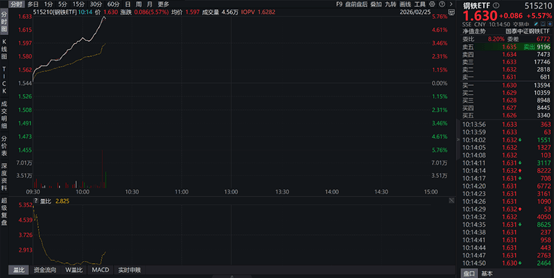
供给端边际改善叠加“反内卷”政策预期升温,钢铁ETF(515210)盘中涨超5.7%
Sou Hu Cai Jing· 2026-02-25 04:17
Core Viewpoint - The steel sector is experiencing a rebound driven by marginal improvements on the supply side and rising expectations for "anti-involution" policies, leading to a significant increase in the steel ETF (515210) by over 5.7% during trading [1] Supply Side - The capacity utilization rate of 247 steel mills increased to 86.4%, up by 0.7 percentage points, with daily molten iron output rising to 2.306 million tons, an increase of 19,000 tons [4] - The "anti-involution" policy expectations are strengthening the logic for production cuts, which could accelerate the rebalancing of supply and demand in the steel industry [4] - Historical trends indicate that improvements in steel industry profitability typically arise from either strong demand driving price increases or supply reductions improving industry dynamics [4] Inventory and Demand - Social inventory of the five major steel products reached 10.267 million tons, a 9.2% increase, while steel mill inventory rose by 4.7% to 4.161 million tons [5] - Apparent consumption of the five major steel products decreased by 9.4% to 6.891 million tons, with rebar consumption dropping by 31.0% [5] - The current inventory increase is attributed to seasonal factors, and if demand rebounds post-holiday, a downward trend in inventory could be anticipated [6] Raw Materials and Profit Margins - The Platts 62% iron ore price index fell to $96.5 per ton, a decrease of 3.7% week-on-week, indicating a weakening trend in raw material prices [7] - The immediate gross profit for long-process rebar was -175 yuan per ton, and for hot-rolled coil, it was -357 yuan per ton, showing marginal improvement despite remaining in a loss position [7] - Historical data suggests that steel stock prices often lead gross profit by 1-2 quarters, indicating that the market is already pricing in expected profit improvements [7] Valuation and Allocation - The steel sector has undergone significant valuation recovery, moving from extreme undervaluation to a moderately low range, still offering absolute return potential [8] - The steel sector's pricing logic is shifting from "pessimistic clearance" to "profit recovery," driven by supply-side policies and macroeconomic stabilization [8] - The steel ETF (515210) serves as a representative product for the industry, reflecting changes in the profitability cycle and offering advantages in diversifying individual stock risks while capturing overall industry trends [8]