RNA干扰(RNAi)

Search documents
圣因生物宣布与基因泰克达成RNAi药物研发战略合作
Cai Jing Wang· 2026-02-03 09:18
Group 1 - The core point of the article is that Saintgen Biotech has entered into a global research and licensing agreement with Genentech to develop an RNA interference (RNAi) therapy [1] - Under the agreement, Saintgen Biotech will grant Genentech exclusive global rights for the development and commercialization of the RNAi drug, while Saintgen will handle early-stage research [1] - Genentech will be responsible for all subsequent clinical development and commercialization activities of the drug [1] Group 2 - Saintgen Biotech's proprietary RNAi drug development platform includes novel drug chemical modifications and delivery technologies, which can be utilized to develop potential breakthrough siRNA drugs across multiple disease areas [1] - According to the agreement terms, Saintgen Biotech will receive an upfront payment of $200 million, with the potential to earn up to $1.5 billion in development and sales milestone payments, along with tiered royalties [1]
新年江苏“第一股”!瑞博生物在港交所上市
Zheng Quan Shi Bao Wang· 2026-01-09 06:11
Group 1 - Suzhou Rebio Technology Co., Ltd. successfully listed on the Hong Kong Stock Exchange on January 9, becoming the first listed company in Jiangsu province this year [1] - The company issued 31.61 million shares at a price of HKD 57.97 per share, raising over HKD 1.8 billion in total [1] - Rebio, founded in 2007 and headquartered in Suzhou, focuses on the research and development of small nucleic acid drugs, utilizing RNA interference (RNAi) technology to develop innovative therapies for major diseases [1] Group 2 - Rebio's research pipeline covers various diseases, particularly chronic diseases, with seven self-developed drugs currently in clinical trials, four of which are in Phase II [1] - The core product, RBD4059, is the world's first clinical-stage small nucleic acid drug for treating thrombotic diseases, offering significant advantages over traditional treatments, such as extended efficacy and lower bleeding risks [1] - With Rebio's listing, the number of companies listed from Suzhou on the Hong Kong Stock Exchange has increased to 42, further expanding the biopharmaceutical sector in the region [2]
120亿,南开伉俪IPO敲钟了
投资界· 2026-01-09 02:18
Core Viewpoint - The article highlights the successful journey of Rebio Biotech, which became the first small nucleic acid drug company to go public in Hong Kong, marking a significant milestone in China's biopharmaceutical industry. The company has received long-term support from investors, particularly from Panhlin Capital, which has invested in multiple rounds over the past decade, demonstrating the value of patient capital in the innovation-driven healthcare sector [2][9]. Group 1: Company Background - Rebio Biotech was founded in 2007 by scientists Liang Zicai and Zhang Hongyan, who returned to China after studying abroad, aiming to explore small nucleic acid innovation [3][4]. - The company has developed a comprehensive technology system covering the entire process from target discovery to clinical development, with seven self-developed drug assets currently in clinical trials [5][9]. Group 2: Investment Journey - Panhlin Capital has been a long-term investor in Rebio Biotech, participating in six funding rounds since 2015, which has allowed the company to navigate various critical phases of technological validation and market fluctuations [6][9]. - The first investment by Panhlin Capital was made during a challenging market period, reflecting their belief in the potential of Rebio Biotech and the importance of supporting innovative companies during tough times [8][11]. Group 3: Market Recognition and Future Outlook - In 2023, Rebio Biotech entered into a significant partnership with Boehringer Ingelheim, valued at over $2 billion, marking a milestone for Chinese small nucleic acid technology on the global stage [5][10]. - The article emphasizes the ongoing growth potential in China's biopharmaceutical sector, driven by aging populations and unmet clinical needs, suggesting that the golden age of Chinese biomedicine is just beginning [10][11].


擎科生物推出"siRNA裸序列定制合成服务",创新实现最快3天交付
Huan Qiu Wang Zi Xun· 2026-01-04 06:25
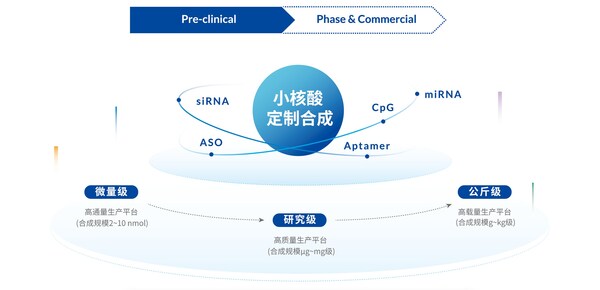
Core Insights - Beijing Qingtian Biotechnology Co., Ltd. has launched a "siRNA naked sequence custom synthesis service" aimed at accelerating early research and drug discovery processes by significantly reducing delivery time to 3-4 calendar days [1][8] Group 1: Service Features - The service addresses early-stage research challenges by enabling rapid target validation, high-throughput in vitro screening, candidate sequence evaluation, and preparation for in-depth mechanistic studies [2][3][4] - Delivery time for standard specifications (5 nmol/2 OD) is reduced by approximately 30%-50% compared to industry norms, with the fastest delivery reaching 3 calendar days [5] - Each sequence undergoes strict quality control via mass spectrometry (MS), ensuring consistent knockdown efficiency comparable to conventionally synthesized products [5] - The service offers flexible specifications ranging from micro (5 nmol) to large quantities (1000 nmol), catering to various experimental stages [5] Group 2: Platform Capabilities - The launch of the rapid synthesis service showcases Qingtian's capabilities within its oligonucleotide CRDMO platform, which has over 20 years of technical experience [6] - The platform provides a comprehensive range of services from research-grade synthesis to GMP-compliant active pharmaceutical ingredient production [6] - The ability to compress delivery time to "as fast as 3 calendar days" highlights the company's strong integration capabilities in process optimization and production scheduling, providing a competitive edge in the small nucleic acid drug CRDMO sector [6] Group 3: Market Implications - The rapid development of RNAi therapies and small nucleic acid drugs has increased market demands for speed, quality, and cost in early research tools [8] - The introduction of the "fastest 3 calendar days delivery" service directly addresses the urgent needs of domestic research institutions and new drug development companies, potentially prompting a reevaluation of overall response standards in the R&D supply chain [8]
Cancer Cell:新型siRNA,选择性靶向抑制肿瘤KRAS G12V突变
生物世界· 2025-06-23 04:00
Core Viewpoint - The article discusses the significance of KRAS gene mutations in cancer, particularly focusing on the development of a first-in-class siRNA drug targeting the KRAS G12V mutation, which currently lacks approved inhibitors [2][4][6]. Group 1: KRAS Gene Mutations - KRAS gene mutations are present in nearly 25% of human cancers, with high prevalence in lung cancer (35%), colorectal cancer (49%), and pancreatic adenocarcinoma (92%) [2]. - The most common KRAS mutations include KRAS G12D (29%), KRAS G12V (23%), and KRAS G12C (15%) [2]. - Historically, KRAS has been considered a challenging drug target, but recent approvals of small molecule inhibitors for KRAS G12C indicate a need for more specific inhibitors targeting other KRAS mutations [2]. Group 2: Development of EFTX-G12V - A new EGFR-directed siRNA drug, EFTX-G12V, has been developed to selectively target the KRAS G12V mutation, which is the second most common KRAS mutation in cancer [4][6]. - The research team utilized an EGFR-binding peptide to enhance the specificity of the siRNA for cancer cells, demonstrating superior anti-tumor activity compared to pan-KRAS siRNA [10]. - EFTX-G12V effectively silenced KRAS G12V in various cancer models, showing significant tumor growth inhibition in lung, colon, and pancreatic cancer models [10]. Group 3: Implications and Future Prospects - The technology behind EFTX-G12V is highly modular, allowing for the potential targeting of nearly any oncogene by simply replacing the siRNA sequence [9]. - This dual-action approach may help overcome drug resistance and enhance the durability of treatment effects [9]. - Overall, this research represents a significant advancement in RNAi-based siRNA drugs for targeting oncogenic mutations, providing new biological insights for KRAS-targeted therapies with broader clinical implications [12].