Scale-up

Search documents
中信建投:800G光模块需求预计将继续高速增长
Xin Lang Cai Jing· 2025-12-22 23:48
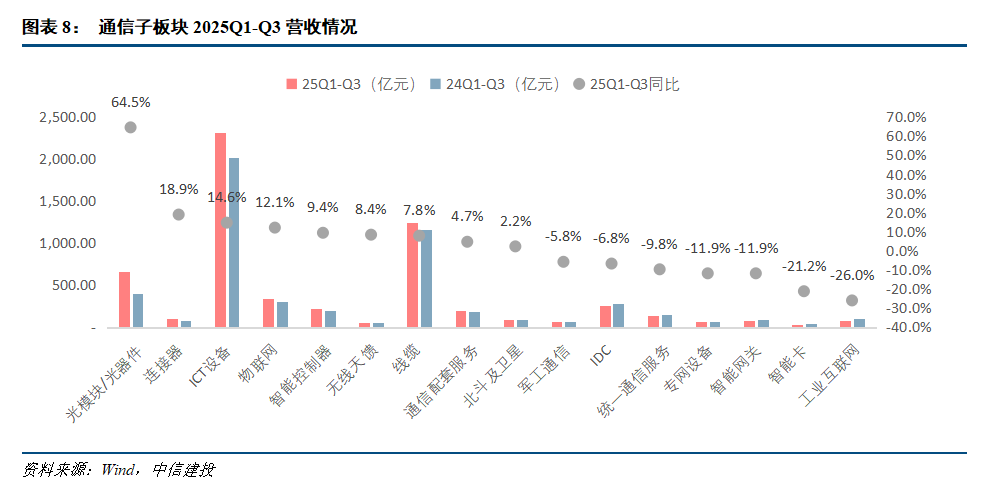
Group 1 - The rapid upgrade of GPU and ASIC technologies is driving a significant increase in computing power and data transmission demands, leading to a preference for higher bandwidth network hardware in AI data centers [1][12][35] - The demand for 800G optical modules is expected to continue its high growth trajectory, with projections for substantial increases in 1.6T shipments and the initiation of 3.2T optical module development by 2026 [1][12][35] Group 2 - In the communication sector, the top three revenue growth rates for Q1-Q3 2025 are led by optical devices/modules (66.2 billion, up 65%), connectors (10 billion, up 19%), and ICT equipment (231.3 billion, up 15%), primarily driven by AI [2][28] - The bottom three revenue growth rates for the same period are industrial internet (7.8 billion, down 26%), smart cards (3.1 billion, down 21%), and smart gateways (8.3 billion, down 12%) [2][28] Group 3 - The highest net profit growth rates for Q1-Q3 2025 are seen in optical devices/modules (16.94 billion, up 123%), connectors (0.82 billion, up 62%), and IDC (6.5 billion, up 52%) [3][29] - The lowest net profit growth rates are in military communication (-0.16 billion, down 194%), smart cards (-0.002 billion, down 102%), and smart gateways (0.04 billion, down 86%) [3][29] Group 4 - The performance of optical devices/modules and connectors is notably strong due to robust AI demand, while military communication, smart cards, and smart gateways are experiencing significant declines due to cyclical fluctuations in downstream demand [6][32] Group 5 - The demand for optical modules is primarily driven by scale-out networks, which enhance processing capabilities by increasing the number of computing nodes, while scale-up networks are expected to have a vast future demand for optical modules [19][45] - The average scale-up bandwidth for XPU products is significantly higher than that of scale-out, with a ratio of 12.5, indicating a larger market potential for scale-up network hardware [21][45] Group 6 - The transition to optical interconnects is likely to become mainstream in the scale-up domain, addressing challenges related to distance and bandwidth, with major companies like Google, Meta, and Huawei already utilizing optical modules for scale-up networks [25][45] - The potential market space for optical modules in the scale-up sector could be 5-8 times larger than current levels, particularly as new architectures are adopted [25][45]



中信建投:高速光模块需求持续高增 Scale-up有望打开市场新空间
Zhi Tong Cai Jing· 2025-12-22 23:45
Core Viewpoint - The rapid upgrade of GPU and ASIC technologies is driving significant demand for higher bandwidth network hardware in AI data centers, with a notable increase in the demand for 800G optical modules and the initiation of 3.2T optical module research and development [1][10]. Group 1: Market Performance - The optical device/module sector is projected to achieve a revenue of 662 billion yuan in the first three quarters of 2025, reflecting a year-on-year growth of 65% driven by AI [2]. - The net profit growth for the optical device/module sector is expected to reach 169.4 billion yuan, with a remarkable year-on-year increase of 123% [5]. - In Q3 2025, the optical device/module sector's revenue is anticipated to be 255 billion yuan, showing a year-on-year growth of 62% [7]. Group 2: Technological Advancements - The demand for 800G optical modules is expected to continue its rapid growth into 2026, with significant increases in the shipment scale of 1.6T modules and the commencement of 3.2T module development [1][10]. - NVIDIA's roadmap indicates a compression of product upgrade cycles to one year, with increasing rates and bandwidths for their platforms, enhancing the overall performance of network hardware [14]. - Google's TPU product evolution shows a consistent increase in bandwidth, with the latest V7 Ironwood chip achieving an ICI bandwidth of 1200GB/s [15][17]. Group 3: Industry Trends - The industry is witnessing a shift towards Scale-up networks, which require higher bandwidth compared to Scale-out networks, with the average Scale-up bandwidth reaching 10Tbps [19]. - The market potential for Scale-up networks is estimated to be 5-10 times larger than that of Scale-out networks, indicating a significant opportunity for network hardware, including switches and optical modules [19][23]. - Major companies like Google, Meta, and Huawei are already utilizing optical modules to build Scale-up networks, highlighting the growing importance of optical interconnects in addressing bandwidth and distance limitations [22].
Lumentum (NasdaqGS:LITE) Conference Transcript
2025-12-08 16:42
Lumentum Conference Call Summary Company Overview - Lumentum is primarily an infrastructure provider focused on data centers, offering semiconductor components and systems to hyperscalers and data center operators [5][6][10] Core Business Segments - **Lasers and Transceivers**: Lumentum specializes in two main types of lasers used in data centers: Continuous Wave (CW) lasers and Externally Modulated Lasers (EMLs). The company predominantly manufactures EMLs, holding approximately 50% to 60% of the global EML market [9][10] - **Emerging Technologies**: The company is also exploring ultra-high power lasers for scale-up and scale-out applications within data centers [10] Market Dynamics - **Demand vs. Supply**: Lumentum is currently facing a supply-demand imbalance, estimating to be 30% behind demand by mid-2026 despite plans to increase capacity by 40% [18][19] - **Capacity Expansion**: The company is virtualizing its indium phosphide fabs to optimize production and meet increasing demand [20][21] Product Development and Trends - **200 Gig EMLs**: The company anticipates that 200 gig EMLs will constitute 10% of volumes in Q1 2026, increasing to 25% by Q4 2026, which will positively impact revenue and margins [22][25] - **Optical Circuit Switches (OCS)**: Lumentum sees significant growth potential in the OCS market, with expectations to grow from $10 million in Q1 to $100 million by Q4 2026 [38][40] Competitive Landscape - **Vertical Integration Risks**: While competitors are exploring vertical integration, Lumentum has opted to focus on components rather than integrated modules, which may mitigate risks associated with competition [16][17] - **Co-Packaged Optics**: The company views co-packaged optics as a growth opportunity, with expectations for material revenue contributions starting in the latter half of 2026 [46][50] Future Outlook - **Growth Drivers**: Lumentum anticipates strong contributions from OCS, scale-out, and scale-up optics in 2026, which are not yet reflected in current financial projections [64][65] - **Market Position**: The company believes its core business, particularly in EMLs and emerging technologies, positions it well for future growth, with optimism about the optics market resurgence [63][66] Key Takeaways - Lumentum is strategically positioned in the data center infrastructure market, focusing on lasers and transceivers, with a strong emphasis on EMLs - The company is addressing supply chain challenges while expanding capacity to meet growing demand - Future growth is expected from new product developments and market opportunities, particularly in OCS and co-packaged optics, indicating a positive outlook for the company in the coming years [64][65]

中际旭创、新易盛现身光博会:1.6T样品集中亮相
财联社· 2025-09-14 07:19
Core Viewpoint - The 26th China International Optoelectronic Expo highlights the growing importance of optical modules driven by AI computing power, with significant participation from various companies in the optical communication sector [1][6][18]. Group 1: Industry Trends - The expo showcased a variety of optical/electrical chips, optical devices, optical modules, and fiber/cables, indicating a strong market interest in optical modules as a key component in AI infrastructure [1][6]. - The industry is witnessing a shift towards 800G and 1.6T optical modules, with expectations that 800G will dominate the market in the near term, while 1.6T products are beginning to see production and deployment [11][12][20]. - Companies are increasingly focusing on overseas markets, particularly the U.S., due to higher demand and better pricing compared to the domestic market, which is characterized by intense competition and price wars [12][13][14]. Group 2: Company Participation - Numerous listed companies participated in the expo, including NewEase, Guangxun Technology, and others, showcasing their latest products and innovations in optical communication [2][4]. - EnDatong, a key supplier for Oracle, attracted significant attention at the expo, highlighting its role in the optical module supply chain [1][12]. Group 3: Market Dynamics - The optical communication industry is closely monitoring the evolution of AI infrastructure, with discussions around Scale-out and Scale-up architectures for AI computing clusters [15][16]. - The demand for optical modules is expected to rise significantly, with projections indicating that the average number of 800G optical modules required per GPU will double by 2026 [20]. - Concerns about potential AI bubbles exist, with industry professionals advocating for a more cautious approach to expansion and production in light of the current market dynamics [17][22].