
税务咨询

Search documents
华尔街市场逆转 年初高共识交易集体失效
Huan Qiu Wang· 2026-02-15 01:06
Group 1 - In early 2026, Wall Street investors' risk appetite reached a high, with cash holdings at a historical low and a significant reduction in hedging positions [2] - The acceleration of AI technology applications has shifted market logic, leading to concerns about the replacement of light asset and white-collar industries such as software, wealth management, brokerage, and tax consulting [2] - The S&P 500 index experienced increased volatility, dropping to its lowest level since November of the previous year, with a rebound driven by moderate inflation data [2] Group 2 - A survey by Bank of America in January revealed that investor cash positions fell to a historical low of 3.2%, with nearly half of fund managers lacking downside protection, the lowest level since 2018 [2] - The correlation among various asset classes has increased, raising the risk of market-wide adjustments triggered by the sell-off of single assets [3] - Investment-grade bond ETFs performed strongly due to safe-haven demand, while U.S. Treasury prices rose, marking the largest weekly gain for long-term Treasury ETFs since April of the previous year [3]


美国IPO一周回顾及前瞻:上周有9家企业上市,18家企业递交申请
Sou Hu Cai Jing· 2025-12-22 06:52
Core Insights - The U.S. IPO market saw significant activity with two notable IPOs, Medline and Andersen Group, experiencing substantial stock price increases ahead of the Christmas holiday [1][2]. Group 1: IPO Highlights - Medline (MDLN) priced its IPO above the midpoint, raising $6.3 billion with a market capitalization of $38.7 billion. The company distributes and manufactures approximately 335,000 medical products and reported a 44% increase in stock price last week [1][3]. - Andersen Group (ANDG) priced its IPO at the midpoint, raising $176 million with a market capitalization of $1.9 billion. The firm provides tax, valuation, and financial consulting services to over 11,900 clients, with a stock price increase of 53% last week [1][3]. Group 2: SPAC Activity - Seven SPACs completed their pricing last week, with Churchill Capital XI (CCXIU) raising $360 million, Crane Harbor Acquisition II (CRANU) raising $300 million, and several others each raising $200 million targeting various sectors including technology, media, and energy [2][3]. - Notable SPACs include Iron Horse Acquisition (IRHOU) and American Drive Acquisition (ADACU), both raising $200 million, focusing on media and defense sectors respectively [2][3]. Group 3: Upcoming Filings - A total of ten companies submitted IPO applications, with ARKO Petroleum (APC) leading with a target of $100 million. Other notable applicants include Aktis Oncology (AKTS) and MiniMed Group (MMED), each also seeking $100 million [3][4]. - Eight SPACs also filed initial applications, with M Evo Global Acquisition (MEVOU) targeting $225 million for critical minerals and Cambridge Acquisition (CAQU) targeting $200 million for technology [4][5]. Group 4: Market Outlook - The IPO market is expected to remain quiet during the Christmas holiday period, with no major IPO plans announced for the upcoming week, although smaller issuers may join the schedule [7].
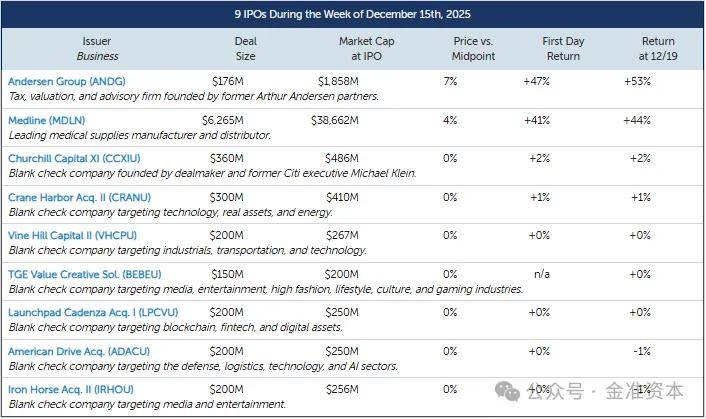
昨日3家企业完成美国IPO定价,1家由中国高管领导的SPAC递交纳斯达克申请
Sou Hu Cai Jing· 2025-12-18 08:20
Group 1: Andersen Group IPO - Andersen Group priced its IPO at $16 per share, at the high end of the previously set range of $14 to $16 [1] - The company raised $176 million by issuing 11 million shares, resulting in a fully diluted market capitalization of $1.9 billion [1] - Andersen Group, founded in 2002, provides independent tax, valuation, and financial consulting services to over 11,900 clients across the U.S. [2] - The company is a member of Andersen Global, which consists of over 300 member firms and partners [2] - Andersen Group is listed on the New York Stock Exchange under the ticker symbol ANDG, with several investment banks acting as joint bookrunners for the transaction [2] Group 2: Iron Horse Acquisition II IPO - Iron Horse Acquisition II, a SPAC focused on media and entertainment, completed its IPO by raising $200 million through the issuance of 20 million units priced at $10 each [3] - The initial plan was to issue 25 million units, but the final structure included 1 share of common stock and 1 warrant per unit [3][4] - The company is led by CEO Jose Bengochea, who is also the founder of Bengochea Capital, and aims to focus on sectors like music, animation, and artificial intelligence [3] Group 3: Churchill Capital XI IPO - Churchill Capital XI, a SPAC founded by Michael Klein, raised $360 million by issuing 36 million units at $10 each, exceeding its initial expectations by 6 million units [6] - Each unit consists of 1 share of common stock and a warrant with an exercise price of $11.50 [6] - The company is focused on acquiring businesses that generate stable free cash flow and have strong management teams [7] - Churchill Capital XI is listed on NASDAQ under the ticker symbol CCXIU, with Citigroup serving as the sole bookrunner for the transaction [8] Group 4: Spectre Acquisition IPO - Spectre Acquisition, led by Chinese executives, filed for an IPO to raise up to $60 million by issuing 6 million units at $10 each [9] - Each unit includes 1 share of common stock and a full warrant with an exercise price of $11.50 [9] - The SPAC plans to target companies outside mainland China that possess key technologies and strong competitive positions [9]

美国IPO一周回顾及前瞻:上周有10家企业上市(含1家中概股),12家企业递交申请
Sou Hu Cai Jing· 2025-12-15 07:59
Core Insights - The U.S. IPO market saw four companies go public and six SPACs listed last week, with eight companies filing for IPOs and four for SPACs [1][4]. Group 1: IPO Highlights - Wealthfront (WLTH) priced at the upper end of its range, raising $485 million with a market cap of $2.6 billion, targeting young "digital-first" customers and boasting over 1.3 million paying clients and $88.2 billion in assets by July 2025 [1]. - Lumexa (LMRI) raised $463 million with a market cap of $1.8 billion, operating 184 outpatient imaging centers across 13 states, and has a high leverage ratio of 3.7 times [2]. - Cardinal Infrastructure (CDNL) raised $242 million with a market cap of $769 million, focusing on utility installation services in the Southeastern U.S. with a backlog valued at $646 million [3]. - JM Group (JMG) raised $15 million with a market cap of $79 million, specializing in merchandise sourcing for various retail categories [3]. Group 2: SPAC Highlights - Six SPACs completed pricing last week, including Meshflow Acquisition (MESHU) and Karbon Capital Partners (KBONU), each raising $300 million targeting blockchain infrastructure and energy sectors respectively [4]. - Other SPACs included Daedalus Special Acquisition (DSACU) raising $225 million for consumer-facing AI and technology, and Twelve Seas III (TWLVU) raising $150 million for investments in oil and gas companies outside the U.S. [4]. Group 3: Upcoming IPOs - Medline (MDLN) plans to raise $5 billion at a market cap of $37.3 billion, focusing on medical supplies distribution, facing recent tariff pressures [8]. - Andersen (ANDG) aims to raise $165 million at a market cap of $1.74 billion, providing tax and advisory services with a 15% CAGR since 2003 [8].
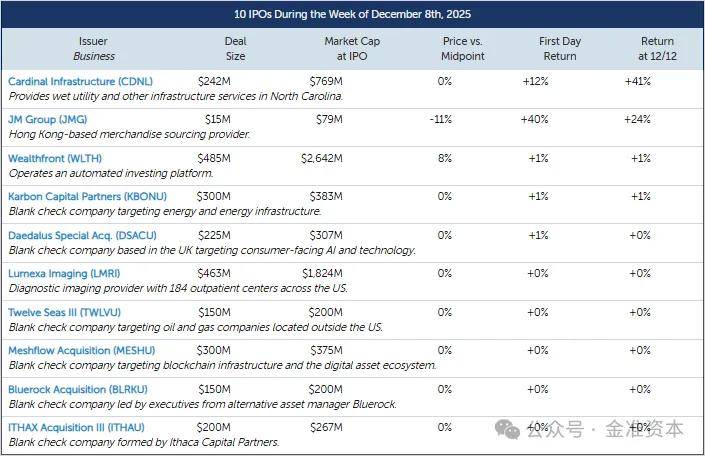
企业出海俄罗斯:国樽涉外律师,警示不可忽视的税务法律风险!
Sou Hu Cai Jing· 2025-12-12 14:12
Core Viewpoint - Russia's unique market position and resource advantages make it a significant destination for outbound enterprises, but strict regulations on business fragmentation pose serious compliance challenges for these companies [2] Group 1: Definition and Regulatory Logic of Business Fragmentation - Business fragmentation in Russia refers to the act of splitting a single business entity into multiple legal entities to gain improper tax benefits, which is closely monitored by tax authorities [3] - The core regulatory logic focuses on identifying the commercial rationale behind fragmentation; if the split lacks genuine business needs and is solely for tax avoidance, it will be deemed illegal [3] Group 2: Key Indicators for Tax Authority Recognition of Business Fragmentation - Enterprises should be aware of 18 key indicators that may trigger tax audits, including: - Multiple entities under special tax regimes with closely aligned operational metrics [4] - High interrelation of business activities among entities pointing to a single operational goal [4] - Shared resources and personnel across entities, indicating a lack of operational independence [4] - Financial and establishment patterns that suggest a lack of genuine business purpose [4] Group 3: Legal and Tax Responsibilities of Business Fragmentation - If deemed illegal, enterprises face comprehensive accountability, including: - Administrative penalties where tax authorities may consolidate revenues of fragmented entities and recalculate taxes owed [5] - Bankruptcy proceedings if the enterprise cannot settle tax debts, with participants in the fragmentation scheme facing joint liability [6] - Criminal liability for responsible individuals if tax debts exceed 15 million rubles [7] Group 4: Successful Legal Defenses in Business Fragmentation Cases - Not all business splits are illegal; several enterprises have successfully defended their fragmentation by demonstrating: - Business independence among entities with no significant overlap in operations [8] - Reasonable functional division aimed at maintaining market competitiveness [8] - Operational independence despite shared accounting services [8] - Compliance with market needs through appropriate business adaptations [8] Group 5: Circumstances to Mitigate Liability - Enterprises may apply for reduced penalties if they demonstrate: - Serious financial difficulties while actively contributing to public welfare [9] - Proactive tax compliance during audits by settling all owed taxes and penalties [9] Group 6: Compliance Recommendations for Enterprises Operating in Russia - Conduct preemptive compliance assessments with local legal and tax experts to ensure business fragmentation has a legitimate commercial basis [10] - Maintain comprehensive evidence of business independence and functional necessity for each entity [11] - Establish a risk monitoring mechanism to regularly review compliance with tax authority indicators [12] - Prepare crisis response strategies based on successful legal defenses to mitigate potential liabilities [13]

支持台胞开设沙县小吃门店等 福建发布12条惠台政策措施
Yang Shi Xin Wen· 2025-12-02 04:06
Core Viewpoint - Fujian Province has developed a set of 12 policy measures to support the demands of Taiwanese individuals and enterprises, focusing on enhancing cross-strait integration and development [1] Group 1: Support for Taiwanese Enterprises and Business Development - Increased land and sea use guarantees for Taiwanese enterprises, with a specific allocation of 1,200 acres for six Taiwanese investment zones [2] - Incentives for Taiwanese enterprises in the Nanjing Precision Machinery Industrial Park, including cash rewards based on actual fixed investments ranging from 500,000 to over 2 million yuan [2] - Premium discounts for Taiwanese aquaculture enterprises on insurance policies, with a maximum discount of 50,000 yuan per policy and an annual total discount cap of 200,000 yuan [2] - Support for Taiwanese enterprises in the Putian arts and crafts industry, including rent exemptions and subsidies for participation in major exhibitions [3] - Direct supply of agricultural inputs to Taiwanese farmers in Fujian, along with free sales space in local agricultural centers [3] Group 2: Optimization of Tax Services for Taiwanese Individuals and Enterprises - Launch of a smart tax service platform for Taiwanese individuals and enterprises, offering 188 intelligent tax services and online processing for 46 tax types [4] - Establishment of a dedicated tax consultation hotline for Taiwanese enterprises, providing bilingual support [4] - Series of "tax-enterprise face-to-face" events aimed at helping Taiwanese enterprises maximize tax benefits and mitigate risks, with 100 events planned by the end of 2026 [4] Group 3: Promotion of Trade, Cultural, and Tourism Exchanges - Support for Taiwanese individuals to open Sha County snack stores in Taiwan, with a one-time entrepreneurial subsidy of 5,000 yuan [5] - Encouragement for Taiwanese tourism operators to collaborate on upgrading homestays in Nanping, with subsidies based on renovation costs [5] - Introduction of a ticket refund insurance service for travelers on the Xiamen-Kinmen route, aimed at reducing economic losses from ticket cancellations [6] - Financial rewards for Taiwanese artists performing in Fuzhou, with subsidies based on contract amounts for approved performances [6]
锚定“智税新生态” 百望股份联合安永探索税务合规新路径
Zheng Quan Ri Bao Wang· 2025-12-01 13:41
Core Insights - The collaboration between Ernst & Young (EY) and Baiwang Co., Ltd. aims to develop a global tax compliance solution that integrates AI capabilities with industry insights to enhance tax risk identification and decision-making support for enterprises [1][2]. Group 1: Company Collaboration - EY and Baiwang have reached a consensus to leverage their strengths in AI technology, vast data resources, and industry insights to create a comprehensive tax compliance solution [1]. - The partnership is expected to transform traditional tax management practices by embedding AI into core business processes, thereby improving digital operational capabilities for enterprises [1][2]. Group 2: Industry Context - The global digital economy is evolving, leading to increased complexity in tax compliance management due to diverse tax systems, frequent regulatory changes, and varied documentation formats [1]. - The collaboration is positioned as a strategic move for Baiwang in the global tax compliance sector, emphasizing the importance of high-quality data and industry knowledge as key competitive advantages [2][3]. - The partnership is anticipated to create a digital capability system that integrates tax compliance, risk management, and strategic decision-making, turning compliance pressures into sustainable competitive value in the digital economy [3].
资源税新规将落地,产品价格会涨吗?
Zhong Guo Zheng Quan Bao· 2025-11-30 14:16
Group 1 - The announcement clarifies the execution standards for resource tax policies, effective from December 1, and addresses nine key areas including tax exemptions and tax base for certain taxable products [1][2] - The announcement does not increase the overall tax burden on related industries, thus it is not expected to cause significant fluctuations in product prices [1][2] - The policy aims to unify execution standards and regulate tax administration processes, which will help stabilize the pricing system of resource products and maintain fair competition in the industry [1][3] Group 2 - The announcement provides detailed definitions for important strategic resources such as coal, salt, and rare earth minerals, clarifying the taxable items for these resources [2] - It specifies the tax obligations for low-priced related party transactions without legitimate reasons, allowing tax authorities to adjust taxable sales amounts accordingly [3] - The implementation of the announcement is expected to promote efficient and green resource utilization, encouraging companies to improve resource efficiency and reduce costs through compliant practices [3]
英国挥刀,斩断百年特权!大批富豪带资出逃,全球避税天堂已死?
Sou Hu Cai Jing· 2025-11-05 08:51
Core Points - The UK is set to abolish its non-resident tax regime in 2025, which has allowed wealthy foreigners to avoid taxes on overseas income for up to 15 years [3] - The new tax system will require newcomers to pay taxes on global income after four years of residency, with an estimated additional tax revenue of £40 billion expected from the change [3] - Public support for the tax reform is high, with 60% of the population in favor, as the wealthiest 1% currently hold half of the nation's wealth but contribute only a third of the taxes [3] Group 1 - The non-resident tax regime was established in 1799 to attract foreign investment, allowing wealthy individuals to buy property in London while minimizing tax liabilities [1] - The Labour government plans to implement a residence-based tax system, expanding inheritance tax to cover global assets [3] - The policy change is expected to impact approximately 73,700 wealthy individuals currently benefiting from the non-resident tax regime [3] Group 2 - The proposed tax changes have faced criticism from the Conservative Party, which argues that it may deter foreign investment [5] - Data indicates a significant outflow of wealthy individuals from the UK, with 9,500 millionaires leaving in 2024, double the previous year, and an expected 16,500 by 2025 [8] - The real estate market in London is already feeling the effects, with a 20% increase in high-end property listings and a softening of prices [8] Group 3 - The global trend of tightening tax regulations is evident, with countries collaborating to share tax information, diminishing the appeal of tax havens [10] - The UK faces a challenging fiscal environment, with public debt exceeding 100% of GDP, necessitating increased tax revenue from the wealthy [12] - Historical precedents show that excessive taxation can lead to capital flight, as seen in Spain during the 17th century, raising concerns about the potential consequences of the new tax regime [12]

美国政府停摆冲击美股IPO市场:SEC审查停滞,年底冲刺上市通道遭堵
智通财经网· 2025-11-05 07:06
Core Viewpoint - The prolonged U.S. government shutdown is significantly hindering companies hoping to go public by the end of the year, as the SEC's review of filings is stalled, leaving these companies with limited options to proceed with their IPOs [1][2]. Group 1: Impact on IPOs - Companies that applied for IPOs in September or October, such as Andersen Group, Medline, and Wealthfront, were likely aiming for a listing before Thanksgiving but are now facing delays due to the shutdown [1]. - The shutdown has lasted nearly two months, causing these companies to miss the opportunity to utilize the SEC's automatic effectiveness provisions, which would have allowed them to set issuance terms and start a 20-day countdown to automatic effectiveness [1]. - The ability of companies to adjust issuance terms based on market demand remains limited, leading to relatively high IPO discount rates [1]. Group 2: Market Reactions - The market has tested the resolve of some companies, with Navan's stock dropping by up to 36% since its IPO on October 30, while MapLight Therapeutics' stock has hovered around its IPO price [1]. - Beta Technologies experienced a decline on its first day of trading but saw some recovery afterward [1]. Group 3: Future Outlook - Companies confident that their IPO applications are complete may find the automatic effectiveness route beneficial, but they must ensure there are no significant misstatements or omissions [2]. - Companies that began preparing for an IPO earlier in 2025 may still have a chance to go public this year, but those awaiting substantial SEC feedback are likely to delay until next year, especially with the holidays approaching [2]. - If the government shutdown continues indefinitely, companies intending to use the automatic effectiveness route will likely see their IPO timelines pushed to after Thanksgiving, a period generally unfavorable for IPOs due to investor travel and holidays [2]. Group 4: SEC Review Process - Once the SEC reopens, a backlog of applications is expected, and the agency may not respond as quickly as usual to resubmissions [3].