
经纪

Search documents
华尔街市场逆转 年初高共识交易集体失效
Huan Qiu Wang· 2026-02-15 01:06
Group 1 - In early 2026, Wall Street investors' risk appetite reached a high, with cash holdings at a historical low and a significant reduction in hedging positions [2] - The acceleration of AI technology applications has shifted market logic, leading to concerns about the replacement of light asset and white-collar industries such as software, wealth management, brokerage, and tax consulting [2] - The S&P 500 index experienced increased volatility, dropping to its lowest level since November of the previous year, with a rebound driven by moderate inflation data [2] Group 2 - A survey by Bank of America in January revealed that investor cash positions fell to a historical low of 3.2%, with nearly half of fund managers lacking downside protection, the lowest level since 2018 [2] - The correlation among various asset classes has increased, raising the risk of market-wide adjustments triggered by the sell-off of single assets [3] - Investment-grade bond ETFs performed strongly due to safe-haven demand, while U.S. Treasury prices rose, marking the largest weekly gain for long-term Treasury ETFs since April of the previous year [3]

能源、必选消费和美债领涨2026!华尔街的“AI交易”被“AI颠覆”了
美股IPO· 2026-02-14 04:12
Group 1 - The core viewpoint of the article is that the initial optimism surrounding AI as a strong investment theme has shifted to concerns about its disruptive potential, particularly for asset-light companies that may be replaced by AI technologies [3][7][22] - The S&P 500 index experienced significant volatility, with its performance deteriorating to the worst levels since November, exacerbated by fears of AI disruption spreading across various markets [4][5] - The financial sector has been notably affected, with a marked decline in performance, while utility stocks have emerged as a safe haven amid AI-related concerns [5][6] Group 2 - Investor sentiment has shifted dramatically, with many now questioning the return timelines on large capital expenditures by tech giants and the sustainability of stock buybacks [8][10] - The market is undergoing a revaluation, particularly in the software sector, raising fears of contagion effects that could impact other industries [9][10] - Extreme positioning and leverage in the market are amplifying volatility, with a significant drop in cash allocations and a lack of downside protection among fund managers [11][12] Group 3 - There has been a notable increase in hedging activities, as evidenced by rising volumes of put options, indicating a growing concern for downside risks [19][20] - The Chicago Board Options Exchange's put-call ratio has surged since January, reflecting heightened investor caution [20] - Despite current volatility, the S&P 500 remains near historical highs, and credit spreads are at ten-year lows, suggesting that a market collapse has not yet materialized [18][22]

能源、必选消费和美债领涨2026!华尔街的“AI交易”被“AI颠覆”了
Hua Er Jie Jian Wen· 2026-02-14 01:49
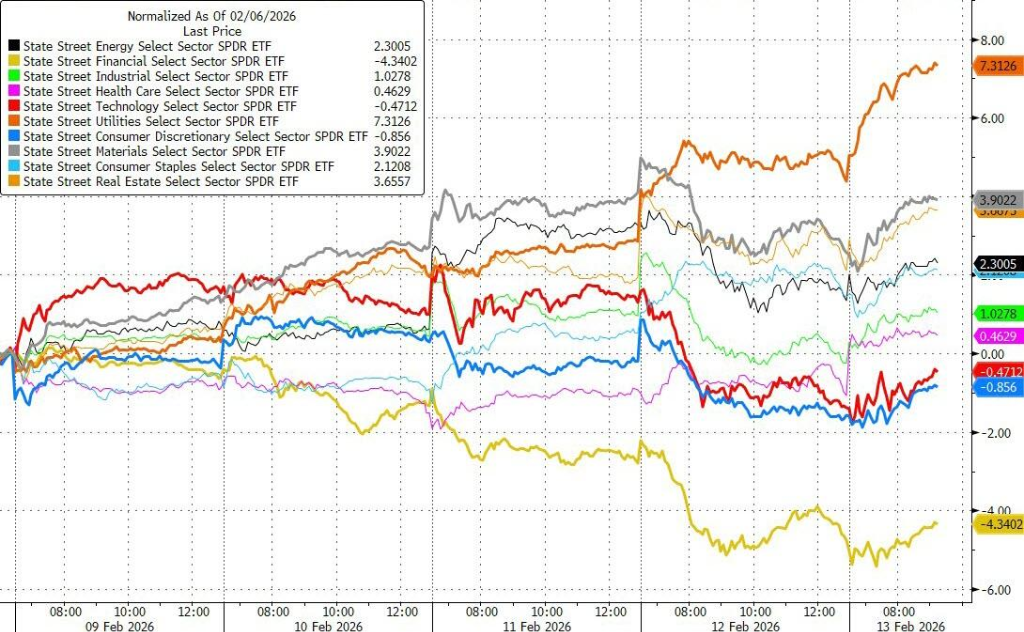
Core Viewpoint - AI, initially seen as a strong investment theme for the year, has shifted to a source of market uncertainty, particularly impacting light-asset companies that may be replaced by AI technology [1][4]. Group 1: Market Performance - The S&P 500 index experienced its worst performance since November until a rebound occurred following mild inflation data on Friday [1]. - The utility sector outperformed as a safe haven against AI impacts, while the financial sector was the worst performer of the week [2]. - Wall Street's previously confident bets have failed over six weeks, with cash allocations at a historic low and hedge levels at their lowest since 2018 [3]. Group 2: AI Impact and Investor Sentiment - Investors are questioning the return timelines on large capital expenditures by tech giants and whether remaining cash can continue to support stock buybacks [4]. - The sentiment is that more stocks have been harmed by AI than benefited, leading to concerns about potential contagion effects across sectors [4]. - The market is undergoing a repricing, particularly in the software industry, raising fears of broader impacts [4]. Group 3: Market Volatility - Two forces are exacerbating volatility in the U.S. stock market: low cash allocations and interconnected leveraged positions that can trigger widespread sell-offs [5]. - The VIX index recently surpassed the critical 20 mark, indicating rising market pressure despite not showing panic signals [6]. - The put-call ratio has surged since January, reflecting increased hedging activity among investors [9][10]. Group 4: Investment Strategy Adjustments - Despite current volatility, the S&P 500 remains near historical highs, and credit spreads are at ten-year lows, indicating that a market collapse has not yet occurred [9]. - There has been a significant inflow of $3.6 billion into ETFs tracking high shareholder return companies this month, suggesting a shift in investment focus [10].
中国房地产估价师与房地产经纪人学会第五届会员代表大会在京召开
Xin Hua Cai Jing· 2026-01-06 02:52
Core Viewpoint - The fifth member representative conference of the China Real Estate Appraisers and Agents Association (CREAAA) was held on December 26, 2025, in Beijing, with nearly 600 representatives attending, and Jiang Wanrong was elected as the new president of the fifth council [1][2]. Group 1: Conference Highlights - The Ministry of Housing and Urban-Rural Development expressed congratulations on the successful convening of the conference and acknowledged the achievements of CREAAA [1]. - The fourth council president, Chai Qiang, reported on the work of the fourth council, emphasizing the focus on self-regulation in real estate appraisal, brokerage, and leasing, as well as the association's development [2]. - A special report was delivered by a representative from the Ministry of Housing and Urban-Rural Development, emphasizing the importance of the real estate industry in supporting urban renewal and high-quality development [3]. Group 2: Future Directions - Jiang Wanrong outlined the new council's commitment to implementing the spirit of the 20th National Congress of the Communist Party and other central meetings, focusing on self-regulation and research in real estate appraisal, brokerage, and leasing [4]. - Key areas of focus include deepening theoretical research, enhancing service quality, promoting a fair competitive environment, building collaborative platforms, and strengthening political leadership within the industry [4].
【安永税务】巴西并购——税务尽职调查并非例行公事
Sou Hu Cai Jing· 2025-12-22 13:13
Core Insights - Brazil, as the largest economy in Latin America, continues to attract strategic and financial investors due to its vast domestic market, rich natural resources, and strategic location in the Southern Hemisphere [1] - The country is undergoing significant tax reforms, including a comprehensive consumption tax reform that aligns with OECD standards, necessitating forward-looking financial and tax due diligence [1][3] Regulatory Environment - The merger and acquisition process in Brazil is more complex compared to jurisdictions like the US or Europe, requiring extensive documentation, additional regulatory approvals, and longer approval timelines [2] - Specific industries such as media, healthcare, and aviation have restrictions on foreign ownership or require special permits, impacting transaction structures and timelines [2] Tax Due Diligence - Tax due diligence (TDD) is critical in Brazil's evolving tax landscape, with three major structural reforms directly affecting valuation models and transaction agreements [3] - The transition from a fragmented VAT system to a dual VAT system (CBS/IBS) is set to begin in 2026, with significant implications for profit margins and working capital [3][10] Transfer Pricing and Global Minimum Tax - Starting January 1, 2024, Brazil will adopt OECD's arm's length principle for transfer pricing, expanding the scope to include services, intangible assets, and financial transactions [4] - The implementation of a qualified domestic minimum top-up tax (QDMTT) from January 1, 2025, will require companies with revenues exceeding €750 million to model effective tax rates and prepare compliance documentation [4] Employment Tax Risks - The Brazilian Supreme Court has paused litigation regarding the legality of hiring through personal service companies (PJs), which poses significant investment risks for industries reliant on contractors [8] - Potential liabilities related to employment taxes could arise if the court's final ruling is unfavorable, impacting cost structures and compliance obligations [8][15] Legal and Judicial Uncertainty - Court rulings can significantly affect tax treatment outcomes, necessitating careful evaluation of each tax dispute to determine refund eligibility and audit risks [7] - The dynamic nature of the CBS/IBS tax framework highlights the need for flexible pricing models and renegotiation clauses in sale and purchase agreements [7] Industry-Specific Considerations - In the consumer and retail sector, traditional pricing models based on ICMS-ST must be adjusted to comply with new CBS/IBS regulations [11] - The technology and digital industries must address historical risks and outdated contract structures while ensuring compliance with OECD transfer pricing rules [13] - The telecommunications sector will benefit from unified taxation rules under CBS/IBS, but transitional risks remain [14] Conclusion - Brazil's market presents attractive investment opportunities, but success hinges on the ability to navigate complex information and incorporate tax reforms, legal uncertainties, and employment tax risks into pricing considerations [17] - Effective tax due diligence is now a strategic tool that transforms complex situations into clear judgments, supporting decision-making processes [17]
——2025年1-10月统计局房地产数据点评:基本面下行斜率扩大,政策宽松必要性提高
Changjiang Securities· 2025-11-17 23:30
Investment Rating - The report maintains a "Positive" investment rating for the real estate industry [8]. Core Insights - The downward slope of various real estate indicators has expanded in October, with significant pressure on sales expected to continue through November and December due to high base effects. The need for further loosening of industrial policies has become increasingly evident as the pressure on both volume and price has intensified throughout the year [2][11]. - The report suggests that the most challenging phase may be nearing its end, with expectations of continued double-digit declines in construction and investment for 2025. However, sales performance will largely depend on the effectiveness of subsequent policy measures [11][12]. Summary by Sections Sales Performance - In the first ten months of 2025, national commodity housing sales value and area decreased by 9.6% and 6.8% year-on-year, respectively. In October alone, sales value and area fell by 24.3% and 18.8% year-on-year, indicating a significant contraction influenced by high base effects [11][12]. - The average selling price of new homes in October was 9,722 yuan per square meter, down 6.9% year-on-year, while the average price for residential properties was 10,286 yuan per square meter, down 6.2% year-on-year [12]. Construction Activity - New construction area in the first ten months of 2025 decreased by 19.8% year-on-year, with a sharper decline of 29.5% in October. The report notes that the decline in construction is primarily due to sales expectations, inventory digestion cycles, and funding pressures [11][12]. - The completed construction area also saw a year-on-year decline of 16.9% in the first ten months, with a 28.2% drop in October, indicating a continued downward trend [11][12]. Financial Conditions - Funding for real estate companies decreased by 9.7% year-on-year in the first ten months, with a notable 21.9% decline in October. This includes a 6.7% drop in domestic loans and a 17.2% decrease in self-raised funds [11][12]. - Real estate development investment fell by 14.7% year-on-year in the first ten months, with a 23.0% decline in October, reflecting ongoing financial pressures on the sector [11][12]. Investment Recommendations - The report recommends focusing on high-quality real estate companies with relatively low inventory pressure and strong product capabilities. It also suggests considering leading firms in commercial real estate, property management, and brokerage sectors for medium to long-term investment opportunities [2][11].
日本一经纪公司社长涉嫌长期猥亵未成年女艺人被捕
Xin Jing Bao· 2025-09-17 12:41
Core Viewpoint - A Japanese talent agency president was arrested for allegedly sexually assaulting a minor female artist over a period of time, raising serious concerns about the safety and treatment of young performers in the entertainment industry [1] Group 1: Incident Details - The president, Hiroshi Torimaru, is accused of committing sexual assault against the victim from 2021 to 2022 [1] - The police reported that Torimaru lured the victim to a hotel under the pretense of taking photos to sell to fans, where he allegedly assaulted her 12 times [1] - The victim, fearing that resistance would jeopardize her idol career, endured the abuse for years before reporting it to the police in March 2025 [1] Group 2: Response and Admission - During the investigation, Torimaru admitted to the sexual assault, claiming his intention was to engage in a relationship with the victim [1]