
资源税政策执行口径

Search documents
资源税最新执行口径(一至二)
蓝色柳林财税室· 2026-01-26 14:33
Core Viewpoint - The article discusses the implementation of resource tax policies by the Ministry of Finance and the State Taxation Administration, effective from December 1, 2025, detailing various tax exemptions, taxable products, and calculation methods for resource tax [10][11]. Group 1: Tax Exemptions and Taxable Products - Taxpayers extracting unprocessed or processed coal, as well as specific mineral products, are subject to resource tax based on the type of product [5][6]. - Taxpayers are exempt from resource tax for certain products, including those used in continuous production of non-taxable products [6][12]. - The article outlines specific conditions under which taxpayers can determine the taxable basis for resource tax, including sales of exempt products and the calculation of sales amounts [6][12]. Group 2: Calculation Methods for Tax Exemptions - Taxpayers can calculate the sales amount of exempt or reduced tax products based on the proportion of production, using a specific formula [12][13]. - For self-used exempt products without sales, the average sales price method can be applied to determine the sales amount [13]. - Taxpayers must retain valid documentation for sales of exempt products and ensure compliance with record-keeping requirements [14]. Group 3: Related Transactions and Pricing - Taxpayers selling taxable products to related parties at prices significantly lower than market rates may have their sales amounts adjusted by tax authorities [7][8]. - Justifiable reasons for pricing differences include adherence to government pricing guidelines and reasonable cost adjustments by related parties [8][9]. Group 4: Tax Obligation Timing - The timing of tax obligations for sales of taxable products varies based on the payment method, with specific rules for direct payments, credit sales, and prepayments [16][17].


这些资源税政策执行口径,你知道吗?
蓝色柳林财税室· 2025-12-23 01:26
Core Viewpoint - The article discusses the tax policies related to resource tax, specifically focusing on the conditions under which resource tax is applicable and the exemptions available for certain entities and situations [9][10]. Tax Policy Summary - The resource tax is determined based on the sales amount excluding value-added tax for taxable products sold or used in the continuous production of non-taxable products [10]. - Certain entities, including administrative and judicial bodies, are exempt from paying resource tax on products seized or collected under relevant laws [9]. - Taxpayers using taxable products for non-monetary asset exchanges, donations, or other specified uses must pay resource tax unless the products are used for continuous production of taxable products [12][14]. Taxpayer Obligations - Taxpayers must pay resource tax on taxable products they extract or produce for self-use, except when these products are used in the continuous production of taxable products [10][14]. - If a taxpayer's reported sales amount for taxable products is significantly low without justification, tax authorities can determine the sales amount based on average prices of similar products from the taxpayer or other taxpayers [12][13].
资源税政策执行口径正式施行 首次明确两类不征税情形
Zhong Guo Jing Ying Bao· 2025-12-01 15:44
Core Viewpoint - The announcement by the Ministry of Finance and the State Taxation Administration marks a significant improvement in the practical implementation of the resource tax system in China, providing clearer guidelines for both taxpayers and tax authorities, thereby promoting green development and efficient resource utilization [1][3]. Group 1: Policy Implementation - The new announcement addresses key issues that have arisen since the implementation of the Resource Tax Law, including disputes over taxable product classifications and unclear definitions, thus providing precise guidance for tax collection [1][2]. - The announcement clarifies that certain products, such as confiscated taxable products and minerals used for backfilling in construction projects, will not be subject to resource tax, which helps delineate the boundaries of tax applicability [1][2]. Group 2: Tax Classification - The announcement specifies that condensate oil will be taxed under the crude oil category, while oil and gas field mixed light hydrocarbons will be taxed according to both crude oil and natural gas categories, based on the defined standards [2]. - For tailings utilization products, the announcement distinguishes between two scenarios: specific mineral components will be taxed according to their respective mineral categories, while sand and gravel products will be taxed under the sand and gravel category [2]. Group 3: Impact on Industry - The clarification of tax regulations is expected to unify tax collection standards across regions, reducing disputes arising from differing interpretations and significantly enhancing tax collection efficiency [3]. - The implementation of these policies is anticipated to further highlight the role of resource tax in regulating resource development and promoting green production practices [3].
资源税有关政策执行口径明确(财经短波)
Ren Min Ri Bao· 2025-11-30 22:20
Core Viewpoint - The Ministry of Finance and the State Taxation Administration have jointly issued an announcement clarifying the implementation guidelines for resource tax policies, effective from December 1, 2025, aimed at reducing discrepancies in tax enforcement across regions and providing clearer operational guidance for tax authorities and taxpayers [1]. Group 1: Resource Tax Policy Clarifications - The announcement outlines nine key aspects regarding the execution of resource tax policies, including circumstances under which resource tax is not payable, applicable tax categories for certain taxable products, and tax bases for taxable products under special circumstances [1]. - It specifies the definition and categorization of important strategic resources such as coal, mineral products, and rare earth elements, addressing common disputes between tax authorities and taxpayers [1]. - The guidelines also cover legitimate reasons for significantly low prices in related party transactions, definitions for self-use continuous production of taxable products, tax exemption management regulations, and calculation methods [1]. Group 2: Implications for Tax Administration - The clarification of resource tax policies is expected to eliminate differences in the execution of resource tax laws across regions, thereby reducing disputes arising from misinterpretations of policies [1]. - The announcement provides clearer operational guidance for both tax authorities and taxpayers, facilitating smoother tax administration processes [1].
资源税新规将落地,产品价格会涨吗?
Zhong Guo Zheng Quan Bao· 2025-11-30 14:16
Group 1 - The announcement clarifies the execution standards for resource tax policies, effective from December 1, and addresses nine key areas including tax exemptions and tax base for certain taxable products [1][2] - The announcement does not increase the overall tax burden on related industries, thus it is not expected to cause significant fluctuations in product prices [1][2] - The policy aims to unify execution standards and regulate tax administration processes, which will help stabilize the pricing system of resource products and maintain fair competition in the industry [1][3] Group 2 - The announcement provides detailed definitions for important strategic resources such as coal, salt, and rare earth minerals, clarifying the taxable items for these resources [2] - It specifies the tax obligations for low-priced related party transactions without legitimate reasons, allowing tax authorities to adjust taxable sales amounts accordingly [3] - The implementation of the announcement is expected to promote efficient and green resource utilization, encouraging companies to improve resource efficiency and reduce costs through compliant practices [3]
明确资源税有关政策执行口径
Qi Huo Ri Bao Wang· 2025-11-25 07:48
Core Viewpoint - The announcement by the Ministry of Finance and the State Taxation Administration clarifies the execution standards for resource tax policies, effective from December 1, 2025, addressing various issues in tax management and compliance [1][2][3] Group 1: Policy Clarifications - The announcement specifies nine aspects of resource tax policy execution, including exemptions from resource tax, applicable tax categories for certain taxable products, and tax calculation bases under special circumstances [1] - It details the tax categories for condensate oil, crude oil, and natural gas, as well as the recycling of tailings for specific mineral components [2] - The definitions of key strategic resources such as coal, salt, and rare earths have been further clarified to reduce disputes between taxpayers and tax authorities [2] Group 2: Compliance and Management - The announcement outlines four legitimate reasons for significantly low prices in related transactions, allowing tax authorities to adjust taxable sales amounts if not justified [2] - It provides a clear calculation method for tax exemptions and specifies the timing of tax obligations under different settlement methods [2] - Experts believe that these clarifications will enhance the fairness and operability of tax law implementation, reduce regional discrepancies, and improve tax collection efficiency [3]
资源税有关政策执行口径明确,去年税额接近3000亿
Sou Hu Cai Jing· 2025-11-24 12:53
Core Viewpoint - The Ministry of Finance and the State Taxation Administration jointly announced the implementation of resource tax policy execution standards, effective from December 1, 2025, to clarify various aspects of resource tax management and address existing ambiguities in the current system [1][4][22] Summary by Sections Resource Tax Policy Execution - The announcement clarifies nine aspects of resource tax policy execution, including circumstances for non-payment, applicable tax categories for certain taxable products, tax basis for taxable products under special circumstances, and management of tax exemptions [4][8] Tax Revenue Data - Resource tax revenue for 2024 is projected at 296.4 billion yuan, a decrease of 3.5% from the previous year. Annual resource tax revenues from 2020 to 2023 were reported as 175.5 billion, 228.8 billion, 338.9 billion, and 307 billion yuan respectively [4][5] Tax Exemption Circumstances - The announcement specifies that certain entities, such as administrative and judicial bodies, are exempt from resource tax for products confiscated or collected under legal authority. Additionally, materials like sand and clay used for construction within approved land areas are also exempt [8][9] Tax Categories and Objects - The announcement details tax categories for various resources, including condensate oil, mixed light hydrocarbons from oil and gas extraction, and specific mineral recovery processes. It also clarifies definitions for coal, rare earths, and salt products [10][12][11] Related Transactions - To mitigate risks associated with related transactions, the announcement outlines four legitimate reasons for significantly low pricing in related party transactions. Tax authorities can adjust taxable sales amounts if no valid reason is provided [15][16] Tax Calculation Methods - The announcement provides detailed methods for calculating tax exemptions and reductions, including formulas based on production ratios and average sales prices. It emphasizes the need for proper documentation to support claims for tax exemptions [17][18] Tax Obligation Timing - The timing for tax obligations is defined based on various sales methods, including direct payment, credit sales, and consignment sales, specifying when the tax obligation arises [21] Implementation Timeline - The new resource tax execution standards will take effect on December 1, 2025, and will apply to any unresolved matters prior to this date [22]
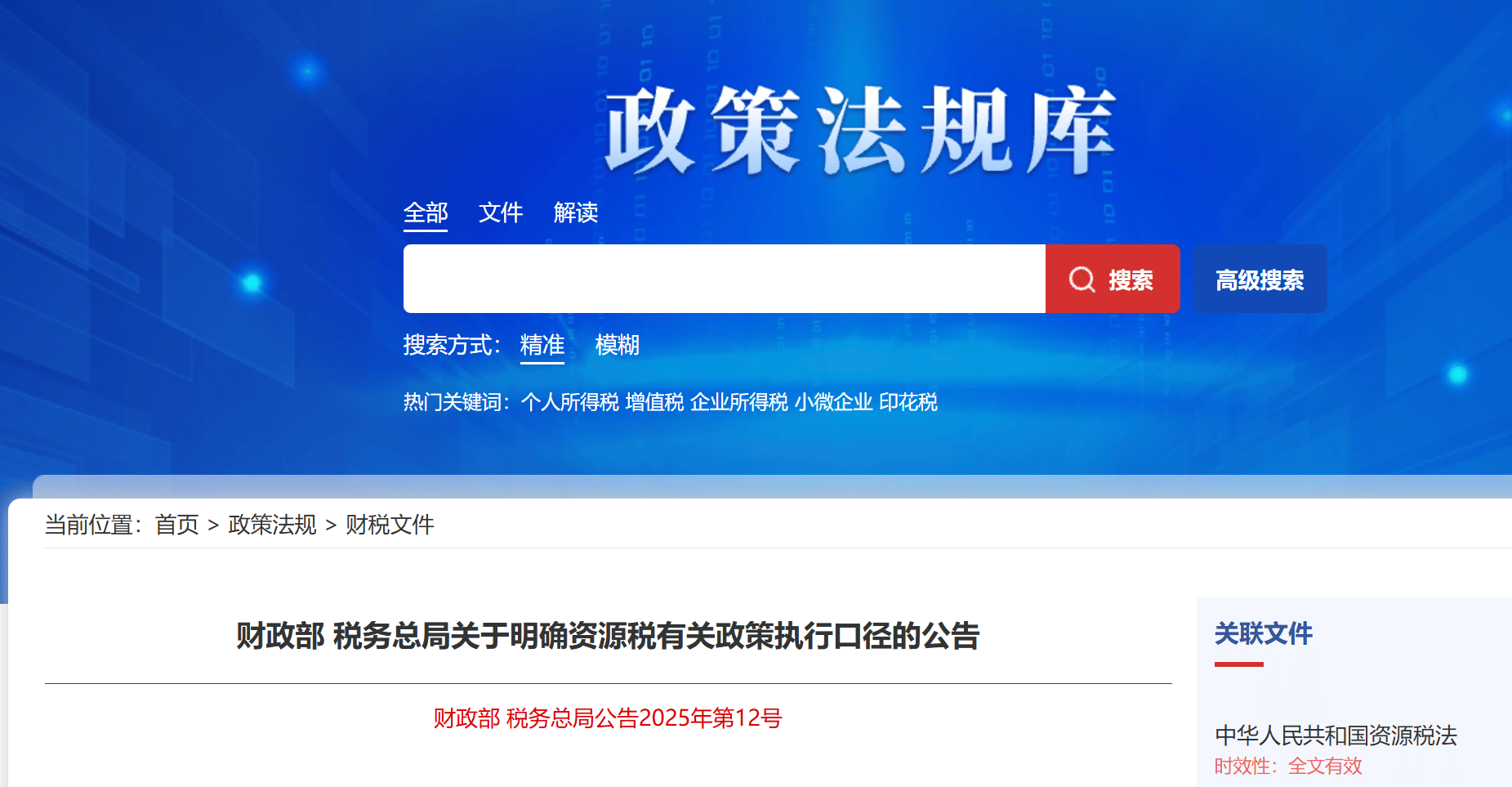
两部门明确资源税有关政策执行口径 消除地区间执行差异及争议空间
Xin Hua Cai Jing· 2025-11-24 12:51
Core Viewpoint - The announcement by the Ministry of Finance and the State Taxation Administration aims to clarify the execution standards of resource tax policies, addressing discrepancies in implementation across regions and reducing disputes arising from policy interpretation [1][3]. Group 1: Policy Clarification - The announcement specifies nine aspects regarding the execution of resource tax policies, including circumstances for non-payment, applicable tax categories for certain taxable products, and the definition of self-used continuously produced taxable products [1][2]. - It addresses the definition and categorization of key strategic resources such as coal, salt, and rare earth minerals, which have been contentious in actual tax administration [2]. Group 2: Compliance and Management - The announcement outlines four legitimate reasons for significantly low prices in related transactions, allowing tax authorities to adjust taxable sales amounts if the reasons do not apply [2]. - It also details the calculation methods and management regulations for tax exemptions, clarifying the timing of tax obligations under different settlement methods [2]. Group 3: Implications for Tax Administration - Experts believe that the clarification of resource tax policies will enhance operational efficiency for tax authorities and taxpayers, reduce tax revenue loss, and maintain tax order [3]. - The measures are seen as crucial for implementing the principle of tax legality, improving the local tax system, and promoting green development through effective resource utilization [3].
中国两部门明确资源税有关政策执行口径
Zhong Guo Xin Wen Wang· 2025-11-24 11:32
Core Viewpoint - The Ministry of Finance and the State Taxation Administration of China have jointly issued an announcement clarifying the execution standards for resource tax policies, effective from December 1, 2025, aiming to address ambiguities and disputes in the current resource tax law implementation [1][2]. Group 1: Policy Clarifications - The announcement outlines nine key aspects regarding the execution of resource tax policies, including circumstances under which resource tax is not payable, applicable tax categories for certain taxable products, and tax bases for taxable products under special circumstances [1]. - The resource tax law was officially implemented on September 1, 2020, but issues such as disputes over tax categories and unclear definitions of taxable products have emerged, necessitating clearer policy execution standards [1]. Group 2: Taxation Scope and Definitions - The announcement specifies the tax categories for condensate oil, mixed light hydrocarbons separated from crude oil and natural gas, and details the tax categories for specific mineral components recovered from tailings [2]. - It further clarifies the definitions of taxable resources, including coal, salt, and rare earth minerals, which have been contentious in actual tax administration [2]. Group 3: Compliance and Risk Management - To enhance risk prevention and compliance management regarding related transactions, the announcement lists four legitimate reasons for significantly low prices in related transactions, allowing tax authorities to adjust taxable sales amounts if not justified [2]. - The clarification of resource tax execution standards is expected to reduce discrepancies in tax law implementation across regions, thereby minimizing disputes and improving tax administration efficiency [2].