AI Music

Search documents
中国AI音乐,悄悄把全球第一拿走了
量子位· 2026-03-25 06:31
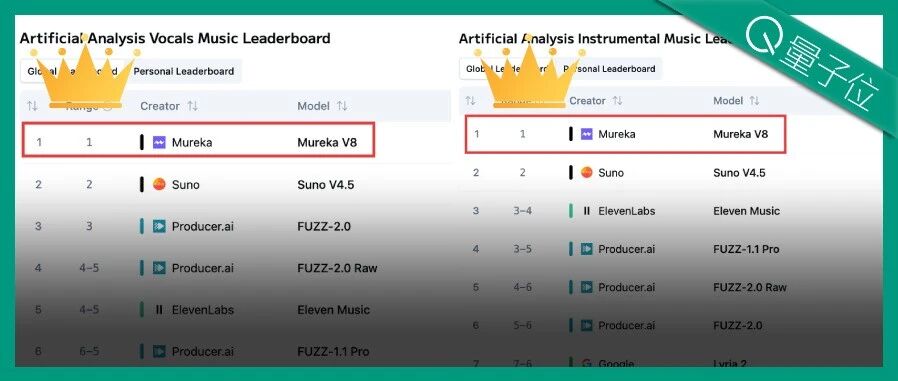
Core Viewpoint - The article highlights that China's AI music model, Mureka V8 by Kunlun Wanwei, has achieved the top position in the Artificial Analysis music model leaderboard, surpassing international models like Suno V4.5 and Udio v1.5 Allegro, marking a significant milestone in the AI music industry [1][25]. Group 1: Mureka V8's Achievements - Mureka V8 has claimed the number one spot in both vocal and instrumental categories, showcasing its dual capabilities [2][25]. - The model's performance is characterized by its ability to generate music that feels natural and emotionally resonant, with clear articulation and nuanced breathing effects in vocal performances [5][20]. - Mureka V8's instrumental capabilities have also impressed, producing engaging and recognizable riffs, demonstrating a significant understanding of musical elements [18][19]. Group 2: Development Timeline - The development of Mureka has been rapid, with eight major versions released in less than two years, averaging an update every three months [27][28]. - The evolution of Mureka reflects a systematic approach to making AI-generated music not only usable but also enjoyable, transitioning from basic functionality to high-quality production [30][31]. - By the time of the V8 release, Mureka had achieved a level of sophistication that allowed it to produce complete songs with coherent structure and emotional depth [38][40]. Group 3: Industry Context - The article discusses a shift in the AI music landscape, where domestic models like Mureka V8 are reclaiming leadership from previously dominant international models [46][47]. - This trend is part of a broader pattern in the AI sector, where Chinese companies are increasingly catching up and even surpassing their Western counterparts in various AI applications [49][51]. - The success of Kunlun Wanwei in AI music is attributed to its long-term investment in making "good music" a reproducible system capability, supported by a robust domestic user base and diverse application scenarios [57][58].


对话ACE Studio:做AI音乐、月收入200万美元,我们选了一条和Suno截然不同的路
Founder Park· 2026-03-11 11:53
Core Insights - The article discusses the emergence of AI music platforms, particularly focusing on ACE Studio, which differentiates itself from competitors like Suno by targeting professional users and enhancing the music creation workflow [5][6][10] - ACE Studio has achieved significant growth, with an annual recurring revenue (ARR) exceeding $10 million and a monthly revenue tripling to $2 million within three months of launching its 2.0 version [5][6] - The potential market for AI music is vast, as it allows individuals to express their emotions through music, democratizing music creation [8][15][36] Group 1: ACE Studio's Unique Position - ACE Studio is positioned as a professional tool that enhances the workflow of music creators, contrasting with Suno's consumer-oriented, one-click generation model [5][10] - The platform has no direct competitors in the professional music creation space, making it a pioneer in reshaping the workflow for professional musicians [6][10] - ACE Studio's models are faster and of higher quality compared to existing AI music models, capable of generating a complete song in seconds [5][10] Group 2: User Engagement and Market Dynamics - ACE Studio has seen a shift in its user base, with many users who are not traditional music producers but have a passion for music now identifying as "new professionals" [20][21] - The platform's ability to generate high-quality music has led to significant user engagement, with users creating professional-grade works without prior experience in traditional music production [21][24] - The AI music market is expected to grow significantly, with estimates suggesting that ACE Studio could capture 10-20% of the $15 billion professional music software market [26] Group 3: Business Model and Revenue Generation - ACE Studio employs a freemium model, offering free access to basic features while monetizing through premium subscriptions and advanced features [25][26] - The company has optimized its operational costs, spending only a small fraction of its revenue on inference costs, which allows for sustainable growth [25][26] - The long-term strategy includes building an open ecosystem that integrates various music models, enhancing the platform's capabilities and user experience [23][24] Group 4: Future of AI Music - The article emphasizes that AI music will fundamentally change how music is produced and consumed, potentially leading to a market worth hundreds of billions [39] - Personalization and user-generated content will be key competitive factors in the future of AI music, as users seek to express their unique identities through music [36][38] - The integration of music creation and consumption is seen as essential for the future of the industry, with ACE Music aiming to create a seamless experience for users [35][38]

AI音乐的下半场,谁能够真正上岸?
3 6 Ke· 2026-02-03 12:35
Core Insights - The AI music industry is experiencing a significant transformation, moving from a phase of rapid growth and experimentation to a more structured and professional stage, where quality and industry standards are becoming paramount [1][2][12]. Group 1: Industry Evolution - AI music is evolving from an entertainment tool to a professional production tool, with major players like Warner Music and MiniMax entering the market [2][21]. - The initial phase of AI music creation involved low-cost, low-quality mass production aimed at creating viral hits, exemplified by the rapid success of songs like "Seven Days Lover" [4][10]. - The industry is now witnessing a clear differentiation, where creators are shifting from merely producing songs to developing digital personas and virtual IPs, integrating music into broader content strategies [6][10]. Group 2: Quality and Standards - The latest AI models, such as MiniMax Music 2.5, are addressing long-standing issues in AI music production, including emotional depth, sound clarity, and adherence to industry standards [15][16][19]. - The emergence of high-quality AI-generated content is leading to a new wave of creativity, where AI can now understand and respond to nuanced artistic directions from creators [17][19]. - The "parody Grammy" video serves as a case study, showcasing AI's ability to replicate high production values and emotional engagement, thus challenging previous perceptions of AI music [14][15]. Group 3: Future Opportunities - The future winners in the AI music space will be those who can integrate AI into the music production process, creating systems that enhance professional workflows rather than merely generating content [20][21]. - AI models that can generate new musical expressions across different cultures and styles will have a competitive edge, as they can create value beyond existing trends [25][28]. - The integration of AI into various industries, such as education and entertainment, highlights its potential to democratize access to high-quality music production, making it a valuable tool for creators across sectors [28][29].

港股异动丨MiniMax涨超20%再创上市新高,市值突破1800亿
Ge Long Hui· 2026-01-29 02:56
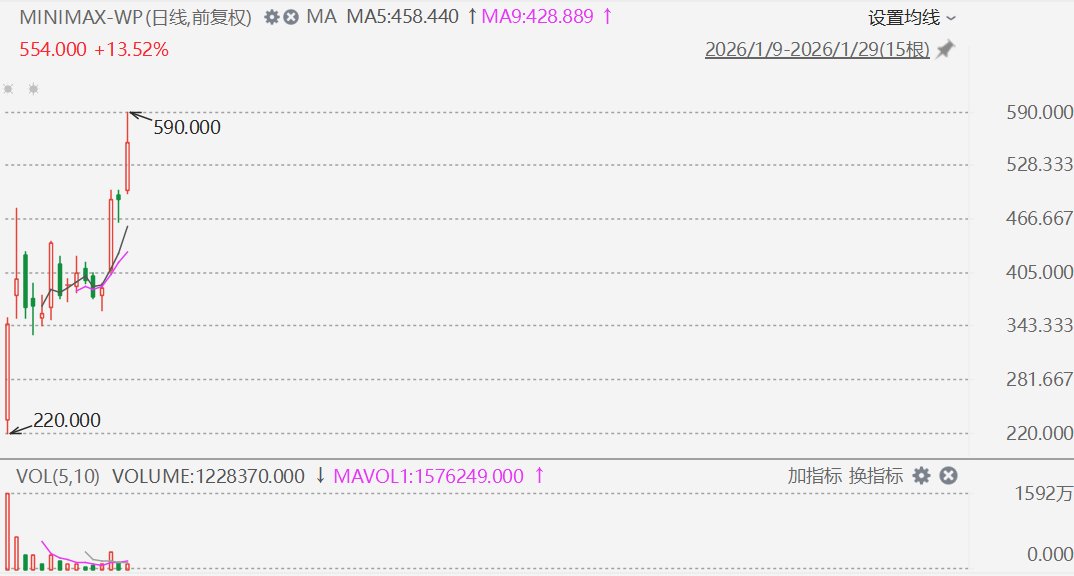
Group 1 - MiniMax-WP (0100.HK) saw a significant intraday increase of nearly 21%, reaching a new high of 590 HKD, with a market capitalization surpassing 180 billion HKD [1] - The official launch of MiniMax Music 2.5 was announced, which has made breakthroughs in "paragraph-level strong control" and "physical-level high fidelity" compared to its predecessor [1] - MiniMax Music 2.5 allows for precise control over 14 structural variations, enabling users to design the emotional curve, climax positions, and instrument configurations from the start of the music creation process [1] Group 2 - The AI music produced by MiniMax Music 2.5 is claimed to achieve "professional production standards" through systematic optimizations in vocal generation, style modeling, and mixing [1] - The stock performance indicators show a price of 590.000 HKD, with a notable increase of 13.52% from previous values [2] - The trading volume for MiniMax-WP was recorded at 1,228,370, indicating a decrease in volume compared to the moving average [2]
OpenAI被曝瞄准AI音乐赛道商业化,Suno首当其冲
3 6 Ke· 2025-10-27 02:41
Core Insights - OpenAI is planning to enter the AI music generation market, which has raised concerns for existing players like Suno AI, valued at $2 billion, as they fear being overshadowed by OpenAI's capabilities [1][6][8] - The collaboration between OpenAI and the Juilliard School aims to leverage advanced models for high-quality music creation, potentially integrating this technology into existing platforms like Sora 2 [4][5] - The AI music generation market is currently fragmented, with the top ten platforms holding only about 24% of the market share, indicating significant room for growth and competition [6][8] Company Developments - Suno AI has reported an annual recurring revenue (ARR) of $150 million, with a nearly fourfold year-on-year growth and a gross margin exceeding 60%, highlighting its successful subscription model [8] - OpenAI's previous music-related projects, MuseNet and Jukebox, laid the groundwork for its renewed focus on music generation, driven by the need for profitable products to offset operational costs [7][8] - The entry of OpenAI into the AI music space is expected to intensify competition, benefiting consumers through increased innovation and options [6][8] Market Dynamics - The AI music generation sector is currently less saturated compared to other AI fields, such as AI coding, making it an attractive target for major tech companies [6][8] - Existing competitors like Udio and Suno have different market focuses, with Udio targeting professional users and Suno appealing to a broader audience [6] - The potential for AI music tools in the advertising industry is highlighted, as companies could utilize OpenAI's technology for creative tasks related to advertising campaigns [4][6]

OpenAI被曝瞄准AI音乐赛道商业化,Suno首当其冲
量子位· 2025-10-26 04:01
Core Viewpoint - OpenAI is preparing to enter the AI music generation market, which poses a significant threat to existing startups like Suno, valued at $2 billion, as they may be overshadowed by OpenAI's capabilities [1][2][11]. Group 1: OpenAI's Entry into AI Music - OpenAI has been collaborating with the Juilliard School to develop a music generation model, aiming to automate and personalize music creation for content creators [7][8]. - The new music model is expected to integrate with existing OpenAI products, potentially allowing users to generate background music for videos easily [7][10]. - The competition in the AI music space is currently limited, with the top ten platforms holding only about 24% of the market share, indicating room for growth and disruption [12]. Group 2: Market Dynamics and Competitors - Suno and Udio are the two most notable players in the AI music generation market, with Suno focusing on accessibility for all users and Udio targeting professional users [12][13][14]. - Suno has reported an annual recurring revenue (ARR) of $150 million, with a nearly fourfold year-on-year growth, and a gross margin exceeding 60%, highlighting the profitability of the AI music sector [29][30][31]. - Other companies, including ByteDance, Alibaba, and Tencent, are also exploring AI music generation, indicating a growing interest in this market [16][18]. Group 3: Historical Context and Future Implications - OpenAI previously attempted to enter the music space with models like MuseNet and Jukebox but faced funding challenges that limited their progress [22][25]. - The renewed focus on music generation aligns with OpenAI's strategy to diversify its product offerings and generate revenue to offset operational costs [26][34]. - The entry of a tech giant like OpenAI into the AI music market is expected to accelerate innovation and provide consumers with more choices [20][34].

AI音乐的“野蛮”时代,要结束了
3 6 Ke· 2025-10-21 12:34
Group 1 - AI music startup Suno is negotiating to raise over $100 million in a funding round, which would increase its valuation to over $2 billion, quadrupling its previous valuation [1] - Suno currently generates over $100 million in annual recurring revenue [1] - Spotify announced plans to collaborate with major record labels and independent music organizations to develop responsible AI music products that prioritize artists [1] Group 2 - The legal landscape for AI music companies is intensifying, with major record labels and independent musicians escalating lawsuits against Suno and Udio for copyright infringement [3][17] - The recent settlement of $1.5 billion between Anthropic and several authors has emboldened record labels to adopt more aggressive legal strategies against AI companies [3][13] Group 3 - Suno and Udio are launching new tools and models, such as Suno's V5 model and Suno Studio, which are transforming music production processes [4][6] - Suno Studio allows users to create music without traditional music theory knowledge, significantly lowering the technical barrier for music creation [8][12] Group 4 - ElevenLabs has entered the AI music space with its product Eleven Music, which emphasizes simplicity and user-friendly design, while also securing strategic investments and licensing agreements [10][12] - The competition among AI music platforms is shifting from technical capabilities to compliance with copyright laws and regulations [21][23] Group 5 - The music industry is witnessing a transformation where AI is reshaping the roles of artists, managers, and collective rights organizations, leading to a reallocation of power within the industry [28][30] - The ongoing legal disputes highlight the need for clear licensing agreements and data governance as AI music becomes more integrated into the commercial landscape [27][30]

程序员用AI写歌还赚钱了,用AI 批量生产“爆款”,这个副业“杀疯了”?
3 6 Ke· 2025-10-17 05:49
Core Insights - The rise of AI-generated music has led to significant public engagement, with notable examples like the song "Seven Days Lover" achieving over 2 million plays on platforms like NetEase Cloud Music, showcasing AI's potential in music creation and monetization [1][4] - The perception of AI in music creation has shifted from skepticism to acceptance, with creators now viewing AI as a tool for enhancing creativity and efficiency rather than a replacement [4][9] - The market for AI-generated music is projected to reach $7 billion by 2026, with AI music expected to account for 50% of the music market by 2030 [4] Group 1: AI Music Creation - AI has generated over 100 million songs as of 2023, indicating its widespread adoption in the music industry [4] - The tools used for AI music creation, such as Suno and DeepSeek, have evolved to produce high-quality outputs that can compete with traditional music [6][7] - AI music is particularly suited for commercial applications like advertising and background music, where functionality is prioritized over artistic complexity [4] Group 2: Creator Perspectives - Creators are increasingly using AI as an assistant, focusing on how to effectively integrate AI into their creative processes [4][5] - The role of human creators is shifting towards defining artistic goals and guiding AI, rather than performing all creative tasks themselves [5][9] - The distinction between human creativity and AI capabilities is becoming clearer, with human emotional understanding being a key differentiator in impactful music creation [9][10] Group 3: Future Trends - The future of music creation may see a greater emphasis on taste and curation over technical skills, as AI makes content generation more accessible [9] - There is a growing need for unified platforms that integrate various AI tools for seamless creative workflows [6][7] - The challenge remains for AI to achieve a deeper understanding of music, moving beyond mere replication of existing works to creating innovative compositions [10]
程序员用AI写歌还赚钱了!用AI 批量生产“爆款”,这个副业“杀疯了”?
AI前线· 2025-10-17 03:39
Core Insights - The article discusses the rapid evolution and acceptance of AI in music creation, highlighting how AI-generated music has gained popularity and commercial success in recent years [2][3][9]. Group 1: AI Music Creation Trends - In 2023, AI has generated over 100 million songs, with projections estimating that the AI music market will reach $7 billion by 2026 and account for 50% of the music market by 2030 [9]. - The perception of AI among creators has shifted from skepticism to viewing it as a valuable tool for enhancing creativity and efficiency [8]. - AI music is increasingly being used for commercial purposes, such as advertising and background music for short videos, where functionality is prioritized over artistic depth [9]. Group 2: Creator Perspectives - Creators are now focusing on how to effectively utilize AI rather than debating its necessity, indicating a more pragmatic approach to AI integration in the creative process [8]. - The role of human creators is evolving; they are seen as directors who define problems and guide AI in the creative process, rather than being replaced by it [10][11]. - The emotional and subjective nature of music means that while AI can generate content, the unique human experience and interpretation remain irreplaceable [15][16]. Group 3: Technological Developments - AI tools have advanced significantly, allowing for the generation of high-quality music with minimal human intervention, although there are still areas for improvement, particularly in emotional storytelling and real-time interaction [11]. - The integration of various AI tools into a cohesive workflow is essential for maximizing creative output, with future developments likely leading to comprehensive AI creative platforms [12]. - The cost of GPU resources remains a significant factor in the development of AI music tools, with ongoing research and technological advancements expected to drive demand for more powerful GPUs [13]. Group 4: Future of AI in Music - The future of music creation may prioritize taste over technical skill, as AI makes content generation easier, leading to a demand for individuals who can curate and refine AI-generated works [16]. - There is a call for AI to achieve a deeper understanding of music, moving beyond simple generation to creating innovative forms of music that resonate on a human level [17].

让东北老铁人人都能当周杰伦
虎嗅APP· 2025-08-25 13:34
Core Viewpoint - The article discusses the evolution and potential of AI in the music industry, highlighting the journey of a company focused on AI music generation and the belief in democratizing music creation for everyone [6][10]. Group 1: Historical Context of AI in Music - The first electronic speech synthesizer, Voder, was built in 1938, marking the initial connection between AI and audio [7]. - In 1957, the first computer-generated music piece, "Illiac Suite," was created, but progress in AI music was slow for decades [7]. - The introduction of Google's Magenta project in 2016 showcased the capabilities of AI in music generation, leading to significant advancements in the field [8]. Group 2: Personal Journey and Company Development - The CEO of the company, who has a background in AI algorithms, experienced a pivotal moment in 2016 when he successfully separated vocals from accompaniment using deep learning techniques [8][9]. - The company was founded in 2021, aiming to create a platform where everyone can compose music, similar to how short videos democratized content creation [10][11]. - The CEO believes that music creation can also achieve equality, allowing diverse voices and stories to be expressed through music [10][11]. Group 3: Technological Innovations and Challenges - The emergence of large models based on the Transformer architecture in 2021 led to significant advancements in AI music generation, culminating in the launch of a product referred to as the "ChatGPT of music" [9][10]. - The company is focused on rapid product iterations, aiming to enhance user engagement and creativity through innovative features [39][48]. - The challenge lies in stimulating user creativity and finding effective ways to shorten the music creation process [45][46]. Group 4: Business Model and Market Positioning - The company plans to offer a freemium model, allowing users to create a limited number of songs for free, with monetization options based on song popularity [52][53]. - A significant effort has been made to build a comprehensive music data labeling database, which serves as a competitive advantage in the AI music space [54]. - The company aims to differentiate itself from competitors by focusing on user-generated content and providing a platform for music creation that emphasizes user ownership of their work [55][61].