
航空航天装备

Search documents
“十五五”规划落地临近,军工景气度有望回升,航空航天ETF(159227)迎长期布局窗口
Mei Ri Jing Ji Xin Wen· 2025-10-10 02:30
Core Viewpoint - The military industry is expected to experience a recovery in overall prosperity due to the implementation of the "14th Five-Year Plan" and the initiation of a new order cycle, which will clarify development guidance for the next three to five years [1] Industry Summary - The military industry is projected to maintain growth in equipment demand over an extended period, with new development opportunities arising from the gradual implementation of the "14th Five-Year Plan" [1] - The entire military industry chain, from upstream raw materials to downstream manufacturers, is anticipated to achieve significant breakthroughs in technological innovation, equipment upgrades, and industrial structure optimization [1] - China's military trade has been expanding its market, with a notable cost-performance advantage in weaponry, which is expected to create new growth points [1] Company Summary - The Aerospace ETF (159227) closely tracks the National Aerospace Index, selecting high-quality companies in aerospace equipment, military electronics, and ground armaments, aligning with the direction of new productive forces [1] - The National Aerospace Index has a higher proportion of aerospace equipment and military equipment compared to the CSI Military and CSI Defense indices, with aerospace equipment accounting for 65.4% of the weight, facilitating investors' strategic allocation [1]
商业航天成军工“第二曲线”,航空航天ETF(159227)冲击4连阳,成交额同类第一
Mei Ri Jing Ji Xin Wen· 2025-10-09 06:13
Group 1 - The core viewpoint of the news highlights the continuous rise of the defense and military industry sector, with the aerospace ETF (159227) showing a 0.34% increase and maintaining a strong trading volume of 1.31 billion yuan, indicating active market participation [1] - The upcoming satellite launch on October 11 at the Taiyuan Satellite Launch Center is significant, marking the second expedition of the "Gravity One" rocket and the 20th sea launch supported by the Eastern Spaceport [1] - According to Zhonghang Securities, the military industry is at a stage where its accumulated technology and production capacity are ready for external expansion, which could significantly elevate the industry's growth ceiling [1] Group 2 - The aerospace ETF (159227) closely tracks the Guozheng Aerospace Index, focusing on high-quality companies in aerospace equipment, military electronics, and ground armament sectors, with a notable 65.4% weight in aerospace equipment [2]
上穿20日均线,航空航天ETF(159227)企稳反弹,全市场规模最大空天国防类ETF
Mei Ri Jing Ji Xin Wen· 2025-09-26 04:54
Group 1 - The A-share market experienced a collective pullback on September 26, with the military industry showing signs of stabilization after a significant adjustment in early September. The aerospace ETF (159227) rose by 1.06%, surpassing the 20-day moving average, with a trading volume of 62.53 million yuan, leading its category. Key stocks such as Aerospace Technology surged over 7% [1] - The military industry is heavily influenced by five-year plans, which significantly impact operational and market expectations. The execution of the "14th Five-Year" plan is entering a critical phase for capability integration and delivery, with order demand expected to accelerate [1] - Dongfang Securities anticipates sustained growth in equipment demand over the long term. The gradual implementation of the "15th Five-Year" plan is expected to present new development opportunities for China's military industry, driving technological innovation, equipment upgrades, and optimization of the industrial structure across the entire military supply chain [1] Group 2 - The aerospace ETF (159227) closely tracks the National Aerospace Index, focusing on core military aerospace sectors. It has a high concentration, with the Shenwan first-level military industry accounting for 97.96%, making it the highest "military purity" index in the market. The weight of aerospace equipment in its constituent stocks is 65.4%, significantly surpassing the China Securities Military and National Defense indices [2] - As the largest aerospace and national defense ETF product in the market, this ETF serves as an efficient tool for investing in leading military stocks [2]
航天环宇9月23日获融资买入979.90万元,融资余额1.40亿元
Xin Lang Cai Jing· 2025-09-24 01:40
Group 1 - The core viewpoint of the news is that Aerospace Universe has shown significant financial performance and trading activity, with a notable increase in revenue and net profit year-on-year [1][2] - As of September 23, 2023, Aerospace Universe's stock price decreased by 2.56%, with a trading volume of 87.16 million yuan, and a net financing purchase of 349,800 yuan [1] - The company has a total financing and securities balance of 141 million yuan, with a financing balance of 140 million yuan, representing 6.47% of its market capitalization, indicating a high level of financing activity [1] Group 2 - For the first half of 2025, Aerospace Universe achieved an operating income of 207 million yuan, reflecting a year-on-year growth of 23.44%, and a net profit attributable to shareholders of 34.70 million yuan, up 52.00% year-on-year [2] - The company has distributed a total of 80.88 million yuan in dividends since its A-share listing [3] - As of June 30, 2025, the number of shareholders increased by 28.71% to 9,454, while the average circulating shares per person decreased by 12.12% to 10,209 shares [2][3]

“十五五”规划开启在即,军工订单需求积压释放,航空航天ETF(159227)布局价值凸显
Mei Ri Jing Ji Xin Wen· 2025-09-22 06:30
Group 1 - The military industry is expected to see a clearer development direction in the next three to five years as the "14th Five-Year Plan" progresses, with a new round of order cycles anticipated to strengthen the industry's growth attributes [1] - CITIC Construction Investment Securities predicts that with personnel adjustments in the military and gradual implementation of related reforms, orders are expected to stabilize and rebound in 2025 due to accumulated and new demand [1] - The military industry is transitioning into a new cycle characterized by structural growth, moving from "volume and price increase" to "volume increase and price stability," and from "comprehensive growth" to "structural growth" [1] Group 2 - The Aerospace ETF (159227) tracks the National Aerospace Index, which has a high military attribute with 97.96% of the Shenwan first-level military industry, making it the highest military content index in the market [2] - The ETF has a significant focus on aerospace equipment, with a weight of 65.4%, surpassing other military indices, providing investors with an efficient way to capture core military aerospace opportunities [2]
双盛会!长春航空展与空军开放活动共谱蓝天华章,聚焦空天国防的航空航天ETF天弘(159241)助力布局军工板块基本面修复机遇
Sou Hu Cai Jing· 2025-09-22 03:15
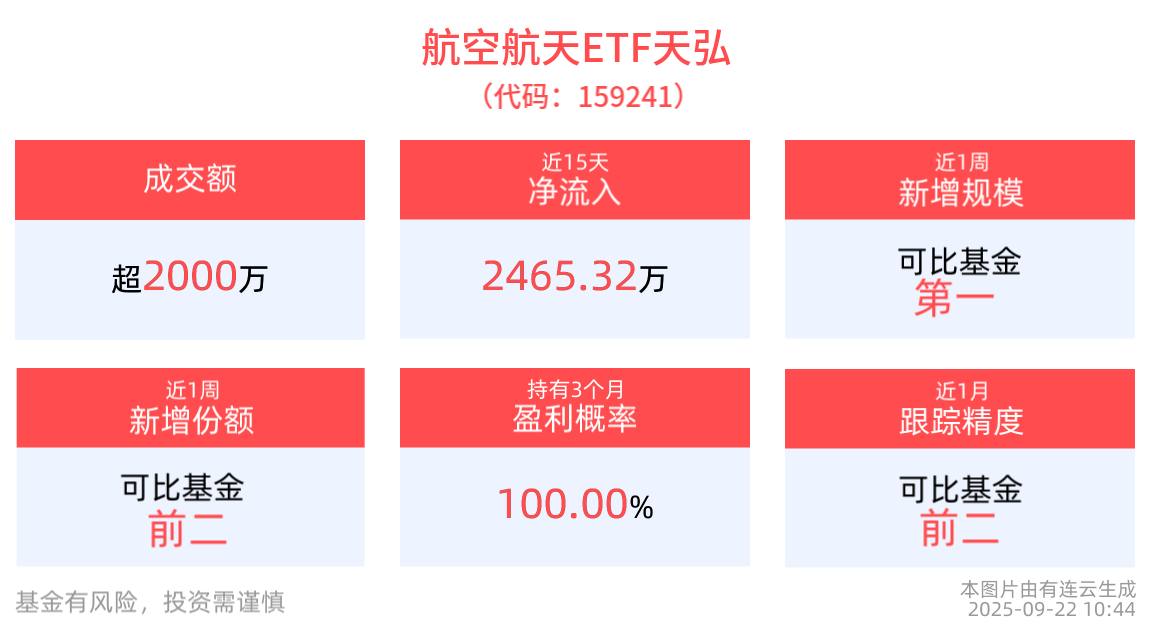
Core Viewpoint - The aerospace ETF Tianhong (159241) has shown significant growth in both scale and share, indicating strong investor interest in the aerospace and defense sector [3][5]. Product Highlights - The aerospace ETF Tianhong (159241) tracks the Guozheng Aerospace Index, with a military attribute of 97.86%, making it the highest military content index in the market. The aerospace equipment weight is 66.8%, surpassing other military indices [3]. Hot Events - The 2025 Air Force Aviation Open Day commenced in Changchun, showcasing the modernization achievements of the Chinese Air Force through aerial performances and ground exercises [3]. - Concurrently, the 2025 Changchun Aviation Exhibition featured over a hundred types of equipment, focusing on emerging fields like drones and low-altitude economy, serving as a platform for technology display and industry collaboration [4]. Institutional Views - According to AVIC Securities, the military industry is expected to enter a relatively stable phase due to recent events and the completion of mid-year performance disclosures. The market shows low systemic risk, with structural rotation within the military sector [5]. - The military sector has demonstrated resilience and vitality, avoiding volatility risks associated with overheating in single areas. Improved performance in certain fields and the anticipation of new orders are expected to strengthen the market outlook [5].


航天彩虹最新股东户数环比下降5.11% 筹码趋向集中
Zheng Quan Shi Bao Wang· 2025-09-16 12:44
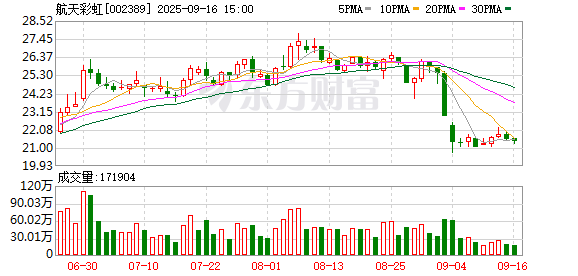
Summary of Key Points Core Viewpoint - Aerospace Rainbow has experienced a decline in shareholder numbers and stock price, indicating potential challenges in its financial performance and market perception [2]. Shareholder Information - As of September 10, the number of shareholders for Aerospace Rainbow was 128,089, a decrease of 6,896 from the previous period (August 31), representing a 5.11% decline. This marks the second consecutive period of decline in shareholder numbers [2]. Stock Performance - The closing price of Aerospace Rainbow was 21.40 yuan, down 0.37%. Since the concentration of shares began, the stock has cumulatively decreased by 18.07%. Over the trading days, the stock recorded 4 increases and 8 decreases, including one instance of hitting the daily limit down [2]. Financial Results - The company reported a total revenue of 811 million yuan for the first half of the year, reflecting a year-on-year decrease of 20.43%. The net profit was -489,600 yuan, a significant decline of 100.74% year-on-year, with basic earnings per share reported as 0.0000 yuan [2]. Analyst Ratings - In the past month, Aerospace Rainbow received buy ratings from three institutions. The highest target price was set by Huatai Securities at 33.78 yuan, as reported on August 22 [2].

“十四五”期间我国发布新能源汽车等 重点行业国家标准4000多项
Yang Shi Xin Wen Ke Hu Duan· 2025-09-05 07:29
Group 1 - The core viewpoint of the news is that since the beginning of the 14th Five-Year Plan, over 4,000 national standards have been released in key industries such as integrated circuits, new materials, new energy vehicles, robotics, and aerospace equipment, playing a significant role in supporting the construction of a modern industrial system and ensuring the stability of key industrial and supply chains [1] - Nearly 20% of the total group standards focus on advanced manufacturing fields such as new generation information technology and high-end equipment manufacturing, providing important support for industrial upgrading and technological innovation [1] Group 2 - In the field of intelligent manufacturing, 491 national standards have been released, providing high-quality references for the digital and intelligent transformation of manufacturing enterprises [2] - In the new energy vehicle sector, 95 national standards have been published, which play an important role in enhancing collaboration across the automotive industry chain and improving production efficiency while reducing costs [2] - In the solar photovoltaic sector, 221 national standards have been established, actively contributing to preventing irrational competition and promoting high-quality development of the industry [2]
我国“标准”领跑国际,制造业转型升级情况如何?
Qi Lu Wan Bao Wang· 2025-09-05 06:29
Core Insights - China has established over 4,000 national standards in advanced manufacturing since the "14th Five-Year Plan," significantly impacting cost reduction, product quality assurance, international trade, and enhancing enterprise competitiveness [1][3][11] Group 1: Standards Development - The State Administration for Market Regulation has released 491 national standards in the smart manufacturing sector, providing high-quality references for the digital and intelligent transformation of manufacturing enterprises [3] - In the new energy vehicle sector, 95 national standards have been published, enhancing collaboration across the automotive supply chain and improving production efficiency while reducing costs [3] - Approximately 20% of China's total group standards focus on advanced manufacturing fields such as new-generation information technology and high-end equipment manufacturing, supporting industrial upgrades and technological innovation [3] Group 2: International Standards and Collaboration - China has proposed 880 international standard proposals and led the development of 532 international standards in areas like new energy vehicles and aerospace during the "14th Five-Year Plan" [3] - The conversion rate of advanced applicable international standards into national standards exceeds 90%, with 4,210 international standards adapted for domestic use [4] - Platforms like the Hongqiao International Economic Forum and the Qingdao International Standardization Conference have been utilized to enhance international standard exchanges in advanced manufacturing sectors [4] Group 3: Impact on Manufacturing Efficiency - The establishment of over 30,000 basic smart factories, 1,200 advanced smart factories, and 230 excellent smart factories has led to significant improvements: average product development cycles shortened by 28.4%, production efficiency increased by 22.3%, defect rates reduced by 50.2%, and carbon emissions decreased by 20.4% [7] - The implementation of standards in smart manufacturing is seen as a key driver for high-quality development in the manufacturing sector, with specific guidelines provided for smart factory construction and safety control [6] Group 4: Future Industry Standards - Jiangsu Province has initiated a three-year action plan for future industry standardization, focusing on sectors like synthetic biology and drones, and promoting collaboration among technical organizations, universities, industry associations, and enterprises [9] - The government work report for 2025 emphasizes the need for standard enhancement to lead the optimization and upgrading of traditional industries [11] - The State Administration for Market Regulation plans to revise and develop over 4,000 national standards focusing on key areas such as artificial intelligence, IoT, and new materials to support manufacturing transformation [12]
我国正牵头制定脑机接口相关国际标准
Zhong Guo Xin Wen Wang· 2025-09-05 01:45
Core Viewpoint - The article emphasizes the critical role of standards in supporting economic activities and social development, particularly in enhancing the quality of manufacturing during the "14th Five-Year Plan" period [1] Group 1: National Standards and Manufacturing Development - Since the beginning of the "14th Five-Year Plan," over 4,000 national standards have been released in key industries such as integrated circuits, new materials, new energy vehicles, robotics, and aerospace equipment [1] - In the field of intelligent manufacturing, 491 national standards have been published, providing high-quality references for the digital and intelligent transformation of manufacturing enterprises [1] - In the new energy vehicle sector, 95 national standards have been established to enhance collaboration across the automotive supply chain, improve production efficiency, and reduce costs [1] - The solar photovoltaic sector has seen the release of 221 national standards, which help prevent irrational competition and promote high-quality industry development [1] Group 2: International Standards and Global Competitiveness - During the "14th Five-Year Plan," China has taken on 26 technical secretariats in international standard organizations and proposed 880 international standard proposals in key areas such as new energy vehicles and aerospace [2] - The conversion rate of advanced applicable international standards into Chinese standards exceeds 90% in key areas [2] - International standards are seen as a means to enhance the international competitiveness of industries, particularly in emerging technologies like artificial intelligence and brain-computer interfaces [2] Group 3: New Business Models and Trade Facilitation - International standards are facilitating the development of new business models driven by digital economy and technological innovation, providing unified technical specifications for various new industries [3] - The establishment of international standards for products like photovoltaic and new energy vehicles promotes smooth international trade connections [3] - Standards related to carbon data tracing and carbon footprint accounting are aiding sustainable development by addressing cross-border comparability and verification challenges [3] Group 4: Future Directions - The focus will be on guiding more technological achievements to be transformed into international standards and enhancing practical exchanges with other countries to continuously support high-quality manufacturing development [4]