
Foreign Exchange

Search documents
2025年5月29日银行间外汇市场人民币汇率中间价
news flash· 2025-05-29 01:20
2025年5月29日银行间外汇市场人民币汇率中间价 美元/人民币报7.1907,上调(人民币贬值)13点; 欧元/人民币报8.1027,下调531点; 港元/人民币报0.91762,上调4.2点; 英镑/人民币报9.6797,下调451点; 澳元/人民币报4.6309,下调93点; 加元/人民币报5.2016,下调91点; 100日元/人民币报4.9497,下调418点; 人民币/俄罗斯卢布报11.1021,下调519点; 新西兰元/人民币报4.2965,上调149点; 人民币/林吉特报0.58846,下调3.5点; 瑞士法郎/人民币报8.6653,下调354点; 新加坡元/人民币报5.5727,下调117点。 ...
【UNFX课堂】如何获取外汇交易基本面数据
Sou Hu Cai Jing· 2025-05-28 07:03
Group 1: Core Views - The acquisition of fundamental forex trading data is crucial for trading decisions, primarily through economic calendars and news websites that track economic indicators, policy changes, and geopolitical events [1] Group 2: Economic Calendar Tools - Economic calendars are essential for forex traders to obtain macroeconomic data release times and expected values, with several commonly used platforms available [2] - "Forex Bang" economic calendar synchronizes with data, covering key metrics like non-farm payrolls and central bank interest rate decisions, suitable for domestic investors due to its Chinese interface [3] - "Forex Factory" offers rapid data updates and strong community interaction, although it is only available in English, making it suitable for English-speaking traders [4] - "Invezz" provides real-time quotes for 200,000 financial products and a comprehensive economic calendar, including Fed rate hike predictions and earnings calendars, supporting multiple languages and free access [4] - "Securities Star" organizes economic data and political events by date, facilitating quick browsing of important indicators for the day [5] - "Forex Tianyan" integrates global economic indicators, bond auctions, and central bank officials' speeches, with clear data categorization, but is positioned as a third-party information query service [6] Group 3: News and Data Websites - "Jin Shi Data" offers instant financial news, data alerts, and event interpretations, excelling in rapid reporting of unexpected events and supporting multi-terminal access [7] - Reuters and Bloomberg are international authoritative media covering global macroeconomic data, central bank policies, and geopolitical analysis, suitable for in-depth reporting and professional commentary [8] - The Wall Street Journal focuses on U.S. economic policies and market dynamics, providing exclusive interpretations of Fed decisions and trade policies [9] - "Invezz" also provides real-time news, analyst opinions, and market sentiment indicators, suitable for comprehensive assessments [10] - "Finance Network" specializes in forex market news and analysis, covering central bank officials' speeches, policy expectations, and strategies combining technical and fundamental analysis [11] Group 4: Usage Tips and Considerations - Prioritize high-impact data such as interest rate decisions, non-farm employment, GDP, and CPI, as these have the most significant effect on exchange rates, with Fed rate decisions typically causing sharp fluctuations in the dollar index [13] - Compare expected values with actual values, as discrepancies often drive short-term market movements, for instance, if U.S. non-farm employment data significantly exceeds expectations, the dollar may strengthen rapidly [14] - Analyze central bank policy trends in conjunction with inflation and employment data for comprehensive judgment, exemplified by the Fed pausing rate cuts in 2025 due to tariff-induced inflation, leading to increased dollar volatility [15] - Utilize tools to assist decision-making, such as combining technical analysis to predict market reactions before data releases and employing hedging tools like forex options or futures to lock in exchange rate risks, especially before major events like elections [16] Group 5: Summary - The acquisition of forex fundamental data relies on professional economic calendars and real-time news platforms, with a focus on high-impact events and data discrepancies. Investors are advised to combine technical analysis and risk management strategies to enhance the accuracy of trading decisions [17]
每周(5.19-5.23)大白外汇英语交易术语学习汇总
Sou Hu Cai Jing· 2025-05-26 06:35
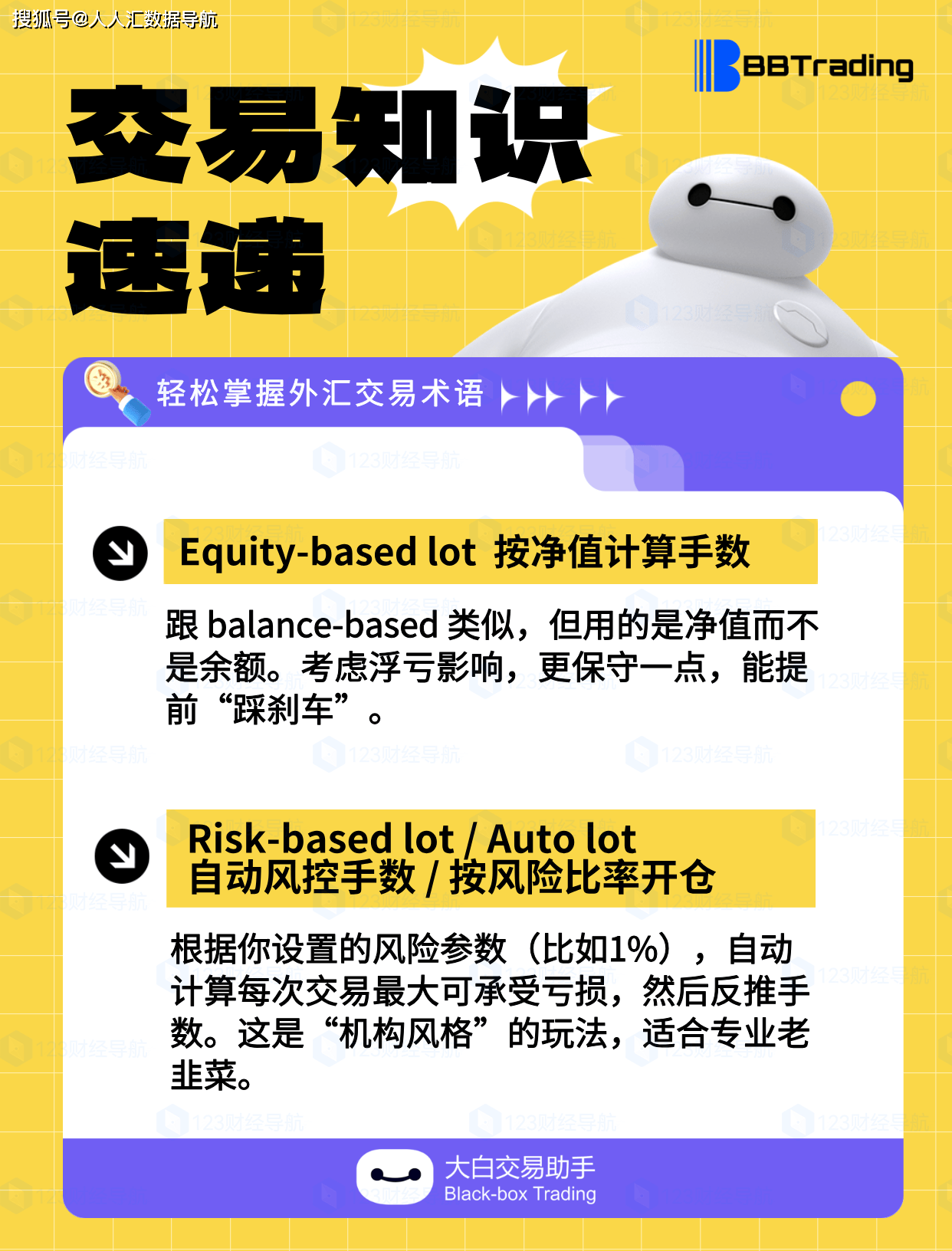
Group 1 - The article provides a summary of foreign exchange trading terminology for the week of May 19-23, focusing on key concepts that traders should understand [1][6]. - "Equity-based lot" is defined as a method of calculating lot size based on account equity rather than balance, allowing for a more conservative approach by considering floating losses [1][5]. - "Risk-based lot / Auto lot" is described as a method that automatically calculates the maximum allowable loss per trade based on set risk parameters, suitable for experienced traders [2][5]. Group 2 - "FX majors" refers to major currency pairs involving the US dollar and other highly liquid currencies, characterized by low spreads and high liquidity, making them popular for automated trading strategies [5][7]. - "FX minors" are defined as currency pairs that do not directly involve the US dollar, typically having higher spreads and lower liquidity, which can increase the risk of slippage and volatility [5][7]. - "Margin" is explained as the portion of funds that is frozen by the trading platform as a deposit for each order, with insufficient margin leading to automatic liquidation of positions [10]. - "Leverage" is described as a tool that allows traders to control larger positions with a smaller amount of capital, with a leverage ratio of 1:100 enabling a trader to control 100 times their investment [10]. - "Breakout" refers to a significant price movement after a period of consolidation, often targeted by trading strategies [13]. - "Consolidation" is characterized by price movements within a narrow range, where certain trading strategies may be favored [13]. - "Slippage" is defined as the difference between the expected price of a trade and the actual price at which the trade is executed, often occurring during volatile market conditions [14][15]. - "Drawdown" is explained as the maximum decline in account value from a peak to a trough, with a specific example illustrating a 50% drawdown [16].

2025年5月22日银行间外汇市场人民币汇率中间价
news flash· 2025-05-22 01:20
Core Viewpoint - The article provides the interbank foreign exchange market's RMB exchange rate midpoint for May 22, 2025, highlighting fluctuations against various currencies, indicating a mixed trend in the currency market [1]. Exchange Rate Summary - USD/RMB is reported at 7.1903, down by 34 points, indicating an appreciation of the RMB [1] - EUR/RMB is reported at 8.1462, up by 197 points, showing a depreciation of the RMB against the Euro [1] - HKD/RMB is reported at 0.91858, down by 3.1 points, indicating an appreciation of the RMB [1] - GBP/RMB is reported at 9.6474, up by 38 points, showing a depreciation of the RMB against the British Pound [1] - AUD/RMB is reported at 4.6273, down by 5 points, indicating an appreciation of the RMB [1] - CAD/RMB is reported at 5.1884, up by 104 points, showing a depreciation of the RMB against the Canadian Dollar [1] - 100 JPY/RMB is reported at 5.0009, up by 101 points, indicating a depreciation of the RMB against the Japanese Yen [1] - RMB/RUB is reported at 11.0853, down by 1220 points, indicating an appreciation of the RMB [1] - NZD/RMB is reported at 4.2688, down by 45 points, indicating an appreciation of the RMB [1] - RMB/MYR is reported at 0.59278, down by 20.9 points, indicating an appreciation of the RMB [1] - CHF/RMB is reported at 8.7096, up by 84 points, showing a depreciation of the RMB against the Swiss Franc [1] - SGD/RMB is reported at 5.5784, up by 146 points, indicating a depreciation of the RMB against the Singapore Dollar [1]
Currency Exchange International Corp. Commences Trading on the OTCQX Market Under the Symbol CURN
Globenewswire· 2025-05-20 11:30
Core Points - Currency Exchange International Corp. has upgraded its trading status to the OTCQX Best Market under the symbol CURN, effective May 20, 2025, from the Pink market [1][3] - The company will continue to maintain its primary listing on the Toronto Stock Exchange under the symbol CXI [2] - The upgrade aims to enhance the company's visibility and engagement with U.S. investors, aligning with its strategy to increase its U.S. shareholder base [3] Company Overview - Currency Exchange International Corp. provides comprehensive foreign exchange technology and processing services for banks, credit unions, businesses, and consumers in the U.S. and select global clients [4] - Key products and services include foreign currency exchange, wire transfer payments, Global EFTs, and foreign cheque clearing [4] - The company serves wholesale customers through proprietary FX software applications and personal relationship managers, while consumers are served through retail branches and an e-commerce platform [4] Operational Changes - The company's wholly-owned Canadian subsidiary, Exchange Bank of Canada, is in the process of discontinuing its operations [5]

【UNFX课堂】外汇市场一周展望(5.19-23):多重不确定性下的波动前瞻
Sou Hu Cai Jing· 2025-05-19 02:29
外汇市场一周展望:多重不确定性下的波动前瞻 (2025年5月19日-5月23日) 1. 美元的信用与避险双重属性博弈: 穆迪近期将美国AAA信用评级展望下调至Aa1,并预测美国债 务/GDP比率将持续攀升,这在长期内引发了市场对美元信用风险的担忧,并可能对美债收益率构 成上行压力。 2. 美联储政策预期的矛盾: 尽管部分美联储官员(如博斯蒂克)重申了2025年可能降息一次的预 期,但最新的美国通胀预期(5月一年期通胀预期初值高达7.3%)和疲软的消费者信心数据,共 同描绘了一幅经济增长放缓与通胀压力并存的复杂图景。这种"滞胀"风险或至少是高通胀的持续 性,可能限制美联储的政策空间,使得市场对降息时点和幅度的预期摇摆不定,进而影响美元走 势。 周一 (5月19日): 中国4月经济数据 (10:00): 工业增加值、社会消费品零售总额等数据。若表现强于预期,通常被视 为全球经济需求改善的信号,有望提振澳元、纽元等商品货币 欧元区4月CPI终值 (17:00): 若最终数据较初值上修,将进一步确认欧元区通胀的黏性,可能强化 欧洲央行维持紧缩或延迟降息的预期,从而支撑欧元。 美联储官员讲话 (20:45): 副主席杰 ...
2025年5月16日银行间外汇市场人民币汇率中间价
news flash· 2025-05-16 01:18
Core Points - The central bank's foreign exchange market data indicates a mixed performance of the Renminbi against various currencies, with a notable depreciation against the US dollar and a significant appreciation against the Swiss franc [1] Exchange Rate Summary - USD/CNY: 7.1938, down 25 points (Renminbi appreciation) [1] - EUR/CNY: 8.0573, up 9 points [1] - HKD/CNY: 0.92146, down 6.3 points [1] - GBP/CNY: 9.5785, up 243 points [1] - AUD/CNY: 4.6114, down 204 points [1] - CAD/CNY: 5.1596, up 39 points [1] - 100 JPY/CNY: 4.9494, up 310 points [1] - CNY/RUB: 11.1060, down 450 points [1] - NZD/CNY: 4.2322, down 201 points [1] - CNY/MYR: 0.59389, down 17.8 points [1] - CHF/CNY: 8.6189, up 556 points [1] - SGD/CNY: 5.5542, up 155 points [1]
HTFX外汇:清算速度对交易体验的影响
Sou Hu Cai Jing· 2025-05-14 16:55
Core Insights - The article emphasizes the importance of clearing speed in enhancing trading experience and profitability for forex traders [3][4][12] - HTFX's clearing speed is highlighted as a competitive advantage that reduces transaction delays and builds user trust [4][6] - Technological support, including automation and real-time monitoring, plays a crucial role in improving clearing efficiency [5][10] Group 1: Impact of Clearing Speed - Clearing speed directly affects decision-making efficiency in forex trading, allowing traders to respond quickly to market changes [6][8] - Faster clearing reduces transaction costs and enhances capital efficiency, enabling traders to execute subsequent trades more flexibly [6][12] - The speed of clearing is particularly critical during high market volatility, where delays can lead to missed trading opportunities [8][12] Group 2: Technological Innovations - Continuous technological advancements are expected to further enhance clearing speed and trading efficiency [10][11] - Automation tools and real-time analysis are essential for optimizing clearing processes and improving overall trading experience [7][10] - The integration of blockchain and artificial intelligence is anticipated to revolutionize clearing solutions, providing transparency and security [10][11] Group 3: User Feedback and System Performance - User feedback is vital for identifying bottlenecks in the clearing process and driving improvements [8][10] - Enhanced system performance directly influences daily operational efficiency and user experience, reducing latency and increasing confidence in the platform [7][10][14] - Key technical factors affecting clearing speed include network latency, server performance, and data processing capabilities [14]

大类资产早报-20250514
Yong An Qi Huo· 2025-05-14 11:53
Report Overview - The report is a macro team report from the research center, dated May 14, 2025, focusing on the performance of global asset markets [2] Global Asset Market Performance 10 - Year Treasury Yields of Major Economies - On May 13, 2025, the 10 - year Treasury yields of the US, UK, France, etc. were 4.467, 4.669, 3.353 respectively. The latest changes ranged from - 0.010 (Japan) to 0.038 (South Korea). Weekly changes varied from - 0.001 (Brazil) to 0.217 (Japan), monthly changes from - 0.124 (Italy) to 0.136 (Japan), and annual changes from - 1.034 (Japan) to 0.323 (UK) [3] 2 - Year Treasury Yields of Major Economies - On May 13, 2025, the 2 - year Treasury yields of the US, UK, Germany, etc. were 3.880, 3.974, 1.932 respectively. The latest changes ranged from - 0.020 (US and UK) to 0.092 (Australia). Weekly changes varied from - 0.051 (China 1Y) to 0.230 (US), monthly changes from - 0.095 (South Korea) to 0.225 (Australia), and annual changes from - 1.363 (Italy) to 0.430 (Japan) [3] Dollar Exchange Rates Against Major Emerging - Market Currencies - On May 13, 2025, the dollar - Brazilian real exchange rate was 5.608 with a latest change of - 1.19%. Weekly changes varied from - 1.86% (Brazil) to 2.12% (Malaysian ringgit), monthly changes from - 5.66% (South Africa) to - 2.83% (South Korea), and annual changes from - 10.36% (Thai baht) to 7.99% (Brazil) [3] Stock Indices of Major Economies - On May 13, 2025, the S&P 500, Dow Jones Industrial Average, and NASDAQ were 5886.550, 42140.430, 19010.080 respectively. The latest changes ranged from - 1.87% (Hang Seng Index) to 1.61% (NASDAQ). Weekly changes varied from - (Russia) to 7.46% (NASDAQ), monthly changes from - (Russia) to 16.00% (NASDAQ), and annual changes from - 11.23% (Thailand) to 31.82% (Germany's DAX) [3] Credit Bond Indices - The latest changes of US investment - grade, euro - zone investment - grade, and emerging - market investment - grade credit bond indices were 0.06%, - 0.01%, 0.01% respectively. Weekly changes were - 0.26%, - 0.13%, - 0.12%, monthly changes were 1.45%, 0.70%, 1.12%, and annual changes were 6.63%, 5.87%, 7.33% [3][4] Stock Index Futures Trading Data Index Performance - The closing prices of A - shares, CSI 300, SSE 50, ChiNext, and CSI 500 were 3374.87, 3896.26, 2708.06, 2062.26, 5781.67 respectively, with涨跌(%) of 0.17, 0.15, 0.20, - 0.12, - 0.21 [5] Valuation - The PE(TTM) of CSI 300, SSE 50, CSI 500, S&P 500, and Germany's DAX were 12.57, 10.93, 29.14, 25.18, 18.98 respectively, with环比变化 of 0.03, 0.04, - 0.08, 0.18, 0.06 [5] Risk Premium - The 1/PE - 10 - year interest rate of S&P 500 and Germany's DAX were - 0.50, 2.59 respectively, with环比变化 of - 0.03, - 0.05 [5] Fund Flows - The latest values of A - shares, the main board, small - and medium - sized enterprise board, ChiNext, and CSI 300 were - 959.81, - 591.43, -, - 302.57, - 115.58 respectively, and the 5 - day average values were - 514.16, - 328.65, -, - 139.64, - 12.26 [5] Trading Volume - The latest trading volumes of the Shanghai and Shenzhen stock markets, CSI 300, SSE 50, small - and medium - sized enterprise board, and ChiNext were 12915.25, 2675.86, 693.58, 2838.92, 3682.05 respectively, with环比变化 of - 168.85, - 285.37, - 95.22, 10.37, 0.61 [5] Main Contract Basis - The basis of IF, IH, IC were - 45.26, - 19.86, - 127.07 respectively, with a basis ratio of - 1.16%, - 0.73%, - 2.20% [5] Treasury Futures Trading Data Treasury Futures - The closing prices of T00, TF00, T01, TF01 were 108.715, 105.955, 108.890, 106.265 respectively, with涨跌(%) of - 0.49%, - 0.19%, - 0.45%, - 0.20% [6] Funding Rates - The R001, R007, SHIBOR - 3M were 1.4343%, 1.5337%, 1.6620% respectively, with daily changes of - 12.00BP, - 2.00BP, - 1.00BP [6]
2025年5月13日银行间外汇市场人民币汇率中间价
news flash· 2025-05-13 01:16
Summary of Key Points Core Viewpoint - The interbank foreign exchange market shows a depreciation of the Renminbi against various currencies, indicating a strengthening of the Renminbi overall [1] Currency Exchange Rates - The USD/CNY exchange rate is reported at 7.1991, down by 75 points, reflecting a Renminbi appreciation [1] - The EUR/CNY exchange rate is at 8.0017, down by 1057 points, indicating a significant Renminbi strengthening against the Euro [1] - The HKD/CNY exchange rate is at 0.92374, down by 26.5 points, showing a slight Renminbi appreciation against the Hong Kong Dollar [1] - The GBP/CNY exchange rate is at 9.5047, down by 868 points, suggesting a notable Renminbi appreciation against the British Pound [1] - The AUD/CNY exchange rate is at 4.5980, down by 413 points, indicating a Renminbi strengthening against the Australian Dollar [1] - The CAD/CNY exchange rate is at 5.1623, down by 241 points, reflecting a Renminbi appreciation against the Canadian Dollar [1] - The JPY/CNY exchange rate is at 4.8633, down by 913 points, showing a significant Renminbi strengthening against the Japanese Yen [1] - The CNY/RUB exchange rate is at 11.2425, down by 1580 points, indicating a Renminbi appreciation against the Russian Ruble [1] - The NZD/CNY exchange rate is at 4.2270, down by 529 points, reflecting a Renminbi strengthening against the New Zealand Dollar [1] - The CNY/MYR exchange rate is at 0.59787, up by 20.7 points, indicating a slight depreciation of the Renminbi against the Malaysian Ringgit [1] - The CHF/CNY exchange rate is at 8.5355, down by 1183 points, suggesting a Renminbi appreciation against the Swiss Franc [1] - The SGD/CNY exchange rate is at 5.5249, down by 388 points, indicating a Renminbi strengthening against the Singapore Dollar [1]