
卖出美国

Search documents
“卖出美国”论调遭打脸:2025年外资对美长期金融资产配置增至1.55万亿美元
智通财经网· 2026-02-19 00:38
Core Viewpoint - The data released on Wednesday indicates a significant increase in foreign purchases of U.S. financial assets in 2025, countering the narrative of "selling America" that has been prevalent among market participants [1] Group 1: Foreign Investment Trends - In 2025, foreign investors net purchased $1.55 trillion of U.S. long-term financial assets, up from $1.18 trillion the previous year, with $442.7 billion flowing into U.S. Treasury bonds [1] - Despite concerns over U.S. tariffs and geopolitical tensions, foreign investors bought more U.S. stocks in 2025, with net purchases reaching $720.1 billion, a 134% increase from $307.5 billion in 2024 [3] - Norway emerged as the largest buyer of U.S. stocks in 2025, net purchasing $81.8 billion, nearly three times its 2024 total, followed by Singapore with $79 billion and South Korea with $73.6 billion [4] Group 2: Regional Investment Insights - European investors accounted for a net inflow of $872.8 billion in long-term financial assets, with the Cayman Islands and Japan also showing significant net purchases of $277.2 billion and $56 billion, respectively [2] - Canada transitioned from being a major seller of U.S. stocks in 2024 to a buyer in 2025, net purchasing $10.6 billion despite trade policy concerns [5] Group 3: Market Sentiment and Economic Policy - The narrative of "selling America" has been challenged by the continued strong demand for U.S. technology stocks, with investors leveraging opportunities presented by the valuation adjustments of the dollar [2][3] - U.S. Treasury Secretary Scott Bessen has consistently refuted the "selling America" claims, asserting that government economic policies enhance the U.S.'s status as a preferred destination for global capital [1]
“抛售美国”论暂不成立:去年海外投资者净买1.55万亿美元美长期金融资产
Sou Hu Cai Jing· 2026-02-18 23:04
Group 1 - In 2025, foreign investors purchased $1.55 trillion in U.S. long-term financial assets, an increase from $1.18 trillion the previous year, driven by demand for stocks and U.S. Treasury securities [1] - Of the total, $658.5 billion flowed into stocks and $442.7 billion into U.S. Treasury securities, including medium- and long-term bonds [1] - The narrative of "Sell America" is countered by the increasing foreign investment in U.S. assets, despite geopolitical concerns and threats of increased tariffs from the U.S. government [1] Group 2 - In addition to stocks and Treasury securities, foreign investors also net purchased $327.8 billion in corporate bonds and $112.9 billion in agency debt from Fannie Mae and Freddie Mac [2] - Europe contributed $872.8 billion in net inflows of long-term financial assets, while China reduced its holdings of U.S. long-term financial assets by $208.6 billion, reaching the lowest level since 2008 [4] - In December, foreign investors had a net inflow of $44.9 billion in long-term securities, with private sector investors contributing $32.7 billion and official sector investors $12.2 billion [6]

去年美国以外的投资者购买美国金融资产的步伐加快,但12月美债持仓减少
Sou Hu Cai Jing· 2026-02-18 22:51
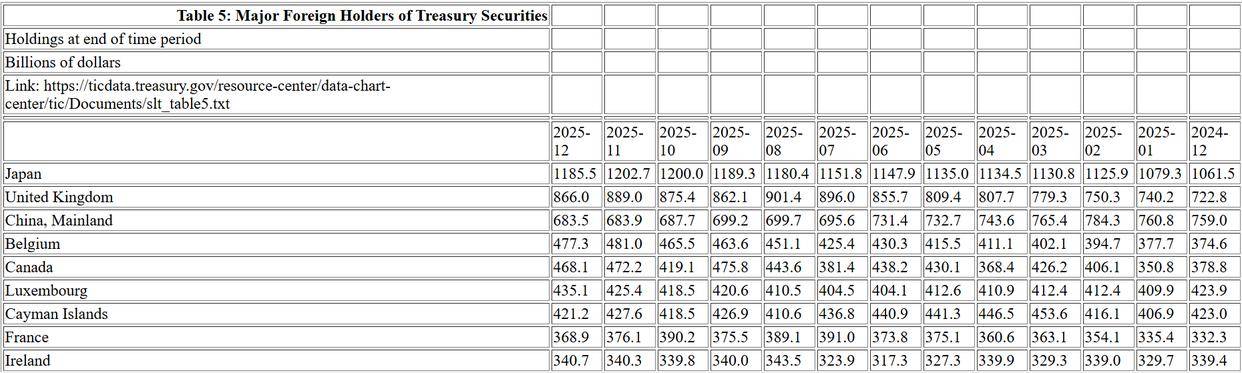
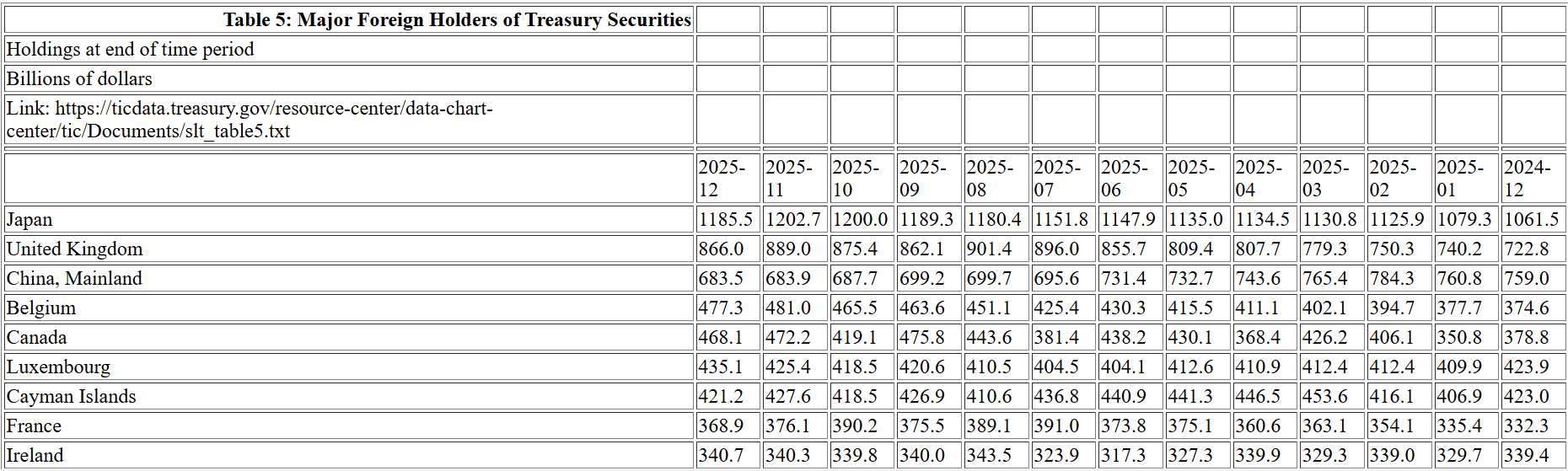
Core Viewpoint - The U.S. Treasury Department reported a significant increase in foreign investment in U.S. financial assets in 2025, countering the "Sell America" narrative, with net purchases reaching $1.55 trillion, up from $1.18 trillion the previous year [1] Group 1: Foreign Investment Trends - In 2025, foreign investors net purchased $1.55 trillion in U.S. long-term financial assets, with $658.5 billion in stocks and $442.7 billion in U.S. Treasury securities [1] - The net purchase of corporate bonds reached $327.8 billion, while net purchases of agency debt amounted to $112.9 billion [2] - European investors contributed $872.8 billion to long-term financial asset net inflows, with the Cayman Islands at $277.2 billion and Japan at $56 billion [4] Group 2: U.S. Treasury Securities Holdings - As of December, foreign holdings of U.S. Treasury securities decreased by $88.4 billion to $9.27 trillion, marking the lowest level since October [3] - Japan remains the largest foreign holder of U.S. Treasury securities, with holdings of $1.19 trillion, followed by the United Kingdom at $866 billion and mainland China at $683.5 billion [3] - China reduced its holdings of U.S. long-term financial assets by $208.6 billion, reaching the lowest level since 2008 [4] Group 3: Market Reactions and Economic Policies - U.S. Treasury Secretary has refuted the "Sell America" narrative, asserting that U.S. economic policies enhance its status as a preferred destination for global capital [2] - Despite geopolitical uncertainties, analysts believe that the fundamental demand for U.S. Treasury securities will remain strong due to their significant share in global sovereign debt [2] - The depreciation of the dollar may encourage some foreign asset managers to increase their holdings in U.S. securities [2]
新闻分析丨欧洲资本欲与美元资产保持“安全距离”
Xin Hua She· 2026-02-12 13:15
Group 1 - European financial institutions and consulting firms are increasingly reducing their investments in US dollar assets due to growing uncertainties in US monetary and fiscal policies, shifting focus towards European and emerging market economies [1][2] - A survey by Barclays Bank revealed that investor willingness to invest in US-based hedge funds has significantly decreased, while interest in hedge funds based in Asia and Europe has notably increased, marking the first decline in interest towards US hedge funds since 2023 [1] - The CEO of Amundi, the largest asset management firm in Europe, indicated a push for investment diversification over the past year, suggesting clients to spread their investments as the dollar may continue to weaken if current US economic policies persist [1] Group 2 - The Dutch pension fund ABP reported a significant decrease in the market value of its US Treasury holdings, dropping from nearly €29 billion to around €19 billion, likely due to selling off bonds rather than price fluctuations [2] - Other European pension funds, including Sweden's Alecta and Denmark's AkademikerPension, have also announced plans to sell or have already sold their US Treasury holdings, reflecting a broader trend of European capital reallocating away from US assets [2] - Analysts believe that the shift in European capital towards reducing dollar asset exposure is a rational response to multiple risks, including the impact of US policies on international stability and trade [2][3] Group 3 - There is a clear trend of European capital seeking safer and more stable investment strategies, with many investors diversifying their asset allocations as a strategic adjustment in response to a complex international environment [3] - Concerns over US dollar assets are influencing investor behavior, potentially putting downward pressure on dollar asset prices, as discussions in Europe about reducing dollar exposure signal caution towards US policies [3] - European capital is increasingly focusing on risk management related to dollar assets and is actively promoting diversified investment strategies, reflecting a structural adjustment in the market [3]

【环球财经】欧洲资本欲与美元资产保持“安全距离”
Xin Hua She· 2026-02-12 12:40
Core Viewpoint - European financial institutions are increasingly reducing their investments in US dollar assets and shifting focus towards European and emerging market economies due to growing uncertainties in US monetary and fiscal policies [1][2][3] Group 1: Investment Trends - A survey by Barclays Bank revealed that investor willingness to invest in US-based hedge funds has significantly decreased, while interest in hedge funds based in Asia and Europe has notably increased [1] - The Dutch pension fund ABP reported a substantial decline in the market value of its US Treasury holdings, from nearly €29 billion to around €19 billion, indicating a potential sale of US debt rather than mere price fluctuations [2] - Major European pension funds, including Sweden's Alecta and Denmark's AkademikerPension, have announced plans to sell or have already sold their US Treasury holdings [2] Group 2: Risk Assessment - Analysts suggest that the trend of European capital reallocating away from US assets reflects a rational assessment of multiple risks, including geopolitical tensions and economic policies from the US that have increased market uncertainty [2][3] - The ongoing discussions in Europe about the potential "weaponization" of US assets highlight the growing concerns regarding the stability of US investments [2] Group 3: Strategic Adjustments - European institutions are not completely divesting from dollar assets but are strategically diversifying their asset allocations to mitigate risks associated with US policies [3] - The shift in investment behavior towards reducing exposure to dollar assets is seen as a psychological effect that could further pressure the prices of these assets [3] - There is a clear trend of structural adjustment within European capital, with investors actively hedging against political risks related to US policies and reassessing their long-term relationships with the US market [3]
“卖出美国”风潮再起 分析师:“对冲美国”更贴近现实
Zhi Tong Cai Jing· 2026-02-02 15:28
Group 1 - The core narrative of "Sell America" is gaining traction among global investors due to rising policy uncertainties under the Trump administration, which has led to concerns about the safety of U.S. assets [1][2] - Foreign investors have historically played a crucial role in supporting the U.S. stock market and filling fiscal and trade deficits, but a shift in sentiment could have profound implications for the dollar, U.S. Treasuries, and the overall economy [1][2] - The U.S. dollar has depreciated approximately 10% since Trump returned to office, indicating a gradual reduction in investor exposure to the dollar [2][3] Group 2 - The "Sell America" narrative is primarily driven by concerns over the rising risks associated with dollar-denominated assets, as evidenced by Moody's downgrade of the U.S. credit rating due to long-term fiscal deficit projections [2][3] - Notable actions include Danish pension fund AkademikerPension's decision to sell about $100 million in U.S. Treasuries, reflecting a growing perception of credit risk associated with the U.S. [3][4] - Japanese markets are being considered as potential alternatives for investment, while some investors are opting for hedging strategies to mitigate further depreciation of the dollar rather than fully divesting from U.S. assets [4][5] Group 3 - Despite the rising risks, divesting from U.S. assets is challenging due to the significant growth of U.S. corporate earnings compared to other regions and the dominance of U.S. tech giants in the global market [5][6] - The market size of U.S. bonds remains unmatched by alternatives such as Australia, New Zealand, or the UK, making it difficult for the euro or other currencies to displace the dollar in the short term [5][6] - The sentiment among experts is that the U.S. remains an essential economy where positive returns can still be achieved, indicating that while risks are present, the U.S. market continues to attract investment [6]
前高盛高管:沃什执掌美联储可降低美国资产遭大规模抛售的风险
Ge Long Hui A P P· 2026-01-30 23:32
Core Viewpoint - The nomination of Kevin Warsh as the next Federal Reserve Chairman reduces the risk of large-scale sell-offs in U.S. assets, as he is expected to take measures to address inflation [1]. Group 1 - Fulcrum Asset Management believes that the market will react positively, leading to a sigh of relief in the dollar market [1]. - Gavyn Davies, co-founder and chairman of Fulcrum, stated that Warsh's selection lowers the risk of a "crisis-laden 'sell America' trade" [1].
综述丨国际金价突破5500美元 再创历史新高
Sou Hu Cai Jing· 2026-01-29 07:35
Group 1 - The international spot gold price and April gold futures on the New York Commodity Exchange both surpassed $5,500 per ounce, marking a historical high, with a market capitalization increase of over $3.5 trillion in the gold market [1][3] - Gold prices have risen more than $500 per ounce in the past 72 hours, with an overall increase of approximately 20% since the beginning of 2026 [1][3] - Concerns regarding the independence of the Federal Reserve, geopolitical risks, trade and tariff worries, and rising inflation pressures are driving individual investors to increase their gold holdings [3] Group 2 - Analysts believe that the current rise in gold prices is not driven by technical buying but by structural changes in the market, with central bank demand providing strong support for price increases [3][4] - Global financial broker XS.com indicates that the rise in gold prices is due to increased market anxiety and a cautious attitude towards the global monetary and fiscal order [3] - Most institutions maintain an optimistic outlook for gold prices, with Goldman Sachs predicting stability at $5,400 by the end of the year and Deutsche Bank forecasting a rise to $6,000 as the dollar weakens [4]

机构称日美联合干预日元门槛较高 短期内不太可能发生
Xin Hua Cai Jing· 2026-01-26 12:48
Core Viewpoint - The New York Fed's recent currency check signals close cooperation between U.S. and Japanese authorities to curb yen depreciation, raising market vigilance for potential intervention [1] Group 1: Market Analysis - Analysts suggest that direct coordinated intervention may not occur as quickly as anticipated, despite the recent currency check [1] - Historical context indicates that coordinated interventions have only happened in rare circumstances, highlighting the distance between a currency check and actual intervention [1] Group 2: Expert Opinions - Morgan Stanley's forex strategist notes that the U.S. may be reluctant to buy a currency that has depreciated for five consecutive years, indicating that any intervention might be limited in scale [1] - Concerns arise that continued Japanese intervention could necessitate selling U.S. Treasury holdings, potentially increasing U.S. bond yields, which is an undesirable outcome for the U.S. [1] - Analysts express skepticism about the U.S. engaging in actions that would lead to a sell-off of the dollar amid global de-dollarization concerns [1]
特朗普威胁:如果欧洲抛售美国资产 将采取“大规模报复”
Zhong Guo Ji Jin Bao· 2026-01-23 00:53
Core Viewpoint - President Trump threatens "massive retaliation" if European countries sell U.S. assets in response to his tariff threats, indicating a potential escalation in trade tensions [2]. Group 1: U.S. Asset Sales - Trump stated that if Europe proceeds with selling U.S. assets, the U.S. will respond strongly, emphasizing that the U.S. has various options available [2]. - Speculation arises that Europe might sell trillions of dollars in U.S. bonds and stocks as a countermeasure to Trump's tariffs [2]. - Danish pension fund AkademikerPension announced plans to exit $100 million in U.S. Treasury investments, while Greenland's SISA Pension is considering its U.S. stock investments [2][3]. Group 2: Market Reactions - U.S. Treasury Secretary Scott Bessenet downplayed the significance of Denmark's asset sales, stating that their investments in U.S. debt are negligible [3]. - The "Sell America" narrative has resurfaced amid geopolitical tensions, particularly following Trump's tariff threats regarding Greenland [3]. - Some European pension funds have begun selling U.S. Treasuries but have not fully exited U.S. equities, indicating a selective approach to asset management [3]. Group 3: Broader Implications - The Ontario Teachers' Pension Plan has reduced its exposure to U.S. dollars and Treasuries, reflecting a cautious stance towards U.S. assets [4]. - UBS CEO Sergio Ermotti warned that divesting completely from U.S. assets is a "dangerous bet," highlighting the strength of the U.S. economy [5].