Semiconductors

Search documents
重视华为昇腾
2026-04-01 09:59
Summary of Huawei Ascend 950 Series Conference Call Company and Industry Overview - The conference call focuses on Huawei's Ascend 950 series AI chips, particularly the 950P2 and the upcoming 950DT, which are positioned to lead the AI chip market and outperform competitors like NVIDIA [1][2]. Key Points and Arguments Performance and Technology - The Ascend 950 series has exceeded market expectations, with significant positive feedback from large internet companies, especially compared to the previous 910B and 910C series [2]. - Core technological features include: - Support for low-precision operations (FP4 and FP8), unlike the previous models which only supported FP16 [2]. - Introduction of Super Node technology and unified memory management [2]. - The first AI chip globally to implement PD separation (Prefill/Decode Separation), which decouples the processing stages to optimize resource allocation [2][3]. PD Separation Technology - PD separation allows for distinct handling of the Prefill and Decode stages, optimizing hardware usage and reducing costs [3][4]. - The Prefill stage requires high parallel processing but low memory bandwidth, while the Decode stage demands high memory bandwidth [4]. - This separation is crucial for meeting the increasing demands of AI inference, allowing for more efficient chip designs [4]. Market Expectations and Industry Impact - The expected order volume for the Ascend 950 chips in 2026 is projected to be between 500,000 to 700,000 units, indicating strong market demand [8]. - The shift towards Huawei's self-manufactured Super Nodes may limit opportunities for third-party server manufacturers, impacting their market elasticity [8]. - Beneficiaries in the supply chain include connector manufacturers (e.g., Huafeng Technology, Yihua Co., Aerospace Electronics) and power management companies (e.g., Jiewa Technology) [8]. Competitive Landscape - Google's TurboQuant technology, which compresses KV Cache requirements, is noted for its potential to reduce memory bandwidth needs significantly, although overall demand for bandwidth is expected to rise due to expanding context windows in AI models [5][6]. - The relationship between TurboQuant and the increasing context window size highlights the ongoing need for advanced hardware capabilities [6]. Future Trends in AI Chip Industry - The year 2026 is anticipated to be pivotal for the domestic AI chip industry, with significant advancements in performance and capabilities compared to previous generations [9]. - New generation chips are expected to support low-precision operations and Super Node technology, enhancing their application in AI inference scenarios [9]. - The overall improvements in performance and architecture signify a robust growth opportunity for the domestic AI chip sector, making it a focal point for investment [9]. Additional Important Insights - The Ascend 950 series is positioned to not only meet current AI inference demands but also to adapt to future technological advancements and market needs [1][7]. - The emphasis on self-manufacturing Super Nodes by Huawei indicates a strategic move to control the supply chain and enhance performance without relying on third-party vendors [7].
半导体-2026 年中国半导体展(SEMICON China)核心收获-Greater China Technology Semiconductors-SEMICON China 2026 Key Takeaways
2026-04-01 09:59
Key Takeaways from SEMICON China 2026 Conference Industry Overview - The conference highlighted that China's semiconductor capacity expansion and domestic equipment substitution are progressing as planned [1][7]. Memory Sector Insights - **YMTC and CXMT** are continuing multi-year capacity build-outs, supported by structured equipment import cycles and accelerating technology migration, which is creating sustained demand for domestic wafer fab equipment (WFE) vendors [2][10]. - **YMTC** is on track to complete its Fab 2 production ramp in 2026, adding 20k wafers per month (wpm) of new capacity, with equipment move-in for Fab 3 scheduled for the second half of 2026 [11]. - **CXMT** is experiencing stronger order momentum in 2026, focusing its capacity expansion primarily on DDR5 technology, which significantly increases the value of front-end thin film deposition equipment [11][10]. - Forecasts indicate that **YMTC** will add 25k wpm and **CXMT** will add 60k wpm of new capacity in 2026 [12]. Advanced Logic Process Developments - Capacity expansion in the advanced logic process space remains robust, with multiple fabs beyond SMIC South adding capacity for leading-edge nodes [3]. - Domestic equipment penetration in leading-edge nodes is expected to reach approximately 15% in 2026, primarily driven by thin film deposition tools [16]. Domestic Equipment Vendor Innovations - Domestic semiconductor equipment vendors showcased significant product breakthroughs at the conference, including new etch systems and mass production achievements in thin film deposition tools [4][21]. - **AMEC** launched several new products, including a high-selectivity etch system for 3D memory devices and an ICP etch tool currently undergoing customer certification [4][24]. - **ACMR** introduced its "Eight-Planet" product roadmap, indicating a shift from a single-product focus to a more diversified semiconductor equipment platform [23]. Investment Recommendations - The report maintains an Overweight (OW) rating on **Naura**, **AMEC**, and **ACMR**, reflecting a positive outlook on their positioning within China's semiconductor localization cycle [5]. Foundry and Advanced Packaging Trends - Leading foundries, including **SMIC** and **XMC**, are vertically integrating into the advanced packaging value chain, establishing dedicated research institutes and 3D integration business units [29]. - Expected dedicated advanced packaging capacity from these foundries is anticipated to come online within the next 1-2 years, potentially reshaping competitive dynamics for domestic OSATs [30]. Economic Context - The growth in China's semiconductor equipment imports has declined to -15% year-over-year as of February 2026, indicating potential challenges in the market [20]. Conclusion - The semiconductor industry in China is poised for significant growth driven by memory capacity expansion, domestic equipment innovation, and advancements in foundry capabilities, despite facing some economic headwinds.
The Market Is Early Calling The Peak In Micron (NASDAQ:MU)
Seeking Alpha· 2026-04-01 09:43
Core Insights - Micron Technology, Inc. has been under scrutiny for high valuations, particularly when trading around $250, yet there remains a strong conviction to buy the stock due to its potential growth opportunities [1]. Group 1: Company Overview - Micron Technology, Inc. is a key player in the semiconductor industry, focusing on memory and storage solutions [1]. Group 2: Analyst Background - The analyst has over 20 years of experience in quantitative research, financial modeling, and risk management, with a strong focus on equity valuation and market trends [1]. - The analyst previously held a Vice President position at Barclays, leading teams in model validation and stress testing, which contributes to a deep expertise in both fundamental and technical analysis [1]. Group 3: Research Approach - The research approach combines rigorous risk management with a long-term perspective on value creation, aiming to provide actionable investment ideas [1]. - There is a particular interest in macroeconomic trends, corporate earnings, and financial statement analysis to uncover high-growth investment opportunities [1].



Chinese chipmakers claim nearly half of of local market as Nvidia's lead shrinks, IDC says
Reuters· 2026-04-01 09:15
Core Insights - Chinese GPU and AI chip makers captured nearly 41% of China's AI accelerator server market in 2025, significantly reducing Nvidia's market dominance [2][5] - The shift is attributed to China's increasing caution about reliance on foreign chips, leading to a push for domestic alternatives amid U.S. export controls [3][5] Market Share Dynamics - Nvidia remains the market leader with approximately 2.2 million AI accelerator cards shipped, holding a 55% market share, but this represents a decline from its previous dominance [4][7] - Chinese vendors collectively shipped 1.65 million cards, marking a significant milestone in the market, with Huawei leading at around 812,000 cards, followed by Alibaba's T-Head with approximately 265,000 cards [5][6] Competitive Landscape - Baidu's Kunlunxin and Cambricon each shipped around 116,000 cards, ranking them jointly third among Chinese vendors [6] - Other Chinese vendors like Hygon, MetaX, and Iluvatar CoreX accounted for 5%, 4%, and 3% of total shipments, respectively [6] Government Initiatives - In 2025, the central government initiated a new wave of AI infrastructure spending, encouraging local governments to accelerate the establishment of intelligent computing centers with directives to prioritize domestic products [6]


Does Google's New TurboQuant Technology Mean the Party's Over for Micron?
The Motley Fool· 2026-04-01 09:15
Core Insights - A Chinese quantitative hedge fund developed an AI model named DeepSeek, which improved training efficiency using fewer and lower-quality semiconductors [1] - Following the initial sell-off of AI semiconductor and memory stocks, the market rebounded as increased model efficiency led to higher demand for computing power and memory [2] - Google Research introduced TurboQuant, a memory compression technology that enhances AI inference efficiency, causing a temporary decline in major memory companies' stocks [3] Group 1: TurboQuant Technology - TurboQuant significantly enhances the capacity and speed of key-value cache (KV-cache) in AI inference, allowing AI algorithms to retain context without recalculating all previous tokens [4] - The technology simplifies data storage by using vectors and embeddings, reducing computational needs while maintaining accuracy through a 1-bit error-correction mechanism [6] - Google Research claims TurboQuant can increase KV-cache capacity by six times and make AI inference eight times faster without loss of accuracy [7] Group 2: Market Implications - The potential for reduced demand for memory in future inference applications due to TurboQuant's efficiency is debated, with concerns about a shift from high-bandwidth memory (HBM) to traditional server memory [9] - HBM, while faster, is more expensive and has been a significant factor in the current memory supply crunch; TurboQuant may allow for more effective use of traditional memory types [10][11] - Despite potential risks to the HBM market, the overall demand for HBM in AI model training is expected to continue increasing, as TurboQuant does not impact this segment [13] Group 3: Investment Opportunities - The recent sell-off in memory stocks, including Micron, may present a buying opportunity for investors who missed previous gains [16] - The ongoing AI era suggests that increased efficiency from technologies like TurboQuant could lead to greater overall demand for memory resources, aligning with Jevon's Paradox [14][15]
Billionaire Ken Griffin Buys 2 AI Stocks Chasing a $1 Trillion Market Opportunity in Robotaxis (Hint: Not Tesla)
The Motley Fool· 2026-04-01 08:48
Market Opportunity - Light-duty vehicles in the U.S. travel over 3 trillion miles annually, with ride-sharing services charging $1 to $2 per mile, indicating a potential trillion-dollar market for robotaxis in the U.S. alone [1] Nvidia - Ken Griffin's hedge fund has significant holdings in Nvidia, which is the industry standard for AI workload acceleration through its GPUs, essential for developing robotaxis [2][4] - Nvidia's software ecosystem, including code libraries and pretrained models, facilitates the development of autonomous driving systems [5] - The integration of Nvidia's tools, such as Omniverse for simulation and Cosmos for generating synthetic data, enhances the training of AI models for autonomous vehicles [6][8] - Nvidia's CFO stated that robotaxis could generate hundreds of billions in revenue over the next decade, with every major OEM utilizing Nvidia technology [8][9] - Wall Street estimates Nvidia's earnings will grow at 38% annually over the next three years, making its current valuation of 35 times earnings appear attractive [9] Amazon - Amazon's second-largest holding is Zoox, which operates purpose-built robotaxis without traditional driving controls, currently providing rides in Las Vegas and San Francisco [10][11] - Zoox is testing robotaxis in Austin and plans to expand its service area, having applied for a commercial ride-sharing service with up to 2,500 vehicles [12] - Morgan Stanley projects Zoox will account for 12% of autonomous rides annually by 2032, positioning it behind major competitors like Waymo, Tesla, and Uber [13] - Amazon's core businesses, including e-commerce and cloud computing, are expected to see earnings growth of 19% annually over the next three years, with a current valuation of 29 times earnings being attractive [14]


Nvidia vs. Broadcom: The Smarter AI Stock to Buy in April
The Motley Fool· 2026-04-01 08:15
Core Insights - Nvidia and Broadcom are leading investments in the artificial intelligence (AI) sector, with Nvidia being the preferred buy for April due to its growth and valuation advantages [1][10]. Nvidia - Nvidia has established itself as the primary provider of AI computing units since the AI expansion began in 2023, with its GPUs being the industry standard for accelerated computing [3]. - The upcoming Vera Rubin chip architecture is expected to significantly enhance performance, requiring four times fewer chips for training and ten times fewer for inference compared to the current Blackwell generation [3][4]. - Nvidia anticipates lifetime sales of Blackwell and Rubin chips to reach $1 trillion by the end of 2027, a substantial increase from the previous expectation of $500 billion by 2026 [4]. - Nvidia's stock is currently trading at $174.36, with a market cap of $4.2 trillion and a gross margin of 71.07% [5]. Broadcom - Broadcom approaches the AI market differently by partnering with AI hyperscalers to create custom AI chips, which are optimized for specific tasks and can outperform Nvidia's GPUs in those areas [6]. - Broadcom expects its custom AI chips to generate $100 billion in revenue by the end of 2027, with its relevant division growing at a rate of 106% to $8.4 billion in the last quarter [7]. - Broadcom's stock is currently priced at $309.29, with a market cap of $1.5 trillion and a gross margin of 64.96% [8]. Market Outlook - The AI build-out is projected to continue through at least 2030, with global data center capital expenditures expected to rise to $3 trillion to $4 trillion annually by the end of that year, providing a significant growth opportunity for both companies [9]. - Nvidia's growth rate has outpaced Broadcom's in the last quarter, and it is considered cheaper from a forward price-to-earnings perspective [10][12].

Why the closure of the Strait of Hormuz is about more than just oil | FT #shorts
Financial Times· 2026-04-01 08:05
thinking about the kind of general economic mayhem that's being caused by the the straight of whom is being closed. You know, energy is first order. That's the one everyone's talking about. There's some chatter about fertilizer that being an issue.It's also helium. What's your kind of favorite, oh dear, we really need to think about that one uh category. >> So, I'll confess that before this war, when I thought of helium, I thought of my kids birthday parties and the balloon that I buy, you know, for them.Bu ...

Nvidia Stock Suffers Rare 2-Quarters Loss. History Gives Reason for Hope.
Barrons· 2026-04-01 07:36
Core Insights - Nvidia stock has experienced two consecutive quarterly losses for the first time in years, indicating a potential shift in the company's financial performance [1] - Despite the recent losses, Nvidia's historical performance suggests there is hope for a recovery in the near future [1] Company Performance - The recent quarterly losses mark a significant change in Nvidia's financial trajectory, which has been characterized by consistent growth in previous years [1] - The company's record suggests that it has the potential to rebound from these losses, reflecting resilience in its business model and market position [1] Industry Context - Nvidia operates in a highly competitive semiconductor industry, where fluctuations in demand and supply can significantly impact financial results [1] - The overall market conditions and technological advancements may play a crucial role in Nvidia's ability to recover from its recent setbacks [1]

Asian stocks jump on renewed hopes of Iran war ending
ABC News· 2026-04-01 07:22
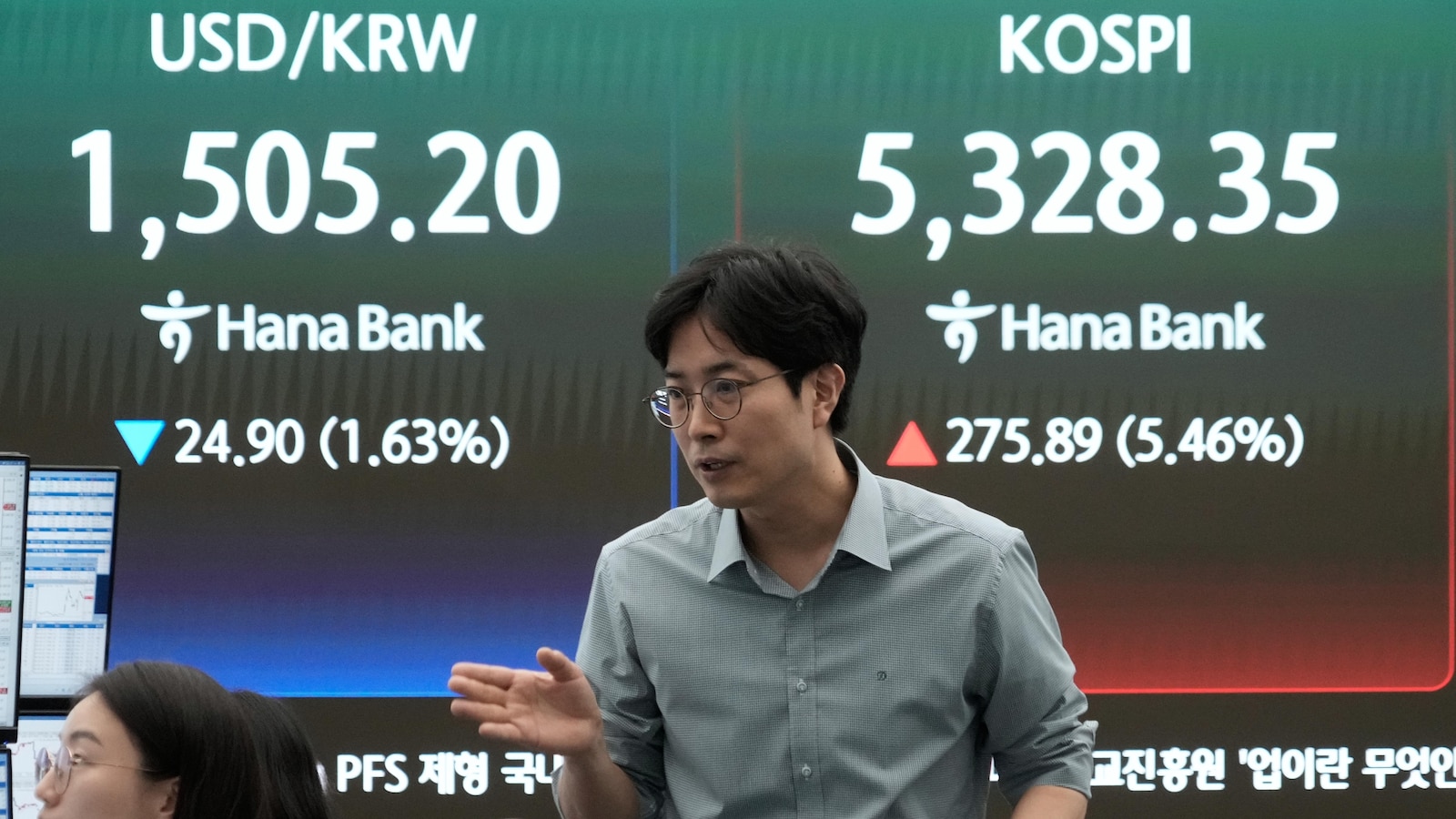
Market Overview - Oil prices have fallen below $100 per barrel, with Brent crude down 4.4% at $99.44 and benchmark U.S. crude down 3.8% to $97.55, amid renewed hopes for a resolution to the Iran war [4][5] - Asian shares have seen significant gains, with South Korea's Kospi up 8.4% to 5,478.70, Japan's Nikkei 225 rising 5.2% to 53,739.68, and Hong Kong's Hang Seng increasing by 2.3% to 25,346.42 [2][3] U.S. Market Performance - U.S. stocks experienced their best day in nearly a year, with the S&P 500 jumping 2.9% to 6,528.52, the Dow Jones Industrial Average rising 2.5% to 46,341.51, and the Nasdaq composite leaping 3.8% to 21,590.63 [6] - U.S. gas prices surged past an average of $4 a gallon for the first time since 2022, reflecting the impact of the Iran war on energy markets [5] Company-Specific Developments - Marvell Technology shares spiked 12.8% following Nvidia's announcement of a $2 billion investment in the company, while Nvidia's stock rose 5.6% [7] - Centessa Pharmaceuticals saw a significant increase of 44% after Eli Lilly announced its acquisition of the company [7] - McCormick, the spice and flavorings company, experienced a decline of 6.1% after confirming its merger with Unilever's food business [7] Currency and Commodity Movements - Gold prices rose 1.6% to $4,751.80 per ounce, indicating a shift in investor sentiment towards safe-haven assets [8] - The U.S. dollar was trading at 158.36 Japanese yen, down from 158.72 yen, while the euro increased to $1.1584 from $1.1553 [8]