信托

Search documents
国网英大: 国网英大信息披露事务管理办法(2025年修订)
Zheng Quan Zhi Xing· 2025-08-27 16:41
General Provisions - The purpose of the information disclosure management measures is to standardize the information disclosure behavior of State Grid Yingda Co., Ltd. and related obligors, improve the management level and quality of information disclosure, and protect the legitimate rights and interests of investors [1] - Information disclosed must be true, accurate, complete, concise, clear, and easy to understand, without false records, misleading statements, or significant omissions [1][2] - Information must be disclosed simultaneously to all investors, and any advance disclosure to specific individuals or entities is prohibited unless otherwise stipulated by laws and regulations [2] Responsibilities of Directors and Senior Management - Directors and senior management must diligently fulfill their duties to ensure the authenticity, accuracy, and completeness of disclosed information [2][3] - If there are doubts about the authenticity or accuracy of disclosed information, a statement must be made in the announcement explaining the reasons [2][3] Types of Disclosure - Disclosure documents include periodic reports, temporary reports, prospectuses, fundraising documents, listing announcements, and acquisition reports [3][4] - Information must be disclosed on the stock exchange's website and in media that comply with the China Securities Regulatory Commission's regulations [4] Confidentiality and Exceptions - Insider information must not be disclosed or leaked before it is legally disclosed, and those who know such information must be kept to a minimum [3][6] - Information that involves state secrets or business secrets may be exempt from disclosure under certain conditions [6][12] Reporting Obligations - The company must disclose periodic reports, including annual, semi-annual, and quarterly reports, which must be audited by a qualified accounting firm [7][8] - Any significant events that may impact the company's stock price must be disclosed immediately, including major liabilities, asset impairments, or changes in shareholder equity [10][11] Internal Management and Compliance - The company must establish internal controls for financial management and accounting, ensuring compliance with relevant regulations [19][20] - The board of directors and senior management are responsible for the authenticity, accuracy, completeness, timeliness, and fairness of information disclosure [20][21] Violations and Penalties - Directors and senior management are held accountable for any violations of disclosure obligations, with potential penalties including warnings, internal criticism, and legal consequences for severe cases [20][22] - Any individual or entity leaking insider information or engaging in market manipulation may be reported to regulatory authorities [22][23]

国网英大: 国网英大市值管理办法
Zheng Quan Zhi Xing· 2025-08-27 16:41
Core Viewpoint - The company has established a value management approach aimed at enhancing investment value and shareholder returns while ensuring compliance with relevant laws and regulations [2][3]. Group 1: Purpose and Principles of Value Management - The main purpose of value management is to enhance company transparency and investor relations through compliant information disclosure and strategic actions such as mergers, stock buybacks, and cash dividends [2][3]. - The basic principles of value management include compliance, systematic approach, scientific methodology, and regular monitoring of market dynamics [4][5]. Group 2: Organizational Structure and Responsibilities - The board of directors leads the value management efforts, focusing on improving company quality and considering investor interests in major decisions [6][7]. - The company’s secretary is responsible for investor relations and ensuring transparent information disclosure [8][9]. Group 3: Main Methods of Value Management - The company will focus on core business operations and may utilize methods such as mergers and acquisitions, employee stock ownership plans, cash dividends, and investor relations management to enhance investment value [6][7]. - The company aims to improve information disclosure quality and may implement share buybacks to stabilize stock prices and enhance investor confidence [7][8]. Group 4: Monitoring and Emergency Measures - The securities department will monitor key indicators like market capitalization and price-to-earnings ratios, triggering alerts for significant deviations [9][10]. - In case of significant stock price declines, the company will analyze causes, communicate with investors, and may consider share buybacks or temporary trading halts to stabilize the market [9][10].
中国信达:2025年上半年净利润同比增长5.78% 经营效益稳健
Xin Hua Cai Jing· 2025-08-27 14:32
Core Viewpoint - In the first half of 2025, China Cinda Asset Management Co., Ltd. demonstrated its role in risk prevention and serving the real economy, achieving a net profit of 2.281 billion yuan, a year-on-year increase of 5.78% [2] Financial Performance - As of June 30, 2025, total assets reached 1.68 trillion yuan, up 2.62% from the end of the previous year, while total liabilities increased by 2.80% to 1.46 trillion yuan [2] - Shareholder equity rose to 197.29 billion yuan, a 1.60% increase year-on-year, with total revenue amounting to 34.362 billion yuan, a decrease of 2.0% compared to the same period last year [2] Business Segments - The non-performing asset management business had total assets of 938.23 billion yuan, growing by 2.51%, with total revenue of 18.491 billion yuan, a slight increase of 0.30% [3] - The financial services segment showed steady growth, with total assets of 736.74 billion yuan, up 1.23%, and a significant increase in pre-tax profits by 63.87% to 3.518 billion yuan [3] - Notable pre-tax profit growth was observed in various subsidiaries: Nanchang Bank (22.68%), Cinda Securities (82.37%), Cinda Trust (60.45%), and Cinda Financial Leasing (69.93%) [3] Risk Management Initiatives - In the first half of 2025, the company acquired 25.506 billion yuan in financial non-performing debt assets, a year-on-year increase of 56.80%, and made significant progress in acquiring individual loan non-performing assets [4] - The company actively participated in the reform of small and medium-sized financial institutions, acquiring nearly 60 billion yuan in non-performing debt from 54 local small banks, an increase of 85.4% [4] - Cinda also focused on real estate risk resolution, launching 19 projects with an investment of 5.4 billion yuan, ensuring the delivery of 14,000 housing units and facilitating the resumption of projects worth over 75.7 billion yuan [4] Future Outlook - The company aims to strengthen governance, customer service, and talent development, focusing on high-quality development and supporting national strategies to enhance its service capabilities [5]

山东国信(01697.HK):上半年营业总收入达到6.34亿元 同比上升7.8%
Ge Long Hui· 2025-08-27 14:10
格隆汇8月27日丨山东国信(01697.HK)发布公告,2025年上半年,集团实现营业总收入人民币6.34亿 元,同比上升7.8%;利润总额人民币2.30亿元,净利润人民币1.67亿元。2025年上半年,面对复杂严峻 的外部环境,山东国信紧盯改革化险、业务转型总目标不放松,坚定回归信托本源,持续培育壮大发展 新动能,努力提升信托综合金融服务质效,不断完善公司治理,在复杂环境中实现了总体平稳发展、稳 中向好的良好态势。 ...
山东国信发布中期业绩 归母净利润1.67亿元 同比减少1.81%
Zhi Tong Cai Jing· 2025-08-27 14:04
Core Viewpoint - Shandong Guoxin (01697) reported a total revenue of 634 million RMB for the six months ending June 30, 2025, reflecting a year-on-year increase of 7.85%. However, the net profit attributable to shareholders decreased by 1.81% to 167 million RMB, with basic earnings per share at 0.04 RMB [1]. Financial Performance - Total revenue reached 634 million RMB, marking a 7.85% increase compared to the previous year [1] - Net profit attributable to shareholders was 167 million RMB, showing a decline of 1.81% year-on-year [1] - Basic earnings per share stood at 0.04 RMB [1]
山东国信(01697)发布中期业绩 归母净利润1.67亿元 同比减少1.81%
智通财经网· 2025-08-27 14:02
智通财经APP讯,山东国信(01697)发布截至2025年6月30日止六个月中期业绩,营业总收入6.34亿元(人 民币,下同),同比增加7.85%;归母净利润1.67亿元,同比减少1.81%;基本每股收益0.04元。 ...
国网英大:上半年净利润同比增长25.18% 拟每股派0.042元
Zheng Quan Shi Bao Wang· 2025-08-27 12:45
Core Insights - The company reported a total revenue of 5.306 billion yuan for the first half of 2025, representing a year-on-year growth of 6.35% [1] - The net profit attributable to shareholders reached 1.147 billion yuan, showing a year-on-year increase of 25.18% [1] - The basic earnings per share (EPS) was 0.201 yuan [1] - The company plans to distribute a cash dividend of 0.042 yuan per share (tax included) to all shareholders [1]
国网英大发布半年报:归母净利润同比增长25.18%,核心竞争能力持续增强
Di Yi Cai Jing· 2025-08-27 12:35
Core Insights - The company reported a total revenue of 5.306 billion yuan for the first half of 2025, representing a year-on-year growth of 6.35% [1] - The total profit reached 1.990 billion yuan, with a year-on-year increase of 22.33% [1] - The net profit attributable to shareholders was 1.147 billion yuan, marking a 25.18% increase compared to the previous year [1] - The basic earnings per share were 0.20 yuan, reflecting a growth of 25.63% year-on-year [1] - The company maintained a stable profit distribution policy, distributing a cash dividend of 0.42 yuan per 10 shares to all shareholders [1] Financial Performance - The company achieved a total revenue of 5.306 billion yuan in H1 2025, up 6.35% year-on-year [1] - Profit before tax was 1.990 billion yuan, showing a 22.33% increase [1] - Net profit attributable to shareholders was 1.147 billion yuan, with a growth of 25.18% [1] - Basic earnings per share increased to 0.20 yuan, a rise of 25.63% [1] Business Strategy - The company focuses on synergizing production and finance, enhancing its financial services, carbon asset management, and power equipment businesses [2] - The financial subsidiary, Yingda Trust, has seen steady growth in asset management, providing specialized financing for key projects [2] - Yingda Securities is expanding its brokerage services and has launched a multi-factor driven mixed asset management product [2] - The company is committed to providing comprehensive green low-carbon services to the energy sector [2] Innovation and Development - The subsidiary, Zhixin Electric, is advancing in high-end, intelligent, and green development, integrating technological and industrial innovation [3] - The company has achieved significant milestones in product development, including the certification of a "zero-carbon factory" and the introduction of new products [3] - The company is focused on enhancing its core competitiveness through technological innovation and has made breakthroughs in the European market [3] Future Outlook - The company aims to deepen production-finance collaboration and enhance its governance system while strengthening risk prevention measures [3] - It is committed to creating more value for society and shareholders, contributing to the healthy development of the capital market [3]
国网英大:2025年上半年净利润11.47亿元,同比增长25.18%
Xin Lang Cai Jing· 2025-08-27 11:41
国网英大公告,2025年上半年营业收入53.06亿元,同比增长6.35%。净利润11.47亿元,同比增长 25.18%。拟向全体股东每股派发现金红利0.042元(含税),合计拟派发现金红利2.4亿元(含税),占 2025年半年度归属于上市公司股东净利润的比例20.94%。 ...
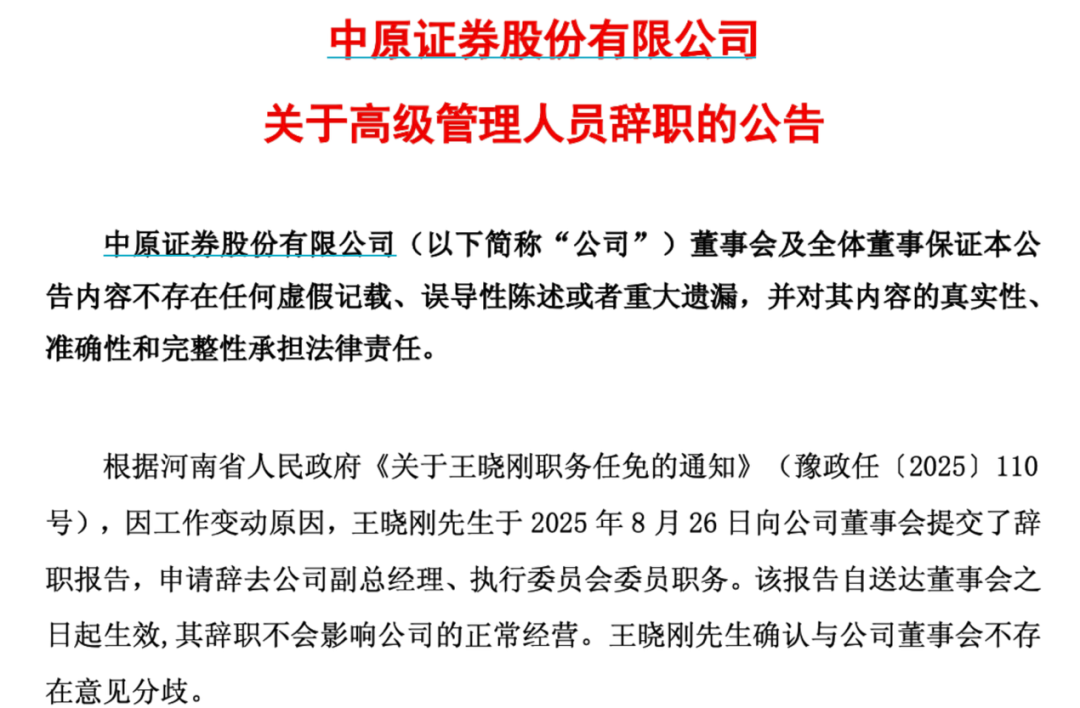
中原证券副总王晓刚转战信托!20载生涯留警示,业务结构困局待破
Xin Lang Cai Jing· 2025-08-27 05:18
Group 1 - Wang Xiaogang resigned from his position as Deputy General Manager of Zhongyuan Securities due to a job change, as he was appointed as Deputy General Manager of Zhongyuan Trust [1][3] - Wang has a long career within the Zhongyuan system, having held various management positions since the establishment of Zhongyuan Securities in 2002, including roles in brokerage, wealth management, and asset management [3][4] - His departure is part of an internal personnel adjustment within the Zhongyuan system, as both Zhongyuan Securities and Zhongyuan Trust are controlled by the Henan Investment Group [4] Group 2 - Zhongyuan Securities is facing challenges in its business layout and revenue performance, particularly in its investment banking and asset management sectors, which have seen significant declines in revenue [5][7] - The brokerage business remains the main revenue driver, with net income from brokerage fees reaching CNY 643 million in 2024, a year-on-year increase of 20.88%, but this reliance on market fluctuations raises concerns about business resilience [5][7] - The company has implemented strong cost control measures, reducing operating expenses from CNY 18.04 billion in 2021 to CNY 11.43 billion in 2024, and decreasing average employee compensation from CNY 487,300 to CNY 272,500 during the same period [7][13]