
军工

Search documents
突然引爆!
中国基金报· 2025-11-17 03:09
Market Overview - On November 17, A-shares opened slightly lower, with all three major indices showing a downward trend, despite some sector opportunities emerging [1][2] - The Shanghai Composite Index fell by 0.70%, the Shenzhen Component Index decreased by 0.43%, and the ChiNext Index dropped by 0.52% [2] Sector Performance - Defense and military, computer, and forestry sectors showed gains, while the pharmaceutical, precious metals, and insurance sectors struggled [2] - The water supply sector surged by 6.44%, lithium mining by 4.07%, cross-strait integration by 3.57%, and aircraft carriers by 3.17% [3] Notable Stocks - Military stocks experienced significant gains, with companies like Changcheng Military Industry and Aerospace Development hitting the daily limit, and Jianglong Shipbuilding rising by 20% [7][8] - Water supply stocks also saw a collective rise, with Guolian Aquatic Products hitting the daily limit and other companies like Dahu Co. and Zhongshui Fisheries also achieving substantial gains [9] Lithium Sector Insights - The lithium mining sector saw a collective rise, with companies like Dazhong Mining and Rongjie Co. hitting the daily limit, and Ganfeng Lithium and Salt Lake Co. rising over 6% [14] - Ganfeng Lithium's chairman predicted a 30% increase in lithium carbonate demand in 2026, reaching 1.9 million tons, with supply expected to grow by 250,000 tons, indicating a potential price increase [11] Stock Highlights - Furi Co. achieved an 8-day consecutive limit-up, indicating strong market interest [12][13] - The stock price of Furi Co. reached a peak of 12.72 CNY, with a trading volume of 43,061 hands on November 17 [15] Market Sentiment - The market is experiencing a trend of speculative trading, with stocks like Furi Co., Sunrise Group, and Dae Oriental showing consecutive gains, reflecting a growing trend of "name-based trading" [16]



突然引爆!
Zhong Guo Ji Jin Bao· 2025-11-17 03:08
【导读】国防军工高开高走,水产、锂矿等概念股活跃,孚日股份8连板 大家好!新一周的交易日开启,来一起关注最新的市场行情和资讯~ 来看详情—— 军工股高开高走 11月17日,A股三大指数早间小幅低开,盘初震荡后整体下探。截至发稿,三大指数均飘绿。 虽然指数整体表现欠佳,但细分板块有机会。上午,国防军工、计算机、林木等板块走高,水产、锂矿、两岸融合、航母等概念股强势;医药、贵金属、 保险等板块不振。 港股三大指数早间低开,上午同步震荡走低。携程集团跌超4%,领跌恒指概念股。 | 6392.25 | 9335.47 5783.02 | | --- | --- | | 生指数 -0.68% | 国企指数 -0.66% 恒生科技指数 -0.51% | | | 序号代码 名称 现价 涨跌 涨跌幅 * | | - | 552.50-23.500 -4.08% 9961 携程集团-S | | 2 | 2269 药明生物 32.380 -0.940 -2.82% | | က | 10.220 -0.280 -2.67% 0992 联想集团 | | 4 | 2359 药明康德 102.50 -2.700 -2.57% | | | ...

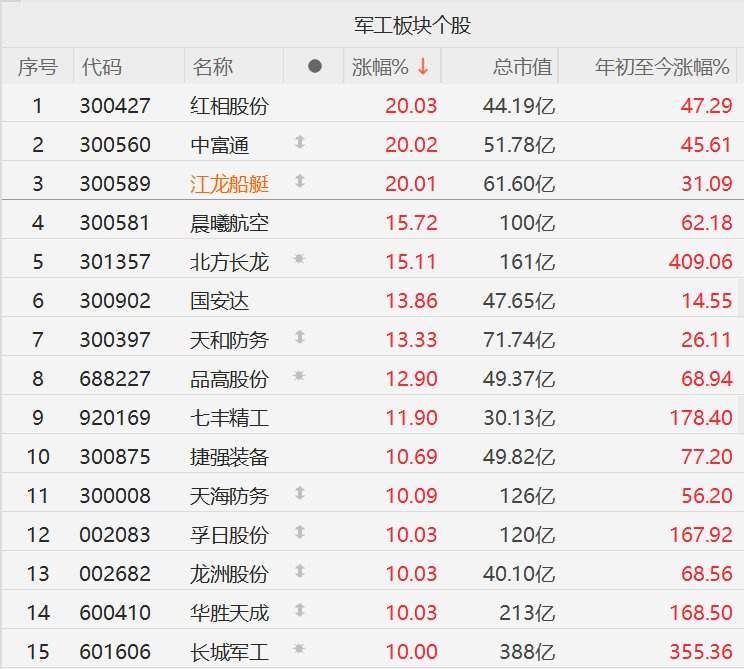
A股军工股掀涨停潮,红相股份、中富通、江龙船艇20CM涨停,北方长龙涨15%,天和防务涨13%,孚日股份、统一股份等近10股涨停
Ge Long Hui· 2025-11-17 02:43
Core Viewpoint - The A-share market has seen a surge in military stocks, with several companies hitting the daily limit up, indicating strong investor interest and potential growth in the defense sector [1][2]. Group 1: Stock Performance - Hongxiang Co., Ltd. (300427) reached a 20.03% increase, with a total market value of 4.419 billion [2]. - Zhongfutong (300560) also saw a 20.02% rise, bringing its market value to 5.178 billion [2]. - Jianglong Shipbuilding (300589) experienced a 20.01% increase, with a market capitalization of 6.160 billion [2]. - Chengxi Aviation (300581) rose by 15.72%, with a market value of 10 billion [2]. - Beifang Changlong (301357) surged by 15.11%, with a total market value of 16.1 billion [2]. - Guo'an Da (300902) increased by 13.86%, with a market capitalization of 4.765 billion [2]. - Tianhe Defense (300397) saw a 13.33% rise, with a market value of 7.174 billion [2]. - Pingao Co., Ltd. (688227) increased by 12.90%, with a market value of 4.937 billion [2]. - Qifeng Precision (920169) rose by 11.90%, with a market capitalization of 3.013 billion [2]. - Jieqiang Equipment (300875) increased by 10.69%, with a market value of 4.982 billion [2]. - Tianhai Defense (300008) saw a 10.09% rise, with a market capitalization of 12.6 billion [2]. - Furui Co., Ltd. (002083) increased by 10.03%, with a market value of 12 billion [2]. - Longzhou Co., Ltd. (002682) also rose by 10.03%, with a market capitalization of 4.010 billion [2]. - Huasheng Tiancai (600410) increased by 10.03%, with a market value of 21.3 billion [2]. - Great Wall Military Industry (601606) saw a 10.00% rise, with a market capitalization of 38.8 billion [2]. Group 2: Year-to-Date Performance - Hongxiang Co., Ltd. has a year-to-date increase of 47.29% [2]. - Zhongfutong has risen by 45.61% year-to-date [2]. - Jianglong Shipbuilding has a year-to-date increase of 31.09% [2]. - Chengxi Aviation has seen a significant year-to-date increase of 62.18% [2]. - Beifang Changlong has an impressive year-to-date increase of 409.06% [2]. - Guo'an Da has a year-to-date increase of 14.55% [2]. - Tianhe Defense has increased by 26.11% year-to-date [2]. - Pingao Co., Ltd. has a year-to-date increase of 68.94% [2]. - Qifeng Precision has a remarkable year-to-date increase of 178.40% [2]. - Jieqiang Equipment has a year-to-date increase of 77.20% [2]. - Tianhai Defense has increased by 56.20% year-to-date [2]. - Furui Co., Ltd. has a year-to-date increase of 167.92% [2]. - Longzhou Co., Ltd. has a year-to-date increase of 68.56% [2]. - Huasheng Tiancai has a year-to-date increase of 168.50% [2]. - Great Wall Military Industry has a year-to-date increase of 355.36% [2].





军工含量第一的航空航天ETF涨超2%,近20日“吸金”超7亿元
Ge Long Hui A P P· 2025-11-17 02:33
Group 1 - The military industry sector continues its strong performance, with aerospace development achieving two consecutive trading limits and Great Wall Aerospace hitting the daily limit, driving the Aerospace ETF up by 2.51% [1] - Recent geopolitical tensions, including inappropriate remarks from Japan's Prime Minister and military exercises in the Yellow Sea, have increased uncertainty in the global landscape, acting as direct catalysts for the sector [2] - The defense and military sector has shown significant profit growth, with a year-on-year increase of 17.29% in net profit attributable to shareholders in the first three quarters, and a remarkable 73.2% increase in the third quarter alone [2] Group 2 - The National Aerospace Index has experienced a cumulative decline of over 9% since September 3, indicating a technical demand for rebound [3] - The "14th Five-Year Plan" has established "building a strong aerospace nation" as an independent goal, marking a shift from technological breakthroughs to systematic national construction, positioning the aerospace industry as a core support for modernization and technological self-reliance [3] - The Aerospace ETF (159227) has attracted over 700 million yuan in capital over the past 20 days, with a high concentration of military-related stocks, accounting for 98.2% of the index [4]
军工板块拉升,中富通、江龙船艇20%涨停,北方长龙等大涨
Zheng Quan Shi Bao Wang· 2025-11-17 02:13
Core Viewpoint - The military industry sector experienced a strong rally on the 17th, with significant stock price increases for companies such as Zhongfu Tong and Jianglong Shipbuilding, indicating heightened investor interest due to escalating geopolitical uncertainties [1] Industry Summary - The military sector is expected to gain increased attention as geopolitical uncertainties rise, with China's advanced main battle equipment not only meeting domestic demand but also showing competitive strength in international markets [1] - There is a positive outlook for the export of high-end and systematic weaponry from China, which is anticipated to drive a revaluation of core military assets [1] - According to CITIC Securities, the period from 2025 to 2027 is expected to see a strong upward trend in the industry, coinciding with the centenary of the military in 2027 and the transition from the 14th Five-Year Plan to the 15th [1] - The demand side of the industry is expected to present numerous opportunities, with orders showing recovery in the first half of the year and upstream companies reporting good performance in their mid-year reports [1] - The "9.3" military parade showcased several advanced equipment, and the third and fourth quarters are typically peak periods for the delivery of national defense and military products, suggesting a continued recovery in order fundamentals [1] - Looking ahead to the fourth quarter, domestic demand growth in the military sector is expected to accelerate, and military trade orders are likely to continue materializing, leading to a significant increase in overall recovery momentum and sustained expectations for consolidation [1]


A股军工股掀涨停潮,孚日股份、统一股份等近10股涨停
Ge Long Hui· 2025-11-17 02:08
Core Viewpoint - The A-share market has experienced a surge in military stocks, with several companies reaching their daily limit up [1] Group 1: Stock Performance - Hongxiang Co., Zhongfutong, and Jianglong Shipbuilding all hit the 20% daily limit up [1] - Morningstar Aviation and Beifang Changlong increased by over 15% [1] - Guoan Da and Tianhe Defense rose by over 13% [1] - Pinggao Group saw an increase of over 12% [1] - Qifeng Precision gained over 11% [1] - Jieqiang Equipment and Tianhai Defense both increased by over 10% [1] - Furui Co., Longzhou Co., Huasheng Tiancai, Great Wall Military Industry, Tongyi Co., and Aerospace Development all reached the 10% daily limit up [1]


港股军工股涨幅居前
Mei Ri Jing Ji Xin Wen· 2025-11-17 01:57
每经AI快讯,11月17日,港股军工股涨幅居前,截至发稿,中船防务(00317.HK)涨5.86%,报14.81港 元;中航科工(02357.HK)涨1.78%,报4港元。 ...
国科军工股价涨5.62%,国泰基金旗下1只基金位居十大流通股东,持有125.69万股浮盈赚取346.92万元
Xin Lang Cai Jing· 2025-11-17 01:55
Group 1 - The core viewpoint of the news is that Guokai Military Industry has seen a significant increase in stock price, rising by 5.62% to reach 51.86 CNY per share, with a total market capitalization of 10.831 billion CNY [1] - Guokai Military Industry, established on December 29, 2007, and listed on June 21, 2023, is primarily engaged in the research, production, and sales of solid rocket engines and ammunition equipment, with military products accounting for 94.81% of its revenue [1] - The company is located in Nanchang Economic and Technological Development Zone, Jiangxi Province, and has a minor revenue contribution from civilian products (4.76%) and other sources (0.42%) [1] Group 2 - Guotai Fund's Guotai Zhongzheng Military Industry ETF (512660) is among the top ten circulating shareholders of Guokai Military Industry, having reduced its holdings by 371,800 shares in the third quarter, now holding 1.2569 million shares, which is 1.08% of the circulating shares [2] - The Guotai Zhongzheng Military Industry ETF has a total scale of 14.109 billion CNY and has achieved a year-to-date return of 12.49%, ranking 3490 out of 4216 in its category [2] - The fund manager, Ai Xiaojun, has been in position for 11 years and has overseen a total asset scale of 169.029 billion CNY, with the best fund return during his tenure being 265.64% [3]

天海防务股价涨7.83%,国泰基金旗下1只基金位居十大流通股东,持有1344.95万股浮盈赚取699.38万元
Xin Lang Cai Jing· 2025-11-17 01:55
Group 1 - Tianhai Defense experienced a stock price increase of 7.83%, reaching 7.16 CNY per share, with a trading volume of 96.51 million CNY and a turnover rate of 0.82%, resulting in a total market capitalization of 12.373 billion CNY [1] - The company, established on October 29, 2001, and listed on October 30, 2009, is located in Shanghai and operates in shipbuilding and marine engineering, military-civilian integration, and clean energy utilization [1] - The revenue composition of Tianhai Defense includes: 92.05% from ship and marine engineering design and construction contracting, 1.97% from design technical services, 1.80% from energy business, 1.75% from other product revenues, 1.18% from defense equipment and products, 0.74% from other supplementary sources, and 0.50% from ship leasing [1] Group 2 - Guotai Fund's Guotai Zhongzheng Military Industry ETF (512660) is among the top ten circulating shareholders of Tianhai Defense, having reduced its holdings by 2.5808 million shares in the third quarter, now holding 13.4495 million shares, which is 0.82% of the circulating shares [2] - The Guotai Zhongzheng Military Industry ETF was established on July 26, 2016, with a current scale of 14.109 billion CNY, yielding a return of 12.49% year-to-date, ranking 3490 out of 4216 in its category, and a one-year return of 4.35%, ranking 3599 out of 3956 [2]
长城军工股价涨10%,国泰基金旗下1只基金位居十大流通股东,持有351.77万股浮盈赚取1713.11万元
Xin Lang Cai Jing· 2025-11-17 01:55
Group 1 - The core point of the news is that Changcheng Military Industry's stock price increased by 10%, reaching 53.55 CNY per share, with a trading volume of 468 million CNY and a turnover rate of 1.21%, resulting in a total market capitalization of 38.782 billion CNY [1] - Changcheng Military Industry Co., Ltd. is located in Hefei, Anhui Province, and was established on November 16, 2000, with its listing date on August 6, 2018. The company's main business involves the research, production, and sales management of military and civilian products through its subsidiaries [1] - The revenue composition of Changcheng Military Industry is as follows: equipment manufacturing accounts for 69.14%, civilian products 28.60%, and others 2.25% [1] Group 2 - From the perspective of the top ten circulating shareholders, Guotai Fund has a fund that ranks among the top shareholders of Changcheng Military Industry. The Guotai Zhongzheng Military Industry ETF (512660) reduced its holdings by 665,500 shares in the third quarter, holding a total of 3.5177 million shares, which represents 0.49% of the circulating shares [2] - The estimated floating profit for the Guotai Zhongzheng Military Industry ETF (512660) today is approximately 17.1311 million CNY [2] - The Guotai Zhongzheng Military Industry ETF (512660) was established on July 26, 2016, with a latest scale of 14.109 billion CNY. Year-to-date returns are 12.49%, ranking 3490 out of 4216 in its category; the one-year return is 4.35%, ranking 3599 out of 3956; and since inception, the return is 17.18% [2]