
基金

Search documents
“一姐”告别、“明星”空降!天弘基金万亿固收团队完成新老交替
Xin Lang Cai Jing· 2026-02-11 10:50
Core Viewpoint - The departure of Jiang Xiaoli, a key figure in Tianhong Fund's fixed income sector, marks a significant transition for the company as it prepares for a new leadership era under Ma Long, who has joined as the new head of fixed income [1][22]. Group 1: Jiang Xiaoli's Career and Departure - Jiang Xiaoli has been with Tianhong Fund for 16 years, starting as a researcher and rising to manage over 700 billion yuan in assets [1][22]. - Under her management, the Tianhong Yongli Bond Fund grew from 30 billion yuan to a peak of 394.66 billion yuan, but has since seen a significant decline to 185.37 billion yuan [4][26]. - Jiang's total management scale dropped from a peak of 781.94 billion yuan in 2022 to approximately 350 billion yuan before her departure [22][26]. Group 2: Transition in Leadership - Ma Long, a former star fund manager from China Merchants Fund, joined Tianhong Fund in May 2025, taking on a leadership role in the fixed income department [1][32]. - The market had anticipated a strong collaboration between Jiang and Ma, but Jiang's sudden decision to take a long break has shifted the dynamics [1][22]. - Ma Long's previous experience includes managing significant assets at China Merchants Fund, where he was a key player in the fixed income sector [32][33]. Group 3: Fund Performance and Strategy - Jiang Xiaoli's funds, primarily focused on fixed income, achieved annualized returns of 7.64%, which did not outperform the CSI 300 index [5][27]. - The fixed income products under her management showed better performance in the short term, with returns of 4.9% and 12.11% over the past one and two years, respectively [5][27]. - Tianhong Fund is shifting its focus towards passive investment strategies, particularly in ETFs, which have seen a 75.85% growth year-on-year, contributing significantly to the overall asset growth [17][40]. Group 4: Industry Context and Future Outlook - The overall public fund management scale for Tianhong Fund reached 1.31 trillion yuan by the end of 2025, with a notable increase in ETF assets [40][43]. - The company is adapting to market trends by increasing its offerings in index funds, with 70% of new products being index-based [15][39]. - The transition in leadership and strategic focus on ETFs may help Tianhong Fund strengthen its competitive position in the fixed income market, despite challenges in active management [20][43].


沪指全天窄幅震荡实现3连涨,关注A500ETF易方达(159361)、沪深300ETF易方达(510310)等投资价值
Sou Hu Cai Jing· 2026-02-11 10:43
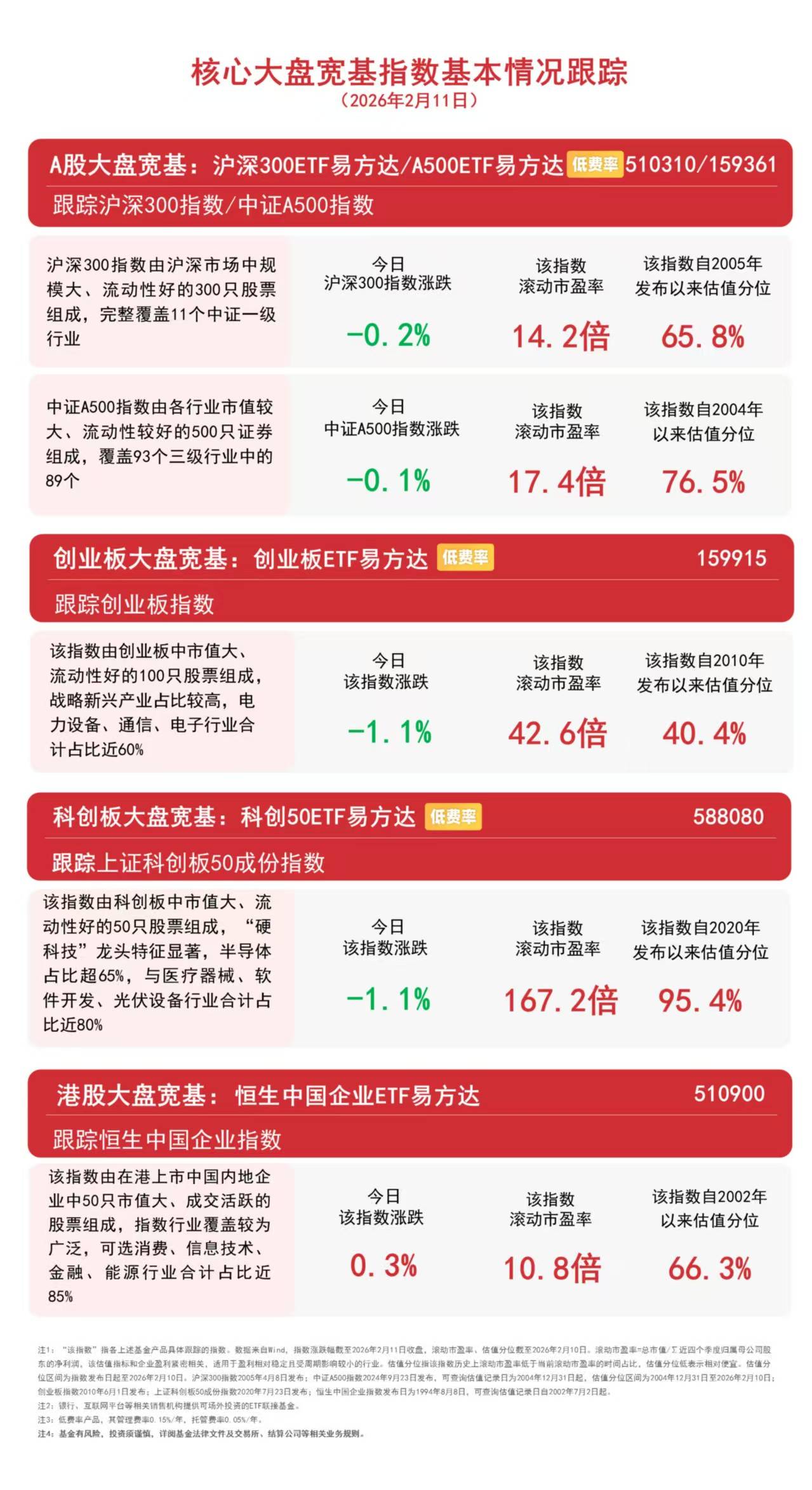
Market Performance - The A-share market showed mixed performance on February 11, with the Shanghai Composite Index rising by 0.09%, marking a three-day increase [1] - The CSI 300 Index fell by 0.2%, while the CSI A500 Index decreased by 0.1% [3][1] - The ChiNext Index and the STAR Market 50 Index both dropped by 1.1% [1] Sector Performance - Leading sectors included small metals, oil and gas extraction and services, chemical fibers, rare earth permanent magnets, steel, dyes, coal mining and processing, batteries, and cement [1] - Underperforming sectors included film and television, short drama games, education, tourism and hotels, cultivated diamonds, military equipment, CPO, and airport and shipping [1] - In the Hong Kong market, sectors such as building materials, non-ferrous metals, chemicals, real estate, and automobiles performed well, while consumer, semiconductor, and non-bank financial sectors weakened [1] Index Details - The CSI 300 Index consists of 300 stocks with good liquidity, covering 11 primary industry categories, with a rolling P/E ratio of 14.2 times [3] - The CSI A500 Index includes 500 securities with good liquidity, covering 89 out of 93 tertiary industries, with a rolling P/E ratio of 17.4 times [3] - The STAR Market 50 Index is composed of 50 stocks with significant market capitalization and liquidity, with over 65% representation from the semiconductor sector [7]
红利板块低开高走,恒生红利低波ETF易方达(159545)、红利ETF易方达(515180)等产品受资金关注
Sou Hu Cai Jing· 2026-02-11 10:43
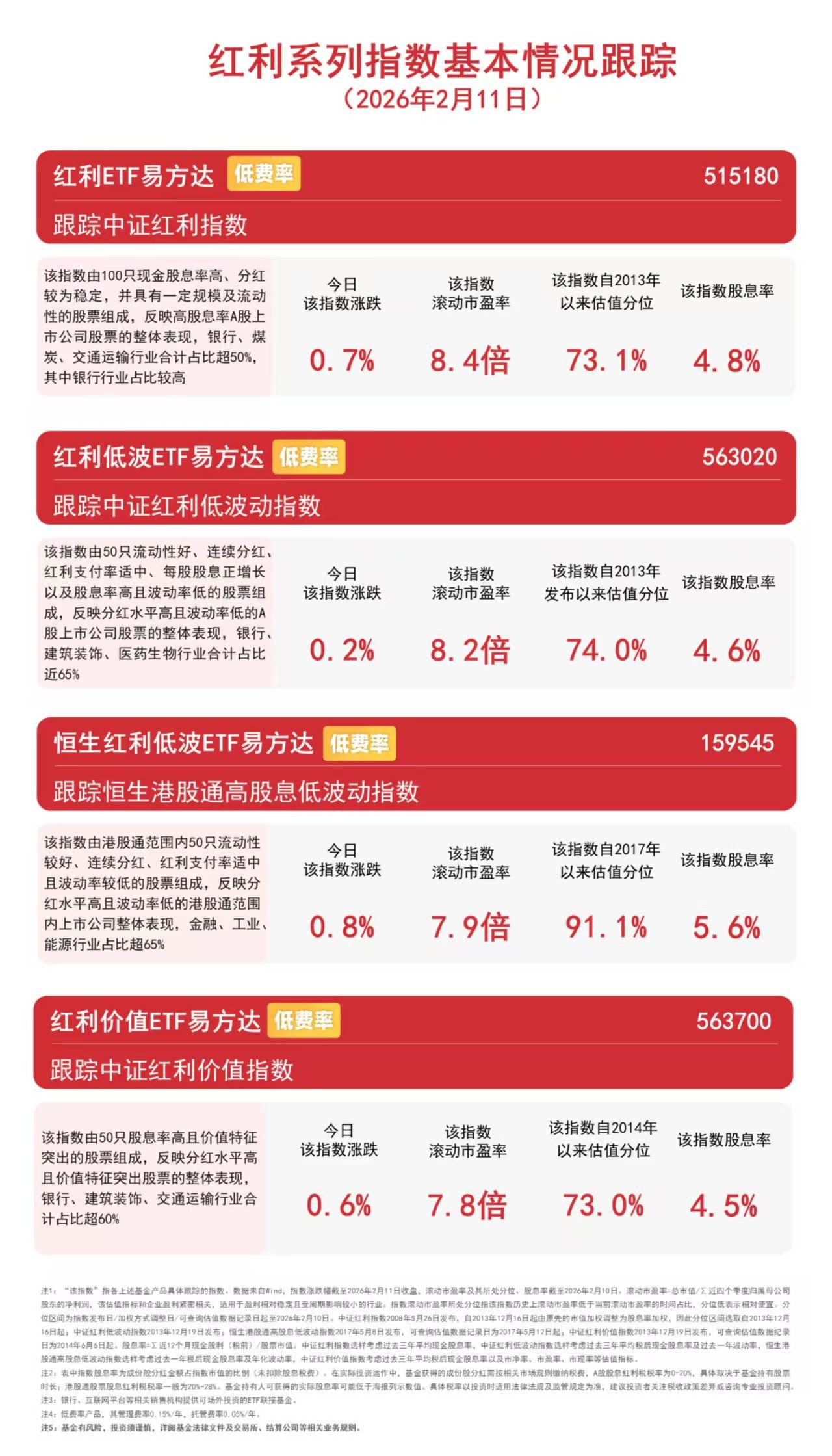
Core Viewpoint - The article highlights the performance of various dividend-focused ETFs managed by E Fund, emphasizing their low fee structure and recent capital inflows, indicating strong investor interest in high dividend yield assets. Group 1: ETF Performance - The Hang Seng High Dividend Low Volatility Index increased by 0.8%, the CSI Dividend Index rose by 0.7%, the CSI Dividend Value Index went up by 0.6%, and the CSI Dividend Low Volatility Index saw a 0.2% increase [1] - E Fund's Hang Seng Dividend Low Volatility ETF (159545) and Dividend ETF (515180) experienced net inflows of 210 million yuan and 420 million yuan respectively over the past week [1] Group 2: E Fund's Low Fee Structure - E Fund is currently the only fund company offering all dividend ETFs at a low management fee rate of 0.15% per year, which helps investors to cost-effectively allocate to high dividend assets [1] - The management fee for E Fund's various dividend ETFs, including the Hang Seng Dividend Low Volatility ETF, Dividend ETF, and others, is consistently set at 0.15% per year [1][5] Group 3: Index Composition - The CSI Dividend Index consists of 100 stocks with high cash dividend yields and stable performance, with banking, coal, and transportation sectors accounting for over 50% of the index [3] - The CSI Dividend Low Volatility Index is composed of 50 stocks that exhibit good liquidity, continuous dividends, moderate dividend payout ratios, and low volatility, with banking, construction, and pharmaceutical sectors making up 65% of the index [3] - The Hang Seng High Dividend Low Volatility Index includes 50 stocks from the Hong Kong Stock Connect that have good liquidity, continuous dividends, moderate dividend payout ratios, and low volatility, reflecting the overall performance of high dividend and low volatility stocks in the Hong Kong market [3]
指数与创新产品研究系列之十七:2025海外ETF:高拥挤格局下的发展启示
Shenwan Hongyuan Securities· 2026-02-11 10:42
1. Report's Industry Investment Rating No information regarding the industry investment rating is provided in the report. 2. Core Viewpoints of the Report - The US ETF market has witnessed continuous and rapid growth in scale, with an increasing proportion of alternative products. Newly issued products show characteristics such as a focus on single - stock products, a higher number of active products than passive ones, and a significant increase in strategy complexity and comprehensiveness. - The US ETF market presents trend - like features, including intense competition among core broad - based products, significant differences in fees based on strategy complexity and scarcity, large differences in institutional ownership among different product types, and managers' forward - looking layout of potential market concerns. - For the domestic ETF business, it is necessary to focus on management details for highly crowded broad - based products, make forward - looking layouts for industry - themed products, and strengthen the "timely promotion" of different products [2]. 3. Summary According to the Directory 3.1 US ETF Scale Continues to Break Through Rapidly, and the Proportion of Alternative Products Increases - In 2025, the total scale of US ETFs reached $13.45 trillion, with a scale increase of 30%. The number of newly issued ETFs reached 1,078, and the total number of all US ETFs reached 4,814, a net increase of 950 compared to the end of 2024. The proportion of alternative products in the newly issued products increased significantly, driving the proportion of alternative products in the entire market to reach 30%. Newly issued bond and money - market funds also had good scales [2][8][10]. - **Single - stock products become the focus of issuance**: Single - stock products were first issued in 2022, and the number of newly issued products in 2025 was the highest. Leveraged products had the largest scale and number, followed by option products. These products are more and more widely distributed, covering different sectors, and the market capitalization of the underlying stocks is also decreasing. The issuance is related to market attention. The single - stock Covered Call products are mainly for high - volatility stocks, aiming to achieve more certain returns through stable high - option premium dividends [18][19]. - **The number of active products exceeds that of passive products**: As of the end of 2025, the number of active ETF products in the US reached 2,682, exceeding the 2,132 passive products, with a total scale of $1.5 trillion. Alternative products are the category with the highest proportion in terms of both quantity and scale. The scale of option - strategy products exceeds $200 billion, making it the most important type of active ETF. The scale of active ETFs has grown rapidly in the past two years, with a compound annual growth rate of 57% from 2019 to 2025 [24][29]. - **The complexity and comprehensiveness of strategies are significantly improved**: As of the end of 2025, there were 697 option - strategy products in the US, with a scale of $224.727 billion, and 221 new products were issued in 2025. Option strategies are increasingly used as an "add - on" to traditional strategies to increase returns. Other types of products also have more complex strategies, and the standardization of ETF strategies is decreasing [34][38][40]. 3.2 Trendy Features of US ETFs - **Intense competition among core broad - based products, and returns have a certain impact on scale**: In 2025, the scale ranking of S&P 500 ETFs changed significantly. The long - time leader, SPY, was continuously surpassed by VOO and IVV, and the gap widened rapidly. Over the past 10 years, VOO has been the best - performing product in 7 years. In 2025, the total inflow of US ETFs was $1.4753 trillion, with significant inflows into broad - based stock and bond ETFs, and the inflow proportion of alternative products mainly based on option strategies significantly exceeded their scale proportion [43][49]. - **Fees vary greatly based on strategy complexity and scarcity**: As of 2025, the scale - weighted average fee of US ETFs was about 0.17%, with the lowest fee as low as 0.01% and the highest exceeding 5%. Most types of active products have an average fee more than 20 basis points higher than passive products, and alternative products have the same average fee. Different asset types also have different fee levels, with broad - based stock and bond products having the lowest fees, and more focused industry - themed products and alternative option - strategy products having higher fees [53]. - **Large differences in institutional ownership among different product types**: Active products generally have a higher institutional ownership than passive products. Different types of products target different customer groups. For example, leveraged products in alternative products are mainly for individual customers with high - risk preferences, while more complex option - strategy products are mainly for institutional customers [56][59]. - **Managers' forward - looking layout of potential market concerns**: US managers continue to actively layout, and the layout direction is often closely related to market concerns and future possible events. For example, in response to the possible concentration risk of the S&P 500, some managers have launched improved S&P 500 ETFs, which have received recognition from institutional customers [60][61]. 3.3 Thoughts on the Domestic ETF Business - **Focus on management details for highly crowded broad - based products**: As of December 2025, domestic non - monetary ETFs had a total scale of 5.8 trillion yuan and 1,369 products. Broad - based products account for 44% of the total scale, but the homogenization competition is fierce. In the competition of domestic broad - based products, after the fee reduction, the competition has entered a stage of "competing on tracking error" and "competing on excess returns". Lower tracking error and higher excess returns are more likely to attract capital inflows [64][71][72]. - **Continue to make forward - looking layouts for industry - themed products**: Although the number of products tracking the same target is relatively small compared to broad - based products, domestic industry - themed products are numerous, widely distributed, and highly segmented, with fierce competition. Some products that were initially unpopular may attract large - scale capital inflows when the market conditions arrive. Therefore, it is still valuable to make early layouts in long - term promising niche segments, but in - depth fundamental research is required before layout [75][80]. - **Strengthen the "timely promotion" of different products**: In addition to early layout, it is also crucial to promote products reasonably at appropriate times. Overseas institutions' Model Portfolio marketing model has had an important impact on ETFs. Domestic managers are also beginning to try ETF portfolio strategies and investment research services to improve investors' investment experience, and this area still has great development potential [81][82][84].
人民银行:截至2025年末银行间债券市场的法人机构成员共3923家
Bei Jing Shang Bao· 2026-02-11 10:27
Core Insights - The People's Bank of China released the financial market operation status for 2025, indicating a total of 3,923 institutional members in the interbank bond market, all of which are financial institutions [1] Group 1: Debt Holding - By the end of 2025, the top 50 investors in corporate credit bonds held 53.4% of the total debt, primarily concentrated among state-owned large commercial banks (self-operated), public funds (asset management), and insurance financial institutions (asset management) [1] - The top 200 investors held 84.5% of the total debt in corporate credit bonds [1] Group 2: Trading Volume - In terms of trading scale, the top 50 investors in corporate credit bonds accounted for 59.2% of the trading volume, mainly concentrated in securities companies (self-operated), fund companies (asset management), and joint-stock commercial banks (self-operated) [1] - The top 200 investors accounted for 89.9% of the trading volume in corporate credit bonds [1]
西部利得基金:中期市场震荡为主,结构性机会仍丰富
Xin Hua Cai Jing· 2026-02-11 10:23
Group 1 - The core viewpoint of the news is that Western Lide Fund has achieved a significant milestone by surpassing a public fund management scale of 100 billion yuan, reaching 117.7 billion yuan, with notable performance in both fixed income and equity funds [1] - The equity management scale of Western Lide Fund has increased significantly from 12.1 billion yuan to 20.8 billion yuan, representing a growth of over 70% [1] - The company has established a comprehensive research and investment system covering core strategies such as fixed income, equity investment, quantitative index, absolute return, and passive investment [1] Group 2 - In terms of market opportunities for 2026, the company’s research department suggests that both A-shares and Hong Kong stocks have good allocation value, with a focus on dividend strategies [2] - The company anticipates that the dual easing of monetary and fiscal policies will continue, maintaining broad interest rates at historically low levels, which may provide potential allocation space for household deposits and foreign capital [2] - Key factors influencing the mid-term market style include the progress of the AI industry, changes in narratives, and whether domestic demand can stabilize and recover [2]
ETF主力榜 | 稀土ETF(159713)主力资金净流出580.46万元,居可比基金第一-20260211
Xin Lang Cai Jing· 2026-02-11 10:16
Group 1 - The Rare Earth ETF (159713.SZ) closed up by 2.80% on February 11, 2026 [1] - The main capital (transactions over 1 million yuan) experienced a net outflow of 580.46 million yuan, ranking first among comparable funds [1] - The latest trading volume of the fund was 109 million shares, with a total transaction amount falling below 170 million yuan, placing it among the bottom two of comparable funds [1]
央行发布2025年金融市场运行情况
Xin Lang Cai Jing· 2026-02-11 09:41
Group 1: Money Market Operations - In 2025, the average daily transaction volume of interbank lending was 361.07 billion yuan, a decrease of 12.1% compared to 2024 [1] - The average daily transaction volume of bond repurchase in the interbank market was 6.9 trillion yuan, an increase of 3.0% compared to 2024 [1] - By the end of 2025, the outstanding balance of interbank lending was 1.0 trillion yuan, while the outstanding balance of bond repurchase in the interbank market was 12.0 trillion yuan [1] Group 2: Bond Market Operations - In 2025, net financing for government bonds reached 1.38 trillion yuan, an increase of 250 billion yuan compared to 2024 [5] - Net financing for corporate bonds was 240 billion yuan, an increase of 48.23 billion yuan compared to 2024 [5] - The bond market's custody balance was 196.7 trillion yuan by the end of 2025 [5] Group 3: Derivatives Market Operations - The transaction volume of the RMB derivatives market in the interbank market was 58.5 trillion yuan, an increase of 58.6% compared to 2024 [11] - The transaction volume of government bond futures was 9.7 trillion yuan, an increase of 43.9% compared to 2024 [11] - The closing price of the 10-year government bond futures main contract was 107.9 yuan, a decrease of 1.0% compared to the end of 2024 [11] Group 4: Commercial Paper Market Operations - In 2025, the acceptance amount of commercial bills was 42.7 trillion yuan, while the discount amount was 33.9 trillion yuan [13] - By the end of 2025, the acceptance balance of commercial bills was 21.2 trillion yuan, an increase of 7.2% compared to the end of 2024 [13] - The discount balance was 16.5 trillion yuan, an increase of 11.2% compared to the end of 2024 [13] Group 5: Stock Market Operations - By the end of 2025, the Shanghai Composite Index closed at 3968.8 points, an increase of 18.4% compared to the end of 2024 [15] - The Shenzhen Component Index closed at 13525.0 points, an increase of 29.9% compared to the end of 2024 [15] - The average daily transaction volume of both markets was 1.70454 trillion yuan, an increase of 61.9% compared to 2024 [15] Group 6: Bond Market Holder Structure - As of the end of 2025, there were 3923 institutional members in the interbank bond market, all of which were financial institutions [30] - The top 50 investors in corporate credit bonds held 53.4% of the total, mainly concentrated in state-owned commercial banks, public funds, and insurance financial institutions [30] - The top 200 investors held 84.5% of the total bonds [30]
央行行长潘功胜:要认真谋划“十五五”时期和2026年反洗钱监测分析领域重点工作 促进反洗钱工作高质量发展
Xin Lang Cai Jing· 2026-02-11 09:27
Group 1 - The People's Bank of China (PBOC) emphasizes the importance of the Silk Road Fund in supporting the Belt and Road Initiative by providing diversified investment and financing support [1] - The Silk Road Fund aims to enhance its investment capabilities and focus on medium to long-term equity investments to better serve the high-quality development of the Belt and Road Initiative [1] - The Anti-Money Laundering Monitoring and Analysis Center is recognized for its significant role in maintaining financial security and governance, with plans to enhance its work in the upcoming 14th Five-Year Plan period [1]
科创债ETF鹏华(551030)收涨10bp,实现5连涨
Xin Lang Cai Jing· 2026-02-11 09:27
Group 1 - The core viewpoint of the news highlights the performance of the Penghua Science and Technology Bond ETF, which has seen a 0.10% increase and achieved five consecutive gains, indicating active market trading with a turnover of 50.53% and a transaction volume of 10.12 billion yuan [1] - The People's Bank of China (PBOC) released its monetary policy execution report for Q4 2025, indicating that the tone remains consistent with Q3 2025, suggesting that the probability of short-term reserve requirement ratio (RRR) cuts or interest rate reductions is low [1] - Major regional events, unexpected economic fluctuations, and increased volatility in financial markets could trigger further easing measures, while the normalization of government bond trading operations suggests a lower risk of significant adjustments in the bond market [1] Group 2 - The Penghua Science and Technology Bond ETF is one of the first ten ETFs tracking the Shanghai AAA Technology Innovation Company Bond Index, which selects bonds with AAA ratings and above from the Shanghai Stock Exchange [2] - Compared to single bond investment strategies, the ETF offers advantages such as low fees, low trading costs, high transparency, high diversification, and efficient "T+0" redemption, which helps to mitigate investment portfolio risks and improve capital efficiency [2] - Penghua Fund has been actively developing a long-term strategy for fixed-income tools since the second half of 2018, aiming to establish itself as a "fixed-income index expert" in China by providing high-quality bond index investment tools [2]