基金风格漂移

Search documents
新规让基金不能挂羊头卖狗肉,不能“收益腾挪”,他们怎么干?
Sou Hu Cai Jing· 2026-02-09 02:22
Group 1 - The core viewpoint of the news highlights the recent challenges faced by prominent fund managers in the industry, including significant financial losses and legal issues, which have led to a loss of investor confidence [1][4][10] - The resignation of renowned fund manager Ge Lan, who incurred a loss of 23.4 billion yuan over ten years, and the legal troubles of another top manager, Cai Song Song, due to bribery allegations, have raised concerns about the integrity of fund management [1][4] - Investors feel misled by fund managers who promote their expertise and investment strategies during marketing campaigns, only to see poor performance that deviates from initial promises [4][9] Group 2 - The introduction of new regulatory guidelines by the Fund Industry Association aims to address the issue of style drift in thematic funds, ensuring that fund managers adhere to their stated investment strategies [4][9] - The guidelines will enforce stricter compliance in areas such as product design, investment operations, risk control, and custody supervision, with a planned implementation in 2026 [4][10] - The regulatory changes will include a "style library" for monitoring and assessing investment style stability, with penalties for significant deviations from stated investment directions [9][10] Group 3 - There are concerns about potential collusion among fund managers, leading to concentrated trading in certain stocks, which may artificially inflate short-term performance before a decline [10][11] - The industry has been criticized for creating misleading profit reports to attract investors, similar to practices seen in bank wealth management products [10] - Future regulatory efforts will focus on ensuring compliance with thematic investment fund management, with the possibility of self-regulatory inspections and penalties for violations [10][11]

2025年公募“垫底王”:鑫元消费甄选亏损近20%,保壳悬了?
Hua Xia Shi Bao· 2026-01-09 12:13
Core Insights - In 2025, the A-share market indices generally rose, with over 90% of actively managed equity funds achieving positive returns, averaging over 30% [2] - The Yongying Technology Smart Selection Fund reported an annual return exceeding 233%, while the Xinyuan Consumer Selection Mixed Fund's A/C share net value fell over 19%, ranking last among similar products, highlighting extreme performance divergence [2] Fund Performance and Investment Style - The Xinyuan Consumer Selection Mixed Fund, established in March 2023, saw its unit net value decline from 1 yuan to approximately 0.52 yuan by the end of 2025, indicating a nearly 50% drawdown [3] - Initially, the fund concentrated heavily on the pharmaceutical and biotechnology sectors, but this focus shifted dramatically in 2024, moving to automotive and household appliance sectors, and later to information technology services [3][4] Management Changes and Fund Viability - The fund has experienced multiple management changes, with the first manager leaving after about a year, resulting in a return of approximately -26%. The second manager also left with a similar return of around -27% [5] - The current manager took over in July 2025, and the fund is at risk of termination if its net asset value falls below 200 million yuan for 60 consecutive working days after three years of operation, with the fund's size at only 29 million yuan by the end of Q3 2025 [5][6] Fund Challenges and Market Perception - The fund's A-class shares saw a significant drop in institutional investor holdings from over 95% to 42.94% by mid-2025, indicating substantial outflows [6] - Analysts have identified key issues with the fund, including a drift in investment style away from its stated objectives, lack of disciplined investment operations, and frequent changes in management leading to instability [10][11]

“消费基”异常大涨遭质疑 业绩比较基准正待精准校表
Zheng Quan Shi Bao Wang· 2025-12-14 23:08
Core Viewpoint - The recent surge in consumer-themed funds amidst a rising technology stock market has led to confusion among investors regarding the underlying assets of their funds [1] Group 1: Fund Performance and Market Reaction - Some funds have shown significant deviation from their performance benchmarks, sparking market discussions about their investment strategies [1] - There are funds that have benefited from the technology sector's rise, while others have maintained long-term positions in financials, leading to a drift in investment styles [1] Group 2: Regulatory Response - Regulatory authorities have introduced measures such as benchmark guidelines, the establishment of a benchmark library, and performance assessment linkage to ensure that performance benchmarks return to their intended purpose [1] - The performance benchmark, which is a key metric for evaluating fund managers' capabilities and style stability, is undergoing the strictest calibration in history [1] Group 3: Industry Adjustments - In response to regulatory pressures, some funds have begun to actively adjust their portfolios to realign with their benchmarks [1] - Fund companies are also submitting plans to revise the performance benchmarks of existing products, indicating a trend towards the standardization and restructuring of performance benchmarks in the industry [1]
“盲盒”基金异象频出 业绩比较基准正待精准校表
Zheng Quan Shi Bao· 2025-12-14 18:29
Core Viewpoint - The recent surge in consumer-themed funds amidst a tech stock rally has raised questions about the underlying assets held by these funds, leading to a significant deviation from their performance benchmarks [1][2]. Group 1: Fund Performance and Style Drift - Some funds have shown performance that diverges significantly from their benchmarks, with consumer funds rising alongside tech stocks, creating confusion among investors about their actual holdings [1]. - A specific consumer fund, Guorong Rongxin Consumer Select A, experienced a 10% increase on December 8, despite the consumer sector declining, highlighting the unusual performance patterns [2]. - The fund's holdings shifted dramatically from consumer stocks like Wuliangye and Midea Group to tech stocks such as CATL and GoerTek within a single quarter, indicating a potential style drift [3]. Group 2: Regulatory Response - In response to the ongoing style drift, regulatory bodies have introduced measures to enforce stricter adherence to performance benchmarks, including the establishment of benchmark libraries and performance assessment guidelines [1][6]. - The China Securities Regulatory Commission (CSRC) has proposed new guidelines that link fund manager compensation to performance relative to benchmarks, aiming to enhance accountability [6]. - Fund companies are now required to submit plans for revising their performance benchmarks to align with actual investment strategies, reflecting a shift towards more accurate performance measurement [7]. Group 3: Industry Trends - The trend of style drift is not isolated, with multiple public funds exhibiting similar behavior, such as the Jin Xin Intelligent China 2025 Mixed Fund, which has heavily invested in financial stocks despite its stated focus on intelligent enterprises [4][5]. - Some funds have begun to correct their investment strategies, moving back towards their original themes, as seen with the "Health Life" fund, which has shifted from heavy investments in metals and military stocks to healthcare and consumer stocks [5]. - The industry is witnessing a push towards the normalization of performance benchmarks, with expectations that a significant number of equity public funds will need to adjust their benchmarks by mid-2026 [6].
【利得基金】监管新规严控基金风格漂移
Sou Hu Cai Jing· 2025-11-19 15:22
Group 1: Regulatory Changes - The China Fund Industry Association has issued guidelines to regulate the style drift of thematic investment funds, clarifying management norms for fund managers and custodians [1] - The guidelines define thematic investment funds as those investing over 80% of non-cash assets in specific investment directions, excluding index funds from these regulations [1] Group 2: Fund Performance - "Fixed Income +" funds have shown significant growth, with a total scale reaching 2.5 trillion yuan, an increase of over 770 billion yuan since the end of last year [2] - The average net value growth rate for 1,795 "Fixed Income +" products is 5.57% year-to-date, with 244 funds increasing over 10% [2] - The "Fixed Income + Growth" strategy has outperformed, particularly those with higher allocations to technology growth assets [2] Group 3: Investor Suitability Regulations - The new draft regulations on investor suitability management emphasize detailed requirements for risk assessment frequency and fund risk rating [3] - Special attention is given to the sale of high-risk funds to investors over 65, requiring fund managers to implement more cautious sales processes [3] Group 4: Market Outlook - The Hong Kong stock market has experienced a bull run, with the Hang Seng Index up 29.15% and the Hang Seng Tech Index up 32.23% in the first ten months of the year [4] - Despite valuation expansion driving market gains, there is an upward revision in profit expectations for many companies, indicating a positive outlook for the market [4] Group 5: Sector Analysis - AI is becoming a key driver in the Hong Kong internet sector, with cloud revenue growth accelerating and higher profit margins for AI cloud products compared to traditional ones [5] - The configuration value of Hong Kong's dividend stocks remains high, with a focus on the price-to-earnings ratio during periods of improvement [5] Group 6: Investment Strategies - The strategy for the upcoming year includes focusing on technology growth and cyclical sectors, with an emphasis on AI software applications and resource price increases [6] - The investment approach suggests a balanced allocation between growth sectors and cyclical recovery opportunities [6]
破解“风格漂移”!大动作来了,最新解读
中国基金报· 2025-11-16 13:03
Core Viewpoint - The article discusses the introduction of the "Guidelines for the Management of Theme Investment Styles in Publicly Raised Securities Investment Funds" aimed at addressing issues of "style drift" and "misleading themes" in theme funds, promoting high-quality development in the public fund industry [3][10][11]. Group 1: Guidelines and Implementation - The guidelines set clear requirements for theme investment funds regarding contract stipulations, management style, and supervision by custodians, including the establishment of a "style library" [5][30]. - Several institutions have begun adjusting their systems, processes, and personnel in response to the guidelines, with a focus on compliance and risk management [6][8]. - The guidelines are seen as a significant step towards correcting the "pseudo-theme" phenomenon in the industry, enhancing regulatory compliance, and protecting investor interests [10][11]. Group 2: Impact on Industry Practices - The guidelines aim to systematically address long-standing issues of style drift and misleading themes, pushing the public fund industry towards high-quality development [10][19]. - The introduction of a style library and clear investment direction requirements is expected to enhance the stability and transparency of fund operations, thereby improving investor trust [11][29]. - The guidelines encourage a shift from a scale-driven approach to one that prioritizes quality and compliance, fostering a culture focused on long-term value creation [14][20]. Group 3: Investor Benefits - The emphasis on "name matching reality" and clear definitions will significantly improve investors' decision-making efficiency, allowing for better identification of fund investment directions [22][26]. - The guidelines are designed to reduce information asymmetry, enabling investors to make more informed choices and enhancing their overall investment experience [23][24]. - By ensuring that funds adhere to their stated themes, the guidelines help mitigate risks associated with style drift, promoting a more stable investment environment [28][29]. Group 4: Future Outlook - The guidelines are expected to lead to a more standardized and transparent investment process, ultimately benefiting the long-term health of the capital market [14][30]. - The establishment of a style library with defined update frequencies will encourage fund managers to focus on long-term strategies rather than short-term market trends [31][33]. - Overall, the guidelines represent a foundational shift towards a more disciplined and research-driven investment culture within the public fund industry [19][20].

买基金像“开盲盒”?监管层出手了!
Guo Ji Jin Rong Bao· 2025-11-12 08:23
Core Viewpoint - The China Securities Investment Fund Industry Association (CSRC) has drafted guidelines to regulate the thematic investment style of public funds, aiming to prevent "style drift" and ensure that fund themes align with their contractual investment strategies [1][2][4]. Group 1: Guidelines and Implementation - The CSRC has issued the "Guidelines for Thematic Investment Style Management" to fund managers, with feedback due by November 15 [1][2]. - The guidelines are expected to be formally implemented in 2026 after gathering feedback from various fund companies [4]. Group 2: Issues with Current Fund Practices - There has been a prevalent issue of "style drift" in public funds, where the actual investment direction deviates significantly from the fund's stated theme, leading to investor dissatisfaction [2][3]. - Examples of style drift include funds with names suggesting a focus on "new energy" heavily investing in electronics or "carbon neutrality" funds investing in robotics [2]. Group 3: Regulatory Enhancements - The guidelines are part of a broader initiative to enhance the quality of public funds, following the CSRC's action plan released in May, which emphasizes stricter registration and supervision of thematic funds [4][5]. - The implementation of these guidelines aims to establish a comprehensive regulatory mechanism to reduce style drift and enhance compliance among fund managers [5]. Group 4: Investor Guidance - Investors are advised to pay attention to key clauses in fund contracts regarding investment directions, regularly review fund reports to ensure alignment with stated themes, and be cautious of funds with vague names [6].
买主题基金怕“开盲盒”?监管新规让基金不能再“挂羊头卖狗肉”
Di Yi Cai Jing· 2025-11-11 07:53
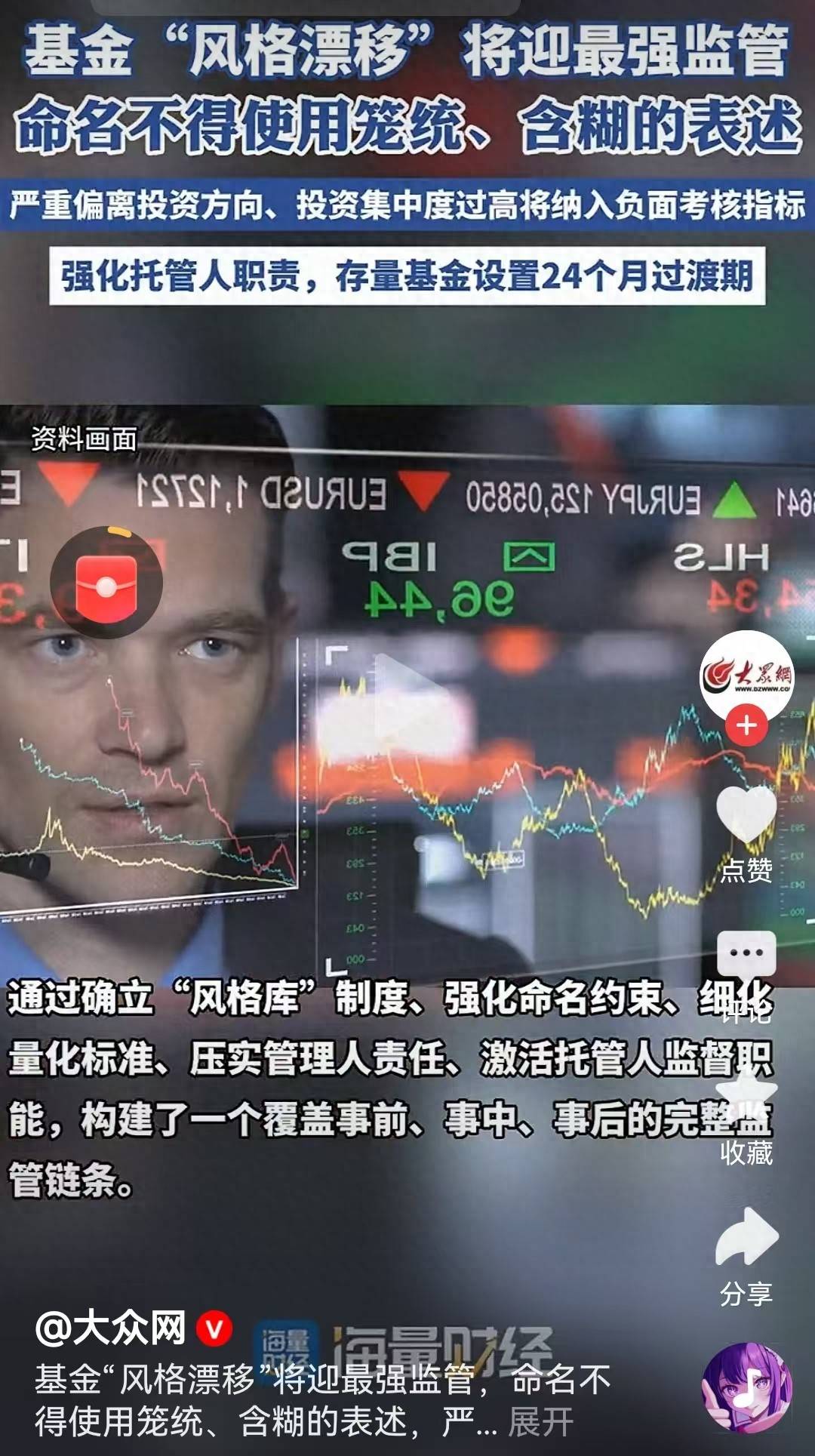
Core Viewpoint - The recent issuance of the "Guidelines for the Management of Theme Investment Style of Publicly Raised Securities Investment Funds" aims to address the long-standing issue of theme fund style drift, promoting a return to long-term investment and standardized development in the industry [2][4]. Group 1: Regulatory Changes - The China Securities Investment Fund Industry Association has introduced new guidelines that require fund companies to submit feedback by November 15, with the guidelines set to be officially implemented in 2026 [2][4]. - The guidelines will impose systematic regulations on theme funds across various aspects, including product design, investment operations, risk control, and custody supervision [2][4][6]. Group 2: Definition and Scope - The guidelines clarify the definition of theme investment funds, specifying that they must invest over 80% of non-cash assets in a specific investment direction, distinguishing them from other fund types [4][5]. - The guidelines mandate that fund names must clearly indicate investment directions and align with contractual agreements to prevent misleading representations [5][6]. Group 3: Management and Supervision - A comprehensive supervision system is established, involving active management by fund managers, oversight by custodians, and self-regulation by the association to prevent deviation from investment objectives [6][7]. - Fund managers are required to implement a full-chain system from product design to compliance management, with specific roles assigned to research, compliance, and fund management personnel [6][7]. Group 4: Performance Assessment - The guidelines emphasize the importance of stability in investment style as part of fund manager assessments, with penalties for significant deviations from investment directions [7][8]. - Custodians are tasked with rigorous oversight of fund contracts and must report any discrepancies to regulatory authorities [7][8]. Group 5: Transition Period - A transition period of 24 months is provided for existing theme investment funds to comply with the new requirements, allowing for necessary adjustments to fund contracts and prospectuses [8].
监管新规让基金不能再“挂羊头卖狗肉”
Di Yi Cai Jing Zi Xun· 2025-11-11 07:14
Core Viewpoint - The article discusses the recent regulatory changes aimed at addressing the issue of "style drift" in theme-based mutual funds in China, which has led to investor confusion and significant performance volatility [3][4]. Group 1: Regulatory Changes - The China Securities Investment Fund Industry Association has issued a draft guideline for theme investment style management, requiring feedback from fund companies by November 15, with plans for implementation in 2026 [3][4]. - The guideline aims to standardize investment behaviors across multiple aspects, including product design, investment operations, risk control, and custody supervision, promoting long-term investment and industry regulation [3][5]. Group 2: Definition and Requirements - The guideline clarifies the definition of theme investment funds, specifying that at least 80% of non-cash fund assets must be invested in a specific direction, which includes various categories such as market segments and investment strategies [5][6]. - It mandates that fund names must clearly indicate investment directions and align with contractual agreements, prohibiting vague terms [6][7]. Group 3: Supervision and Accountability - A comprehensive supervision system is established, involving active management by fund managers, oversight by custodians, and self-regulation by the association to prevent deviation from investment objectives [7][8]. - Fund managers are required to incorporate investment style stability into performance evaluations, with penalties for significant deviations from investment directions [8][9]. Group 4: Transition Period and Compliance - A transition period of 24 months is provided for existing theme investment funds to comply with the new requirements, allowing for necessary adjustments to fund contracts and prospectuses [9][10]. - The association will conduct regular inspections to ensure compliance with the new guidelines, with penalties for violations [9].

监管新规让基金不能再“挂羊头卖狗肉”
第一财经· 2025-11-11 07:04
Core Viewpoint - The article discusses the recent regulatory changes aimed at addressing the issue of "style drift" in theme-based mutual funds in China, which has led to confusion and losses for investors due to discrepancies between fund names and actual holdings [3][4]. Group 1: Regulatory Changes - The China Securities Investment Fund Industry Association has issued a draft guideline titled "Guidelines for the Management of Theme Investment Style of Publicly Raised Securities Investment Funds," which aims to standardize the investment behavior of theme funds [4][7]. - The guidelines will require funds to clearly define their investment direction, ensuring that fund names align with their actual investment strategies, thus preventing misleading representations [8][9]. - The new regulations are set to be implemented in 2026, with a 24-month transition period for existing funds to comply with the new requirements [13]. Group 2: Issues with Theme Funds - The phenomenon of "style drift" has been a persistent issue in the mutual fund industry, driven by factors such as market style changes, fund manager shifts, and performance pressures [6][7]. - Many fund managers have been observed to frequently switch between different market styles, leading to significant volatility in fund performance and investor losses [11][12]. - The guidelines aim to clarify the definition of theme funds, stipulating that at least 80% of non-cash fund assets must be invested in a specific direction, thereby reducing ambiguity in fund positioning [6][8]. Group 3: Management and Supervision - The guidelines establish a comprehensive supervision system involving fund managers, custodians, and self-regulatory measures to prevent deviations from stated investment styles [10][12]. - Fund managers are required to implement robust internal controls and risk management practices, while custodians must enhance their oversight responsibilities [12][13]. - The guidelines also emphasize the importance of maintaining investment style stability in the performance evaluation of fund managers, with penalties for significant deviations [12].