
大摩数字经济混合A

Search documents
2025年公募盘点:冠军刷新历史纪录,年内首尾业绩相差约260%……
聪明投资者· 2025-12-31 07:17
Core Viewpoint - The year 2025 marked a significant turnaround for active equity funds, with a notable performance improvement after three years of underperformance against the market, driven by structural market trends favoring technology and healthcare sectors [4][7]. Group 1: Market Performance - The Shanghai Composite Index closed at 3968.84 points, reflecting an annual increase of 18.41%, while the CSI 300 rose by 17.66% [3]. - The active equity fund index recorded a total return of 33.81% for the year, with over 90% of active equity funds achieving positive returns [4][5]. - The top-performing fund, Yongying Technology Select Mixed A, achieved a cumulative return of 239.78%, breaking the previous record held by Wang Yawei for 18 years [6][12]. Group 2: Sector Analysis - In 2025, 28 out of 31 sectors reported positive returns, with the top five sectors being non-ferrous metals (92.64%), telecommunications (87.27%), electronics (49.39%), comprehensive (44.9%), and power equipment (43.12%) [7]. - The bottom five sectors included food and beverage (-9.15%), coal (-4.77%), beauty and personal care (-0.44%), transportation (0.47%), and real estate (0.71%) [7]. - The market's structural trends were heavily influenced by the narrative surrounding technology and artificial intelligence, which dominated the year [7][8]. Group 3: Fund Issuance and Growth - The total scale of public funds reached a historic high of 37.02 trillion yuan by the end of November 2025, marking a continuous increase over eight months [8]. - A total of 1498 new funds were issued in 2025, the second-highest annual issuance on record, with index funds accounting for a quarter of all index funds issued since 2002 [9][10]. - The ETF market saw a significant growth of nearly 2.3 trillion yuan in 2025, with the total market size reaching 601.87 billion yuan, a 60% increase from the beginning of the year [10][11]. Group 4: Fund Manager Insights - The top 30 fund managers saw a significant number of their funds outperforming the market, with 130 out of 136 funds achieving positive returns [64]. - Notable fund managers included Du Meng from Morgan Stanley and Chen Hao from E Fund, both of whom saw substantial performance improvements in their managed products [65][67]. - The performance of funds was heavily influenced by their sector allocations, particularly in technology and communication sectors, which were common among the top-performing funds [47][49].

“主题投资”风行一时 “全市场选股”暂避锋芒
Zheng Quan Shi Bao· 2025-11-23 23:34
Core Viewpoint - The investment style of public funds in China is shifting from traditional core assets to emerging industries, driven by economic transformation and policy support, leading to a focus on thematic investments rather than broad market selection [2][3][5]. Group 1: Investment Strategy Changes - Public funds are moving from a "full market selection" strategy to a "thematic investment" approach, allowing for better positioning in high-growth stocks and enhancing competitiveness in performance rankings [3][4]. - The previous success of large-cap stocks like Sany Heavy Industry and Kweichow Moutai has diminished, with thematic products now dominating annual performance rankings [4][5]. - The rapid development of broad-based indices and Smart Beta products has made traditional active equity products less competitive, necessitating differentiation in style and active management [5][6]. Group 2: Thematic Investment Trends - Thematic funds have gained prominence, focusing on high-growth sectors such as artificial intelligence and innovative pharmaceuticals, which are seen as more lucrative compared to traditional sectors [6][7]. - Structural opportunities are increasingly concentrated in a few high-growth sectors, leading to significant performance disparities among funds [7][8]. - The focus on single themes allows for potentially higher returns, but also increases volatility and risk, necessitating careful management of exposure and risk [8][9]. Group 3: Challenges of Thematic Investment - Thematic investment requires deeper industry understanding and foresight, raising the bar for fund managers in terms of research and analysis capabilities [9][10]. - The need for rigorous valuation and risk management frameworks is heightened, as concentrated investments in specific sectors can lead to significant impacts from individual stock performance or policy changes [10][11]. - The complexity of managing concentrated portfolios increases, demanding more sophisticated risk management strategies to mitigate potential losses [10][11]. Group 4: Future of Investment Strategies - The "full market selection" strategy is not expected to disappear, as it offers unique advantages in capturing structural opportunities across various sectors [12][13]. - The market's aesthetic preferences will continue to evolve, but the fundamental skills associated with "full market selection" will remain relevant [12][13]. - The dual nature of thematic investments presents both opportunities for high returns and risks of significant losses, emphasizing the need for careful asset allocation and risk management [14][15].

押对基金经理就够了吗?大摩基金同一基金经理旗下产品,业绩首尾差竟近130%!
Hua Xia Shi Bao· 2025-11-14 13:16
Core Insights - Recent data shows a nearly 130 percentage point performance gap between different products managed by the same fund manager at Morgan Stanley Fund, highlighting potential risks in the "star manager, light product" investment model [2][6] - The case raises questions about the research and investment system, risk control mechanisms, and product layout rationality within fund companies [2] Group 1: Fund Manager Performance - Lei Zhiyong, a fund manager at Morgan Stanley, achieved the best market performance in 2024 with his fund focused on the digital economy, boasting a cumulative return of 125.88% since March 2, 2023, significantly outperforming the average of 12.47% [4] - Lei manages a total of 8 funds, with some showing outstanding performance, while others, like the Morgan Stanley Innovation Mixed A fund, have underperformed, with a return of -7.72% since May 7, 2020, compared to the average of 45.38% [5][6] Group 2: Performance Disparity Among Products - Wang Dapeng, another core fund manager at Morgan Stanley, has a stark performance disparity among his products, with the best-performing fund, Morgan Stanley Health Industry Mixed A, returning 81.40%, while the worst, Morgan Stanley Health Industry Mixed C, has a return of -47.78% [6][7] - The significant performance gap raises concerns about investor trust and reflects potential deficiencies in compliance and responsibility awareness among fund managers [7] Group 3: Market and Strategy Impact - Analysts suggest that the performance of fund managers is closely linked to the alignment of their investment strategies with market conditions, indicating that external factors such as macroeconomic changes can heavily influence fund performance [8] - The phenomenon of performance disparity may also stem from fund managers' divided attention when managing multiple products, leading to varied execution priorities and outcomes [8]

大摩基金两经理今年业绩大不同
Zhong Guo Jing Ji Wang· 2025-11-11 02:03
Group 1 - Morgan Stanley Fund Management (China) has experienced performance divergence among its fund managers this year, with Lei Zhiyong's Digital Economy fund showing strong results, while Wang Dapeng's Health Industry fund underperformed the index and benchmark returns [1][2] - The Digital Economy Mixed A fund managed by Lei Zhiyong has achieved a year-to-date return of 71% as of November 9, significantly outperforming the benchmark by 46 percentage points, and ranking among the top in its category [1] - Over the past year, the Digital Economy fund has delivered nearly 80% returns, exceeding the benchmark by approximately 59 percentage points, and has achieved a remarkable 192% return over the past two years [1] Group 2 - The Health Industry Mixed A fund, managed by Wang Dapeng, has heavily invested in the popular innovative drug sector but has only realized a year-to-date return of 5%, underperforming the benchmark by nearly 11 percentage points [2] - The Health Industry fund has shown negative returns over various time frames, with returns of -2%, -16%, -27%, and -32% over the past year, two years, three years, and five years respectively, all trailing the benchmark returns [2]
大摩基金两经理 今年业绩大不同
Shen Zhen Shang Bao· 2025-11-11 00:43
Group 1 - Morgan Stanley Fund Management (China) has experienced performance divergence among its fund managers this year, with Lei Zhiyong's Digital Economy fund performing exceptionally well, while Wang Dapeng's Health Industry fund underperformed the index and benchmark returns [1][2] - The Digital Economy Mixed A fund managed by Lei Zhiyong has shown strong performance, achieving a year-to-date return of 71% as of November 9, significantly surpassing the benchmark return by 46 percentage points [1] - Over the past year, the Digital Economy fund has nearly 80% returns, exceeding the benchmark by approximately 59 percentage points, and has achieved a remarkable 192% return over the past two years [1] Group 2 - The Health Industry Mixed A fund, managed by Wang Dapeng, has heavily invested in the popular innovative drug sector but has only achieved a year-to-date return of 5%, underperforming the benchmark by nearly 11 percentage points [2] - Over longer periods, the Health Industry fund has recorded returns of -2%, -16%, -27%, and -32% over the past year, two years, three years, and five years respectively, consistently underperforming the benchmark returns [2]
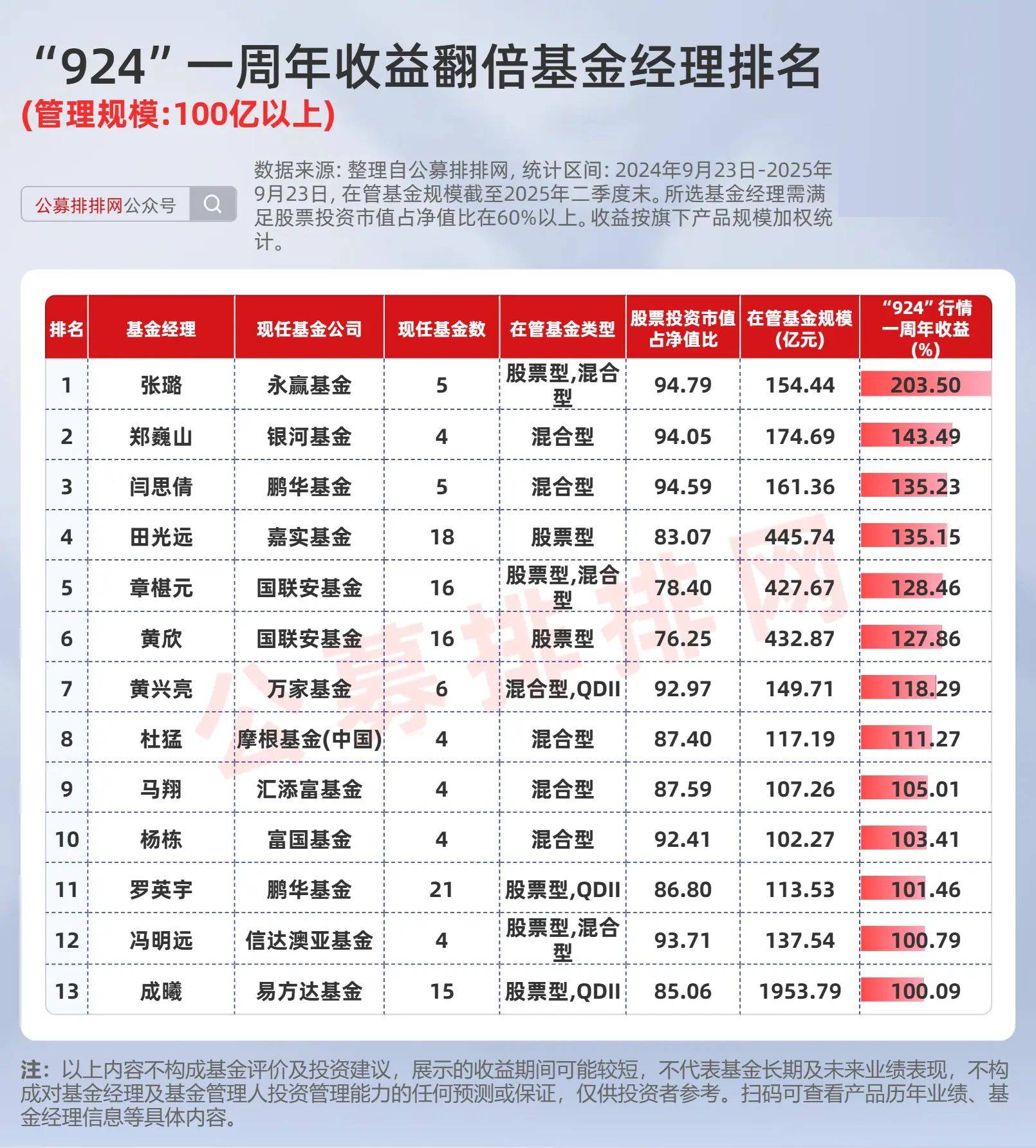
924一周年!146位基金经理收益翻倍!张璐、郑巍山等领衔!
Sou Hu Cai Jing· 2025-09-26 08:59
Core Insights - The equity market has shown signs of recovery since the "924" market rally, with an average increase of 80% across the A-shares, indicating a slow bull market trend [1] - During the one-year anniversary of the "924" rally, 1989 stock fund managers achieved an average return of 53.21%, with 146 managers doubling their returns [1] Group 1: Fund Managers with Over 100 Billion in Assets - Among the 184 fund managers managing over 100 billion, the average return during the "924" rally anniversary was 56.05%, with all achieving positive returns [1] - The top three fund managers in this category were Zhang Lu from Yongying Fund, Zheng Weishan from Galaxy Fund, and Yan Siqian from Penghua Fund [1][5] - Zhang Lu's funds achieved a remarkable return of 203.05%, with his flagship product, "Yongying Advanced Manufacturing Smart Selection Mixed A," returning 253.12% [5][6] Group 2: Fund Managers with 50-100 Billion in Assets - In the 50-100 billion category, 191 stock fund managers had an average return of 58.40%, with 23 managers doubling their returns [7] - The top three fund managers were Nong Bingli from Invesco Great Wall Fund, Sun Quan from Fortune Fund, and Xiao Ruijin from Bosera Fund [7][10] - Nong Bingli's funds achieved a return of 165.53%, with his representative product returning 151.02% [10] Group 3: Fund Managers with 20-50 Billion in Assets - Among 360 fund managers in this category, the average return was 55.22%, with 31 managers doubling their returns [11] - The top three were Lei Tao from Debang Fund, Wang Wenlong from Yongying Fund, and Wu Yang from E Fund [11][15] - Lei Tao's funds achieved a return of 172.03%, focusing on AI technology stocks [15] Group 4: Fund Managers with 10-20 Billion in Assets - In this segment, 309 fund managers had an average return of 54.09%, with 18 managers doubling their returns [16] - The top three were Ren Jie from Yongying Fund, Lu Yang from Debang Fund, and Han Hao from AVIC Fund [16][19] - Ren Jie achieved a return of 239.88%, with a focus on AI-related stocks [19] Group 5: Fund Managers with 5-10 Billion in Assets - The average return for 244 fund managers in this category was 52.55%, with 14 managers doubling their returns [20] - The top three were Zhou Jiansheng from Nord Fund, Dai Yi from Changsheng Fund, and Chen Peng from Anxin Fund [20][24] - Zhou Jiansheng's funds achieved a return of 179.19%, primarily investing in AI technology stocks [24] Group 6: Fund Managers with 0-5 Billion in Assets - Among 700 fund managers, the average return was 49.88%, with 47 managers doubling their returns [25] - The top three were Leng Wenpeng from CITIC Construction Investment Fund, Liu Xiaoming from Xinda Aoya Fund, and Li Ningning from Zhongjia Fund [25][29] - Leng Wenpeng's funds achieved a return of 261.14%, with his flagship product returning 263.38% [29]
机构风向标 | 中恒电气(002364)2025年二季度已披露前十大机构累计持仓占比39.01%
Xin Lang Cai Jing· 2025-08-21 01:13
Group 1 - Zhongheng Electric (002364.SZ) released its semi-annual report for 2025 on August 21, 2025, indicating that as of August 20, 2025, 11 institutional investors disclosed holding A-shares of Zhongheng Electric, totaling 220 million shares, which accounts for 39.02% of the total share capital [1] - The top ten institutional investors include Hangzhou Zhongheng Technology Investment Co., Bank of China - Morgan Stanley Digital Economy Mixed Securities Investment Fund, Hong Kong Central Clearing Limited, and others, with the top ten investors collectively holding 39.01% of the shares, an increase of 0.32 percentage points compared to the previous quarter [1] Group 2 - In the public fund sector, there was an increase in holdings from one public fund, namely Morgan Stanley Digital Economy Mixed A, with an increase of 0.52% [2] - Three public funds reduced their holdings compared to the previous quarter, including Debon Xinxing Value A, Debon Fuxin A, and Jiahe Ruijin Mixed A, with a total reduction of 0.39% [2] - Four new public funds were disclosed this period, including Guoshou Anbao Low Carbon Economy Mixed A, Morgan Stanley Technology Leading Mixed A, Morgan Stanley Basic Industry Mixed, and Guoshou Anbao Jingchen 6-Month Holding Period Mixed A [2] - One new foreign institution disclosed this period, which is Hong Kong Central Clearing Limited [2]

中恒电气连跌4天,摩根士丹利基金旗下1只基金位列前十大股东
Sou Hu Cai Jing· 2025-07-22 14:20
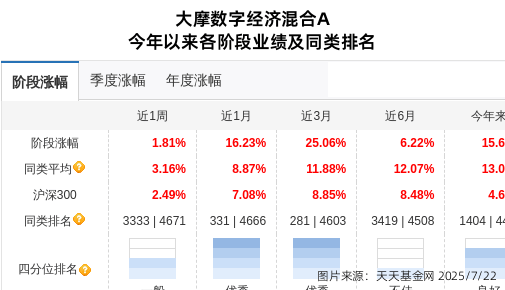
Core Viewpoint - Zhongheng Electric has experienced a decline in stock price over four consecutive trading days, with a cumulative drop of -5.29% [1] Company Overview - Zhongheng Electric Co., Ltd. was founded in 1996 and listed on the Shenzhen Stock Exchange in March 2010. The company focuses on building a zero-carbon intelligent society and operates in the digital energy sector [1]. Financial Performance - Morgan Stanley Fund's "Morgan Stanley Digital Economy Mixed A" has entered the top ten shareholders of Zhongheng Electric, marking a new investment in the second quarter of this year. The fund has achieved a return of 15.60% year-to-date, ranking 1404 out of 4491 in its category [1]. Fund Manager Profile - The fund manager of Morgan Stanley Digital Economy Mixed A is Lei Zhiyong, who holds a master's degree in computer software and theory from Peking University. He has held various positions in telecommunications and fund management since joining Morgan Stanley in October 2014 [4][5].
机构风向标 | 广合科技(001389)2024年四季度已披露前十大机构累计持仓占比77.28%
Xin Lang Cai Jing· 2025-04-01 01:14
Group 1 - Guanghe Technology (001389.SZ) released its 2024 annual report on April 1, 2025, indicating that as of March 31, 2025, 215 institutional investors disclosed holdings in Guanghe Technology A-shares, totaling 338 million shares, which accounts for 79.58% of the total share capital [1] - The top ten institutional investors include Guangzhou Zhenyun Investment Co., Ltd., Shenzhen Guangxie Investment Enterprise (Limited Partnership), and others, with a combined holding ratio of 77.28%, showing a decrease of 0.54 percentage points compared to the previous quarter [1] Group 2 - In the public fund sector, 202 new public funds were disclosed this period compared to the previous quarter, including major funds such as Morgan Stanley Digital Economy Mixed A and Xinao New Energy Industry Stock [2] - There were 16 public funds that were not disclosed this period, including Internet Leaders ETF and Huatai-PineBridge MSCI China A50 Connect ETF [2]
机构风向标 | 蓝思科技(300433)2024年四季度已披露前十大机构累计持仓占比73.40%
Xin Lang Cai Jing· 2025-03-28 01:15
Group 1 - Blue Silicon Technology (300433.SZ) released its 2024 annual report on March 28, 2025, with 190 institutional investors holding a total of 3.804 billion shares, representing 76.34% of the total share capital [1] - The top ten institutional investors collectively hold 73.40% of the shares, with a slight decrease of 0.16 percentage points compared to the previous quarter [1] Group 2 - In the public fund sector, two funds increased their holdings, accounting for a 0.26% increase, while six funds decreased their holdings, representing a 0.10% decrease [2] - A total of 14 new public funds were disclosed this period, while 123 funds were not disclosed compared to the previous quarter [2] - One foreign fund, Hong Kong Central Clearing Limited, increased its holdings by 0.19% [2]
