物流行业

Search documents
刘强东:未来员工可能每周只需工作一天甚至一小时
Zheng Quan Shi Bao Wang· 2025-11-07 10:08
Core Viewpoint - JD Logistics has achieved warehouse automation through 10 years of technological accumulation, with plans to establish the world's first fully automated delivery station by April next year [1][2]. Group 1: Technological Advancements - JD Logistics has successfully implemented warehouse automation, with over 700,000 kilometers of internal testing for unmanned trucks and millions of kilometers for last-mile delivery vehicles [2]. - The company plans to purchase 3 million robots, 1 million unmanned vehicles, and 100,000 drones over the next five years to enhance its logistics supply chain [2][3]. - The development of high-density solid-state batteries is expected to trigger a new wave of growth in the robotics and drone industries [2]. Group 2: Employment and Job Creation - Automation will not conflict with employment; instead, it will free workers from heavy labor and create new job opportunities [2][3]. - Future employees may only need to work one day a week or even one hour, as automation reduces the physical demands of their roles [2]. - The development of technology will lead to new demands and services, potentially increasing the global tourism market tenfold in the next five years [3]. Group 3: Logistics Cost Reduction - JD's entry into the logistics sector aimed to reduce China's high social logistics costs, which were significantly above those in developed countries due to disorganized cargo movement [4][5]. - The company believes that social logistics costs as a percentage of GDP can decrease from over 14% to below 10% within five years [5]. - In 2007, the logistics cost in China was over 18% of GDP, while developed countries had logistics costs between 6% and 8% [4][5]. Group 4: Future Projections - If logistics costs can be reduced to 6%, it could save enterprises trillions of yuan in net profits annually, fostering technological advancement and better employee compensation [5]. - JD Logistics has built a national logistics network with over 3,600 warehouses and more than 660,000 frontline employees as of June 2025 [5].

京东刘强东:未来5年我国社会物流总费用与GDP比率有望降至10%以内
Zhong Guo Qing Nian Bao· 2025-11-07 07:41
Core Viewpoint - The logistics costs in China are expected to significantly decrease with the advent of artificial intelligence (AI) and robotics, potentially bringing the ratio of social logistics costs to GDP below 10% within five years [2]. Group 1: Logistics Costs and Economic Impact - High logistics costs in China are primarily due to the disorganized flow of goods, which leads to resource wastage and low efficiency in resource allocation [2]. - Reducing social logistics costs could increase corporate profits, drive technological advancements, improve employee wages and benefits, and ultimately stimulate consumer spending, creating a positive economic cycle [2]. Group 2: Automation and Technological Advancements - JD Logistics has implemented significant automation and intelligence initiatives, with robots replacing 90% of manual labor in sorting centers in Beijing [3]. - By April next year, JD plans to establish the world's first fully automated delivery station, where all delivery tasks will be performed by robots [3]. - The development and application of digital technologies are expected to lead to deeper automation across various sectors, significantly reducing human working hours while also creating new demands in areas such as humanities and arts [3].


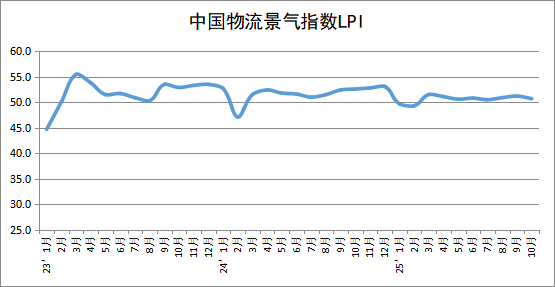
中物联:2025年10月份中国物流业景气指数为50.7% 较上月回落0.5个百分点
Zhi Tong Cai Jing· 2025-11-05 09:24
Core Viewpoint - The logistics industry in China experienced a slight decline in the logistics prosperity index for October 2025, which stands at 50.7%, down 0.5 percentage points from the previous month, yet remains in the expansion zone [1][7]. Group 1: Logistics Demand and Business Activity - The logistics demand showed a slight pullback in October, with the business volume index at 50.7%, reflecting a decrease of 0.5 percentage points, although it remains in the expansion range [4][9]. - The industrial logistics sector saw a decline in demand for home appliances, communication products, and renovation materials, while demand for electronic components, new energy vehicles, and transportation equipment remained strong [9]. - The consumer logistics sector experienced growth, driven by active online shopping and promotional activities during the National Day and Mid-Autumn Festival, with the postal express industry’s business volume index rising to 70.5%, up 0.4 percentage points [9]. Group 2: Business Resilience and Profitability - Logistics companies demonstrated resilience, with the main business profit index rising by 0.2 percentage points despite rising costs, indicating stable operational performance [10]. - Small and micro enterprises saw an increase in their main business profit index by 0.1 and 0.4 percentage points respectively, while large and medium-sized enterprises experienced a decline of 0.2 percentage points [10]. Group 3: Investment and Market Expectations - Fixed asset investment in logistics maintained an expansion trend, with the completion index at 55.2%, indicating ongoing investment in the sector [5][11]. - The business activity expectation index remained high at 55.3%, reflecting a positive outlook among enterprises for the future [6][11]. - Overall, the logistics industry is expected to maintain a steady growth trajectory, supported by strong demand and resilient supply chains [11].
鲁渤:完善现代流通网络畅通双循环
Jing Ji Ri Bao· 2025-11-05 00:20
Core Viewpoint - Accelerating the construction of a high-efficiency, standardized, fair competition, and fully open national unified market is crucial for breaking regional barriers and promoting the free flow of factors and efficient resource allocation, thereby unleashing the potential of a super-large-scale market and accelerating the establishment of a new development pattern [1] Group 1: Importance of Modern Circulation Network - The modern circulation network is a key carrier for addressing bottlenecks in the domestic circulation, effectively shortening time and space distances, and reducing circulation costs through modern infrastructure such as railways, highways, and ports [2] - The modern circulation network consists of "strategic pivot cities + backbone circulation corridors," playing a fundamental role in the national economic cycle and enhancing circulation efficiency while lowering costs [3] - A high-efficiency and smooth modern circulation network can significantly promote the national economic cycle by facilitating the efficient flow of goods and services through a three-dimensional layout of "channels + hubs + networks" [3] Group 2: Breaking Market Barriers - The advancement of a national unified market requires unified rules, interconnected facilities, and sufficient competition, with the modern circulation network playing a vital role in breaking physical barriers and promoting resource flow [4] - The construction of a modern circulation network can standardize and smartly build systems that facilitate the smooth flow of resources across larger areas, thereby optimizing allocation [4] Group 3: Reducing Logistics Costs - The level of social logistics costs reflects the quality of national economic development and competitiveness, and reducing these costs is beneficial for smoother flow of goods and services [5] - The modern circulation network can effectively lower social logistics costs and transaction costs through process optimization and smart scheduling, enhancing economic efficiency [5] Group 4: Addressing Market Blockages - The modern circulation network is essential for promoting the integration of markets and breaking through existing blockages in the super-large-scale market, focusing on high-standard connectivity of facilities and smooth flow of factors [6][7] - The network supports the integration of urban and rural markets, with e-commerce and cold chain logistics reshaping production and sales patterns [7] Group 5: Systematic Advancement of Modern Circulation Network - Building and improving the modern circulation network requires systematic advancement from top-level design, digital transformation, institutional reform, and enterprise cultivation [9] - Emphasizing top-level design and planning is crucial for establishing a unified national circulation network and ensuring collaborative approval and regulation across regions [9] - Promoting data element innovation and the application of technologies like IoT and digital twins in logistics can significantly enhance the efficiency and resilience of the circulation system [10]
“卷王”京东物流:既要又要还要
YOUNG财经 漾财经· 2025-11-04 15:07
Core Viewpoint - JD.com aims to build a more resilient "super supply chain" and has announced a significant investment plan to procure 3 million robots, 1 million unmanned vehicles, and 100,000 drones over the next five years, marking an unprecedented move in China's logistics history [2][7][10]. Investment Plan - JD Logistics plans to invest at least 290 billion RMB in the procurement of robots, unmanned vehicles, and drones, with estimated costs of 240 billion RMB for robots, 40 billion RMB for unmanned vehicles, and 10 billion RMB for drones [11][12]. - The investment will be capitalized as fixed assets, potentially increasing depreciation and amortization costs, which may compress accounting profits in the short term [14]. Financial Position - As of mid-2025, JD Logistics has 17.317 billion RMB in cash, which is insufficient to cover the planned expenditures. JD Group, which holds a 63.31% stake in JD Logistics, has a total of 223.4 billion RMB in cash and cash equivalents, but even with annual cash flow growth, JD may struggle to independently bear this massive investment [15]. Technological Investment - JD Logistics has significantly increased its R&D spending, with over 10 billion RMB invested from 2022 to 2024, surpassing competitors like SF Express. The company has developed various technologies, including AI models and autonomous robots, to enhance operational efficiency [16][18]. Cost Structure - Employee salaries and outsourcing costs account for 77.4% of JD Logistics' total operating costs, indicating a high reliance on human labor. The shift towards automation aims to reduce this dependency and improve cost efficiency [17]. Global Expansion - JD Logistics is pursuing a "global network plan," expanding its overseas warehouses and international logistics capabilities, with coverage in 23 countries as of mid-2025. The company aims to double its self-operated overseas warehouse area by mid-2025 [18]. Instant Delivery Services - The company has initiated a large-scale recruitment of full-time delivery personnel, with over 660,000 self-owned delivery staff, including more than 150,000 full-time riders for its food delivery service [19][22]. Strategic Transformation - JD Group is undergoing a strategic transformation from a traditional e-commerce company to a technology-driven supply chain infrastructure service provider, with JD Logistics playing a crucial role in this transition [23][25]. Financial Performance - In the first half of 2025, JD Logistics reported a net profit of 3.339 billion RMB, a 7.1% increase year-on-year, but faced a decline in operating cash flow, indicating potential challenges in maintaining profitability amid aggressive expansion [27]. Customer Satisfaction - Recent complaints against JD Logistics highlight potential issues in customer satisfaction, suggesting that the company's rapid expansion and strategic shifts may be impacting service quality [28].
广汇物流:已回购1477.04万股,使用资金总额8498.54万元
Xin Lang Cai Jing· 2025-11-04 11:20
Group 1 - The company Guanghui Logistics announced that as of October 31, 2025, it has repurchased a total of 14,770,400 shares through centralized bidding, which represents 1.24% of the current total share capital of 1,193,329,151 shares [1] - The highest purchase price for the repurchased shares was 10.96 yuan per share, while the lowest price was 4.62 yuan per share [1] - The total amount paid for the repurchased shares, excluding transaction fees, was 84,985,433.60 yuan [1]

广汇物流:累计已回购股数1477.04万股
Xin Lang Cai Jing· 2025-11-04 10:47
广汇物流公告,截至2025年10月31日,公司已通过集中竞价交易方式累计回购公司股份1477.04万股, 占公司目前总股本11.93亿股的比例为1.24%,购买的最高价格为10.96元/股、最低价格为4.62元/股,已 支付回购股份的总金额为8498.54万元(不含交易费用)。 ...
中国外运:累计回购约9256万股
Mei Ri Jing Ji Xin Wen· 2025-11-04 09:48
Group 1 - The core point of the article is that China National Foreign Trade Transportation Group (China Foreign Trade) announced a share buyback plan, repurchasing approximately 92.56 million A-shares, which accounts for 1.27% of the total share capital as of October 31, 2025 [1] - The maximum purchase price for the shares was 6.14 CNY per share, while the minimum was 4.67 CNY per share, with a total expenditure of approximately 475 million CNY [1] - As of the report date, the market capitalization of China Foreign Trade is 47.4 billion CNY [1] Group 2 - In 2024, the revenue composition of China Foreign Trade is entirely from the logistics industry, with a 100% share [1] - There is a significant increase in overseas orders, which surged by 246%, covering over 50 countries and regions [1] - Entrepreneurs have raised concerns about potential vicious competition extending overseas, as some are selling at a loss [1]

消费新场景活力强劲 借助物流业“含金量”十足数据解锁经济新动力
Yang Shi Wang· 2025-11-04 03:57
Core Viewpoint - The logistics industry in China continues to show expansion in October, with the logistics prosperity index remaining above the threshold, despite a slight month-on-month decline in the overall index [1][3]. Group 1: Logistics Prosperity Index - The logistics prosperity index for October is reported at 50.7%, reflecting a decrease of 0.5 percentage points from the previous month [3]. - Despite a minor adjustment in the logistics business volume index, overall demand remains in an expansion phase [3]. Group 2: Demand Trends - Industrial logistics demand, particularly for bulk commodities, has seen a decline due to the impact of the long holiday, while consumer logistics demand is accelerating [5]. - The logistics business completion index, new orders index, logistics service price index, capital turnover index, employment index, investment completion index, and expectation index all remain in the expansion zone [5]. Group 3: Consumer Logistics Growth - Consumer logistics growth stands out in October, driven by offline and online retail activities during the National Day and Mid-Autumn Festival holidays [7]. - Various local initiatives have stimulated consumption, leading to accelerated trade circulation and rapid growth in retail business [7]. Group 4: E-commerce and Delivery Services - E-commerce activities remain robust, with the postal express business volume index at 70.5%, showing a month-on-month increase of 0.4 percentage points [9]. - The improvement of the "15-minute convenient living circle" has led to a more than 8% year-on-year increase in instant delivery business volume, expanding from basic necessities to high-end products [9]. Group 5: Investment Outlook - Logistics infrastructure investment continues to expand, with the fixed asset investment completion index at 55.2%, indicating ongoing growth [12]. - Fixed investment completion indices for railway, road, air transport, pipeline transport, and postal express are all above 50%, with railway, air transport, and postal express exceeding 55% [12]. Group 6: Future Expectations - The logistics demand is expected to maintain steady growth in the fourth quarter, providing strong support for the overall economic goals [14]. - The business activity expectation index stands at 55.3%, remaining above 55% for eight consecutive months, indicating a positive outlook for the year [15].

前三季度消费需求和重点产业结构升级呈现新的亮点
Sou Hu Cai Jing· 2025-11-03 10:40
Economic Performance - China's GDP grew by 5.2% year-on-year in the first three quarters, maintaining a leading position among major global economies [1][4] - Retail sales of consumer goods increased by 4.5%, accelerating by 1.2 percentage points compared to the same period last year [4] - Industrial added value for large-scale enterprises rose by 6.2%, marking the highest growth for the same period since 2022 [4] Economic Resilience - Despite external pressures, China's goods exports maintained a growth rate of 7.1% [5] - The export structure has improved, with high-tech and high-value-added products seeing growth rates of 11.9% and 9.6%, respectively [5] - Exports to countries involved in the Belt and Road Initiative increased by 12.4%, and exports to ASEAN countries have seen an upward trend for eight consecutive months [5] Innovation and Industry Growth - China's innovation index has entered the global top ten, supporting the development of emerging industries [4] - The added value of equipment manufacturing and high-tech manufacturing increased by 9.7% and 9.6%, respectively, with their shares in large-scale industry rising [4] - Production of civilian drones and industrial robots surged by 43.2% and 29.8%, while production of new energy vehicles and lithium-ion batteries for vehicles grew by 29.7% and 46.9% [5] Financial Support and Investment - Over 5 trillion yuan has been allocated to support more than 2,300 projects, with total project investments around 7 trillion yuan, focusing on digital economy, AI, and urban infrastructure [7] - The National Development and Reform Commission will continue to promote project construction to expand effective investment and drive high-quality development [7] Logistics and Cost Efficiency - The total logistics cost in China for the first three quarters was 14.2 trillion yuan, with a GDP ratio of 14.0%, a decrease of 0.1 percentage points from the previous year [10] - The logistics infrastructure network is being optimized, with significant advancements in digitalization and automation, leading to improved operational efficiency [10] - The implementation of the "Action Plan" aims to further reduce logistics costs and enhance service quality across the logistics sector [10]