
金融科技服务

Search documents
金融科技“静默赋能”:构建消费新场景生态圈的隐性基石
Sou Hu Cai Jing· 2026-01-09 16:21
冬浅风清 不负流年 金融科技正从"可见工具"迈向"隐性生态",核心是实现从消费场景的"外部辅助"到"内生架构"的系统性 升级。这一转变并非技术的简单迭代,而是金融逻辑与场景生态深度融合的必然结果。嵌入场景的无感 金融科技,通过重构角色定位、升级运作机理、拓展价值维度实现"静默赋能",使其成为消费新场景生 态圈的支付与信用核心基石,既让生态圈具备自生长、自优化的能力,也让用户在无缝消费体验中悄然 享受技术红利。 生态重构: 从工具补位到场景原生 传统"可见工具"阶段,金融科技以具象化形态存在于消费场景中,呈现出"功能单一化、形态显性化、 场景割裂化"特征。POS机、ATM、第三方支付分别作为线下固定结算设备、银行服务物理延伸、线上 交易信任补充,以独立形态存在,仅被动响应支付或融资需求,未参与场景构建与创新,形成场景先 行、金融补位的传统逻辑。 进入"隐形生态"阶段,金融科技彻底打破这一传统逻辑,成为新消费场景的"启动器"与"连接器",其功 能内嵌于场景构建全流程。一方面,场景激活前置化通过"先享后付"等模式重构消费逻辑——支付与信 用作为核心支撑,既以信用评估替代预付资金降低消费门槛(如线下商超"先逛后付"、 ...
毕马威:金融业大模型应用建设将渐进收敛,智能体场景渗透进一步深化
Bei Jing Shang Bao· 2026-01-09 13:28
毕马威中国金融科技主管合伙人黄艾舟指出,复盘过去十年国内金融科技企业的发展脉络,地域分布上 呈现京、沪、深领跑的第一梯队格局,长三角、粤港澳和京津冀三大城市群发展格局强化;技术要素层 面,人工智能持续领跑,细分技术应用协同深化;细分赛道中,AI与大数据、数智赋能赛道近五年快 速增长,赛道分布趋多元化布局方向。 毕马威中国客户及业务发展主管合伙人江立勤指出,金融科技作为连接金融与产业生态的核心纽带,正 通过AI、区块链、量子计算等前沿技术的深度介入,重塑金融服务模式,推动金融资源更精准、高效 地注入科技创新领域。他指出,金融科技已从经营管理、业务创新、风险防范等环节为金融业提供新价 值锚点,并通过耐心资本与科技创新的深度融合,助力构建"科技-产业-金融"良性循环,进一步强化金 融回归本源、服务实体的战略定位。 北京商报讯(记者 马换换 李佳雪)1月9日,毕马威发布金融科技"双50"十周年报告,同时揭晓了"2025 年度第十届毕马威金融科技企业双50"榜单。 展望行业长期发展,黄艾舟提出三大核心趋势:其一,以支持科技创新和产业发展为导向,金融科技赋 能金融服务向科技企业全生命周期渗透;其二,金融业大模型应用建设渐 ...
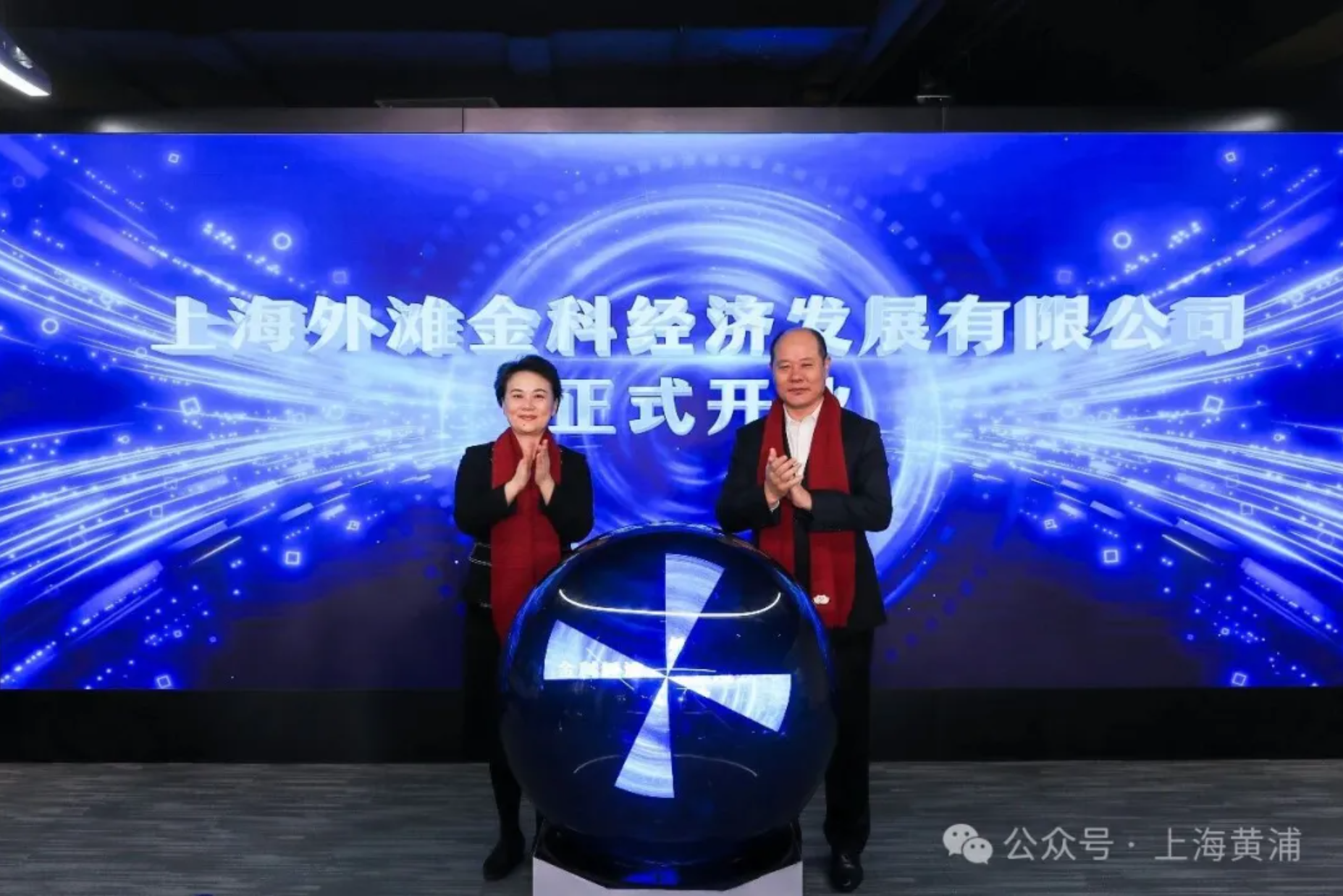
外滩FTC运营平台正式成立 浦发银行为上海全球金融科技中心建设添砖加瓦
Jin Rong Jie Zi Xun· 2026-01-09 10:43
Core Insights - Shanghai is accelerating its development as a world-class financial technology center, highlighted by the establishment of the Shanghai Bund Fin-Tech Economic Development Co., Ltd. in collaboration with SPDB and the Huangpu District government [1][2] - The new company aims to create a mixed-ownership structure that integrates state-owned and financial shareholders, focusing on the dual empowerment of "finance + technology" and "content + technology" [1][2] - The initiative is expected to transform the financial technology ecosystem in Shanghai into a market-oriented platform, enhancing the city's global financial technology competitiveness [2][4] Company and Industry Developments - The operational framework of the Bund Fin-Tech ecosystem includes multiple departments for industry incubation, ecological investment, brand promotion, and comprehensive services, enhancing market responsiveness [2] - By 2025, the Bund Fin-Tech center aims to attract 74 companies and 1,670 content creators, establishing a diverse network of technology firms, content creators, financial institutions, and professional services [3] - The "Puchuang Huazhang" venture capital fund, established by SPDB, will focus on strategic emerging industries such as artificial intelligence and new energy, providing comprehensive financial support for innovation [3][4] - The Bund Fin-Tech ecosystem is anticipated to evolve from a local financial technology hub to an internationally recognized innovation node, contributing significantly to Shanghai's position in the global financial technology landscape [4]

中科江南股价涨5.35%,华宝基金旗下1只基金位居十大流通股东,持有239.86万股浮盈赚取311.82万元
Xin Lang Cai Jing· 2026-01-09 05:55
Group 1 - The core viewpoint of the news is that Zhongke Jiangnan has seen a significant increase in its stock price, rising by 5.35% to 25.60 CNY per share, with a trading volume of 387 million CNY and a turnover rate of 4.74%, resulting in a total market capitalization of 9.033 billion CNY [1] - Zhongke Jiangnan, established on November 8, 2011, and listed on May 18, 2022, specializes in providing comprehensive solutions based on electronic payment technology [1] - The company's main business revenue composition includes electronic payment at 63.43%, smart finance at 20.19%, government and enterprise digitalization at 12.68%, and others at 3.70% [1] Group 2 - From the perspective of major circulating shareholders, Huabao Fund's ETF has increased its holdings in Zhongke Jiangnan by 1.1901 million shares, bringing its total to 2.3986 million shares, which represents 0.73% of the circulating shares [2] - The Huabao Zhongzheng Financial Technology Theme ETF, established on March 4, 2021, has a latest scale of 12.319 billion CNY, with a year-to-date return of 2.45% and a one-year return of 33.32% [2] - The fund manager, Chen Jianhua, has a cumulative tenure of 13 years and 22 days, with the best fund return during his tenure being 175.25% [3]
奇富科技发布首个信贷多模态评测基准
Xin Lang Cai Jing· 2026-01-09 04:14
Core Insights - Qifu Technology, in collaboration with Fudan University and South China University of Technology, has launched the first multimodal evaluation benchmark for credit scenarios, named FCMBench-V1.0, aimed at enhancing AI applications in credit assessment [1][2] - The benchmark is designed to address real credit business scenarios, focusing on multi-modal evaluation tasks that reflect practical business needs, thereby promoting academic research and application in credit AI [1] - Unlike traditional evaluations that focus on single recognition or understanding capabilities, this benchmark assesses model capabilities relevant to key processes in micro-enterprise credit granting, such as multi-document recognition and risk clue discovery [1] Summary by Sections - **Benchmark Development**: The FCMBench-V1.0 provides a standardized evaluation platform to foster collaboration between academia and industry, enabling fair comparisons of AI model capabilities in the credit field [1] - **Data and Framework**: The benchmark includes a highly consistent evaluation framework with 18 core credit document types, comprising 4,043 compliant images and 8,446 test samples, covering the entire credit review process [2] - **Industry Impact**: This initiative aims to break down data and knowledge barriers within the industry, facilitating a shift from "single-point optimization" to "collaborative innovation" between academia and financial technology companies [1]
外滩金融科技生态,重磅升级!
Zhong Guo Jin Rong Xin Xi Wang· 2026-01-09 03:23
Core Insights - The article discusses the establishment of the Shanghai Bund FinTech Economic Development Company, which aims to integrate financial, technological, content, and policy resources to foster high-density innovation in the financial technology sector without relying on large-scale land expansion or sacrificing historical aesthetics [1][3]. Group 1: Company Structure and Operations - The Shanghai Bund FinTech Economic Development Company is a mixed-ownership structure with state-owned and financial shareholders, marking a shift towards professional and market-oriented operations in the financial technology ecosystem [1][3]. - The company focuses on a dual empowerment model of "Finance + Technology" and "Content + Technology," creating an ecosystem that includes incubation, investment, and industry integration [3][4]. - An operational system has been established with multiple departments collaborating on industry incubation, ecological investment, brand promotion, and comprehensive services, enhancing market responsiveness [3]. Group 2: Ecosystem Development and Partnerships - The first batch of eight fintech companies and eight content creation companies have been awarded plaques, showcasing the ecosystem's ability to attract high-quality industry resources across various fields [4]. - Key initiatives such as the establishment of a fintech laboratory, signing of ecological partner alliances, and the launch of the PuChuang Huazhang Fund have created a complete ecosystem loop from platform building to capital empowerment [4]. - The Bund FinTech ecosystem is expected to evolve from a local fintech cluster to an internationally recognized innovation hub, positioning Shanghai as a significant player in the global fintech landscape [6].

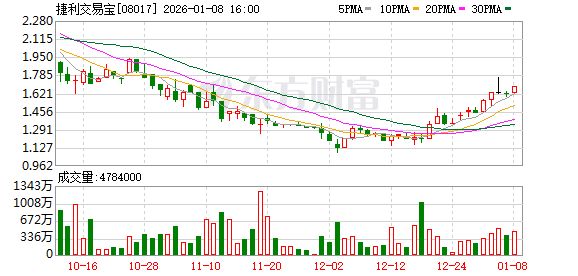
捷利交易宝(08017.HK)连续8日回购,累计回购1600.00万股
Zheng Quan Shi Bao Wang· 2026-01-08 15:03
| 日期 | 回购股数(万股) | 回购最高价(港元) | 回购最低价(港元) | 回购金额(万港元) | | --- | --- | --- | --- | --- | | 2026.01.08 | 200.00 | 1.680 | 1.640 | 330.26 | | 2026.01.07 | 200.00 | 1.640 | 1.600 | 323.67 | | 2026.01.06 | 200.00 | 1.770 | 1.660 | 341.08 | | 2026.01.05 | 200.00 | 1.630 | 1.500 | 313.74 | | 2026.01.02 | 200.00 | 1.570 | 1.480 | 305.90 | 证券时报·数据宝统计,捷利交易宝在港交所公告显示,1月8日以每股1.640港元至1.680港元的价格回购 200.00万股,回购金额达330.26万港元。该股当日收盘价1.680港元,上涨3.70%,全天成交额792.42万 港元。 (文章来源:证券时报网) 捷利交易宝回购明细 自2025年12月29日以来公司已连续8日进行回购,合计回购1600.00万股,累 ...
东方财富:公司一直致力于金融科技领域的探索和实践
Zheng Quan Ri Bao Wang· 2026-01-08 14:13
Core Viewpoint - Dongfang Caifu (300059) is leveraging its self-developed Miaoxiang AI model to enhance its financial services and create a more intelligent internet wealth management ecosystem [1] Group 1: Company Developments - The company has integrated Miaoxiang AI capabilities across all its product lines and business areas, focusing on optimizing its vertical capabilities in core financial scenarios [1] - Dongfang Caifu is committed to exploring and practicing in the fintech sector, aiming to empower finance through technology and create more value for users [1] Group 2: Technological Advancements - The Miaoxiang AI model is characterized by its data features and algorithm advantages, which contribute to the continuous improvement of the company's financial services [1] - The integration of Miaoxiang AI into the company's ecosystem is part of a broader strategy to enhance the construction of an internet wealth management ecosystem [1]

外滩FTC:在历史金融地标上,黄浦区如何重塑金融科技“策源地”
Di Yi Cai Jing Zi Xun· 2026-01-08 12:05
Core Insights - Shanghai is accelerating its development as a world-class financial technology center, with Huangpu District leading innovative practices that integrate historical significance with modern financial technology [1][9] - The FinTech Community (FTC) at the Bund is set to begin substantial operations by 2025, focusing on the integration of finance and technology to create a replicable model for global financial technology development [1][9] Group 1: Historical and Spatial Transformation - The FTC is located in the renovated Gu Xiang Building, which previously served traditional office functions but lacked modern relevance [2] - The renovation follows a "light modification" principle, maintaining the building's original structure while introducing new financial technology and content creation functions [2] - The redesigned FTC features a vertical ecological community layout, including public spaces, offices, and event areas, promoting flexible use of space [2] Group 2: Operational Mechanisms and Models - The establishment of the Shanghai Bund FinTech Economic Development Co., Ltd. marks the transition of FTC to a professional and market-oriented operational phase [3][4] - The operational model emphasizes a dual empowerment approach of "finance + technology" and "content + technology," creating an integrated ecosystem for incubation, investment, and industry collaboration [3][4] Group 3: Industry and Ecosystem Development - The FTC has quickly demonstrated its industry aggregation effects, attracting numerous financial technology companies and content creators since its trial operation [5][6] - By December 2025, 74 companies and over 1,670 content creators are expected to be engaged, forming a diverse network of technology firms, content creators, financial institutions, and service providers [7][8] Group 4: Service and Empowerment - The FTC is developing a comprehensive service system that covers the entire lifecycle of enterprises, providing integrated services such as market registration and financial support [8] - The initiative includes the establishment of a digital platform for content creators and businesses, facilitating resource matching and community interaction [8] Group 5: Broader Implications and Future Goals - The FTC's model offers a solution for urban areas to foster high-level financial technology innovation without relying on large-scale land development [9][10] - Future goals include collaboration with top universities and research institutions to extend financial technology innovation into cutting-edge fields and enhance global connectivity [11][12]
捷利交易宝(08017) - 自愿公告二零二五年十二月之未经审核营运数据
2026-01-08 10:04
香港交易及結算所有限公司及香港聯合交易所有限公司對本公告之內容概不 負 責,對 其 準 確 性 或 完 整 性 亦 不 發 表 任 何 聲 明,並 明 確 表 示,概 不 對 因 本 公 告 全部或任何部份內容而產生或因倚賴該等內容而引致之任何損失承擔任何責 任。 TradeGo FinTech Limited 捷利交易寶金融科技有限公司 | | 二零二五年 | 二零二四年 | | | --- | --- | --- | --- | | | 十二月 | 十二月 | 同比 | | 新增機構客戶數量 | 7 | 6 | +1 | | 註冊用戶數量 | 886,727 | 835,156 | +6.2% | | 打新記用戶數量 | 113,808 | 105,016 | +8.4% | 董 事 會 謹 此 提 醒 股 東 及 潛 在 投 資 者,上 述 營 運 數 據 未 經 審 核,有 關 數 據 乃 根 據 本 集 團 初 步 內 部 資 料 編 製,鑒 於 收 集 該 等 營 運 數 據 資 料 過 程 中 存 在 各 種 不 確 定 因 素,該 等 營 運 數 據 與 本 公 司 按 年 度 或 半 年 度 ...