Internet

Search documents
豆包被封VS硅谷结盟,谁在葬送中国的万亿AIoT市场?
3 6 Ke· 2025-12-16 10:17
Core Viewpoint - The launch of Doubao phone by ByteDance represents a significant move into AI hardware, but it faced immediate backlash from major platforms like Tencent and Alibaba, highlighting the ongoing conflict between AI development and platform data sovereignty [1][3][4]. Group 1: Doubao Phone Launch and Immediate Reactions - Doubao phone was launched on December 1, marking ByteDance's entry into AI hardware [1]. - Following the launch, Doubao's AI agent faced restrictions from Tencent, Alibaba, and banks due to unauthorized automated operations, leading to a rapid retreat from its initial capabilities within five days [3][4]. - The incident illustrates a collective resistance from the Chinese internet ecosystem against unauthorized AI operations, termed as "digital parasitism" [4][5]. Group 2: Contrasting Approaches in AI Development - On December 9, Anthropic announced the donation of the Model Context Protocol (MCP) to the Linux Foundation, transitioning it from a proprietary asset to a neutral open standard [3][8]. - This move signifies a shift towards collaboration in the AI industry, contrasting with the competitive and closed-off strategies seen in China [8][9]. - The establishment of the AI Agent Foundation (AAIF) by major tech companies in Silicon Valley aims to address interoperability issues, emphasizing the need for a unified approach to AI development [8][9]. Group 3: Challenges and Future Directions for AI in China - The current landscape in China is characterized by fragmented standards and internal competition among tech giants, which hinders the scalability of AI and IoT [13][14]. - The lack of a unified protocol could lead to two potential pitfalls: adopting foreign standards without consideration of local context or continuing fragmented development efforts [15][16]. - To overcome these challenges, China needs to establish its own AI interconnectivity protocol (CN-MCP) that addresses both connectivity and service standardization [18][21]. Group 4: The Need for Open Standards - The article argues that the future of AI and IoT hinges on the establishment of open standards that allow for seamless interaction between devices and services [22][24]. - The current reliance on visual recognition and simulated clicks is deemed unsustainable, necessitating a shift towards API-based interactions that provide clear pathways to core data [12][24]. - The call for a national-level industry alliance or neutral open-source foundation to lead the standardization efforts is emphasized as crucial for the development of a cohesive AI ecosystem in China [19][22].


普通人也能用AI赚钱了,百度沈抖:人人都是创造者
Yang Zi Wan Bao Wang· 2025-12-16 10:00
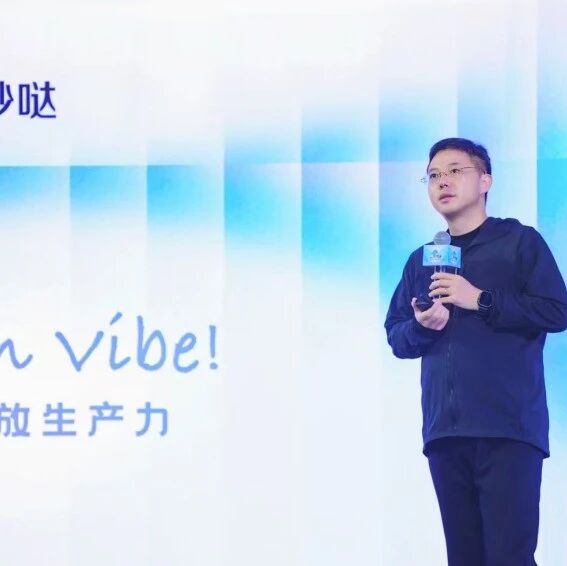
Core Insights - The era of AI is transforming creation from being a privilege of a few to a right accessible to many [1] - AI is now integral to production and decision-making processes, allowing anyone with ideas to become a creator [3] - The development of technology has led to new entrepreneurial models where the creation of value precedes the establishment of a company [3] Group 1: AI and Creation - AI significantly lowers the barriers to production, enabling employees and entrepreneurs to create value directly [3] - The shift in creation dynamics allows for a more democratized approach to innovation, where anyone can contribute [3] Group 2: Business Model Transformation - The traditional sequence of establishing a business before creating a product has been reversed; now, products can be developed and monetized first [3] - The focus is on creating tools that generate sustainable income from day one, rather than just simple applications [3] Group 3: Baidu's Initiatives - Baidu's no-code application platform, Miaoda, has generated over 500,000 commercial applications in eight months, creating economic value exceeding 5 billion [3] - The "Creator Dream Plan" aims to support 1 million creators over the next three years through various forms of assistance [4] - Baidu anticipates that Miaoda will generate at least 10 billion in value in the coming year [5]


12天集结全球AI大神,72小时极限创作,百度为AI创作者铺了一条什么
Sou Hu Cai Jing· 2025-12-16 09:54
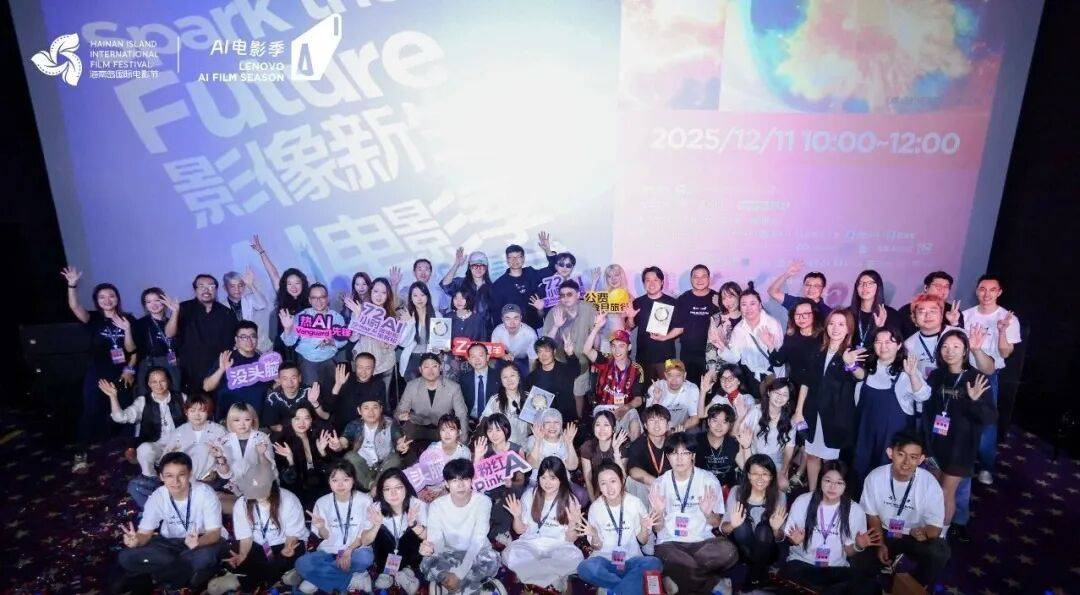
Core Insights - The seventh Hainan Island International Film Festival featured a unique "AI Film Season" with a 72-hour AI microfilm hackathon, showcasing the potential of AI in filmmaking [4][28] - The event attracted 105 teams globally within two weeks, highlighting Baidu's strong presence in the AIGC content ecosystem [6][31] - The hackathon demonstrated the creative capabilities of AI, with teams producing innovative films under tight deadlines, emphasizing the irreplaceable role of human storytellers [28][29] Group 1: Event Overview - The hackathon involved 10 teams competing to create AI microfilms within 72 hours, divided into two rounds with specific themes [9][28] - The winning team, "Publicly Funded Moon Travel," produced the film "WORLD CUP 2026," which creatively blended various narrative styles [9][14] - Other notable awards included the "Hot AI Pioneer Award" for films addressing universal themes and emotional resonance [9][28] Group 2: Creative Process and Themes - Teams faced intense pressure, with some creators expressing exhaustion but also a deep appreciation for collaboration and creativity [14][28] - The champion film utilized a mockumentary style to explore themes of reality and human connection through a video game narrative [14][21] - Other films tackled diverse themes, from personal regrets to broader human experiences, showcasing the versatility of AI in storytelling [25][26] Group 3: Baidu's Role and Future Directions - Baidu is actively building a supportive ecosystem for AI content creators, focusing on nurturing talent and facilitating commercial opportunities [31][40] - The company has seen a 194% year-on-year growth in AIGC content, indicating a robust expansion in this sector [31][39] - Future initiatives include collaborations with renowned IPs and a focus on various creative fields, aiming to integrate AI into cultural narratives [32][34]
Chinese Stocks Near Correction as Rally Fades on Weak Economy
Yahoo Finance· 2025-12-16 09:13
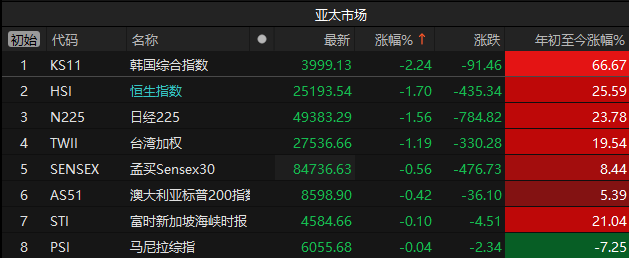
Market Performance - Chinese stocks in Hong Kong experienced a significant selloff, with the Hang Seng China Enterprises Index declining by 1.8% and the MSCI China Index falling by 1.6%, both indices briefly entering technical correction territory [1] - Major tech companies like Alibaba Group Holding Ltd. and Tencent Holdings Ltd. were among the largest contributors to this decline, with a gauge of tech stocks in Hong Kong nearing bear market conditions [1] Economic Concerns - The recent pullback in the market has raised concerns about fragile investor confidence due to ongoing economic weakness and the Chinese government's hesitance to implement substantial stimulus measures [2] - New data indicating further deterioration in economic confidence has heightened worries about potential spillover effects into other asset classes [2] Investment Sentiment - Investors are reevaluating their positions in China's equity market following a surge earlier in the year, with concerns about stretched valuations in the tech sector and broader benchmarks contributing to declining confidence [4] - The fragility of the market was evident after reports showed a slump in Chinese investment and the slowest retail sales growth since the COVID-19 pandemic, leading to market instability [5] Real Estate and Consumption Issues - Home prices in China have resumed their decline, exacerbating fears regarding the ongoing real estate crisis, particularly in light of China Vanke Co.'s increasing debt problems [5] - Issues such as deflation, weak consumption, and real estate challenges remain unresolved, prompting profit-taking among investors amid uncertainty [3] Government Policy and Economic Quality - President Xi Jinping has expressed intentions to address "reckless" projects that do not contribute to meaningful growth, reflecting concerns over the quality of GDP growth and financial resource allocation [6] Tech Sector Challenges - The tech sector is facing worries about an artificial intelligence bubble, compounded by weak macroeconomic conditions and a lack of significant catalysts from recent economic policy meetings [7]
A股连续大跌原因找到了!恒生科技进入技术性熊市,水牛可能结束了
Sou Hu Cai Jing· 2025-12-16 08:58
值得注意的是,这次是上证指数走出了双头结构,且面临破位下跌风险,而恒生科技指数今天跌破250日线,盘中最大回撤接近20%,相 当于进入了技术性熊市。我之前就提示过港股异常弱势,没想到美联储降息落地后会继续走弱。 上周五公布的11月社融数据和昨天公布的经济数据显示内需不振,市场特别是外资降低预期; 美股AI持续调整,本周美国将公布11月份非农和通胀数据,再加上日本央行加息,去年8月的亚太股市崩盘就是美国非农暴雷叠加日元 走强引发套息交易反转,虽然这一次日本加息市场有预期,但在当前弱势市场环境下不妨碍资金避险。 从更长期来看,我觉得有个很重要的逻辑需要关注下,那就是11月M2、M1增速继续下滑,非银存款异常的弱,再加上经济工作会议的 定调,明年不管是货币政策还是财政政策的力度都不如今年,这也意味着明年m2、m1增速很难像今年一样强势。 今天亚太股市全线下挫,A股、港股昨天刚跳完水,今天又是接着跳,沪指打响3800点保卫战,创业板指跌超2%。 我觉得正如去年924我们要从熊市思维摆脱出来转向牛市思维、坚定做多。而现在宏观环境发生了变化,国内超规模财政和宽松的货币没 了,m2和m1增速见顶回落,海外美联储快速降息阶段 ...
界面新闻2025年度科技行业CEO榜单发布:腾讯马化腾登顶
Xin Lang Cai Jing· 2025-12-16 08:07
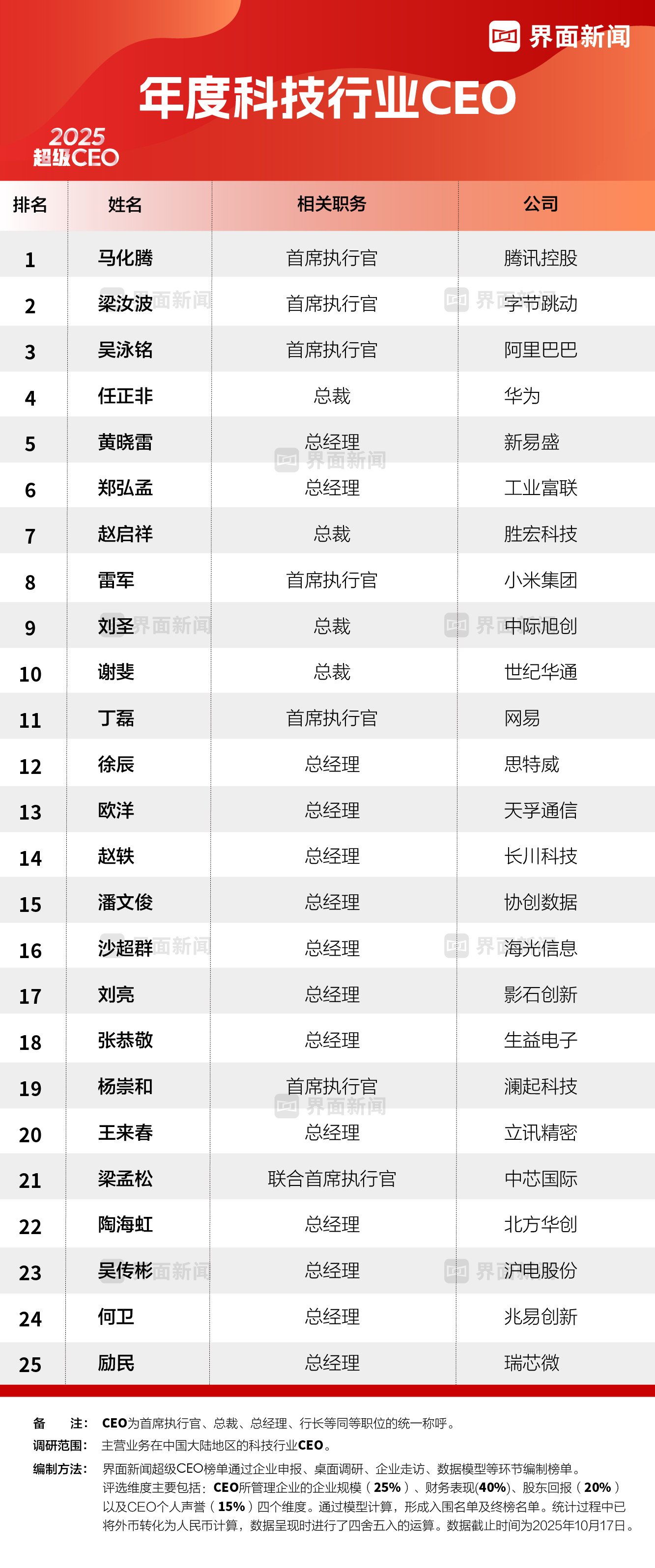
Core Insights - The article highlights the release of the "Annual Super CEO" list by Zhito Finance, recognizing outstanding leaders in various industries who have achieved financial growth and shareholder returns while maintaining personal reputation [1][9] - The technology sector is emphasized, with a focus on CEOs leading companies in China's mainland technology industry, showcasing their exceptional performance in a challenging economic environment [1][9] Industry Overview - The technology industry, as defined by Zhito Finance, includes information and communication technology (ICT) and its derivative application sectors, with significant developments in artificial intelligence, cloud computing, the metaverse, and semiconductors [2] - China's R&D investment is projected to exceed 3.63 trillion yuan, with an R&D intensity of 2.69%, indicating a strong focus on innovation and technological advancement [7] CEO Performance - The 25 CEOs on the list achieved a median revenue growth of 45.06% and a median net profit growth of 71.96%, with median return on equity and total asset return at 15.99% and 10.10% respectively [9] - The average market capitalization of these companies reached 632.997 billion yuan, reflecting their significant market presence [9] Notable CEOs - Tencent's CEO, Ma Huateng, ranked first, with the company achieving a revenue of 660.257 billion yuan in 2024, a year-on-year increase of 8.41%, and a net profit of 194.073 billion yuan, up 68.44% [18] - Huawei's CEO, Ren Zhengfei, ranked fourth, with the company reporting a revenue of 862.1 billion yuan, a 22.42% increase, and R&D investment of 179.1 billion yuan, accounting for 20.8% of total revenue [19] - Zhao Qixiang, CEO of Shenghong Technology, ranked seventh, with a revenue of 10.731 billion yuan, a 35.31% increase, and a net profit of 1.154 billion yuan, up 71.96% [20] Gender and Education Representation - Among the 25 CEOs, only four are women, indicating a male-dominated leadership landscape [9] - Nearly 50% of the CEOs have advanced degrees, with eight holding master's degrees and four holding doctorates [13] Sector Distribution - The semiconductor sector leads with seven companies represented, followed by five internet-related companies [15]




3 Artificial Intelligence (AI) Stocks Billionaires Can't Stop Buying Ahead of 2026
The Motley Fool· 2025-12-16 08:06
Core Insights - The article highlights the increasing interest of billionaire money managers in AI stocks as a significant investment trend for the upcoming year, with a focus on three key companies: Alphabet, Nvidia, and Meta Platforms [1][2][4]. Group 1: Alphabet (GOOGL) - Alphabet has been a consistent choice among billionaire fund managers, with notable purchases including 17,846,142 Class A shares by Warren Buffett and additional stakes by Coatue Management [5][6]. - The company holds a dominant position in the internet search market, capturing 89% to 93% of global market share over the past decade, and benefits from strong advertising pricing power [8]. - Alphabet's Google Cloud is integrating generative AI solutions, contributing to a revenue growth rate of around 30%, positioning it as a potential primary revenue source in the future [9][10]. Group 2: Nvidia (NVDA) - Nvidia is recognized as a leading player in the AI revolution, with significant share purchases by investors like David Tepper and Dan Loeb, indicating strong confidence in the company's future [12][13]. - The company dominates the AI-GPU market, with no significant competition challenging its hardware capabilities, and plans to introduce advanced chips annually [14]. - Nvidia's CUDA software platform enhances customer loyalty and maximizes the performance of its GPUs, further solidifying its market position [16]. Group 3: Meta Platforms (META) - Meta Platforms has seen increased investment from billionaire fund managers, with multiple new positions and additions to existing stakes during the third quarter [18][19]. - The company generates approximately 98% of its net sales from advertising across its popular platforms, which attract a daily average of 3.54 billion users [20][21]. - Meta is leveraging generative AI in its advertising solutions, potentially improving ad performance and pricing power, while maintaining a strong cash position of nearly $44.5 billion [22].




百度沈抖:AI开发从搓玩具进入能赚钱阶段,人人都是创造者
IPO早知道· 2025-12-16 05:18
Group 1 - The core idea of the article is that in the AI era, creation is shifting from being a privilege of a few to a right accessible to many, enabling widespread participation in production and decision-making processes [2][3]. - AI has integrated into core production and decision-making roles, allowing tasks such as coding, design, analysis, operations, and product development to be performed more efficiently [2][3]. - The source of creation is moving from technical departments to frontline employees and entrepreneurs, empowering anyone with ideas and a desire to create value to become a creator [3]. Group 2 - The development of AI has introduced new entrepreneurial models, where the sequence of turning an idea into a business has reversed; now, the focus is on creating and using products before formalizing a business plan [3]. - The concept of no-code creation is emphasized, where the goal is to build tools that generate real value and sustainable income from day one, rather than just simple prototypes [3]. - Baidu's no-code application platform, Miaoda, has generated over 500,000 commercial applications in various sectors within eight months, creating economic and efficiency value exceeding 5 billion yuan [3]. - Baidu announced the "Creator Dream Plan," aiming to support 1 million creators in generating income through traffic support, revenue sharing, and technical assistance over the next three years [3]. - It is projected that Miaoda will create at least 10 billion yuan in value in the coming year [4].
Should You Invest $1,000 in Alphabet Right Now?
The Motley Fool· 2025-12-16 04:36
Core Insights - Alphabet's stock has surged 63% in 2025, reaching a market cap of $3.7 trillion, indicating strong investor confidence and positive momentum [1][3] - The current forward price-to-earnings ratio of 28 is considered reasonable, supported by Alphabet's economic moat, innovation history, and substantial free cash flow [3] - The stock has outperformed the S&P 500 over the past five years and is expected to continue this trend through 2030, driven by new revenue streams such as advertising on the Gemini app [6] Financial Performance - Alphabet generated $74 billion in ad revenue in the third quarter, a figure expected to grow and enhance profitability [7] - The current stock price is $308.22, with a day's range between $304.88 and $311.42 [4] - The stock has a gross margin of 59.18% and a dividend yield of 0.27% [5] Market Position - Alphabet's shares have a 52-week range of $140.53 to $328.83, reflecting significant price movement and investor interest [5] - The company has a trading volume of 29 million, with an average volume of 37 million, indicating active trading [5]

腾讯控股 - 业务分享要点
2025-12-16 03:30
Summary of Tencent Holdings Ltd. Conference Call Company Overview - **Company**: Tencent Holdings Ltd. (0700.HK) - **Industry**: China Internet and Other Services - **Market Cap**: US$734.57 billion - **Current Stock Price**: HK$616.00 (as of December 12, 2025) - **Price Target**: HK$735.00, representing a 19% upside potential Key Points from the Conference Call International Cloud Strategy - Tencent Cloud operates in 22 regions with 64 available zones and has a reserved bandwidth of 200T, along with over 3,200 acceleration nodes, positioning it as a leading cloud service provider in ASEAN [7] - Major customer acquisitions include GoTo in Indonesia and CP Group in Thailand, highlighting Tencent's competitive pricing and vertical experience in sectors like media and fintech [7] Gaming Sector Insights - Tencent's overseas games have started to show positive results this year, with a focus on the shooting games genre, which is projected to generate US$38 billion in 2025 [7] - The company has improved its market share in the gaming sector, achieving 60-70% during the battle royale era (2020) and 70-80% during the extraction era (2025) [7] - Success factors for Tencent's gaming studios include productivity differentials, category dynamics, and a focus on authenticity and creativity in game development [7] Financial Projections - Revenue projections for the fiscal years ending December 2024 to 2027 are as follows: - 2024: Rmb 660.3 billion - 2025: Rmb 753.4 billion - 2026: Rmb 836.7 billion - 2027: Rmb 918.3 billion [5] - Earnings per share (EPS) estimates are projected to grow from Rmb 20.63 in 2024 to Rmb 31.68 in 2027 [5] Risks and Opportunities - **Upside Risks**: - Successful execution of new game launches both domestically and internationally - Market share gains in social and short video ads - Increased adoption of consumer AI technologies [12] - **Downside Risks**: - Regulatory uncertainties in the gaming industry - Intensified competition in social networks and advertising budgets - Tightened regulations amid US-China tensions [12] Analyst Ratings - Tencent is rated as "Overweight" by Morgan Stanley, indicating a positive outlook compared to its industry peers [5] - The overall industry view is considered "Attractive," suggesting favorable conditions for growth in the China Internet and Other Services sector [5] Additional Insights - Tencent's cloud services are underappreciated by the market, indicating potential for growth that may not yet be fully recognized [1] - The company continues to prioritize internal chip usage for AI model training, reflecting a strategic focus on enhancing its technological capabilities [7] This summary encapsulates the key insights and financial metrics discussed during the conference call, providing a comprehensive overview of Tencent Holdings Ltd.'s current position and future outlook in the market.