
AI电影

Search documents
豆包App开启Seedance 2.0灰度测试,港股通互联网ETF易方达(513040)最新单日净流入1.18亿元
Xin Lang Cai Jing· 2026-02-12 02:57
Group 1 - The core viewpoint of the news highlights the significant performance of the E Fund Internet ETF (513040), which has reached a new high in both scale and shares, indicating strong investor interest and inflow of funds [1][2] - As of February 11, the latest scale of the E Fund Internet ETF is 10.299 billion, with a total of 7.347 billion shares, marking a record since its inception [1] - The net inflow of funds into the E Fund Internet ETF has reached 118 million, with a total of 445 million in net inflows over the past five trading days, showing a positive trend in investment [1] Group 2 - The E Fund Internet ETF closely tracks the CSI Hong Kong Stock Connect Internet Index, which selects 30 listed companies involved in internet-related businesses to reflect the overall performance of internet-themed stocks within the Hong Kong Stock Connect [2] - The index covers key sectors such as e-commerce, advertising, and cloud services, aligning with the global AI-driven industrial upgrade, making it an efficient tool for capturing opportunities in the Hong Kong internet sector [2] Group 3 - ByteDance's AI assistant Doubao has initiated a gray test for its latest video generation model, Seedance 2.0, which is expected to enhance the creative process in AI-generated content [1] - The core breakthrough of Seedance 2.0 is the transition from low-deterministic "blind box generation" to a more controllable and reusable creative workflow, which could support the scaling of AI-driven content such as AI comic dramas and short films [1] - The maturation of AI video industrial capabilities is anticipated to drive changes in the value distribution structure of the content industry [1]
对2026中国电影的十个问题:500亿票房还能达成吗?100亿影片还会有吗?
Xin Lang Cai Jing· 2026-01-15 02:45
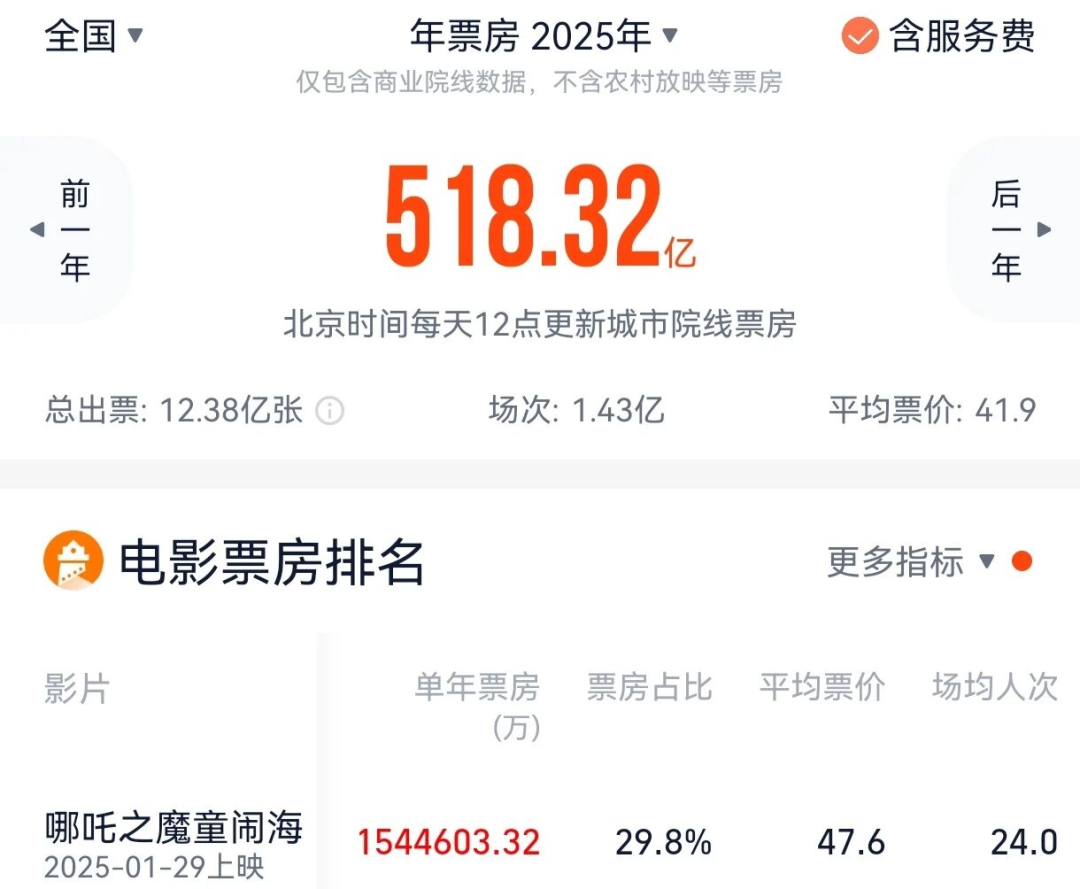
Core Insights - The Chinese film market achieved a remarkable total box office of 51.832 billion, with "Nezha: The Devil Child Comes to the World" leading at 15.446 billion, setting a new record for Chinese films and ranking as the top global box office film of the year [1][2] - The success of major IPs indicates a strong rebound in audience demand, but structural issues such as the concentration of resources on blockbuster films are creating challenges for smaller productions [3][5] Box Office Performance - "Nezha: The Devil Child Comes to the World" grossed 15.446 billion, with an average ticket price of 47.6 [4] - Other notable films include "Zootopia 2" at 4.327 billion and "The Wandering Earth 2" at 3.612 billion, showcasing a diverse range of successful titles [4] Market Dynamics - The dominance of blockbuster films is leading to a lack of balance in the market, with many mid and low-budget films struggling for screen time and box office success [3][5] - The film industry is witnessing a shift with major players like Alibaba Pictures transforming into new entertainment entities, indicating a strategic pivot towards enhancing cinema experiences [4] Future Outlook - The film industry faces uncertainties in 2026, including whether box office revenues can maintain the 500 billion scale and the impact of traditional companies adapting to new market dynamics [5][6] - The emergence of AI technology in filmmaking and the potential for a "Grocery Economy" around film IPs are expected to shape future revenue streams [21][42] Industry Challenges - The failure of several high-profile films in 2025 has raised concerns about the sustainability of traditional film companies, with some facing significant financial losses [13][14] - The need for better storytelling and innovative content is emphasized as a critical factor for the industry's recovery and growth in 2026 [16][46]


元旦档电影票房7.39亿元收官 平均票价连续三年下降
Zheng Quan Ri Bao· 2026-01-04 16:41
Group 1 - The core viewpoint of the articles highlights that the 2026 New Year's film box office reached 739 million yuan, with "Zootopia 2" leading the box office at 219 million yuan, while the average ticket price decreased for three consecutive years [1][2] - The New Year's holiday in 2026 lasted three days, resulting in a year-on-year box office increase of 141.7% compared to 2025, but a 52% decrease compared to 2024, with ticket sales dropping from 36.69 million in 2024 to 18.64 million [1] - Government initiatives, such as movie consumption vouchers totaling 170 million yuan in Hunan and a planned investment of at least 1 billion yuan in viewing subsidies, have contributed to lowering the actual payment costs for audiences, which is a major factor in the decline of ticket prices [1] Group 2 - The lack of high-quality new films capable of breaking through in the 2026 New Year's period is identified as a core reason for the box office performance, with most new releases failing to exceed 100 million yuan [2] - The trend in the 2025 film market indicates that mid-tier films are struggling to succeed, as audiences prefer high-investment works or adaptations of major IPs, leading to a stagnation in box office for smaller budget films [2] - The investment costs for mid-tier films are expected to decrease further in 2026, potentially accelerating the adoption of AI in film production, which could address issues of long creation cycles and high production costs, though audience acceptance remains uncertain [2]
AI电影:技术重构生产,生态开启新篇
Soochow Securities international· 2025-12-31 11:20
Investment Rating - The industry investment rating is "Overweight," indicating that the industry index is expected to outperform the market by more than 5% in the next six months [5]. Core Insights - The AI film industry is entering a phase of large-scale implementation driven by technological convergence and policy support, with significant demand for cost reduction and efficiency improvements in the film sector [8]. - AI technology is deeply penetrating the entire film production process, leading to dual breakthroughs in cost reduction and content innovation [8]. - The industry faces both opportunities and challenges, with a need for sustainable development amidst the release of industrial value [8]. - A competitive landscape has emerged with multiple strong players focusing on technology, content, and ecosystem integration [8]. Summary by Sections A. Technological Path Convergence and Policy Support - AI video generation technology has evolved through three stages, currently dominated by the DiT (Diffusion Transformer) architecture, which addresses key issues like frame consistency and physical realism [13]. - Domestic models such as Kuaishou's Keling and ByteDance's Jidream have shown significant advancements, particularly in Chinese semantic understanding and local scene adaptation [17][20]. B. AI's Penetration Across the Film Industry Chain - AI tools enhance script creation and concept design, significantly reducing the time required for these processes [24]. - Virtual filming and digital human applications are optimizing production processes, reducing costs associated with physical sets and actor availability [27]. - Post-production efficiency is improved through AI-driven editing and special effects, with tools enabling high-quality output at lower costs [31]. C. Industry Logic Reconstruction - The positive impacts of AI include significant cost reductions, lowered creative barriers, and the emergence of new content forms like AI comics and interactive films [39]. - Challenges include copyright and compliance risks, content homogenization, and employment impacts due to reduced demand for traditional roles [40]. D. Competitive Landscape - The industry features a multi-strong player dynamic, with key players like OpenAI and Google leading in technology, while domestic companies like Kuaishou and ByteDance are rapidly catching up [42]. - Traditional film companies are increasingly adopting AI to enhance production efficiency, with firms like Huace Film and Light Media leveraging AI for content creation [42].




12天集结全球AI大神,72小时极限创作,百度为AI创作者铺了一条什么
Sou Hu Cai Jing· 2025-12-16 09:54
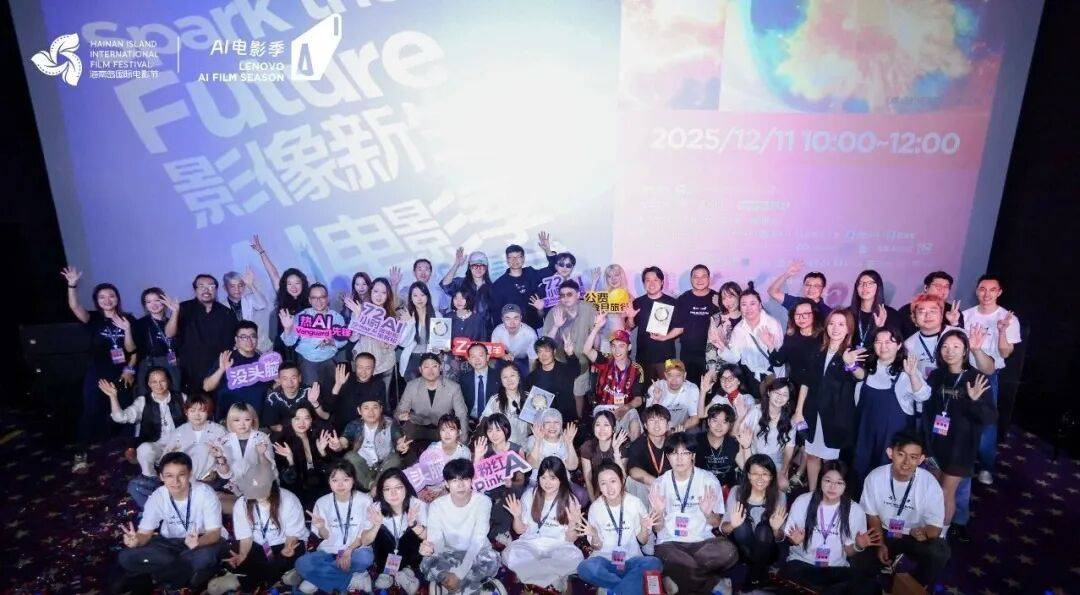
Core Insights - The seventh Hainan Island International Film Festival featured a unique "AI Film Season" with a 72-hour AI microfilm hackathon, showcasing the potential of AI in filmmaking [4][28] - The event attracted 105 teams globally within two weeks, highlighting Baidu's strong presence in the AIGC content ecosystem [6][31] - The hackathon demonstrated the creative capabilities of AI, with teams producing innovative films under tight deadlines, emphasizing the irreplaceable role of human storytellers [28][29] Group 1: Event Overview - The hackathon involved 10 teams competing to create AI microfilms within 72 hours, divided into two rounds with specific themes [9][28] - The winning team, "Publicly Funded Moon Travel," produced the film "WORLD CUP 2026," which creatively blended various narrative styles [9][14] - Other notable awards included the "Hot AI Pioneer Award" for films addressing universal themes and emotional resonance [9][28] Group 2: Creative Process and Themes - Teams faced intense pressure, with some creators expressing exhaustion but also a deep appreciation for collaboration and creativity [14][28] - The champion film utilized a mockumentary style to explore themes of reality and human connection through a video game narrative [14][21] - Other films tackled diverse themes, from personal regrets to broader human experiences, showcasing the versatility of AI in storytelling [25][26] Group 3: Baidu's Role and Future Directions - Baidu is actively building a supportive ecosystem for AI content creators, focusing on nurturing talent and facilitating commercial opportunities [31][40] - The company has seen a 194% year-on-year growth in AIGC content, indicating a robust expansion in this sector [31][39] - Future initiatives include collaborations with renowned IPs and a focus on various creative fields, aiming to integrate AI into cultural narratives [32][34]

联想集团副总裁王传东:AI电影正走向“全民共创”
Huan Qiu Wang· 2025-12-08 06:27
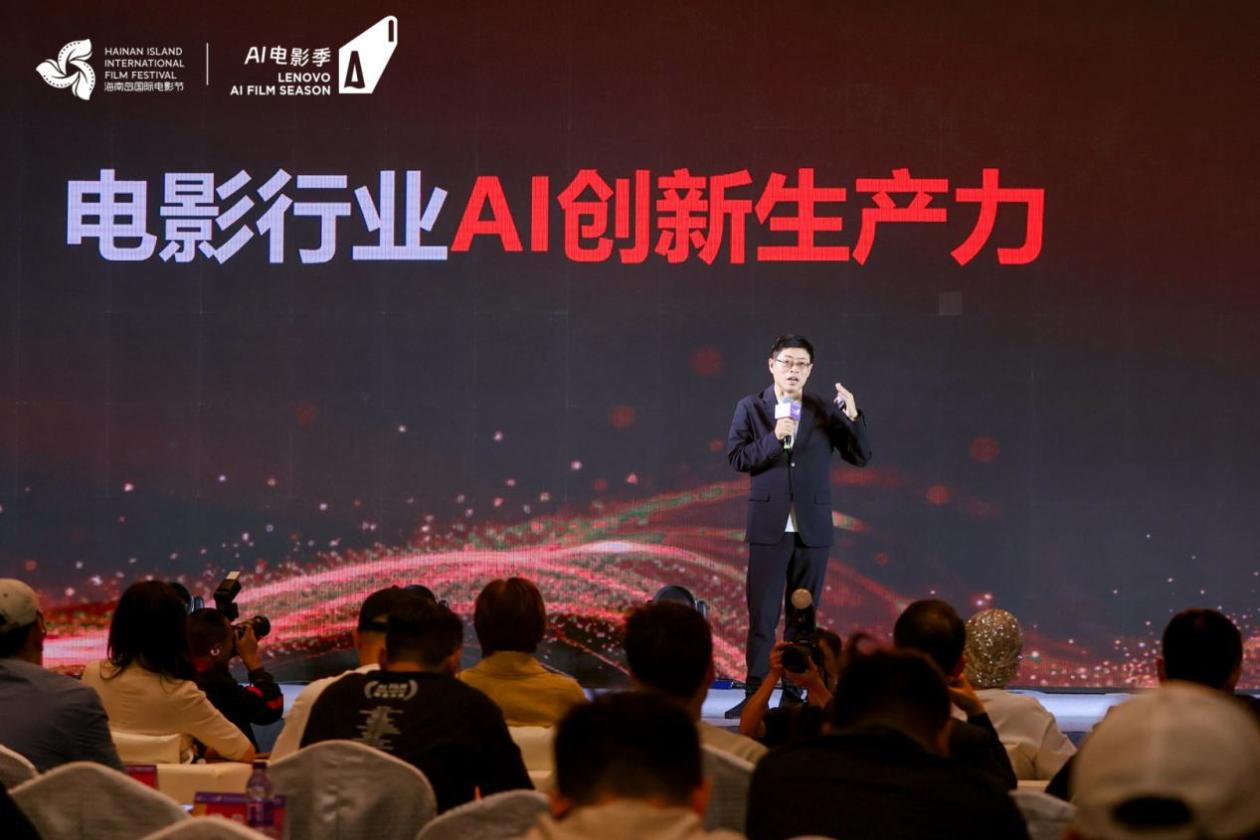
Core Viewpoint - The era of "human-machine co-creation" has arrived, with Lenovo aiming to empower AI creators to surpass their imagination through AI tools and services [1]. Group 1: AI in Film Creation - Over the past two years, AI has become an indispensable force in film creation, marking a significant trend in the evolution of the film industry [4]. - The establishment of the AI Film Season at the Hainan Island International Film Festival represents a strategic move to embrace the multi-modal transition of AIGC (AI-Generated Content) and to lay the groundwork for future imaging [4]. - The rapid evolution of AIGC is reconstructing the paradigm of film production, transitioning from the film era to the digital era, and now to the AI film era [4]. Group 2: Characteristics of AI Film Creation - The creation in the AI film era exhibits three characteristics: integrated end-cloud architecture, multi-modal fusion, and collaboration among multiple intelligent agents [4]. - AI has broken down creative barriers, allowing individual creators to possess large-scale production capabilities, significantly reducing the creation time from months to mere hours [4]. Group 3: Lenovo's AI Tools and Services - Lenovo offers a comprehensive suite of AI tools and services to empower creators, enabling them to have their own "dream factory" [4]. - The Tianxi AI, Lenovo's personal AI, is designed to assist creators in various aspects of film production, including script writing and storyboard design, achieving the effect of "one person as the entire crew" [5]. - Lenovo's AI workstations support local deployment of powerful models, serving top film post-production teams globally, exemplified by their work on the critically acclaimed film series "Dune" [5]. Group 4: Future Initiatives - Lenovo has launched the "Parallel Universe" creative concept, aiming to collaborate with pioneering creators through co-creation of worldviews, characters, scenes, and music, enriching traditional film production models [5]. - The AI Film Season is expected to inspire filmmakers to expand their imagination and foster a thriving ecosystem in the AI era [5].

AI能「拍」好电影?五部短片亮相釜山电影节,答案出乎意料
机器之心· 2025-09-27 06:13
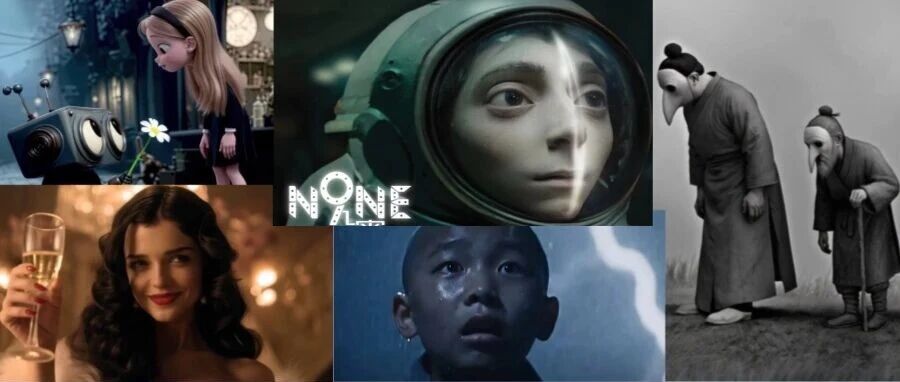
Core Viewpoint - The article discusses the technological advancements in AI-generated films, highlighting the successful creation of the first fully AI-generated short film "Nine Heavens" by a young team from Hong Kong, which has been recognized at the Busan International Film Festival [2][5][40]. Group 1: AI in Film Production - The team at ManyMany Creations Limited aimed to create a 15-minute narrative short film entirely generated by AI, which they successfully accomplished with "Nine Heavens" [2][3]. - "Nine Heavens" is notable for its reliance on subtle micro-expressions to convey the protagonist's emotional journey, showcasing AI's capability in narrative storytelling [5][6]. - The film was part of a larger initiative called the "Future Image Plan," which aims to explore AI's role in filmmaking [5][18]. Group 2: AI Technology and Tools - The production utilized advanced AI models from platforms like Jiemeng AI and Volcano Engine, which have significantly improved the quality and realism of AI-generated images and videos [17][18]. - The article mentions the evolution of AI tools, such as Seedream 4.0, which allows for multi-image fusion, enabling creators to generate detailed storyboards and videos from simple descriptions [23][25]. - The integration of AI in film production has led to a reduction in production time and costs, with "Nine Heavens" being produced in a fraction of the time compared to traditional methods [25][26]. Group 3: Industry Trends and Future Outlook - Major film companies, like Bona Film Group, are embracing AI technologies, establishing dedicated AI production centers to explore new creative workflows [19][20]. - The shift towards AI in filmmaking is seen as a way to democratize the industry, allowing non-professionals to create high-quality content with minimal resources [30][31]. - Despite the advancements, challenges remain in achieving consistent quality in longer scenes, indicating that human intervention is still necessary in the production process [40][47]. Group 4: Creative Freedom and Expression - AI tools have provided unprecedented creative freedom, allowing filmmakers to experiment with character designs and settings without the constraints of traditional production processes [32][33]. - The article emphasizes that while AI can generate content, the essence of storytelling and artistic expression remains rooted in human creativity and perspective [48][49].
推动电影业高质量发展
Jing Ji Ri Bao· 2025-05-28 18:43
Core Insights - The Chinese film market is showing promising growth, particularly highlighted by successful releases like "Ne Zha" and "Detective Chinatown 3" during the Spring Festival [1][2] - The development of the film industry requires a focus on quality, innovation, and the integration of technology, as emphasized by industry leaders [1] Group 1: Industry Development - The film industry must prioritize "watchability," literary script creation, talent cultivation, market regulation, economic diversification, technological advancement, international cooperation, and a supportive environment for investment [1] - The overall quality of the film industry is contingent upon innovation and new artistic and technical discoveries [1] Group 2: Market Dynamics - The Chinese film market has a large audience and increasingly mature production processes, necessitating better resource allocation to create high-quality content [2] - The future of Chinese cinema relies on both large cities with high-tech productions and smaller locales that emphasize authenticity and local culture [2] - The film industry is becoming a significant driver of consumption and economic growth, indicating its expanding influence beyond entertainment [2]