
化肥

Search documents
中化化肥(00297):中化化肥(00297.HK)买入-A(维持)
Shanxi Securities· 2025-08-28 11:13
Investment Rating - The report maintains a "Buy-A" rating for the company [2][7] Core Insights - The company reported a revenue of 14.715 billion yuan for H1 2025, a year-on-year increase of 7.56%, and a net profit of 1.104 billion yuan, up 5.04% year-on-year [3] - The growth in revenue and profit is attributed to the strong performance of the core business segment, which generated 10.107 billion yuan in revenue, a 29.9% increase year-on-year, and a profit contribution of 719 million yuan, up 53.3% year-on-year [4] - The company is focusing on optimizing its differentiated product structure, with a notable increase in sales of its "Bio+" high-end products, which saw a 51% year-on-year growth [5] Financial Performance - The company achieved a basic earnings per share (EPS) of 0.17 yuan and a diluted EPS of 0.17 yuan [2] - The net asset return rate (ROE) stands at 10.27% [2] - The projected net profits for 2025, 2026, and 2027 are 1.352 billion yuan, 1.483 billion yuan, and 1.599 billion yuan, respectively, with corresponding price-to-earnings (PE) ratios of 6.6, 6.1, and 5.6 [7] Business Segments - The core business segment's revenue growth is driven by strategic procurement optimization and the promotion of biological phosphate and potassium fertilizers, which effectively reduced overall fertilizer costs [4] - The growth business segment contributed 7.753 billion yuan in revenue, a 4.4% increase year-on-year, with a profit contribution of 420 million yuan, up 5.4% year-on-year [4] - The production business segment generated 3.202 billion yuan in revenue, an 8.4% increase year-on-year, but saw a profit decline of 15.6% due to rising raw material prices and a drop in urea market prices [4]
冠通研究:震荡调整
Guan Tong Qi Huo· 2025-08-28 10:53
【冠通研究】 震荡调整 制作日期:2025 年 8 月 28 日 【策略分析】 今日低开高走,日内震荡偏强。今日尿素现货市场氛围转好,低价拿货情 况有增加。山东、河南及河北尿素工厂小颗粒尿素出厂价格范围在 1650-1690 元/吨,部分工厂价格上调 10 元/吨左右。基本面来看,今日上游工厂装置多发 停车检修,山西潞安、河南心连心及山西兰花均开启检修,日产数据下调至 18 万吨左右,但目前均属于正常计划内检修。需求端,工业需求有韧性,复合肥 工厂开工已至历史同期高位,后续攀升高度有限,近期受阅兵环保限产的影 响,复合肥工厂连续两周出现限产减产情况,开工负荷继续下调。成品库存近 两个月位于五年同期高位水平,本周库存有去化,秋季肥逐渐开始跟进。期库 存继续累库,较上周增加 6.19 万吨,环比增加 6.05%,部分地区有出口订单或 停车检修计划,库存有所去化。今日盘面震荡回调,行情依然位于震荡区间 内,市场暂无明显驱动,向上向下空间均有限,九月初印标结果将对行情造成 一定影响,短期或震荡调整,中期有反弹布空机会。 【期现行情】 期货方面:尿素主力 2601 合约 1737 元/吨低开高走,日内震荡偏强,最终 收 ...
亚钾国际(000893):钾肥吨盈利持续提升 公司成长可期
Xin Lang Cai Jing· 2025-08-28 10:40
Core Viewpoint - The company has demonstrated strong financial performance in H1 2025, with significant year-on-year growth in both revenue and net profit, driven by high demand and favorable pricing in the potassium fertilizer market [1][2]. Financial Performance - In H1 2025, the company achieved revenue of 2.522 billion yuan, representing a year-on-year increase of 48.5%, and a net profit attributable to shareholders of 855 million yuan, up 216.6% year-on-year [1]. - In Q2 2025, revenue reached 1.309 billion yuan, with year-on-year and quarter-on-quarter growth of 23.0% and 8.0% respectively, while net profit was 470 million yuan, reflecting a year-on-year increase of 149.2% and a quarter-on-quarter increase of 22.4% [1]. Potassium Fertilizer Production and Sales - The company maintained high levels of potassium chloride production and sales, with production and sales volumes of 1.0141 million tons and 1.0454 million tons respectively in H1 2025, marking increases of 20.0% and 21.4% year-on-year [2]. - In Q2 2025, production and sales volumes were 507,900 tons and 517,100 tons respectively, with a quarter-on-quarter change of +0.3% and -2.1% [2]. Market Conditions - The potassium fertilizer market has experienced sustained high demand and rising prices since H2 2024, particularly driven by spring planting in Q1 2025 and production cuts by major overseas players [2][3]. - As of August 21, 2025, domestic potassium fertilizer inventory at major ports was 1.66 million tons, down 45% from the beginning of the year, indicating a tightening market [3]. Growth Prospects - The company is well-positioned for growth with a current production capacity of 3 million tons per year for potassium chloride and ongoing projects to expand capacity by an additional 2 million tons [4]. - The company also has a 46% stake in an Asian bromine business, which is expected to expand its production capacity from 2,500 tons to 5,000 tons per year, enhancing its non-potassium business segment [4]. Investment Outlook - The company maintains its profit forecasts for 2025-2027, projecting net profits of 1.847 billion yuan, 2.602 billion yuan, and 3.359 billion yuan respectively, with corresponding price-to-earnings ratios of 16.5x, 11.7x, and 9.1x [4]. - A target price of 42.30 yuan is set for 2026, based on a 15x target PE ratio, reflecting confidence in the company's growth potential [4].

50%关税生效!印度将损失370亿美元,买俄油省的钱全搭进去都不够
Sou Hu Cai Jing· 2025-08-28 10:09
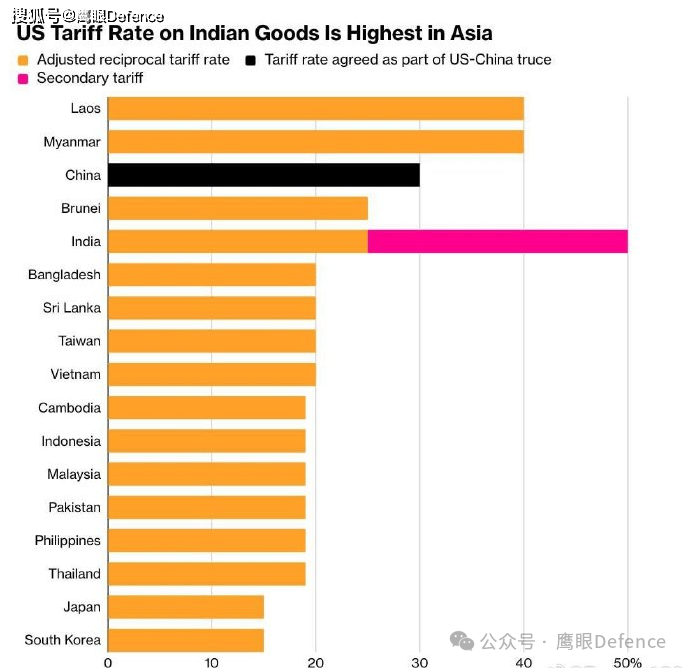
Group 1 - The United States has imposed a new 25% tariff on India, resulting in a total tariff of 50% on nearly all goods and services exported from India to the U.S., making India the country with the highest tariffs from the U.S. [1] - In 2024, India exported over $80 billion worth of goods and services to the U.S., including pharmaceuticals, telecommunications equipment, jewelry, fertilizers, cotton textiles, electronics, and seafood. The new tariffs are expected to significantly impact India's "Make in India" initiative, leading to industry shrinkage and layoffs [3]. - Following the imposition of the 50% tariff, India's exports are projected to suffer a loss of up to $37 billion, which is insufficiently offset by the $17 billion saved from purchasing cheap Russian oil since the outbreak of the Russia-Ukraine war in 2022 [3]. Group 2 - India has become the second-largest buyer of Russian oil, with its share of Russian oil exports rising from 1% in 2020 to 36% in 2025, while China's share increased from 34% to 46% [6]. - U.S. officials have criticized India's substantial purchases of Russian oil, claiming it provides funding for the Kremlin and undermines U.S.-India relations [8]. - The Indian refining industry has begun to adapt under U.S. pressure, with state-owned refineries starting to purchase non-Russian oil from the U.S., Brazil, and the Middle East [13]. Group 3 - Despite U.S. pressure, the Indian government maintains a firm stance, with reports indicating that former President Trump attempted to contact Prime Minister Modi regarding tariff issues but was unsuccessful [16]. - Indian Prime Minister Modi has engaged in discussions with Ukrainian President Zelensky about bilateral cooperation, but has not made concessions regarding limiting Russian energy exports [19]. - Indian state-owned oil companies have resumed purchasing Russian oil, indicating that as long as prices remain low, India is unlikely to abandon Russian oil [22].

云图控股(002539):复合肥量利齐升,磷矿和合成氨项目顺利推进,业绩符合预期
Shenwan Hongyuan Securities· 2025-08-28 07:49
Investment Rating - The investment rating for the company is "Outperform" (maintained) [1] Core Views - The company's performance in the first half of 2025 met expectations, with total revenue of 11.4 billion yuan (up 3.6% year-on-year) and a net profit attributable to shareholders of 511 million yuan (up 12.6% year-on-year) [6] - The growth in compound fertilizer sales and profitability, along with improved profitability in yellow phosphorus, contributed to the increase in net profit [6] - The company is progressing well with its phosphate and synthetic ammonia projects, which are expected to enhance its growth potential [6] Financial Data and Profit Forecast - Total revenue projections for 2025 are 21.205 billion yuan, with a year-on-year growth rate of 4.0% [2] - The net profit attributable to shareholders is forecasted to be 1.013 billion yuan in 2025, reflecting a year-on-year increase of 25.9% [2] - Earnings per share (EPS) is expected to be 0.84 yuan in 2025, with a projected price-to-earnings (PE) ratio of 13 [2] Market Data - As of August 27, 2025, the closing price of the stock was 11.10 yuan, with a market capitalization of 9.781 billion yuan [3] - The stock has a price-to-book ratio of 1.5 and a dividend yield of 1.80% [3] Business Performance Insights - The company achieved a gross profit of 3.36 billion yuan from conventional compound fertilizers (up 12% year-on-year) and 7.46 billion yuan from new-type compound fertilizers and phosphate fertilizers (up 38% year-on-year) in the first half of 2025 [6] - The company is expanding its production capacity for compound fertilizers, with new projects in Hubei and Liaoning expected to enhance output significantly [6] - The company is also focusing on optimizing its industrial structure and enhancing its cost advantages through integrated production chains [6]

中化化肥(00297):业绩向好,生物肥料快速增长
Guosen International· 2025-08-28 07:31
Investment Rating - The report assigns a "Buy" rating for the company, with a target price raised to HKD 1.8, indicating a potential upside of 29% from the current price of HKD 1.4 [1][4][7]. Core Insights - The company's performance in the first half of 2025 met expectations, with revenue reaching RMB 14.72 billion, a year-on-year increase of 7.6%, and net profit of RMB 1.1 billion, up 5.0% [2][4]. - The growth in revenue is attributed to the rise in domestic potash prices and the continued high growth of the company's bio-fertilizers [4]. Summary by Sections Financial Performance - In the first half of 2025, the company achieved revenue of RMB 14.72 billion, with a net profit of RMB 1.1 billion, and earnings per share of RMB 0.15, all reflecting a year-on-year growth of 7.6%, 5.0%, and 5.0% respectively [2][4]. - The company's core business segments, including basic, growth, and production businesses, reported revenues of RMB 7.56 billion, RMB 5.86 billion, and RMB 1.3 billion, with year-on-year growth rates of 9.9%, 5.4%, and 4.2% respectively [3]. Business Development - The company is focusing on high-quality development across its various business segments, particularly in bio-composite fertilizers and specialty fertilizers, which saw a 51% increase in high-end fertilizer sales [3]. - The production segment faced challenges with a significant drop in prices for synthetic ammonia and urea, leading to a decrease in pre-tax profits [3]. Future Projections - The company expects net profits to reach RMB 1.23 billion, RMB 1.41 billion, and RMB 1.59 billion for the years 2025, 2026, and 2027, representing year-on-year growth rates of 16.2%, 14.7%, and 12.1% respectively [4].
尿素日报:需求缓慢推进,尿素库存上升-20250828
Hua Tai Qi Huo· 2025-08-28 05:22
Report Industry Investment Rating - Unilateral: Neutral; Inter - period: After the export window period, conduct a reverse spread on UR01 - 05 when the price is high; Inter - variety: None [3] Core Viewpoints - Recently, the influence of export sentiment has weakened. Manufacturers have cut prices to attract orders, and downstream buyers are cautious. Spot prices have fallen to previous lows, and transactions have improved. The agricultural demand is in the off - season, and the industrial demand is weak. The production of urea remains at a high level, and the upstream inventory is still relatively high year - on - year. Although some companies are expected to conduct maintenance and the output may decline slightly, with the release of new production capacity, the future supply - demand of urea is still relatively loose. The profit of coal - based urea is acceptable, and the cost - side support is average. The export of urea is ongoing, and the port inventory has increased slightly. The Indian NFL's urea import tender may boost the international urea market [2] Summary by Directory 1. Urea Basis Structure - On August 27, 2025, the closing price of the urea main contract was 1,737 yuan/ton (+0). The ex - factory price of small - particle urea in Henan was 1,710 yuan/ton (+0), in Shandong was 1,700 yuan/ton (+0), and in Jiangsu was 1,710 yuan/ton (+0). The basis in Shandong was - 37 yuan/ton (+0), in Henan was - 27 yuan/ton (+0), and in Jiangsu was - 27 yuan/ton (+0) [1] 2. Urea Production - As of August 27, 2025, the capacity utilization rate of enterprises was 83.98% (+0.08%). Some companies such as Yuntianhua, Henan Xinlianxin, and Shanxi Lu'an are expected to conduct maintenance, and the output may decline slightly. But with the release of new production capacity, the future supply - demand of urea is still relatively loose [1][2] 3. Urea Production Profit and Operating Rate - The production profit of urea was 170 yuan/ton (+0). As of August 27, 2025, the capacity utilization rate of enterprises was 83.98% (+0.08%) [1] 4. Urea FOB Price and Export Profit - The export profit was 1,292 yuan/ton (+5). India's NFL issued a urea import tender, and the tender will close on September 2. This tender requires 1 million tons each for the east and west coasts, which will boost the international urea market [1][2] 5. Urea Downstream Operating Rate and Orders - As of August 27, 2025, the capacity utilization rate of compound fertilizer was 40.84% (-2.64%); the capacity utilization rate of melamine was 46.60% (-3.22%); the advance order days of urea enterprises were 6.06 days (+0.00) [1] 6. Urea Inventory and Warehouse Receipts - As of August 27, 2025, the total inventory of sample enterprises was 1.0858 million tons (+61,900 tons), and the inventory of port samples was 501,000 tons (+37,000 tons) [1]
亚钾国际(000893):钾肥景气持续向好 公司新项目投产预期增强
Xin Lang Cai Jing· 2025-08-28 02:36
Core Viewpoint - The company, Yara International, reported significant growth in revenue and net profit for the first half of 2025, driven by a favorable market for potassium fertilizers and stable production and sales [1][2]. Financial Performance - In the first half of 2025, the company achieved total revenue of 2.522 billion yuan, a year-on-year increase of 48.54%, and a net profit of 856 million yuan, up 219.48% year-on-year [1]. - For Q2 2025, the company reported revenue of 1.309 billion yuan, a 23% increase year-on-year and a 7.99% increase quarter-on-quarter, with a net profit of 472 million yuan, reflecting a 152.08% year-on-year increase and a 23% quarter-on-quarter increase [1]. Industry Outlook - The potassium fertilizer market is experiencing a small boom, with the average price of potassium chloride in H1 2025 at 2,943.20 yuan/ton, a 20.44% increase year-on-year [2]. - The average price of potassium chloride in Q2 2025 rebounded to 3,276 yuan/ton, a 30.21% increase from the year's low [2]. - The import volume of potassium chloride in H1 2025 was 6.28 million tons, a decrease of 2.34% year-on-year, indicating a tightening supply [2]. Shareholder Structure - The company underwent a change in its major shareholder, with Huineng Group becoming the largest shareholder after acquiring 5% of the shares from China Agricultural Production Materials Group [3]. Resource and Cost Management - The company holds potassium salt mining rights in Laos, with a resource reserve exceeding 1 billion tons of pure potassium chloride [4]. - A tax rate reduction from 35% to 20% for corporate income tax and from 7% to 1.5% for export duties is expected to lower overall costs from 2024 to 2028 [4]. Production Capacity Expansion - The company has a current production capacity of 3 million tons/year for potassium chloride, with ongoing projects to expand capacity further [4]. - The second and third 1 million tons/year potassium fertilizer projects are in the later stages of construction, with significant progress reported [4]. Profit Forecast and Valuation - Revenue projections for 2025-2027 are 5.558 billion, 9.490 billion, and 12.232 billion yuan, respectively, with net profits of 1.930 billion, 3.475 billion, and 4.212 billion yuan [5]. - The company is positioned as a leader in the potassium salt sector, with a favorable growth outlook supported by new capacity additions [5].
亚钾国际2025年上半年营业收入增长49% 净利润翻两倍
Zheng Quan Shi Bao Wang· 2025-08-27 11:19
Core Viewpoint - The company, Yaqi International, reported significant growth in its financial performance for the first half of 2025, with a notable increase in revenue and net profit, indicating strong operational momentum in the potassium fertilizer sector [1][2]. Financial Performance - The company achieved a revenue of 2.522 billion yuan, representing a year-on-year increase of 48.54% [1] - The net profit attributable to the parent company was 855 million yuan, marking a substantial year-on-year growth of 216.64% [1] - Basic earnings per share stood at 0.9358 yuan [1] Business Operations - Yaqi International focuses on potassium salt mining, potassium fertilizer production, and sales, with its main product being potassium chloride [1] - The company currently holds potassium salt mining rights over an area of 263.3 square kilometers in Laos, with a total resource reserve of approximately 1 billion tons of pure potassium chloride [1] - The company has an existing production capacity of 3 million tons per year for potassium chloride and is actively pursuing expansion projects [1] Production and Sales - In the first half of 2025, the company produced 1.0141 million tons of qualified potassium chloride products and sold 1.0454 million tons [2] - The company is developing a dual-circulation sales system that integrates domestic and international markets, enhancing its global presence [2] - Collaborations with international partners, including the establishment of a dedicated terminal at Vietnam's Wan'an Port, are part of the company's strategy to expand its international sales network [2] Market Demand - The demand for potassium fertilizers is expected to rise due to global population growth, reduced arable land per capita, and increasing needs for food and biofuels [2] - According to Argus, global potassium fertilizer demand is projected to reach 74.3 million tons by 2025, providing a favorable market environment for Yaqi International's business development [2] Strategic Development - The company is exploring non-potassium industry chains through joint development and investment, with plans to expand bromine production capacity from 25,000 tons to 50,000 tons by 2025 [3] - Future plans include extending its business into bromine chemicals, salt chemicals, coal chemicals, compound fertilizers, and high-tech industries, centered around potassium salt [3] Leadership Changes - The company announced that its chairman, Guo Baichun, was arrested for alleged embezzlement and abuse of power, with director Liu Bingyan temporarily assuming the role of chairman and legal representative [3]
亚钾国际:2025年半年度净利润约8.55亿元,同比增加216.64%
Sou Hu Cai Jing· 2025-08-27 09:55
Group 1 - The core viewpoint of the article highlights the significant financial growth of Yara International, with a reported revenue of approximately 2.522 billion yuan for the first half of 2025, representing a year-on-year increase of 48.54% [1] - The net profit attributable to shareholders of the listed company is approximately 855 million yuan, showing a substantial year-on-year increase of 216.64% [1] - The basic earnings per share reached 0.9358 yuan, reflecting a year-on-year increase of 220.7% [1] Group 2 - The article also mentions the booming pet industry, valued at 300 billion yuan, indicating a significant market opportunity for related companies [1] - The report suggests that the surge in the pet industry has led to positive market responses from listed companies within this sector [1]