Funds

Search documents
ALLIANCEBERNSTEIN CLOSED-END FUNDS ANNOUNCE DISTRIBUTION RATES
Prnewswire· 2025-07-28 20:06
Core Viewpoint - AllianceBernstein Closed-End Funds announced distributions for two funds, indicating ongoing income generation for investors [1] Fund Distributions - AllianceBernstein Global High Income Fund, Inc. (NYSE: AWF) will distribute $0.0655 per share of investment income, with ex-dividend and record dates set for August 7, 2025, and payment date on August 22, 2025 [1] - AllianceBernstein National Municipal Income Fund, Inc. (NYSE: AFB) will distribute $0.03961 per share of investment income, with the same ex-dividend and record dates as AWF, and payment date also on August 22, 2025 [1] - Both funds are managed by AllianceBernstein L.P., reflecting the company's commitment to providing returns to its investors [1]


兴业恒泰债券型证券投资基金基金份额发售公告
Shang Hai Zheng Quan Bao· 2025-07-28 18:57
登录新浪财经APP 搜索【信披】查看更多考评等级 重要提示 1、兴业恒泰债券型证券投资基金(以下简称"本基金")的募集已获中国证监会2025年3月14日证监许可 【2025】491号文准予募集注册。中国证监会对本基金募集的注册并不代表其对本基金的投资价值和市 场前景作出实质性判断、或保证,也不表明投资于本基金没有风险。 2、本基金的基金类型是债券型证券投资基金,基金运作方式是契约型开放式,基金存续期限为不定 期。 3、本基金的基金管理人和登记机构为兴业基金管理有限公司(以下简称"本公司"、"兴业基金"),基 金托管人为招商银行股份有限公司。 4、本基金募集对象包括符合法律法规规定的可投资于证券投资基金的个人投资者、机构投资者、合格 境外投资者以及法律法规或中国证监会允许购买证券投资基金的其他投资人。 5、本基金自2025年8月4日至2025年8月22日通过基金管理人指定的销售机构公开发售。本基金的募集期 限不超过3个月,自基金份额开始发售之日起计算。基金管理人根据认购的情况可适当调整募集时间, 并及时公告,但最长不超过法定募集期限。 6、本基金通过兴业基金管理有限公司直销机构及其他销售机构进行公开发售,基金管 ...

7/28财经夜宵:得知基金净值排名及选基策略,赶紧告知大家
Sou Hu Cai Jing· 2025-07-28 16:15
Core Viewpoint - The article provides a ranking of open-end funds based on their net asset value growth, highlighting the top and bottom performers in the market as of July 28, 2025 [2][4]. Fund Performance Summary Top 10 Funds - The top 10 funds with the highest net value growth on July 28, 2025, include: 1. 泰信汇盈债券A: Unit Net Value 1.3064, Cumulative Net Value 1.3760, Daily Growth 27.75% 2. 泰信汇盈债券C: Unit Net Value 1.1155, Cumulative Net Value 1.1851, Daily Growth 7.74% 3. 德邦鑫星价值A: Unit Net Value 2.1317, Cumulative Net Value 2.2697 4. 德邦鑫星价值C: Unit Net Value 2.0496, Cumulative Net Value 2.1976 5. 信澳业绩驱动混合A: Unit Net Value 0.9926, Cumulative Net Value 0.9926 6. 信澳业绩驱动混合C: Unit Net Value 0.9751, Cumulative Net Value 0.9751 7. 东兴数字经济混合发起C: Unit Net Value 1.1123, Cumulative Net Value 1.1123 8. 东兴数字经济混合发起A: Unit Net Value 1.1140, Cumulative Net Value 1.1140 9. 信澳转型创新股票C: Unit Net Value 1.0330, Cumulative Net Value 1.0330 10. 信澳转型创新股票A: Unit Net Value 1.0520, Cumulative Net Value 1.0520 [2][4]. Bottom 10 Funds - The bottom 10 funds with the lowest net value growth on July 28, 2025, include: 1. 恒生前海恒源昭利债券E: Unit Net Value 1.2406, Cumulative Net Value 1.2406 2. 国泰中证煤炭ETF: Unit Net Value 1.0823, Cumulative Net Value 2.4246 3. 招商中证煤炭等权指数C: Unit Net Value 1.9518, Cumulative Net Value 1.9518 4. 招商中证煤炭等权指数E: Unit Net Value 1.9423, Cumulative Net Value 1.9423 5. 招商中证煤炭等权指数A: Unit Net Value 1.9594, Cumulative Net Value 1.3858 6. 国联煤炭C: Unit Net Value 1.7540, Cumulative Net Value 1.7540 7. 富国中证煤炭指数C: Unit Net Value 1.9060, Cumulative Net Value 1.9060 8. 国联煤炭A: Unit Net Value 1.7680, Cumulative Net Value 1.7680 9. 国泰中证煤炭ETF联接C: Unit Net Value 1.9107, Cumulative Net Value 2.2817 10. 国泰中证煤炭ETF联接E: Unit Net Value 1.9374, Cumulative Net Value 1.9374 [4][5]. Market Analysis - The Shanghai Composite Index showed a slight recovery, with a trading volume of 1.76 trillion, and the number of advancing stocks outnumbered declining ones at 2781 to 2438. The leading sectors included insurance, components, and communication equipment, with gains exceeding 2% [7].

每日钉一下(行业投资,选指数基金还是主动基金呢?)
银行螺丝钉· 2025-07-28 13:56
Group 1 - The core concept of fund advisory is to serve as an investment consultant for funds [1] - Fund advisory emerged to address the issue where "funds make money, but investors do not" [4] - Fund advisory has advantages in helping investors achieve better returns through its dual role of "advising" and "investing" [5] Group 2 - Various industries utilize consultants, especially those with high specialization [2] - The article suggests that just as one needs a doctor for medical issues or a lawyer for legal problems, fund advisory serves a similar purpose in investment [7]

CEF Weekly Review: More CEF Liquidations
Seeking Alpha· 2025-07-28 12:20
Group 1 - The article discusses the closed-end fund (CEF) market activity, providing insights from both individual fund news and broader market trends [1] - It emphasizes the importance of yield and risk management in investment strategies, particularly through engineered income portfolios [1] - The article encourages the use of interactive tools for navigating various investment markets, including BDC, CEF, OEF, preferreds, and baby bonds [2] Group 2 - The company offers investor guides specifically focused on CEFs, preferreds, and PIMCO CEFs to assist investors in making informed decisions [2] - A promotional offer for a 2-week free trial is highlighted, allowing potential investors to explore services without risk [2]


百万存款“围城”:高收入≠高财商,年轻新贵们的财富焦虑
Nan Fang Du Shi Bao· 2025-07-28 08:29
Core Insights - The incident at China Merchants Bank highlights the increasing wealth threshold for exclusive services, with a minimum asset requirement of 20 million yuan, reflecting a shift in wealth perception among young individuals [2][5] - The article explores the financial landscape of young individuals in Shenzhen with over one million yuan in savings, examining their wealth accumulation paths and the challenges they face in a low-interest-rate environment [2][6] Wealth Profile: Young Millionaires in Shenzhen - A significant portion of young individuals in Shenzhen, particularly those in the financial technology sector, have accumulated wealth through high-paying jobs, with average monthly salaries in the AI industry reaching 17,204 yuan [5][6] - Young entrepreneurs in Shenzhen benefit from a favorable business environment, leading to substantial wealth accumulation in various sectors, including traditional and emerging industries [6] - Early beneficiaries of asset appreciation, such as those who purchased real estate between 2015-2020, have also contributed to the rise of young millionaires [6] - Some young individuals inherit wealth from high-net-worth families, with a notable percentage of them having family assets exceeding 50 million yuan [6] Financial Dilemmas: High Income Does Not Equal High Financial Literacy - Despite having over one million yuan in savings, many young individuals in Shenzhen experience anxiety due to declining deposit interest rates, with one-year fixed deposit rates dropping below 1% [8][9] - The transition to net value-based bank wealth management products has led to increased market volatility and risk, causing concerns among investors about the stability of returns [9][10] - Young investors face challenges in balancing risk and return, with many expressing a lack of confidence and knowledge in navigating the investment landscape [11][12] Path to Solutions: Emphasizing Diversification and Long-Term Strategies - Experts recommend a diversified investment approach, emphasizing the importance of aligning asset allocation with individual risk tolerance and financial goals [15][16] - The current market environment calls for a focus on quality assets, including bonds and gold, to mitigate volatility and enhance portfolio resilience [16][17] - Long-term investment strategies are crucial, as short-term speculation can lead to losses, highlighting the need for a rational approach to asset management [17]
HIX: Continued NAV Destruction Makes It Hard To Recommend This High-Yielding Fund
Seeking Alpha· 2025-07-28 07:57
Group 1 - The Western Asset High Income Fund II (NYSE: HIX) is a closed-end fund focused on investing in a portfolio of both domestic and foreign junk bonds to provide investors with a very high level of income [1] - The fund aims to generate a 7%+ income yield by investing in energy stocks while minimizing the risk of principal loss [1] - A two-week free trial is currently being offered for the investment service, allowing access to exclusive research and investment ideas [1]

两市ETF两融余额减少9.36亿元丨ETF融资融券日报
2 1 Shi Ji Jing Ji Bao Dao· 2025-07-28 04:57
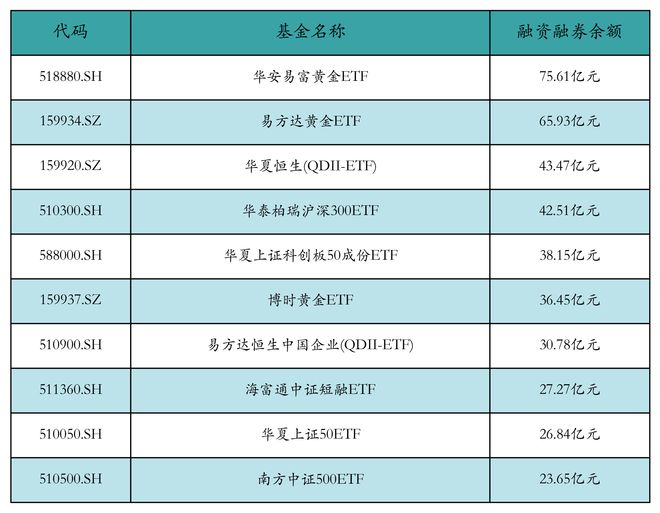
Market Overview - On July 25, the total ETF margin balance in the two markets was 99.456 billion yuan, a decrease of 0.936 billion yuan from the previous trading day [1] - The financing balance was 93.569 billion yuan, down by 0.936 billion yuan, while the securities lending balance increased by 356,300 yuan to 5.888 billion yuan [1] - In the Shanghai market, the ETF margin balance was 67.031 billion yuan, a decrease of 0.724 billion yuan, with a financing balance of 61.932 billion yuan, down by 0.722 billion yuan [1] - In the Shenzhen market, the ETF margin balance was 32.426 billion yuan, a decrease of 0.213 billion yuan, with a financing balance of 31.637 billion yuan, down by 0.214 billion yuan [1] ETF Margin Balance - The top three ETFs by margin balance on July 25 were: - Huaan Yifu Gold ETF (7.561 billion yuan) - E Fund Gold ETF (6.593 billion yuan) - Huaxia Hang Seng (QDII-ETF) (4.347 billion yuan) [2] - The top ten ETFs by margin balance included: - Huatai-PB CSI 300 ETF (4.251 billion yuan) - Huaxia Shanghai Stock Exchange Sci-Tech Innovation Board 50 ETF (3.815 billion yuan) - Bosera Gold ETF (3.645 billion yuan) [2] ETF Financing Buy Amount - The top three ETFs by financing buy amount on July 25 were: - E Fund CSI Hong Kong Securities Investment Theme ETF (1.31 billion yuan) - Hai Fu Tong CSI Short Bond ETF (1.097 billion yuan) - Huaxia Shanghai Stock Exchange Sci-Tech Innovation Board 50 ETF (0.855 billion yuan) [3] ETF Financing Net Buy Amount - The top three ETFs by financing net buy amount on July 25 were: - Fuguo Medium and Long-term Policy Financial Bond ETF (99.463 million yuan) - E Fund CSI Hong Kong Securities Investment Theme ETF (84.699 million yuan) - E Fund CSI Artificial Intelligence Theme ETF (58.040 million yuan) [5] ETF Securities Lending Sell Amount - The top three ETFs by securities lending sell amount on July 25 were: - Southern CSI 500 ETF (53.323 million yuan) - Huatai-PB CSI 300 ETF (10.948 million yuan) - Guolian An CSI All-Index Semiconductor Products and Equipment ETF (7.437 million yuan) [7]
昨日ETF两市资金净流入118.44亿元
news flash· 2025-07-28 01:23
Core Insights - As of July 25, the total inflow of funds into ETFs reached 178.226 billion yuan, while outflows amounted to 166.382 billion yuan, resulting in a net inflow of 11.844 billion yuan [1] Fund Inflows - The non-monetary ETFs with the highest net inflows were: - Huaxia SSE Sci-Tech Innovation Board 50 ETF (588000) with a net inflow of 744 million yuan - Bosera Sci-Tech Innovation Board Artificial Intelligence ETF (588790) with a net inflow of 340 million yuan - Fortune CSI Hong Kong Stock Connect Internet ETF (159792) with a net inflow of 317 million yuan [1] Fund Outflows - The non-monetary ETFs with the highest net outflows were: - Huaxia Hang Seng Internet Technology Industry ETF (QDII) (513330) with a net outflow of 651 million yuan - E Fund CSI Hong Kong Securities Investment Theme ETF (513090) with a net outflow of 484 million yuan - Liquor ETF (512690) with a net outflow of 374 million yuan [1]
资金热捧科创债ETF
21世纪经济报道· 2025-07-28 00:54
Group 1 - The core viewpoint of the article highlights the rapid growth of the bond ETF market, particularly the newly launched Sci-Tech Bond ETFs, which have quickly surpassed 100 billion yuan in total scale, reflecting a strong demand for transparent, low-cost, and highly liquid investment tools [2][4][12] - The first batch of 10 Sci-Tech Bond ETFs was launched on July 17, 2023, and within just six trading days, they achieved a total trading volume of 722.78 billion yuan, indicating significant market interest [4][5] - The total scale of bond ETFs has exceeded 500 billion yuan, with the introduction of these innovative products marking a new phase in the bond ETF market, driven by institutional demand [2][11] Group 2 - The design of the Sci-Tech Bond ETFs includes features such as T+0 trading, physical redemption, and market maker pricing, which enhance trading flexibility and arbitrage opportunities, leading to high turnover rates on the first trading day [7][8] - The underlying indices of the Sci-Tech Bond ETFs focus on high-credit-rated bonds from technology companies, which are expected to benefit from the government's support for innovation and technology development [6][8] - The current environment of "asset scarcity" in the bond market has increased the attractiveness of these ETFs, as they offer a yield advantage and meet the investment needs of institutions [7][8] Group 3 - Prior to the launch of the Sci-Tech Bond ETFs, the first batch of 8 benchmark market-making credit bond ETFs had already gained significant traction, with a total scale of 1,317.6 billion yuan by July 24, 2023 [10][11] - The overall number of bond ETFs has increased from 20 at the end of 2024 to 39 by July 2023, indicating a growing market for credit bond ETFs [11][12] - The rapid expansion of credit bond ETFs is driven by institutional investors, including banks, trusts, and insurance companies, who are seeking transparent and liquid investment options [12][13]