
生物科技

Search documents
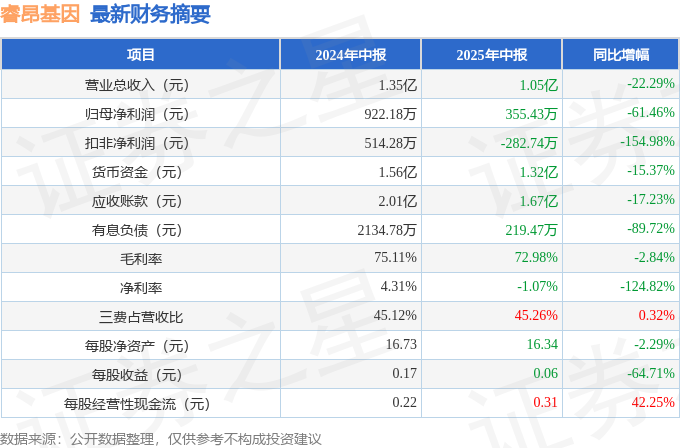
睿昂基因2025年中报简析:净利润同比下降61.46%,公司应收账款体量较大
Zheng Quan Zhi Xing· 2025-08-29 22:41
Core Viewpoint - Ruiang Gene (688217) reported disappointing financial results for the first half of 2025, with significant declines in revenue and net profit compared to the previous year [1]. Financial Performance - Total revenue for the first half of 2025 was 105 million yuan, a decrease of 22.29% year-on-year [1]. - Net profit attributable to shareholders was 3.55 million yuan, down 61.46% year-on-year [1]. - In Q2 2025, total revenue was 50.01 million yuan, a decline of 29.17% year-on-year [1]. - Q2 2025 net profit attributable to shareholders was 199,300 yuan, a staggering drop of 97.71% year-on-year [1]. - The company's accounts receivable accounted for 68.8% of total revenue, indicating a large receivables burden [1]. Profitability Metrics - Gross margin was 72.98%, down 2.84% year-on-year [1]. - Net margin was -1.07%, a decrease of 124.82% year-on-year [1]. - Total selling, administrative, and financial expenses amounted to 47.41 million yuan, representing 45.26% of revenue, a slight increase of 0.32% year-on-year [1]. - Earnings per share (EPS) was 0.06 yuan, down 64.71% year-on-year [1]. - Operating cash flow per share was 0.31 yuan, an increase of 42.25% year-on-year [1]. Balance Sheet Highlights - Cash and cash equivalents were 132 million yuan, a decrease of 15.37% year-on-year [1]. - Accounts receivable stood at 167 million yuan, down 17.23% year-on-year [1]. - Interest-bearing debt was 2.19 million yuan, a significant drop of 89.72% year-on-year [1]. - Book value per share was 16.34 yuan, a decrease of 2.29% year-on-year [1]. Business Model and Historical Performance - The company's business relies heavily on research and marketing efforts, necessitating a deeper analysis of these driving factors [3]. - Historical data indicates a median Return on Invested Capital (ROIC) of 5.26%, with the worst year being 2024 at -2.91%, suggesting poor investment returns [3]. - The company has reported mixed financial results since its listing, with one year of losses, warranting further investigation into potential underlying issues [3].


仁度生物: 2025年半年度募集资金存放与实际使用情况的专项报告
Zheng Quan Zhi Xing· 2025-08-29 17:57
Fundraising Overview - The company raised a total of RMB 726.5 million by issuing 10 million shares at RMB 72.65 each, with a net amount of RMB 652.76 million after deducting issuance costs of RMB 73.74 million [1][2] - As of the report date, all raised funds have been received and verified by an accounting firm [2] Fund Utilization and Balance - Cumulative usage of the raised funds reached RMB 283.99 million, with RMB 31.16 million used in the first half of 2025 [2][6] - The company has RMB 380 million temporarily idle for cash management, with a remaining balance of RMB 18.24 million in the fundraising account [2][6] Fund Management System - The company established a fundraising management system to ensure the safety and efficiency of fund usage, complying with relevant laws and regulations [2][3] - A tripartite supervision agreement was signed with a bank and a sponsor to ensure strict approval for fund usage [3] Cash Management of Idle Funds - The company approved the use of up to RMB 430 million of temporarily idle funds for cash management, investing in safe and liquid financial products [4][5] - The report details various structured deposits and their expected returns, indicating a focus on capital preservation [5][6] Compliance and Reporting - The company has adhered to disclosure requirements, ensuring timely and accurate reporting of fundraising and usage status, with no violations noted [6][7]

英诺特: 上海荣正企业咨询服务(集团)股份有限公司关于北京英诺特生物技术股份有限公司2025年限制性股票激励计划(草案)之独立财务顾问报告
Zheng Quan Zhi Xing· 2025-08-29 17:46
Core Viewpoint - The report outlines the independent financial advisor's assessment of Beijing Innotech Biotechnology Co., Ltd.'s 2025 restricted stock incentive plan, confirming its compliance with relevant laws and regulations, and its potential positive impact on the company's long-term development and shareholder interests [1][2][27]. Group 1: Incentive Plan Overview - The 2025 restricted stock incentive plan is designed to motivate directors, senior management, core technical personnel, and other key employees deemed necessary by the board [4][5]. - The total number of restricted stocks to be granted is 2,112,740 shares, accounting for approximately 1.55% of the company's total share capital at the time of the plan's announcement [8][9]. - The plan includes a reserve portion of 414,500 shares, which represents 19.62% of the total grant [7][8]. Group 2: Grant and Vesting Conditions - The vesting period for the restricted stocks is set for a maximum of 60 months, with specific vesting arrangements based on performance metrics [9][10]. - The initial grant will vest in three phases: 20% after 12 months, 40% after 24 months, and 40% after 36 months [11][12]. - The vesting conditions include achieving specific performance targets related to revenue growth and product registration certificates [19][20]. Group 3: Compliance and Feasibility - The independent financial advisor confirms that the incentive plan complies with the relevant regulations and does not harm the interests of the company or its shareholders [27][28]. - The advisor also notes that the plan's operational procedures are feasible and align with legal requirements [24][25]. - The funding for the incentive plan will come from the participants' own resources, with the company not providing any financial assistance [25][26]. Group 4: Performance Assessment - The performance assessment for the incentive plan includes both company-level and individual-level evaluations, ensuring alignment between employee performance and company goals [30][32]. - The company-level performance indicators focus on revenue growth and the number of product registration certificates obtained, which are critical for the company's market competitiveness [31][32]. - The individual performance assessment will categorize results into four tiers, determining the actual number of shares vested based on performance outcomes [21][22]. Group 5: Long-term Impact - The implementation of the incentive plan is expected to positively influence the company's sustainable operational capacity and shareholder equity, as it aligns the interests of management with those of shareholders [29][30]. - The plan aims to enhance the company's competitive edge and motivate employees, contributing to long-term growth and stability [31][32].

英诺特: 2025年限制性股票激励计划(草案)摘要公告
Zheng Quan Zhi Xing· 2025-08-29 17:46
Core Viewpoint - The company is implementing a new stock incentive plan aimed at enhancing corporate governance, attracting and retaining talent, and aligning the interests of shareholders, the company, and core team members to promote long-term development [1][2]. Summary by Sections 1. Purpose of the Stock Incentive Plan - The plan aims to improve the corporate governance structure and establish a long-term incentive mechanism to attract and retain talent while ensuring shareholder interests are protected [1]. 2. Stock Incentive Method and Source of Shares - The incentive plan utilizes second-class restricted stocks, with eligible participants receiving shares at a set price upon meeting specific conditions. The shares will be sourced from market repurchases or directed issuance [2][3]. 3. Quantity of Restricted Stocks to be Granted - The plan proposes to grant a total of 2.112740 million restricted stocks, accounting for approximately 1.5483% of the company's total share capital. The initial grant will consist of 1.698240 million shares, representing 80.3809% of the total grant [3][4]. 4. Determination and Scope of Incentive Objects - Incentive objects include directors, senior management, and core technical personnel, excluding independent directors and supervisors. The selection is based on their direct impact on the company's performance and future development [5][6]. 5. Distribution of Restricted Stocks - The distribution of restricted stocks among incentive objects is detailed, ensuring that no individual receives more than 1.00% of the total share capital through all incentive plans [7][8]. 6. Validity Period of the Incentive Plan - The plan will be valid from the date of the first grant of restricted stocks until all granted stocks are vested or become invalid, with a maximum duration of 60 months [9]. 7. Conditions for Granting and Vesting of Restricted Stocks - Specific conditions must be met for granting and vesting, including financial performance criteria and compliance with legal regulations. The vesting schedule is structured over multiple periods [16][18]. 8. Performance Assessment Criteria - The performance assessment will focus on revenue growth and the number of product registration certificates obtained, with specific targets set for each assessment year [19][20]. 9. Adjustment Methods for Granting and Vesting - The plan includes provisions for adjusting the number and price of restricted stocks in response to corporate actions such as stock splits or capital increases [27][28]. 10. Accounting Treatment and Impact on Performance - The company will account for the stock incentive plan in accordance with relevant accounting standards, ensuring that the costs and impacts on financial performance are accurately reflected [30].
透景生命: 关于首次回购公司股份的公告
Zheng Quan Zhi Xing· 2025-08-29 17:46
证券代码:300642 证券简称:透景生命 公告编号:2025-062 上海透景生命科技股份有限公司 本公司及董事会全体成员保证信息披露的内容真实、准确、完整,没有虚 假记载、误导性陈述或重大遗漏。 上海透景生命科技股份有限公司(以下简称"公司")于 2025 年 4 月 8 日 召开第四届董事会第八次会议,审议通过了《关于以集中竞价交易方式回购公司 股份的议案》。本次回购的股份用于股权激励或员工持股计划,用于回购股份的 资金总额不低于人民币 2,000 万元(含)且不超过人民币 4,000 万元(含),回 购股份价格不超过 16.00 元/股(含),实施期限为自公司董事会审议通过本次 回购股份方案之日起 12 个月内。具体内容请详见公司分别于 2025 年 4 月 8 日、 中竞价交易方式回购股份方案的公告》(公告编号:2025-008)、《回购报告书》 (公告编号:2025-010)。 因公司 2024 年度权益分派已实施完毕,自 2024 年度权益分派除权除息日 (即 整为 15.85 元/股(含)。具体内容请详见公司于 2025 年 5 月 13 日在巨潮资讯 网(www.cninfo.com.cn) ...
英诺特: 北京英诺特生物技术股份有限公司内部控制评价制度(2025年8月修订)
Zheng Quan Zhi Xing· 2025-08-29 17:25
Core Viewpoint - The internal control evaluation system of Beijing Innotech Biotechnology Co., Ltd. aims to standardize the internal control evaluation process, ensuring effective operation and compliance with relevant laws and regulations [1][2]. Group 1: General Principles - The internal control evaluation is defined as a comprehensive assessment of the effectiveness of internal controls conducted by the board of directors and management, resulting in a conclusion and evaluation report [1]. - The evaluation must adhere to principles such as comprehensiveness, importance, objectivity, balance, adaptability, and cost-effectiveness [2][3]. Group 2: Organization and Implementation - The board of directors leads the internal control evaluation, delegating the organization and implementation to the audit department [6]. - Responsibilities include the board overseeing the design and operation of internal controls, while the audit committee guides and supervises the evaluation process [6][7]. Group 3: Evaluation Content - The evaluation focuses on elements such as internal environment, risk assessment, control activities, information communication, and internal supervision [11][12]. - Specific evaluations include assessing the organizational structure, risk identification, control measures, information systems, and the effectiveness of internal audits [12][13]. Group 4: Evaluation Procedures and Methods - The evaluation process includes developing a work plan, forming an evaluation team, conducting tests, identifying control deficiencies, and compiling an evaluation report [18][19]. - The audit department is responsible for leading the evaluation and ensuring compliance across departments and subsidiaries [19][20]. Group 5: Deficiency Identification - Internal control deficiencies are categorized into design and operational deficiencies, with severity levels classified as major, important, and general [23][24]. - The criteria for identifying deficiencies include their potential impact on financial reporting and operational effectiveness [24][25]. Group 6: Evaluation Reporting - The company must prepare an annual internal control evaluation report based on legal and regulatory requirements, detailing the evaluation process, identified deficiencies, and corrective actions [26][27]. - The report should be approved by the board and disclosed alongside the annual financial report [30][31]. Group 7: Supervision and Accountability - The audit committee supervises all internal control evaluation activities, and the board is responsible for implementing rewards and penalties based on evaluation outcomes [33][34]. - Any significant deficiencies or risks identified must be reported to the relevant authorities, along with the measures taken to address them [34][35].
英诺特: 北京英诺特生物技术股份有限公司内部审计管理制度(2025年8月修订)
Zheng Quan Zhi Xing· 2025-08-29 17:25
Core Viewpoint - The internal audit management system of Beijing Innotech Biotechnology Co., Ltd. aims to enhance governance structure, ensure compliance with financial regulations, improve management efficiency, safeguard assets, and promote sustainable development of the company [1]. Group 1: General Principles - The internal audit is defined as an independent and objective activity that evaluates the appropriateness and effectiveness of business activities, internal controls, and risk management [1]. - The internal audit management system is established based on various laws and regulations, including the Audit Law of the People's Republic of China and the guidelines from the Shanghai Stock Exchange [1]. Group 2: Internal Audit Structure and Personnel - The company has established an Audit Department under the Board of Directors' Audit Committee, responsible for supervising business activities, risk management, and internal controls [2]. - The Audit Department reports directly to the Audit Committee and is responsible for evaluating the internal audit work [2]. - The head of the Audit Department is appointed by the General Manager, with the Audit Committee involved in the assessment of the head's performance [2][3]. Group 3: Responsibilities and Authority of the Audit Department - The Audit Department is tasked with evaluating the integrity and effectiveness of internal control systems across the company and its subsidiaries [4]. - It is responsible for auditing financial data and ensuring compliance with legal and regulatory requirements [4]. - The department must report to the Audit Committee at least quarterly, detailing the execution of the audit plan and any issues identified [4]. Group 4: Audit Procedures - The internal audit process includes determining annual audit priorities based on risk assessments and company needs, forming audit teams, and notifying audited units [5]. - Audit findings are documented, and reports are communicated to the audited units for feedback and understanding [6]. - The Audit Department must track the implementation of corrective actions based on previous audit findings [6]. Group 5: Audit Archive Management - The Audit Department is required to establish and maintain a system for managing audit work papers and archives [7]. - Internal audit documents are classified into permanent and temporary storage, with a temporary retention period of 10 years [7]. - Access to internal audit archives is restricted and requires approval from the Audit Department head or the General Manager [7]. Group 6: Accountability - Internal audit personnel who violate the management system may face disciplinary actions or financial penalties [8]. - Departments or individuals obstructing the audit process or failing to comply with audit recommendations may also be subject to criticism or penalties [8].
康为世纪: 关于召开2025年第一次临时股东大会的通知
Zheng Quan Zhi Xing· 2025-08-29 17:25
Meeting Overview - The shareholder meeting is scheduled for September 15, 2025, at 14:40 [1] - The meeting will be held at Jiangsu Kangwei Century Biotechnology Co., Ltd., located at 18 Zelan Road, Taizhou, Jiangsu Province [1] - Voting will be conducted through both on-site and online methods using the Shanghai Stock Exchange's network voting system [1] Voting Procedures - The online voting period is from September 15, 2025, during trading hours [1] - Specific voting times for the trading system are from 9:15-9:25, 9:30-11:30, and 13:00-15:00 [1] - Shareholders must complete identity verification to vote online for the first time [3] Agenda Items - The meeting will review several proposals, including: - The completion of certain fundraising investment projects and the permanent allocation of surplus funds to working capital [2] - The cancellation of the supervisory board and amendments to the company's articles of association [2] - The revision of the fund occupation prevention system for controlling shareholders and related parties [2] - The establishment of a remuneration management system for directors and senior management [2] Attendance and Registration - Shareholders registered by the close of trading on September 9, 2025, are eligible to attend [3] - Proxy representation is allowed, with specific documentation required for registration [4] - Registration must be completed by September 12, 2025, at 17:00 [5] Contact Information - The company’s contact address is Jiangsu Kangwei Century Biotechnology Co., Ltd., 4th Floor, Securities Affairs Department, 18 Zelan Road, Taizhou, Jiangsu Province [5] - Contact number: 0523-86200880, Contact person: Wang Tao [5]

康为世纪: 关于2024年限制性股票激励计划第一个归属期不符合归属条件暨作废已授予尚未归属的限制性股票的公告
Zheng Quan Zhi Xing· 2025-08-29 17:25
证券代码:688426 证券简称:康为世纪 公告编号:2025-030 事会第十四次会议审议,通过了《关于 2024 年限制性股票激励计划第一个归属 期不符合归属条件暨作废已授予尚未归属的限制性股票的议案》,同意对 2024 年限制性股票激励计划中已获授但尚未归属的第二类限制性股票 2,098,400 股全 部取消归属,并作废失效。 江苏康为世纪生物科技股份有限公司 关于 2024 年限制性股票激励计划第一个归属期不符合 归属条件暨作废已授予尚未归属的限制性股票的公告 本公司董事会及全体董事保证公告内容不存在任何虚假记载、误导性陈述 或者重大遗漏,并对其内容的真实性、准确性和完整性依法承担法律责任。 江苏康为世纪生物科技股份有限公司(以下简称"公司")于 2025 年 8 月 27 日召开的第二届董事会第十六次会议和第二届监事会第十四次会议审议通过了 《关于 2024 年限制性股票激励计划第一个归属期不符合归属条件暨作废已授予 尚未归属的限制性股票的议案》,同意对 2024 年限制性股票激励计划中已获授但 尚未归属的第二类限制性股票 2,098,400 股全部取消归属,并作废失效。其中 失去了激励资格须予以作 ...
康为世纪: 内幕信息知情人登记制度
Zheng Quan Zhi Xing· 2025-08-29 17:12
Core Points - The article outlines the insider information management system of Jiangsu Kangwei Century Biotechnology Co., Ltd, emphasizing the importance of confidentiality and fair disclosure to protect investors' rights [2][3][4]. Group 1: Insider Information Management - The management of insider information is the responsibility of the board of directors, with the board secretary organizing its implementation [2]. - Any department or individual within the company is prohibited from disclosing insider information without board approval [2]. - Insider information is defined as non-public information that could significantly impact the company's operations, finances, or the market price of its securities [2][3]. Group 2: Scope of Insider Information - Insider information includes significant changes in business policies, major investments, important contracts, and any substantial losses or debts [2][3]. - The scope also covers changes in shareholding structures, major lawsuits, and any criminal investigations involving the company or its executives [2][3]. Group 3: Insider Information Recipients - Insider information recipients include company directors, senior management, major shareholders, and individuals who can access insider information due to their roles [3][4]. - The list of insider information recipients must be accurately recorded and maintained for regulatory review [4][5]. Group 4: Confidentiality and Penalties - Individuals with access to insider information are required to maintain confidentiality and are prohibited from trading the company's securities based on that information [6][9]. - Violations of confidentiality or insider trading can lead to penalties, including potential criminal charges [6][9].