
Semiconductor

Search documents
Oppenheimer Raises PT on KLA (KLAC) Stock to $1,900
Yahoo Finance· 2026-03-19 15:44
Core Viewpoint - KLA Corporation (NASDAQ:KLAC) is recognized as one of the best semiconductor stocks to invest in currently, with positive outlooks from analysts following its Investor Day [1]. Group 1: Analyst Ratings and Price Targets - Oppenheimer raised its price target on KLA's stock to $1,900 from $1,800 while maintaining an "Outperform" rating, citing a more positive outlook than expected from the Investor Day [1]. - Jefferies analyst Blayne Curtis lowered the price target on KLA's stock to $1,700 from $1,850 but retained a "Buy" rating, indicating optimism about the company's near-term outlook [2]. Group 2: Financial Projections - The long-term targets for KLA Corporation include a potential revenue of $26 billion and earnings per share (EPS) of $84 by 2030, assuming higher capital intensity and market share [2]. Group 3: Company Overview - KLA Corporation specializes in providing process control and yield management solutions for the semiconductor and related nano-electronics industries [3].

Stifel Upgrades Ichor Holdings (ICHR) Stock to Buy from Hold
Yahoo Finance· 2026-03-19 15:43
Group 1 - Ichor Holdings, Ltd. (NASDAQ:ICHR) has been upgraded by Stifel from "Hold" to "Buy" with a new price target of $55, significantly increased from the previous target of $30, indicating renewed confidence in the company's gross margin trajectory as it enters an up-cycle [1] - The firm previously anticipated that 2026 would be a transitional year for Ichor Holdings, but now believes that cyclical business conditions are accelerating [1] - For Q4 2025 and FY 2025, Ichor Holdings reported annual revenue of $948 million, reflecting a 12% year-over-year growth, primarily driven by strength in etch and deposition, although this growth was somewhat offset by softening build rates of EUV and decreased demand in some trailing edge markets [2] Group 2 - Ichor Holdings is a U.S. technology company that specializes in designing, engineering, and manufacturing critical fluid delivery subsystems and components, particularly gas and chemical delivery systems used in semiconductor capital equipment [3]

AI 时代芯片设计“新解”,Arm 订阅模式打破前期壁垒
傅里叶的猫· 2026-03-19 15:19
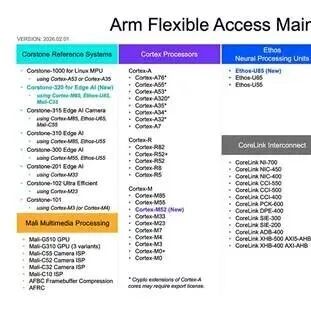
Core Insights - The article discusses the transformative impact of artificial intelligence (AI) on the chip design industry, driven by the surge in demand for edge devices such as smart cars, smart homes, industrial robots, and wearables. This growth presents challenges including increased design complexity, high upfront costs, and intricate business processes [1] - The introduction of Arm's technology licensing subscription model offers a new solution to these challenges, enabling companies of various sizes and stages to participate in chip innovation during the AI era [1][3] Summary by Sections Arm Technology Licensing Subscription Model - The model is not merely an upgrade of traditional IP licensing but a comprehensive system designed to meet the diverse needs of the chip design industry, allowing for flexible access to technology [2][3] Arm Total Access - Arm Total Access provides a comprehensive suite of Arm IP products for large enterprises that need to develop complex systems and multiple projects. It includes three tiers of packages based on performance requirements: - Package A (Low Power) includes IPs like Cortex-A53, Cortex-M85, Ethos-U65, Mali-G310, CoreLink, and CoreSight [4] - Package B (High Efficiency) includes IPs such as Cortex-A520, Mali-G625, and Cortex-A55, along with Package A [5] - Package C (High Performance) includes IPs like Cortex-A7x, Neoverse-N, and Mali-G7x, along with Packages A and B [6] Arm Academic Access - Arm Academic Access is a free program for academic institutions, allowing them to use Arm technology for education, training, and non-commercial research. It includes access to over 70 CPU, GPU, and NPU IPs, as well as unlimited free tape-out opportunities (up to 1000 chips per tape-out) [7] Industry Significance - The subscription model represents an innovative business strategy and an upgrade in the chip design industry paradigm. It aligns with the trends of diversification in edge devices, rapid technological iteration, and personalized market demands. This model serves as an "accelerator" for chip innovation, enabling companies to better address design challenges and focus on core differentiation [8]

Keysight Expands 1.6T Interconnect Validation Technology to Include Passive Copper and Low Power Optics
Businesswire· 2026-03-19 15:00
Core Viewpoint - Keysight Technologies has expanded its 1.6T Ethernet interconnect validation technology to include passive copper and low power optics, enhancing reliability and reducing risks in AI and high-performance computing networks [1][2][4]. Group 1: Technology Enhancements - The new generation of 1.6T Ethernet interconnect error-performance validation includes capabilities for passive copper Direct Attach Cables (DAC), Active Copper Cables (ACC), Low Power Optics (LPO), and Linear Receive Optics (LRO) [2][4]. - Enhanced testing platforms, INPT-1600GE and AresONE 1600GE, are designed to accurately characterize the error performance of these interconnect technologies, which are essential for AI and HPC applications [4][5]. Group 2: Market Demand and Trends - As AI and HPC infrastructures scale, the demand for 1.6T interconnect technologies is increasing, requiring ultra-high Ethernet speeds with minimal cost and power consumption [3][4]. - Global data center power demand is projected to rise by 50% by 2027 and up to 165% by the end of the decade compared to 2023, highlighting the need for energy-efficient interconnect solutions [3]. Group 3: Industry Collaboration and Future Directions - Keysight is actively participating in the development of industry standards and has joined the newly announced ACC-MSA, indicating its commitment to advancing 224G interconnect technologies [8]. - The company will showcase its latest 1.6T Ethernet and interconnect validation solutions at OFC 2026, emphasizing its role in supporting the industry's transition to next-generation networking solutions [8].


台积电40%产能被逼转为美国产
国芯网· 2026-03-19 13:19
Core Viewpoint - The article discusses the increasing pressure on TSMC to invest in the U.S. semiconductor industry, with potential investments reaching up to $2 trillion and a target to shift 40% of its production capacity to the U.S. [1][3] Group 1 - TSMC has committed to investing $165 billion in the U.S., but the U.S. government believes this is insufficient and may require an additional investment of $100 billion to $200 billion [1] - The production capacity that TSMC may transfer to the U.S. will not include outdated or mature processes, but rather advanced technologies such as 3nm and 2nm nodes, which could significantly impact TSMC's operational capabilities [3] - NVIDIA's CEO Jensen Huang expressed skepticism about the feasibility of transferring 40% of TSMC's capacity to the U.S., emphasizing that the focus should be on adding new capacity rather than shifting existing production [3][4] Group 2 - Huang views the potential for TSMC to expand its production in the U.S. as a positive development, suggesting that it will enhance the resilience of U.S. manufacturing and create a win-win situation for both TSMC and the U.S. [4]

Adeia Named a Top 100 Global Innovator for 2026 by LexisNexis
Globenewswire· 2026-03-19 12:06
Core Insights - Adeia Inc. has been recognized as one of the Top 100 Global Innovators for 2026 by LexisNexis Intellectual Property Solutions, highlighting its leadership in innovation within the semiconductor and media industries [1][2][3] Group 1: Innovation Recognition - The Top 100 Global Innovators list identifies companies that excel in innovation based on measurable improvements in patent portfolio quality, utilizing the LexisNexis® Patent Asset Index which assesses over 17 million global patent families [2] - Adeia's recognition reflects its strong innovation strategy and ongoing investments in high-impact technologies, particularly in semiconductor integration, AI infrastructure, and next-generation media experiences [3][4] Group 2: Patent Portfolio and Technology Impact - Adeia holds a portfolio of over 13,750 patent assets that support critical innovations, enabling semiconductor manufacturers and hyperscalers to enhance performance and efficiency through advanced technologies like hybrid bonding and RapidCool™ direct-to-chip liquid cooling [4] - The company's innovations also drive intelligent content discovery, adaptive streaming, and personalized engagement in media and e-commerce ecosystems, showcasing its commitment to scalable packaging and connectivity solutions [4] Group 3: Industry Perspective - The LexisNexis® Patent Asset Index provides an objective framework for evaluating innovation leadership, emphasizing the importance of patent strength changes rather than volume alone [5] - Adeia's focus on innovation translates into measurable industry impact and sustainable value creation, reinforcing its role in shaping the future of digital entertainment and high-performance computing [4][6]


Stocks Slip Before the Open as Oil Prices Advance, U.S. Economic Data and FedEx Earnings on Tap
Yahoo Finance· 2026-03-19 10:36
Market Overview - Wall Street's three main equity benchmarks closed lower, with the Magnificent Seven stocks declining, including Amazon.com (AMZN) down over -2% and Microsoft (MSFT) down more than -1% [1] - Cryptocurrency-exposed stocks also fell, with Bitcoin dropping more than -4%, leading to a slump in Strategy (MSTR) by over -6% and Riot Platforms (RIOT) by about -4% [1] - The Trade Desk (TTD) plunged more than -6% after a downgrade from Rosenblatt [1] - LyondellBasell (LYB) was the top gainer on the S&P 500, climbing over +5% after an upgrade from UBS [1] Economic Data - U.S. producer price index (PPI) for final demand rose +0.7% month-over-month (m/m) and +3.4% year-over-year (y/y) in February, exceeding expectations [5] - Core PPI, excluding food and energy, rose +0.5% m/m and +3.9% y/y, also stronger than anticipated [5] - U.S. factory orders for January increased by +0.1% m/m, in line with expectations [5] Federal Reserve Actions - The Federal Reserve left interest rates unchanged in a range of 3.50%-3.75%, with a vote of 11-1 [6] - Policymakers highlighted uncertainty due to the Middle East conflict and raised the 2026 inflation forecast to 2.7% from 2.4% [6] - Fed Chair Jerome Powell indicated that further progress in reducing inflation is necessary before considering rate cuts [7] Upcoming Economic Indicators - Investors are awaiting U.S. Initial Jobless Claims data, expected at 215K, and the Philadelphia Fed Manufacturing Index, anticipated to be at 8.3 [8] - New Home Sales data for January is forecasted at 722K, down from 745K in December [9] - The Conference Board's Leading Economic Index is expected to drop -0.1% m/m [10] International Market Reactions - The Euro Stoxx 50 Index fell -1.64%, influenced by rising oil and gas prices due to the Middle East conflict [12] - The U.K. unemployment rate remained at 5.2%, while average earnings ex-bonus were at 3.8%, weaker than expected [13] - Japan's Nikkei 225 Index closed sharply lower, influenced by rising oil prices and the Fed's decision to keep rates unchanged [15] Corporate Earnings - High-profile companies such as Accenture (ACN), FedEx (FDX), and Darden Restaurants (DRI) are set to report quarterly figures [10] - Micron Technology (MU) fell over -5% in pre-market trading due to increased spending on production despite positive earnings guidance [18] - Five Below (FIVE) rose more than +6% after posting strong Q4 results and guidance [19]
芯片需求炸裂,晶圆厂一路长虹
半导体芯闻· 2026-03-19 10:19
Core Viewpoint - The global wafer foundry industry is expected to grow significantly in 2026, driven by the demand for AI-related chips from North American cloud service providers and AI startups, with an anticipated annual growth rate of 24.8%, reaching approximately $218.8 billion [2]. Group 1: Advanced Process Demand - The demand for advanced processes (5/4nm and below) will be primarily driven by AI GPUs from companies like NVIDIA and AMD, as well as self-developed AI chips from Google, AWS, Meta, and AI startups like OpenAI and Groq, which are entering mass production this year [2]. - TSMC's capacity for 5/4nm and below is expected to be fully loaded until the end of the year, leading to a comprehensive price increase for 5/4nm foundry services in 2026, with visibility extending into 2027 [3]. Group 2: Mature Process and 8-inch Wafer Demand - The 8-inch wafer production is experiencing a recovery due to stable growth in AI power-related demand and domestic needs in China, although the overall utilization rate may vary, making widespread price increases challenging [3]. - TSMC and Samsung are accelerating the reduction of 8-inch wafer production, which is expected to support the overall capacity utilization rate for the year [3]. Group 3: 12-inch Wafer Market Outlook - The 12-inch wafer market is projected to face limited order visibility due to the impact of rising memory prices on consumer electronics, despite ongoing product upgrades and process transitions that could improve average selling prices [4]. - The capacity utilization rate for 12-inch wafers is expected to remain below full capacity, with strong momentum only in advanced processes [4].
研报 | AI动能稳健,预估2026年晶圆代工产值年增24.8%,部分制程涨价浮现
TrendForce集邦· 2026-03-19 06:29
Core Insights - The global wafer foundry industry is expected to grow significantly in 2026, driven by demand from North American cloud service providers (CSPs) and AI startups, with an anticipated annual growth rate of 24.8%, reaching approximately $21.88 billion [2] - TSMC is projected to experience the highest growth among major players, with an expected annual increase of 32% in 2026 [2] Advanced Process Demand - The demand for advanced processes in 2026 will be propelled by AI GPUs from companies like NVIDIA and AMD, as well as self-developed AI chips from CSPs such as Google, AWS, and Meta, along with AI startups like OpenAI and Groq [4] - TSMC's capacity for 5/4 nm and below is expected to be fully loaded until the end of the year, with Samsung Foundry also seeing a significant increase in orders for similar processes [4] - TSMC has raised its foundry prices for 5/4 nm and below processes for 2026, with visibility of orders extending into 2027, indicating potential for consecutive price increases [4] Mature Process Segment - In the mature process segment, TSMC and Samsung are accelerating the reduction of eight-inch wafer production, while stable growth in AI power-related demand is expected to improve overall capacity utilization for the year [5] - The demand for eight-inch wafers is primarily driven by AI-related power products and domestic demand in China, with some support from early inventory preparations by PC/Notebook ODMs due to concerns over rising IC costs [5] - Despite improvements in eight-inch production lines, full capacity utilization is not anticipated, and there are concerns about the consumer supply chain in the second half of the year, leading to mixed utilization rates [5] - For twelve-inch wafers, the expansion of 28 nm and above mature processes is expected to continue in 2026, but limited visibility on orders is anticipated due to the impact of high storage prices on consumer end products [5]

CXL方案优化AI存储架构-头部厂商有望加速应用
2026-03-19 02:39
Summary of CXL Technology and Market Insights Industry Overview - The discussion centers around the CXL (Compute Express Link) technology and its application in optimizing AI storage architectures, particularly for CPU and GPU resource management [1][2][3]. Key Points and Arguments - **CXL Memory Pooling**: CXL enables unified scheduling of CPU/GPU resources, alleviating memory capacity and bandwidth bottlenecks in AI computing [1][2]. - **Cost Efficiency**: A system using 16 x 128GB DDR and 16 x 128GB CXL configuration has a lower total cost compared to a traditional setup with 16 x 256GB memory [1][4]. - **Market Penetration Forecast**: By 2030, it is expected that 13% of servers will utilize CXL functionality, and HBM (High Bandwidth Memory) will account for 15% of server DRAM share [1][8]. - **Innovative Solutions**: CXL technology is being utilized to optimize KV cache storage, which can significantly reduce the cost per token in AI inference processes [3]. - **Direct GPU Access**: CXL allows GPUs to directly access pooled memory resources, enhancing efficiency and addressing memory constraints in AI workloads [2]. Important Developments - **NVIDIA's Initiatives**: NVIDIA has acquired Fabric and introduced the Vera CPU, which supports CXL, facilitating the deployment of CXL memory solutions in AI data centers [6]. - **Domestic Hardware Progress**: Companies like Alibaba Cloud and Inspur are launching CXL-related hardware, such as the PolarDB database server and memory expansion solutions, indicating a growing adoption of CXL technology [7]. - **Leading Products**: - **澜起科技 (Lianqi Technology)**: Launched the first CXL 3.1 MXC chip, with a projected gross margin exceeding 62% in 2025 [1][9]. - **聚辰股份 (Jucheng Technology)**: Their VPD chip is entering the design validation phase, crucial for enterprise SSDs and CXL memory expansion modules [10][11]. - **江波龙 (Jiangbolong)**: Introduced the Force CXL 2.0 memory expansion module, expecting revenues of 17.5 billion in 2024 [1][12]. Additional Insights - **CXL Ecosystem Development**: The CXL ecosystem is supported by a wide range of participants, including major storage and chip manufacturers, which is crucial for accelerating the technology's application [5]. - **Future Market Potential**: The overall industry is expected to mature, creating growth opportunities as CXL technology becomes more integrated into server configurations [8].