
Internet

Search documents
资金涌入恒生科技指数ETF(513180),份额创历史新高
Sou Hu Cai Jing· 2025-11-27 01:51
据CME美联储观察工具数据,美联储在12月降息的概率升至84.7%,而在此前的一周降息概率一度低至 30%。美联储态度的转变大幅提振市场信心,各类风险资产近期活跃度回升,港股市场表现较好。 以上内容与数据,与有连云立场无关,不构成投资建议。据此操作,风险自担。 受海外流动性预期变化影响,近期港股市场震荡调整,恒生科技指数相较于前期高点大幅回落。各类资 金跑步进场,全市场规模最大的恒生科技指数ETF(513180)已连续20日获得资金申购。 恒生科技指数是港股市场的代表性指数之一,具有高弹性,高成长的特点,软硬科技兼备,囊括小米、 网易、腾讯、阿里、美团等相较于A股更为稀缺的中国科技核心资产。 ...
Alphabet: Why It Beat The Rest Of The Magnificent 7 During The Market Pullback (GOOG)
Seeking Alpha· 2025-11-26 21:15
Core Insights - Despite a market sell-off driven by concerns over an AI bubble and high valuations, Alphabet Inc. (GOOG, GOOGL) achieved new all-time highs [1] Company Performance - Alphabet Inc. reached new all-time highs during a period of market volatility, indicating strong investor confidence in the company's fundamentals [1]



Top Performing Leveraged/Inverse ETFs: 11/23/2025
Etftrends· 2025-11-26 18:01
Core Insights - The article highlights the top-performing leveraged and inverse ETFs for the past week, emphasizing the significant returns driven by market volatility and investor sentiment regarding tech valuations and interest rate expectations [1]. Performance Summary - **ProShares UltraShort Ether ETF (ETHDA)**: Achieved a weekly return of 28.18%, benefiting from a decline in Ethereum prices amid a broader sell-off in riskier assets [2]. - **ProShares UltraShort Bitcoin ETF (SBIT)**: Recorded a weekly gain of 23.26%, influenced by fears over inflated tech stocks and reduced expectations for U.S. interest rate cuts [3]. - **MicroSectors Solactive FANG & Innovation -3X Inverse Leveraged ETN (BERZA)**: Delivered a return of 20.38%, as the technology sector faced pressure from retail sales and inflation data [4]. - **Direxion Daily Semiconductor Bear 3x Shares (SOXS)**: Gained 18.91% due to negative news regarding Meta's potential chip contract shift from Nvidia to Google-designed chips [4]. - **Direxion Daily GOOGL Bull 2X Shares (GGLLA)**: Achieved a return of 17.04%, as Google stock rallied amid the aforementioned chip contract considerations [5]. - **Direxion Daily Technology Bear 3X Shares (TECS)**: Saw a return of 16.40%, reflecting the overall bearish sentiment in the technology sector [5]. - **2x Long VIX Futures ETF (UVIXA)**: Gained 15.37%, as market volatility increased due to concerns over high tech stock valuations [6]. - **Direxion Daily Dow Jones Internet Bear 3X Shares (WEBS)**: Achieved a return of 14.08%, driven by ongoing concerns about high valuations in the tech sector [6]. - **ProShares Short Ether ETF (SETHA)**: Recorded a weekly gain of 13.53%, profiting from the decline in Ether prices [7]. - **ProShares Ultra VIX Short-Term Futures ETF (UVXY)**: Achieved a return of 11.97%, reflecting the volatility in the market [7].

AI slop recipes are taking over the internet — and Thanksgiving dinner
Fortune· 2025-11-26 16:53
Core Insights - The rise of AI-generated content is significantly impacting food bloggers, leading to a decline in web traffic and revenue as consumers increasingly trust AI-generated recipes over traditional ones [2][3][10] Impact on Traffic and Revenue - Food bloggers report drastic declines in traffic, with some experiencing drops of up to 80% in revenue due to AI-generated content taking precedence in search results [10][24] - Specific examples include a 40% year-over-year decline in traffic for a turkey recipe and a 30% drop in Google traffic for a German recipe blog [2][18] Quality and Accuracy Concerns - AI-generated recipes often contain inaccuracies, leading to potential cooking disasters for consumers, as seen in examples where incorrect cooking times and methods are provided [2][6] - Bloggers express concerns that AI cannot replicate the real-life testing of recipes, which undermines the trustworthiness of the content [5][6] Content Visibility and Competition - AI-generated content is flooding platforms like Pinterest and Facebook, pushing down the visibility of vetted recipes from human creators [4][18] - Many bloggers have noted that their original recipes are being copied and altered by AI, leading to confusion among consumers and further diminishing their traffic [20][23] Platform Responses - Companies like Google and Pinterest acknowledge the changes but emphasize that their AI tools are meant to supplement human creativity rather than replace it [8][25] - Despite these claims, food bloggers feel that the algorithms favor AI-generated content, making it difficult for original creators to gain visibility [24][26] Long-term Implications - The shift towards AI-generated content raises existential concerns for food bloggers about the future of their businesses and the authenticity of culinary knowledge shared online [26] - There is a fear that if content creators abandon their platforms due to declining traffic, the quality of available recipes will deteriorate further, leading to a cycle where AI-generated content becomes the primary source of cooking information [10][26]



Evercore ISI's Mark Mahaney on Alphabet: ‘The fundamentals look great'
Youtube· 2025-11-26 15:57
Core Viewpoint - The stock of Alphabet has experienced a significant recovery, doubling in value over the past six months, driven by strong fundamentals and a shift in market sentiment [1][2][3]. Company Fundamentals - Alphabet's fundamentals have remained consistent, contrasting with the recovery patterns seen in other tech stocks like Meta and Netflix, which were recovering from broken fundamentals [2]. - The company is positioned as a leader in AI, with a robust monetization strategy and the lowest cost infrastructure due to its vertical integration [4][5]. - There is an expectation of accelerating growth in search revenue, YouTube, and Google Cloud, with the latter projected to maintain growth in the mid-30% range [7]. Market Sentiment and Valuation - The market was overly negative on Alphabet six months ago, primarily due to concerns over the DOJ and competition from ChatGPT, leading to the stock being oversold at 15 times earnings [3]. - Currently, the stock is trading at 29 times earnings, but it is not considered overbought due to strong fundamentals [3][6]. - The narrative around Alphabet has shifted positively, with the company now seen as a high-quality compounder, similar to Meta [8]. Competitive Landscape - The competition from ChatGPT and OpenAI is acknowledged, with expectations of an ad model launch that could impact the market in the next few years, but it is not anticipated to affect Alphabet's revenue in the short term [7]. - The robo-taxi market is dominated by Alphabet, showcasing its innovative capabilities and market leadership [7].

Contrarius Loads Up On Baidu Stock With Over 743,000 Shares Bought
The Motley Fool· 2025-11-26 15:41
Company Overview - Baidu, Inc. is a leading internet technology company in China, known for its dominant search engine, diversified cloud offerings, and expanding AI initiatives, leveraging its strong technological foundation and extensive user base to drive growth across digital advertising, cloud computing, and online entertainment [5] - The company generates revenue primarily from digital advertising, cloud computing, and subscription-based content platforms, serving businesses seeking digital marketing and cloud solutions, as well as consumers accessing search, video, and entertainment content [8] Investment Activity - Contrarius Group Holdings Ltd significantly increased its stake in Baidu during the third quarter of 2025, reporting ownership of 891,749 shares, up from 148,544 shares in the previous quarter, with the position now valued at $117.51 million [2][3] - The Baidu stake now accounts for 5.32% of Contrarius's $2.21 billion in reportable U.S. equity assets as of September 30, 2025, making it the fund's fifth-largest holding [3][9] - The increase in Baidu shares by 500% is notable, especially compared to a 1,285% increase in shares of Meta Platforms, indicating a stronger conviction in Baidu despite the latter's higher valuation [9][10] Financial Performance - As of November 11, 2025, Baidu's shares were priced at $131.95, reflecting an 8.9% decline from the 52-week high, while the stock returned 49.47% over the past year, outperforming the S&P 500 by 34.13 percentage points [7] - Baidu's market capitalization is reported at $45.36 billion, with a revenue of $18.09 billion and a net income of $1.22 billion for the trailing twelve months (TTM) [3][7] - The company experienced a $2.3 billion impairment cost in Q3, temporarily affecting profitability and raising its P/E ratio to 41, but the forward P/E of 17 suggests potential for gains if investment conditions remain favorable [12][13]


百度启动近几年来最大规模裁员
Sou Hu Cai Jing· 2025-11-26 15:15
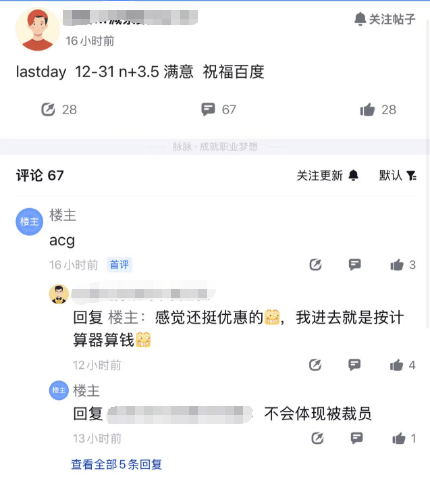
Core Insights - Baidu is undergoing a new round of layoffs, focusing on employees with less than one year of service, older employees, and those with low performance ratings or no promotions in the last two years [1][3] - The compensation package for laid-off employees is reportedly higher than the industry average, with new employees receiving N+1.5 and older employees receiving N+3 to N+3.5, including year-end bonuses [1][3] - The scale of layoffs is unprecedented since 2018, with a total reduction of nearly 10,000 employees over four years, including significant cuts in R&D personnel [3][4] Layoff Details - The layoffs are part of a broader trend of workforce reduction at Baidu, which has been ongoing since 2021, with 4,200 employees cut in 2022, 1,500 in 2023, and an estimated 3,900 in 2024 [3][4] - The Mobile Ecosystem Group (MEG) is particularly affected, with some departments seeing a reduction of 20%-30% [3][4] - The layoffs follow Baidu's Q3 financial report, which showed a net loss of 11.2 billion yuan, driven by a decline in traditional advertising revenue [5] Business Impact - Baidu's traditional advertising business has seen a continuous decline, with revenues dropping to 15.3 billion yuan, a year-on-year decrease of 18% [5] - Despite AI-related business contributing nearly 10 billion yuan, it is insufficient to offset the losses from the advertising sector [5] - The company is shifting its strategy towards AI, establishing new research departments to enhance its competitive edge in the AI landscape [5]
百度新设两大AI研发核心部门,老将吴甜贾磊负责,直接汇报李彦宏,打破向CTO汇报常规架构
Sou Hu Cai Jing· 2025-11-26 11:48
Core Insights - Baidu has established two new core departments: the Basic Model Research Department and the Application Model Research Department, both reporting directly to CEO Li Yanhong, indicating a strategic focus on AI development [3][5]. Group 1: Department Functions - The Basic Model Research Department, led by Wu Tian, will focus on developing high-intelligence, scalable general AI models, supporting all business lines with foundational AI technology [3][4]. - The Application Model Research Department, headed by Jia Lei, will specialize in tuning and exploring models tailored to specific business application scenarios, integrating general model technology with actual business needs [4]. Group 2: Leadership and Structure - Both new departments report directly to Li Yanhong, breaking from the previous structure where the model research department reported to the CTO, reflecting Baidu's heightened emphasis on large model business [5]. - Wu Tian and Jia Lei are both seasoned leaders with extensive experience in AI, having made significant contributions to Baidu's core products [3][4]. Group 3: Financial Performance - Baidu's Q3 2025 financial report showed total revenue of 31.2 billion yuan, a year-on-year decline of 7% and a quarter-on-quarter decrease of 5% [5]. - The company reported a net profit of 3.77 billion yuan, down 36% year-on-year and 21% quarter-on-quarter, with a net loss of 11.22 billion yuan [5]. - AI business revenue was disclosed for the first time, totaling 9.6 billion yuan, with a year-on-year growth of over 50%, and AI cloud revenue increased by 33% to 4.2 billion yuan [6]. Group 4: Strategic Implications - The restructuring and focus on AI core business suggest that Baidu aims to allocate more resources to enhance its AI capabilities and address potential shortcomings in current product performance [7].
BNP Paribas Exane Initiates Alphabet (GOOGL) at Outperform, Citing AI and Cloud Leadership
Yahoo Finance· 2025-11-26 10:01
Core Viewpoint - Alphabet Inc. is recognized as a leading player in AI and Cloud sectors, with a recent "Outperform" rating and a price target of $355.00 from BNP Paribas Exane, indicating potential for growth and recovery in its stock price [1][2]. Group 1: Company Overview - Alphabet Inc. is a multinational technology conglomerate that wholly owns Google and other businesses [3]. Group 2: Market Position and Performance - The company has a dominant position in Search, a leading video ad platform through YouTube, and is expanding its cloud computing business with Google Cloud [1]. - After facing regulatory challenges and competitive pressures, Alphabet's shares have started to recover, suggesting a positive trend for future performance [2]. Group 3: Future Catalysts - Analysts believe that two main catalysts could drive Alphabet's stock higher: outperformance in Google Advertising and stronger-than-expected growth in its cloud services [2].
Baidu (BIDU) Gets Big Upgrade from JPMorgan: AI Chips and Cloud Now Driving the Story
Yahoo Finance· 2025-11-26 09:43
Core Insights - Baidu, Inc. has been upgraded by JP Morgan to "Overweight" with a price target increase from $110.0 to $188.0, driven by optimism regarding AI and cloud as growth engines for the company [1] - Analyst Alex Yao believes the market is underestimating Baidu's transition, suggesting investors should buy the stock now to benefit from valuation rerating [2] - Baidu's cloud revenue growth is projected to accelerate to approximately 61% in 2026, up from 23% in 2025, primarily due to a six-fold increase in sales of Kunlun AI chips [2][3] Company Performance - The SOTP (Sum of the Parts) valuation framework attributes around $34 billion to Baidu's cloud business, which constitutes about 53% of the target price [3][4] - The domestic demand for AI compute in China is intense, with local hyperscalers increasingly sourcing from domestic providers, positioning Kunlun AI chips favorably for significant sales growth [3] Market Trends - GPU compute revenue is expected to maintain triple-digit growth due to enterprise demand for model training, fine-tuning, and inference, further supporting Baidu's cloud revenue growth projections [4] - The shift towards AI and cloud technologies is seen as a fundamental transformation for Baidu, justifying the dedicated SOTP valuation approach [4]