
百度搜索

Search documents
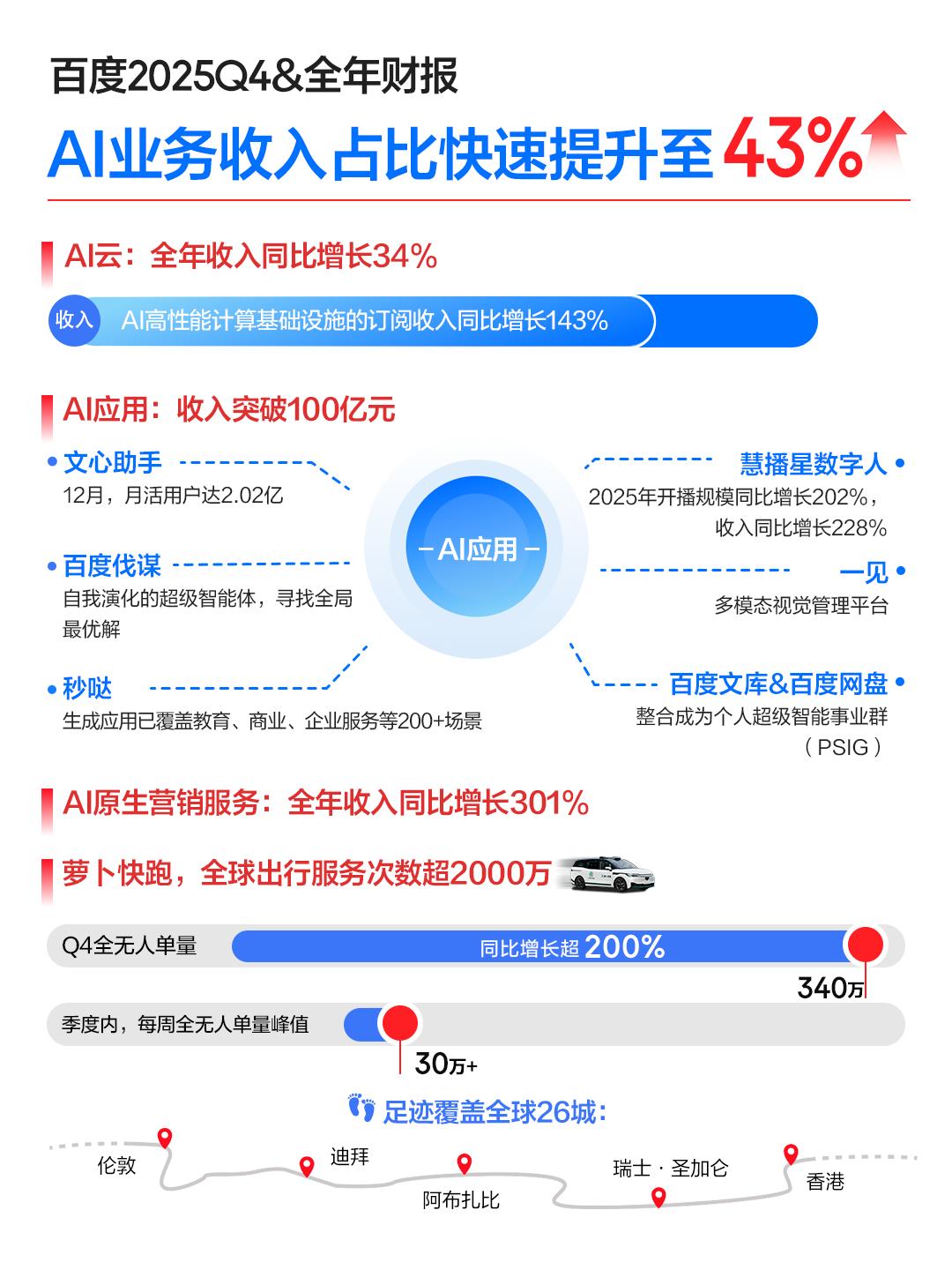
AI业务收入占比43%,百度AI价值加速兑现
3 6 Ke· 2026-02-26 13:01
Core Insights - The article highlights the transformative impact of AI on companies like Google, Microsoft, IBM, and Oracle, with Baidu emerging as a key player in China's AI landscape, integrating AI into its core business and achieving significant revenue growth [1][5]. Group 1: Baidu's AI Business Growth - Baidu's total revenue is projected to reach 129.1 billion yuan by 2025, with AI business revenue expected to hit 40 billion yuan, indicating a strong upward trend in AI integration across its business lines [1]. - In Q4, Baidu's total revenue was 32.7 billion yuan, with AI business revenue accounting for 43% of its general business income, surpassing market expectations [1]. - The company's AI capabilities are transitioning from a "cost center" to a "profit center," validating its full-stack AI business model and showcasing its value in the internet sector [5]. Group 2: AI Implementation Strategies - Baidu has developed a comprehensive four-layer technology stack encompassing chips, cloud services, models, and intelligent agents, which addresses the challenges of AI implementation in the B2B sector [7]. - The Kunlun chip, designed specifically for AI scenarios, has successfully powered 30,000 card clusters by 2025, enabling efficient training of large models and reducing integration costs for enterprises [8]. - Baidu's intelligent cloud services have achieved the highest number and value of bids for large model projects in China, with a revised revenue growth target of 200% for AI-related income by 2026 [8]. Group 3: AI Applications and User Engagement - Baidu's AI applications are projected to generate over 10 billion yuan in revenue by 2025, reflecting user willingness to pay for genuine AI productivity [12]. - The integration of AI into existing products like search and the launch of new AI-native products have significantly increased user engagement, with monthly active users of Baidu's AI assistant growing fourfold during the Spring Festival [12]. - The "秒哒" product has lowered the barrier for AI application development, resulting in over 500,000 commercial applications across various sectors within eight months of its launch [12]. Group 4: Autonomous Driving and Global Expansion - Baidu's autonomous driving initiative, "萝卜快跑," has seen a more than 200% increase in service usage in Q4 2025, with over 300 million kilometers driven globally, demonstrating its scalability [15]. - The initiative has expanded its ecosystem to Europe and the Middle East, partnering with companies like Uber and PostBus for autonomous driving services [15][16]. Group 5: Market Valuation and Future Prospects - Baidu is experiencing a moment of value reassessment, with multiple financial institutions raising their target prices for the company, indicating confidence in its sustainable growth potential [18]. - The company plans to repurchase $5 billion in stock and distribute dividends for the first time, reflecting its strong cash flow and commitment to shareholder value [19][20]. - The upcoming launch of the new Kunlun chip series is expected to enhance Baidu's AI capabilities and market valuation, with potential estimates reaching $50 billion [23].


Baidu Profit Drops as Revenue Decline Continues
WSJ· 2026-02-26 09:49
Core Insights - The Chinese search giant is experiencing pressure on both its revenue and profit margins due to a slowdown in its primary advertising business [1] Group 1 - The company's main advertising business is facing a slowdown, impacting overall financial performance [1]

百度打响“O计划” :从搜索到“智能体调度”
Hua Er Jie Jian Wen· 2026-02-10 08:31
Core Insights - The core message of the articles highlights the intensifying competition in the AI entrance market, particularly focusing on Baidu's new initiative, the "O Plan," which aims to integrate its search and cloud teams to enhance AI capabilities and user experience [1][2][4]. Group 1: Baidu's Strategic Shift - Baidu has initiated the "O Plan," which signifies a collaborative effort between its search and cloud teams, breaking down departmental barriers to enhance service delivery through the Baidu App [1][2]. - The focus of the "O Plan" is on improving reasoning efficiency, which is crucial for reducing the cost of intent parsing in AI search, thereby avoiding unprofitable operations [2][6]. - The relationship between Baidu's search and its AI assistant, Wenxin, has evolved, with Wenxin now acting as the primary interface while search functions as a knowledge verification tool [3][6]. Group 2: Competitive Landscape - The AI entrance competition has escalated into a battle for "default entry," with major players like Baidu, Alibaba, Tencent, and ByteDance all vying for dominance [4][5]. - Each company is adopting distinct strategies: ByteDance focuses on content distribution and user engagement, Alibaba integrates AI with local services and e-commerce, while WeChat's Yuanbao leverages social connections [5][6]. - Baidu aims to leverage its deep content and comprehensive AI capabilities to address complex user queries, positioning itself as a potential operator in the AI era [6][7]. Group 3: Market Dynamics - The competition is not just about technology but also about user engagement and mental occupancy, with the goal of making AI interactions seamless and intuitive [6][7]. - The success of Baidu's "O Plan" hinges on its ability to transform search into an intelligent distribution platform, which could redefine its role in the AI landscape [6][7]. - The upcoming Chinese New Year is seen as a critical moment for the AI industry, where the effectiveness of different strategies will be tested through user interactions and transactions [4][6].
Kimi公开喊话百度:搜官网前4条全是广告!有网友称被坑199元
新浪财经· 2026-02-01 08:53
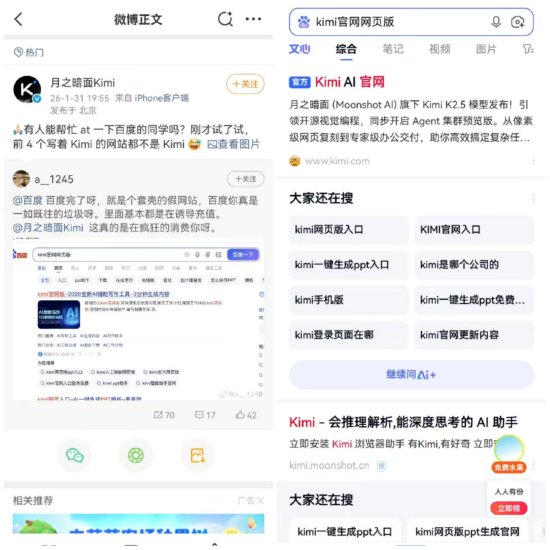
Core Viewpoint - The article highlights the ongoing issues with Baidu's search results, particularly regarding misleading advertisements that misrepresent official websites, as exemplified by the case involving Kimi, which has raised concerns about user trust and the accuracy of information provided by search engines [2][3]. Group 1: Incident Overview - Kimi's official account publicly criticized Baidu for displaying misleading search results when users searched for "Kimi官网," with the top four results being non-official sites [2][3]. - Following public outcry, Baidu adjusted its search results to prioritize Kimi's official webpage and marked it as "official," indicating a reactive approach to user complaints [9]. - Users reported being misled by Baidu's search results, leading to financial losses when they mistakenly paid for services from a third-party site posing as Kimi [11][12]. Group 2: Industry Context - The incident reflects a broader issue within Baidu's search engine, where misleading advertisements and lax review processes have been persistent problems, impacting user trust and the company's performance [11][15]. - Baidu's online marketing revenue has been declining, with a reported 18% year-over-year drop in Q3 2025, marking the sixth consecutive quarter of decline [17]. - The shift in user behavior towards multiple platforms for information retrieval, such as Xiaohongshu and Douyin, indicates a decreasing reliance on Baidu, further exacerbating its challenges in maintaining user engagement [17]. Group 3: Legal and Regulatory Implications - Legal experts suggest that search engines like Baidu may bear responsibility for misleading search results, especially if they fail to correct known issues or promote misleading content through their algorithms [14]. - The article discusses the need for Baidu to balance its advertising revenue with the accuracy of information, emphasizing that maintaining user trust is crucial in the competitive landscape of AI-driven search engines [15][16].
Kimi公开喊话百度:搜官网前4条全是广告!有网友称被坑199元
Xin Lang Cai Jing· 2026-02-01 08:47
Core Viewpoint - The incident highlights the ongoing issues with Baidu's search results, particularly regarding misleading advertisements that can confuse users and harm brand trust [2][3][17]. Group 1: Incident Overview - Kimi's official account publicly criticized Baidu for displaying non-official websites as top search results when users searched for "Kimi official website," leading to user confusion and potential financial loss [2][3][18]. - Following public outcry, Baidu adjusted its search results to prioritize Kimi's official webpage and marked it as "official," indicating a reactive approach to user complaints [6][19]. Group 2: User Experiences - Multiple users reported being misled by Baidu's search results, mistakenly believing they were accessing Kimi's official site and subsequently paying for services from a third-party provider, "Panda Office," which was not affiliated with Kimi [5][21]. - Users expressed frustration over the misleading nature of the search results, which they felt were designed to induce payments without clear disclosure [8][18]. Group 3: Industry Context - This incident is not isolated; Baidu has a history of misleading search results due to its auction-based advertising model, which has been criticized for prioritizing revenue over user experience [17][25]. - The ongoing issues with search result accuracy have contributed to a decline in Baidu's financial performance, with online marketing revenue dropping 18% year-over-year in Q3 2025, marking the sixth consecutive quarter of decline [3][26]. Group 4: Financial Impact - Baidu's total revenue for Q3 2025 was reported at 31.2 billion yuan, a 7% decrease year-over-year, with a net loss of 11.2 billion yuan, reflecting the adverse effects of its search result issues on overall business performance [26]. - The stagnation in user growth for Baidu's app, with only a 1% increase in monthly active users year-over-year, indicates a shift in user behavior towards other platforms, further challenging Baidu's market position [26].
官网搜索结果获优化 月之暗面删除喊话百度博文
Xin Lang Cai Jing· 2026-02-01 06:31
Core Viewpoint - The incident highlights issues with search result accuracy on Baidu, as misleading links were displayed for the official Kimi website, prompting a response from the Kimi team [1][2]. Group 1: Incident Overview - On January 31, Kimi's official Weibo account raised concerns about Baidu search results, stating that the top links for "Kimi官网" were not the official site [1][2]. - Kimi's comments indicated that the misleading titles could confuse users, as the first four search results were ads rather than the actual Kimi website [1][2]. Group 2: Response and Resolution - Following public outcry, Baidu optimized its search results, and the official Kimi website became the top result for the "Kimi官网" search query [1][2]. - Kimi's official Weibo later confirmed that the issue had been resolved, stating "已恢复" (has been restored) [1][2]. - As of the report, both parties had not issued any official statements regarding the incident, and Kimi subsequently deleted the initial posts addressing Baidu [1][2].
“百度完了”!搜 Kimi 全是推广,月之暗面暗示收敛。网友调侃:祖传技能,谁叫你不充值
程序员的那些事· 2026-02-01 04:15
Core Viewpoint - The article discusses user dissatisfaction with Baidu's search results, highlighting concerns over paid promotions overshadowing genuine content, particularly for the Kimi website [1][3]. Group 1: User Experience and Search Results - A user expressed frustration on social media, claiming that Baidu's search results for Kimi were dominated by promotional links, pushing the official website down the rankings [1]. - Kimi's official account responded by sharing a screenshot showing that the top four search results were indeed paid promotions, subtly criticizing Baidu's practices [3]. - Following the backlash, Baidu adjusted its search algorithm, placing Kimi at the top and removing the paid promotions, indicating a reactive approach to user feedback [5]. Group 2: Broader Implications - The issue is not limited to Kimi; it extends to other well-known brands and even free/open-source tools like VS Code and Python, where users encounter misleading paid promotions [5]. - An example was provided where a user searching for "Python free download" was misled by a paid link offering a download for 0.01 yuan, which included a default subscription for 99 yuan per month, showcasing the potential for consumer exploitation [5].

月之暗面公开喊话求助百度 百度悄然优化“Kimi官网”检索结果
Xin Lang Ke Ji· 2026-02-01 01:57
Group 1 - The core issue revolves around the misleading search results for "Kimi official website" on Baidu, where the top links were advertisements rather than the actual website [1] - Kimi's representatives expressed concern that the title containing "Kimi official website" could mislead users [1] - Baidu has since optimized the search results, ensuring that the official Kimi website appears first when searching for "Kimi official website" [1] Group 2 - Users have suggested that Kimi could file a complaint with Baidu, particularly regarding the misleading use of their trademark in search results [1] - The process of filing a complaint is noted to be time-consuming, and there is a possibility that other advertisers may take the place of the removed ads [1] - Baidu has not responded to media inquiries regarding the situation with Kimi [1]
月之暗面公开喊话求助百度,百度悄然优化“Kimi官网”检索结果
Xin Lang Cai Jing· 2026-02-01 01:49
Core Viewpoint - The issue of misleading search results on Baidu regarding the official website of "Kimi" has been highlighted, leading to user confusion and a call for action from Kimi's representatives [1][2]. Group 1: User Experience and Concerns - Kimi expressed concern that the search results for "Kimi官网" were misleading, as the top links were advertisements rather than the official site [1][2]. - Users have suggested that Kimi could file a complaint with Baidu regarding the misleading titles, although the process may be time-consuming and ineffective due to the potential for other ads to appear [2]. Group 2: Response from Baidu - Baidu has since optimized its search results, ensuring that the official Kimi website appears first when searching for "Kimi官网" [3]. - Despite the changes made to the search results, Baidu has not responded to media inquiries regarding the situation [3].
壹快评|“李鬼”网站长期猖獗,百度搜索何以成了骗子的“帮手”?
Di Yi Cai Jing· 2026-01-31 15:07
Core Viewpoint - Companies must balance commercial interests with social responsibilities, especially in the context of online safety and fraud prevention [1][3][4] Group 1: Incident Overview - An elderly resident in Shanghai lost over 1000 yuan due to a phishing website disguised as the official site for a prepaid card [1] - Similar scams have been reported since March of the previous year, indicating a persistent issue [1] - The search engine's auction-based ranking system allows fraudulent sites to appear prominently in search results, raising concerns about the platform's content review processes [1][2] Group 2: Historical Context - The incident recalls the "Wei Zexi incident" from 2016, where a student was misled by a top-ranked hospital in search results, leading to tragic consequences [2] - Despite regulatory improvements following the incident, similar issues continue to arise, suggesting ongoing vulnerabilities in content moderation [2] Group 3: Platform Responsibility - Platforms must take responsibility for the authenticity and legality of promoted content, as they profit from advertising [3] - The search engine's role has evolved beyond a mere commercial tool to a critical information infrastructure, necessitating a commitment to social responsibility [3] Group 4: Regulatory Recommendations - Strengthening regulatory oversight is essential to combat fraudulent websites, with calls for a consistent monitoring mechanism for search engines [4] - There is a need for a cross-departmental information-sharing system to enhance the collective response to online fraud [4]