保险

Search documents
国家发展改革委等三部门:到2027年无人驾驶航空器责任保险强制投保制度初步建立 低空保险产品不断丰富
Mei Ri Jing Ji Xin Wen· 2026-02-12 08:48
(文章来源:每日经济新闻) 每经AI快讯,2月12日,国家发展改革委、金融监管总局、中国民航局发布关于推动低空保险高质量发 展的实施意见。其中提到,到2027年,无人驾驶航空器责任保险强制投保制度初步建立,低空保险产品 不断丰富,更好满足各类应用场景保障需求;到2030年,低空保险政策框架基本形成,对低空经济安全 健康发展的保障作用持续增强。 ...
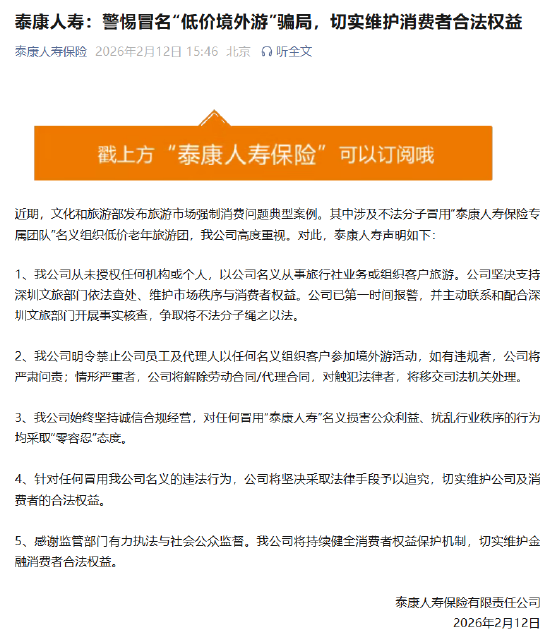
不法分子冒用“泰康人寿保险专属团队”名义组织低价老年旅游团,泰康人寿辟谣!
Xin Lang Cai Jing· 2026-02-12 08:13
Core Viewpoint - Recently, Taikang Life Insurance issued a statement addressing the misuse of its name by fraudsters organizing low-cost senior travel groups, emphasizing its commitment to consumer rights and market order [1][3]. Group 1: Company Response - The company has never authorized any individual or organization to conduct travel agency business or organize customer travel under its name, and it supports the Shenzhen cultural and tourism department in legal actions against such activities [1][3]. - Taikang Life has explicitly prohibited its employees and agents from organizing overseas travel activities under any name, with strict accountability measures for violations, including potential termination of contracts and legal action against offenders [1][3]. - The company maintains a zero-tolerance policy towards any actions that misuse its name to harm public interests or disrupt industry order [1][3]. Group 2: Legal and Regulatory Actions - The company will take legal measures against any illegal activities that misuse its name, ensuring the protection of both the company and consumer rights [1][3]. - Taikang Life expresses gratitude to regulatory authorities for their enforcement actions and public oversight, committing to enhance consumer rights protection mechanisms [1][3].


免费热饮、充电宝供应!保险业启动春节新市民关爱驿站
Guang Zhou Ri Bao· 2026-02-12 07:06
Core Viewpoint - The company has launched the "New Citizen Care Station" in Guangzhou to support urban workers during the Spring Festival, providing essential services and care for delivery riders, sanitation workers, and other city guardians [1] Group 1: Service Initiative - The care station is designed as a warm resting place and energy supply station for urban workers during the Spring Festival [1] - The initiative includes the "Insurance Energy Station" service, offering free hot drinks and food, along with a dedicated rest area and convenience items like public charging banks [1] Group 2: Consumer Education - The service integrates consumer education, featuring a financial education corner to promote awareness of financial consumer rights through posters and brochures [1] - This initiative aims to enhance financial risk awareness among the public while providing warm services [1] Group 3: Operational Details - The care station will operate from February 11 to 16 and February 20 to 26, daily from 8:30 AM to 6:00 PM, providing uninterrupted services to new citizens [1]
中国太保一周动态:科技金融创新落地,监管处罚与股价震荡并行
Jing Ji Guan Cha Wang· 2026-02-12 07:04
Group 1 - The core viewpoint of the articles highlights recent developments in China Pacific Insurance (601601) regarding business innovation, compliance, and capital market activities [1] - The company launched its first "Qin Scientific Research Development Insurance" in Shaanxi province, providing funding and risk protection for related R&D projects [1] - The life insurance branch in Siping was warned and fined by regulators due to misleading training materials, while the company’s Jinzhong branch also faced penalties for violations [1] - The board approved a reform plan for the compensation system of professional managers, reaffirming the company's asset allocation strategy based on the characteristics of insurance liabilities during investor interactions [1] Group 2 - The stock performance of China Pacific Insurance showed a downward trend over the past week, with a cumulative decline of 2.75% [2] - The latest closing price was 43.52 yuan, reflecting a daily drop of 1.81%, with net outflow of main funds [2] - Technical indicators suggest weak short-term momentum, and the overall insurance sector also performed poorly during this period [2]

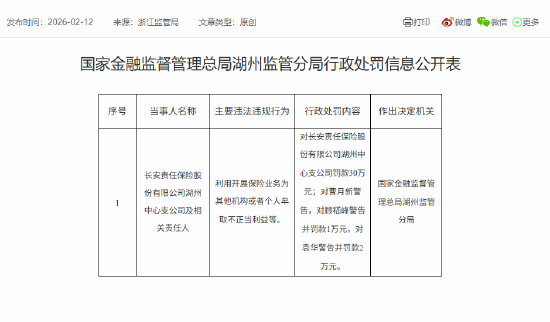
长安保险湖州中心支公司被罚30万元:利用开展保险业务为其他机构或者个人牟取不正当利益等
Xin Lang Cai Jing· 2026-02-12 07:04
2月12日金融一线消息,国家金融监督管理总局湖州监管分局行政处罚信息公开表显示,长安责任保险 股份有限公司湖州中心支公司因利用开展保险业务为其他机构或者个人牟取不正当利益等,被罚款30万 元;相关责任人曹月新被警告,顾嵇峰被警告并罚款1万元,袁华被警告并罚款2万元。 2月12日金融一线消息,国家金融监督管理总局湖州监管分局行政处罚信息公开表显示,长安责任保险 股份有限公司湖州中心支公司因利用开展保险业务为其他机构或者个人牟取不正当利益等,被罚款30万 元;相关责任人曹月新被警告,顾嵇峰被警告并罚款1万元,袁华被警告并罚款2万元。 | 序号 | 当事人名称 | 主要活法违规行为 | 行政处罚内容 对长安责任保险股 | 作出决定机关 | | --- | --- | --- | --- | --- | | | 长安责任保险股 | | 份有限公司湖州中 心支公司罚款30万 | | | | | 利用开展保险业务为 | | 国家金融监督管 | | | 份有限公司湖州 | | 元:对曹月新警 | | | 1 | | 其他机构或者个人单 | | 理总局湖州监管 | | | 中心变公司及相 | | 告,对顾格峰营告 | | | ...
平安人寿增资至360.03亿元
Mei Ri Jing Ji Xin Wen· 2026-02-12 06:32
(文章来源:每日经济新闻) 每经AI快讯,国家企业信用信息公示系统显示,2026年2月11日,中国平安人寿保险股份有限公司发生 注册资本变更,其注册资本由338亿元人民币增至360.03亿元人民币,增资约22亿元人民币。 ...

中信里昂:提升港股权重至超配20% 首选万洲国际(00288)等
智通财经网· 2026-02-12 06:03
Core Viewpoint - Citic Lyon has upgraded the weighting of the Hong Kong market to overweight by 20%, citing reduced correlation with the Chinese market and allowing for differentiated allocation [1] Group 1: Market Performance - The Hong Kong IPO market is expected to surpass its performance in 2025, with total IPO and placement fundraising amounting to $82.3 billion last year [1] - The Hong Kong property market has recorded its first annual increase since 2021, which is anticipated to boost the stock market [1] Group 2: Earnings and Valuation - Earnings forecasts for Hong Kong companies are projected to turn positive starting July 2025, ranking second in the Asia-Pacific region after Japan, South Korea, and Taiwan [1] - The valuation of the Hong Kong stock market is attractive relative to regional peers, with a price-to-earnings ratio of 16.7 times, slightly below the 35-year average of 17.2 times [1] - The Hong Kong market is the furthest from its historical highs, indicating potential for catch-up [1] Group 3: Stock Recommendations - Preferred stocks include WH Group (00288), AIA (01299), Hong Kong Exchanges and Clearing (00388), Sun Hung Kai Properties (00016), CK Hutchison Holdings (00001), Techtronic Industries (00669), and Galaxy Entertainment Group (00027), all rated as "outperform" [1] - WH Group is highlighted as a stock with "high confidence" by the firm [1]





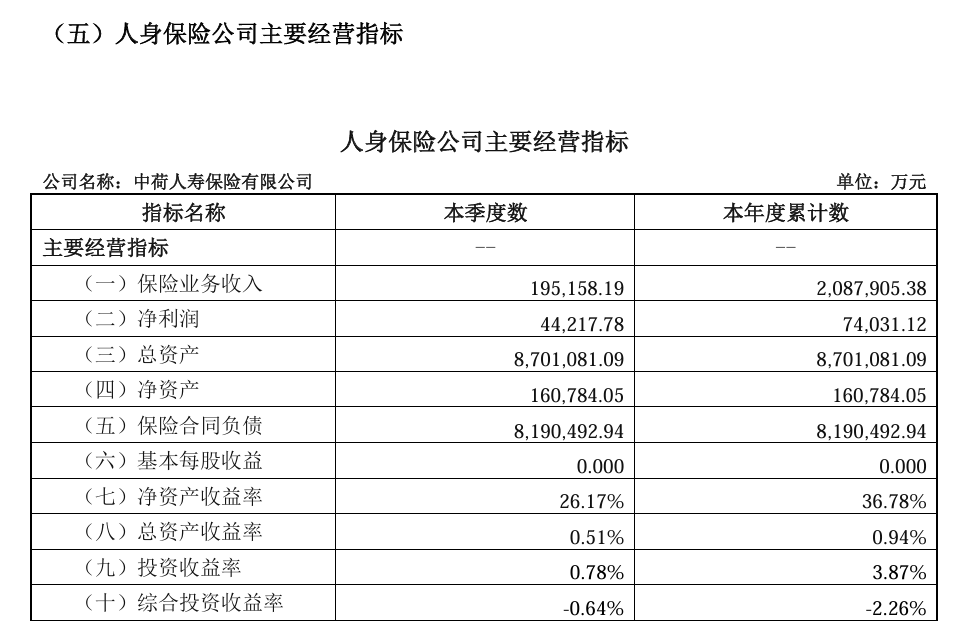
中荷人寿去年保费规模稳步增长 最近三年综合投资收益率排名却从业内上游滑落至垫底
Sou Hu Cai Jing· 2026-02-12 05:56
Core Viewpoint - In 2025, Zhonghe Life Insurance experienced a significant decline in its comprehensive investment return rate, dropping to -2.26%, ranking last among 57 non-listed life insurance companies, after achieving a high of 14.42% in 2024 [1][4]. Group 1: Investment Performance - In 2023, Zhonghe Life's comprehensive investment return rate was 5.83%, significantly above the industry average, ranking ninth [1]. - The company achieved a comprehensive investment return rate of 14.42% in 2024, ranking fifth among non-listed life insurance companies [1]. - In 2025, the investment return rate for the fourth quarter was only 0.78%, with an annual cumulative investment return rate of 3.87%, placing it at the lower end of the industry [4]. Group 2: Premium Income and Growth - In the fourth quarter of 2025, Zhonghe Life reported a single-quarter premium income of 1.95 billion yuan, maintaining a high growth rate of 36.48% from the first half of the year [1]. - The total premium income for the year reached 20.88 billion yuan, representing a year-on-year growth of over 36%, significantly outperforming peers [1]. Group 3: Regulatory and Operational Challenges - In 2025, six branches of Zhonghe Life faced regulatory penalties totaling 760,000 yuan due to issues such as false financial data and fraudulent invoicing [5]. - Consumer complaints about Zhonghe Life primarily focused on sales misguidance, automatic deductions, and disputes over policy terms [5]. Group 4: Product Performance and Refunds - The top three products with the highest refund scale in 2025 were from the "Family Evergreen" series of whole life insurance, with a total refund scale of approximately 422 million yuan [7]. - The refund rates for the "Family Evergreen" series products were notably high, indicating significant pressure on the company regarding policy cancellations [7]. Group 5: Related Transactions and Market Position - At the end of the previous year, Zhonghe Life disclosed two major related transactions, including a 350 million yuan agency fee cap with its major shareholder, Beijing Bank, and a 100 million yuan sales cooperation agreement with Nanjing Bank [8]. - Concerns have been raised about the company's reliance on shareholder channels, which may affect its business independence and market expansion [8].
镁信健康更新招股书:中国最大医药多元支付平台,「AI+洞察」重塑支付生态
IPO早知道· 2026-02-12 05:24
Core Viewpoint - The article discusses the progress of Shanghai Meixin Health Technology Group Co., Ltd. in its IPO process and highlights its role in transforming China's medical payment system, emphasizing its growth and innovative solutions in the healthcare sector [1][2]. Group 1: Company Performance - Meixin Health's revenue for the first ten months of 2025 increased by 33.85% year-on-year to 1.873 billion RMB, with a gross profit exceeding 600 million RMB [1]. - The company's revenue for 2022, 2023, and 2024 is projected to be 1.069 billion RMB, 1.255 billion RMB, and 2.035 billion RMB, respectively, outpacing the average growth rates of the Chinese healthcare and insurance industries [1]. - Adjusted net losses decreased from 87 million RMB in the first ten months of 2024 to 55 million RMB in the same period of 2025, indicating a trend towards sustainable profitability [1]. Group 2: Market Context - The Chinese innovative drug and medical device market is expected to grow from 92.3 billion RMB in 2019 to 162 billion RMB by 2024, with a compound annual growth rate (CAGR) of 11.9% [2]. - By 2030, the market size is projected to reach 2,356.8 billion RMB, with a CAGR of 15.8% from 2024 to 2030, driven by government policies encouraging the expansion of commercial health insurance [2]. Group 3: Business Model and Solutions - Meixin Health has developed a new model that integrates the needs of patients, insurers, and pharmaceutical companies, creating diverse payment solutions that alleviate the financial burden on patients [3]. - The company offers two main industry solutions: the Smart Drug Solution, which provides commercialization plans for pharmaceutical companies, and the Smart Insurance Solution, which integrates AI technology to enhance health insurance innovation [3][4]. - The "One Code Direct Payment" platform enhances user experience by offering various payment options and streamlining the payment process [4]. Group 4: Infrastructure and Technology - Meixin Health has established three key infrastructures: mind42.ai (an AI hub), MediTrust Rx (integrating the medical supply chain), and MediTrust Healthcare (optimizing patient treatment processes) [4][6]. - The AI medical review coverage has exceeded 60%, with review times reduced to under 10 minutes, significantly improving operational efficiency [6]. Group 5: Partnerships and User Base - As of October 31, 2025, Meixin Health has served approximately 2 million patients and partnered with all top 20 insurers in China by premium income [5]. - The company has collaborated with over 140 pharmaceutical companies, including 90 from the top 20 global revenue rankings for 2024 [5]. Group 6: Funding and Future Plans - Meixin Health has completed seven rounds of financing, with notable investors including Ant Group and GIC [7]. - The company’s valuation reached 11.6775 billion RMB prior to its IPO, with funds raised intended for service expansion, platform development, and operational efficiency improvements [8].

从“温暖护航”到“风险减量”,春运保险服务多维升级
Bei Jing Shang Bao· 2026-02-12 04:47
Core Viewpoint - The insurance industry is evolving from a reactive role in claims processing to a proactive approach focused on risk prevention during the upcoming 2026 Spring Festival travel period, which is expected to see record cross-regional movement of people [1] Group 1: Insurance Services and Initiatives - Insurance companies are enhancing their service offerings to ensure safety during the Spring Festival travel, including initiatives like "online quick claims" and "offline service stations" [2] - China Pacific Insurance has launched the "Ten Thousand Families Safe Travel" campaign, focusing on regions with historically high claim volumes during the Spring Festival, employing a risk reduction model that combines data analysis and localized strategies [3] - Various insurance firms are providing 24/7 support and proactive communication through platforms like WeChat to ensure accessibility and timely assistance for travelers [3] Group 2: Upgrades and Industry Responsibility - The upgrades in insurance services during the Spring Festival are aimed at quickly processing claims, reducing road congestion, and enhancing travel safety, reflecting the industry's responsibility to maintain social order and support consumer spending [4] - Insurance companies are leveraging technology to streamline processes, improve response times, and enhance service experiences, particularly during high-risk periods like the Spring Festival [4][5] - The insurance sector is also developing new products tailored to specific consumer scenarios during the holiday, such as skiing and short trips, to provide comprehensive coverage [5]