
无人驾驶航空器责任保险

Search documents
金融监管总局等三部门提出: 加快建立无人驾驶航空器责任保险强制投保制度
Sou Hu Cai Jing· 2026-02-25 07:16
Core Viewpoint - The implementation opinion aims to establish a comprehensive low-altitude insurance policy framework by 2030, focusing on the mandatory insurance for unmanned aerial vehicles (UAVs) and enhancing the insurance product offerings to meet various application scenarios [1][4]. Group 1: Low-altitude Insurance Development - The implementation opinion outlines the necessity of a low-altitude insurance system that provides risk coverage for low-altitude flight activities, including UAV manufacturing, operation, and infrastructure [4]. - By 2027, a preliminary mandatory insurance system for UAVs is expected to be established, with a continuous expansion of low-altitude insurance products to better meet diverse application needs [1][4]. - The policy aims to strengthen the support for low-altitude insurance through various economic development plans, positioning insurance as a key tool for enhancing operational safety and accident management [4][5]. Group 2: Service and Product Enhancement - The implementation opinion emphasizes the need to build a comprehensive insurance product system covering the entire low-altitude industry chain, improving the supply and service capabilities for both UAVs and traditional manned aircraft [5]. - Targeted insurance coverage will be developed for various application scenarios such as agricultural operations, low-altitude inspections, logistics, urban governance, emergency management, and medical rescue, based on the specific risks and management needs of each scenario [5]. - The establishment of a low-altitude insurance information platform is encouraged to enhance the operational capabilities of insurance institutions and facilitate better integration with low-altitude intelligent network systems [5].

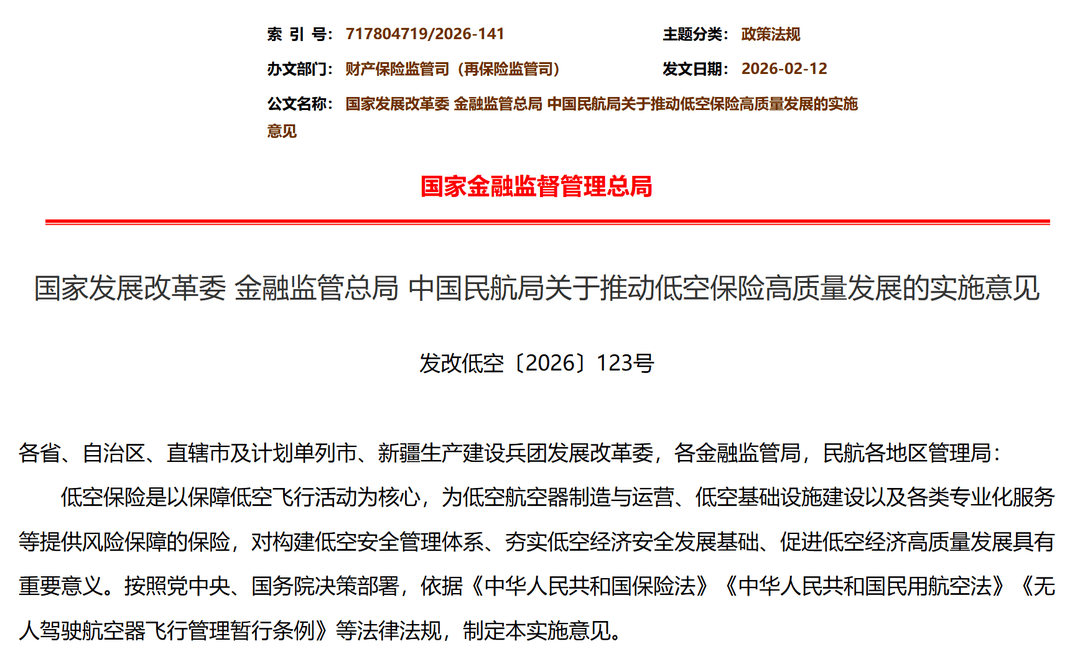
三部门给低空经济上保险
Jin Rong Shi Bao· 2026-02-25 02:57
Core Viewpoint - The low-altitude economy in China is transitioning from "taking off" to "utilizing," with the market expected to reach 1.5 trillion yuan by 2025 and potentially exceed 2 trillion yuan by 2030. The traditional insurance model is inadequate for the complex demands of low-altitude flight activities, prompting the release of the "Implementation Opinions" to establish a systematic approach to low-altitude insurance development [1][2]. Group 1: Policy Framework and Development Goals - The "Implementation Opinions" outlines a phased development goal for low-altitude insurance, aiming to establish a mandatory insurance system for unmanned aerial vehicles (UAVs) by 2027 and a comprehensive policy framework by 2030 [2][3]. - The document emphasizes the importance of low-altitude insurance in building a safety management system and supporting the high-quality development of the low-altitude economy [2]. Group 2: Mandatory Insurance for UAVs - A key highlight of the "Implementation Opinions" is the establishment of a mandatory insurance system for UAVs, akin to compulsory traffic insurance, which will be integrated into flight activity approval processes [3][4]. - This mandatory insurance aims to enhance public safety and compel operators to improve safety management practices [3]. Group 3: Comprehensive Risk Coverage - The low-altitude economy's diverse applications necessitate a broad and precise risk coverage approach, prompting the "Implementation Opinions" to advocate for a comprehensive insurance service system that extends across the entire industry chain [5][6]. - The document calls for the development of insurance products that address new types of risks associated with low-altitude operations, including safety in technology, data, and environmental aspects [5][6]. Group 4: Service Enhancement and Application Scenarios - The "Implementation Opinions" stresses the need for tailored insurance solutions based on various application scenarios such as agriculture, logistics, emergency management, and tourism, ensuring that insurance services evolve from mere product supply to proactive empowerment [6]. - The establishment of a robust service guarantee system is seen as a critical measure to integrate insurance into the low-altitude economy, providing a safety net for industry development [6].
新华财经周报:2月9日至2月15日
Xin Hua Cai Jing· 2026-02-15 09:43
Domestic News - The "Modern Capital Urban Circle Spatial Collaborative Planning (2023-2035)" has been released, marking the first urban circle plan approved by the Central Committee of the Communist Party of China and the State Council. The plan emphasizes the "four zones and one engine" positioning, aiming to construct a nested structure of commuting, functional, and industrial collaboration circles, and promotes the coordinated development of Beijing-Tianjin-Hebei region to build a world-class urban circle [1] - The Ministry of Commerce announced that the first batch of national subsidy funds amounting to 62.5 billion yuan has been allocated to local commerce departments, which will guide increased subsidy distribution during the nine-day Spring Festival holiday [3] - The People's Bank of China reported that by the end of January, the broad money supply (M2) reached 347.19 trillion yuan, reflecting a year-on-year growth of 9% [6] - The State Administration for Market Regulation has interviewed seven platform companies to eliminate various forms of "involution" competition and ensure compliance with competition laws [7] Industry Developments - The State Council has issued implementation opinions on improving the national unified electricity market system, aiming for 70% of electricity consumption to be traded in the market by 2030 [2] - The Ministry of Industry and Information Technology has proposed to enhance the planning and policy support for the low-altitude industry, aiming for a 90% coverage of ground mobile communication networks for low-altitude public air routes by 2027 [4] - The National Development and Reform Commission and other departments have released opinions to promote the high-quality development of low-altitude insurance, with a mandatory insurance system for unmanned aerial vehicles expected to be established by 2027 [4] - The Ministry of Industry and Information Technology and other departments have issued opinions to strengthen the capacity building of the information and communication industry to support low-altitude infrastructure development [5] Market Regulation - The State Administration for Market Regulation has released guidelines to regulate pricing behavior in the automotive industry, aiming to promote a healthy and orderly automotive market [8] - The National Bureau of Statistics reported that in January, the consumer price index (CPI) rose by 0.2% year-on-year, with food prices decreasing by 0.7% and non-food prices increasing by 0.4% [8] - The National Bureau of Statistics also indicated that in January, the sales prices of new residential properties in first-tier cities decreased by 0.3% month-on-month, while second-hand residential prices fell by 0.5% [9]
三部门发文推动低空保险高质量发展
Ren Min Ri Bao Hai Wai Ban· 2026-02-15 01:40
Core Viewpoint - The implementation of a mandatory insurance system for unmanned aerial vehicles (UAVs) is being accelerated to enhance the low-altitude insurance policy framework in China [1] Group 1: Policy Development - The National Development and Reform Commission, the Financial Regulatory Administration, and the Civil Aviation Administration of China have jointly issued guidelines to promote high-quality development of low-altitude insurance [1] - The guidelines emphasize the need to incorporate mandatory insurance requirements into the approval process for UAV flight activities [1] Group 2: Implementation Measures - There will be a strengthened verification of insurance coverage during flight operations management and a thorough check during accident handling [1] - A legal framework for mandatory UAV liability insurance will be established, defining basic liability scope and minimum coverage limits under controllable risk principles [1] Group 3: Insurance Supply Enhancement - The guidelines call for improving the supply and service capabilities of related insurance products, providing targeted insurance coverage for various application scenarios [1]
【东吴周视点】节前震荡蓄力,节后行情可期(第342期)
Xin Lang Cai Jing· 2026-02-14 01:48
Market Overview - The market indices experienced narrow fluctuations this week, with trading volumes dropping below 2 trillion yuan on Wednesday and Friday. AI safety, film industry, and computing power leasing sectors led the gains, while traditional consumer sectors like liquor showed weakness. The Shanghai Composite Index rose by 0.41%, the ChiNext Index increased by 1.22%, and the CSI 300 Index gained 0.36% [3]. Policy Developments - On February 12, the National Development and Reform Commission, the Financial Regulatory Bureau, and the Civil Aviation Administration of China released implementation opinions to promote the high-quality development of low-altitude insurance. By 2027, a mandatory insurance system for unmanned aerial vehicles is expected to be established, with a comprehensive policy framework for low-altitude insurance by 2030. This sector is seen as a significant investment opportunity, with projections of a trillion-yuan market emerging [6][6]. - The Peking University Institute of Modern Optics announced the successful development of a high-performance quantum key distribution chip and an optical microcavity frequency comb light source chip. This development supports the establishment of a large-scale quantum key distribution network, which is expected to drive growth in the global Ethernet optical module market due to strong demand from AI infrastructure [6][6]. Technical Analysis - The Shanghai Composite Index has been fluctuating within the 4050-4150 point range but fell below the 4100 point support level on Friday. The MACD indicator shows increasing bearish momentum, suggesting a potential test of the lower support at 4050 points in the near term [7]. Market Outlook - The market is expected to maintain a cautious stance with structural rotation of hotspots as investors await post-holiday liquidity and risk appetite recovery. The upcoming events, including the annual lending surge and the Two Sessions, are anticipated to support a gradual structural bull market. The historical data indicates a high probability of positive performance for the A-share market around the Spring Festival, with a notable 80% chance of gains in the five days before and after the holiday [11][12]. - The market is characterized by strong index resilience and stock differentiation, with funds gradually positioning for post-holiday expectations. High expectation companies are gaining recognition from investors, and the structural recovery is expected to continue [13]. Sector Performance - The robotics sector is highlighted, with Tesla's third-generation humanoid robot set to launch in Q1 2026, aiming for a production target of one million units annually. This sector has shown significant stock price increases, with notable gains among various companies [15][16].
三部门联合推动低空保险高质量发展
Xin Lang Cai Jing· 2026-02-13 16:23
Core Viewpoint - The implementation of a comprehensive low-altitude insurance policy framework is aimed at enhancing the safety and development of the low-altitude economy by 2030, with specific measures to establish mandatory insurance for unmanned aerial vehicles by 2027 [1][2]. Group 1: Policy Framework - The joint issuance of the implementation opinions by the National Development and Reform Commission, the Financial Regulatory Administration, and the Civil Aviation Administration of China emphasizes the need to strengthen the low-altitude insurance policy system [1]. - The policy aims to support low-altitude economic development planning and encourages the effective use of insurance mechanisms by various operators in the low-altitude economy [2]. Group 2: Specific Measures - Nine specific measures are outlined to enhance the low-altitude insurance framework, focusing on policy system, institutional construction, product services, and foundational capabilities [2]. - A mandatory insurance system for unmanned aerial vehicles is to be established, with efforts to strengthen verification of insurance coverage and develop implementation guidelines [2]. - The construction of a service guarantee system is prioritized, aiming to create a comprehensive insurance product system that caters to the entire low-altitude industry chain [2]. - The initiative includes the development of a low-altitude insurance information platform to improve the operational sustainability of insurance services and enhance the capabilities of insurance institutions [2].
关注下游扩消费活动开展
Hua Tai Qi Huo· 2026-02-13 08:16
Report Summary 1. Report Industry Investment Rating No information provided. 2. Core Viewpoints - The National Development and Reform Commission, the Financial Regulatory Administration, and the Civil Aviation Administration of China have issued an implementation opinion on promoting the high - quality development of low - altitude insurance. By 2027, a preliminary mandatory insurance system for unmanned aerial vehicle liability will be established, and by 2030, the policy framework for low - altitude insurance will basically take shape [1]. - The National Film Administration and the Ministry of Commerce have organized a "Film +" consumption comprehensive pilot program to boost consumption and promote the transformation of the film industry into a diversified consumption ecosystem [1]. 3. Summary by Industry Level Upstream - Black commodities are at low prices [1]. - Egg prices have declined [1]. - Building material prices have dropped [1]. Midstream - The operating rates of PX and urea remain high [2]. - The coal consumption of power plants has increased [2]. - The production of pork products has increased [2]. Downstream - The sales of commercial housing in first - and second - tier cities have seasonally declined [2]. - The number of domestic flights has remained high and stable [2]. 4. Key Industry Price Indicators | Industry | Indicator | Value (as of 2/9) | YoY | | --- | --- | --- | --- | | Agriculture | Spot price of corn | 2271.4 yuan/ton | 0.00% | | | Spot price of eggs | 7.1 yuan/kg | - 12.96% | | | Spot price of palm oil | 8972.0 yuan/ton | - 0.47% | | | Spot price of cotton | 15986.0 yuan/ton | - 0.65% | | | Average wholesale price of pork | 18.3 yuan/kg | - 0.76% | | Non - ferrous metals | Spot price of copper | 101646.7 yuan/ton | 0.79% | | | Spot price of zinc | 24656.0 yuan/ton | - 1.26% | | | Spot price of aluminum | 23406.7 yuan/ton | 1.90% | | | Spot price of nickel | 138650.0 yuan/ton | - 0.20% | | | Spot price of aluminum | 16506.3 yuan/ton | 0.08% | | | Spot price of rebar | 3170.0 yuan/ton | - 0.61% | | Ferrous metals | Spot price of iron ore | 786.9 yuan/ton | - 2.25% | | | Spot price of wire rod | 3367.5 yuan/ton | - 0.96% | | | Spot price of glass | 13.3 yuan/square meter | 0.15% | | Non - metals | Spot price of natural rubber | 16125.0 yuan/ton | 0.62% | | | China Plastic City Price Index | 786.7 | - 0.56% | | | Spot price of WTI crude oil | 63.6 dollars/barrel | - 2.55% | | Energy | Spot price of Brent crude oil | 68.1 dollars/barrel | - 1.83% | | | Spot price of liquefied natural gas | 3620.0 yuan/ton | 0.39% | | | Coal price | 799.0 yuan/ton | - 0.50% | | | Spot price of PTA | 5144.3 yuan/ton | - 0.57% | | Chemical | Spot price of polyethylene | 6800.0 yuan/ton | - 3.20% | | | Spot price of urea | 1765.0 yuan/ton | - 0.70% | | | Spot price of soda ash | 1201.4 yuan/ton | - 0.12% | | Real estate | National cement price index | 131.7 | - 0.79% | | | Building materials composite index | | - 0.43% | | | National concrete price index | 89.8 | - 0.42% | [36]
无人机“交强险”要来了!三部门联手给低空经济上保险
2 1 Shi Ji Jing Ji Bao Dao· 2026-02-13 06:45
Core Viewpoint - The implementation of the "Implementation Opinions" by the National Development and Reform Commission, the Financial Regulatory Bureau, and the Civil Aviation Administration marks a significant step towards the development of low-altitude insurance, which is crucial for the safety and high-quality development of the low-altitude economy [1][2]. Group 1: Policy Framework - The "Implementation Opinions" consist of six parts and twelve articles, outlining principles for systematic planning, key breakthroughs, collaborative advancement, and steady implementation [2]. - It emphasizes the establishment of a mandatory insurance system for unmanned aerial vehicles (UAVs), akin to compulsory insurance for automobiles, which will be integrated into flight activity approval processes [2][4]. Group 2: Insurance Product Development - The document encourages the development of a comprehensive insurance product system covering the entire low-altitude industry chain, including research, manufacturing, operation, and infrastructure [5]. - It highlights the need for insurance companies to adapt to new business models in the low-altitude economy, promoting the supply of insurance for medium and large UAVs while optimizing traditional manned aircraft insurance [5]. Group 3: Application Scenarios - The "Implementation Opinions" propose targeted insurance solutions for various application scenarios such as agricultural operations, low-altitude logistics, emergency management, and medical rescue, based on the specific risks and management needs of each scenario [6]. - It also encourages collaboration among industry chain leaders to reduce risk costs and supports small and medium enterprises in enhancing their risk defense capabilities through insurance [6]. Group 4: Data Infrastructure and Professional Capability - The document addresses the need for improved data infrastructure to support sustainable insurance operations, proposing the establishment of a low-altitude insurance information platform to facilitate data sharing and risk monitoring [7]. - It emphasizes the importance of enhancing professional capabilities within insurance institutions to better identify and assess new risks associated with low-altitude operations [7]. Group 5: Organizational Support and Timeline - The "Implementation Opinions" outline a clear organizational structure for implementing low-altitude insurance, with specific responsibilities assigned to various regulatory bodies [8]. - A phased timeline is set, aiming for the establishment of a mandatory UAV insurance system by 2027 and a comprehensive low-altitude insurance policy framework by 2030, indicating the growing importance of low-altitude insurance in the economic system [8].
三部门:加快建立健全低空保险政策体系
Zhong Guo Zheng Quan Bao· 2026-02-12 20:26
Core Viewpoint - The National Development and Reform Commission, along with the Financial Regulatory Administration and the Civil Aviation Administration of China, has issued implementation opinions to promote the high-quality development of low-altitude insurance, aiming to establish a comprehensive low-altitude insurance policy system [1][2]. Group 1: Policy Framework - The implementation opinions propose nine specific measures across four areas: policy system, institutional construction, product services, and foundational capabilities [1]. - It emphasizes the need to strengthen the support of low-altitude economic development planning policies for low-altitude insurance, using insurance as a key tool for enhancing operational safety regulation and accident handling systems [1]. Group 2: Mandatory Insurance for UAVs - The implementation opinions call for the establishment of a mandatory insurance system for unmanned aerial vehicles (UAVs), including the development of verification mechanisms for insurance compliance and the creation of model clauses [2]. Group 3: Service and Product Development - There is a requirement to gradually establish an insurance product system that covers the entire low-altitude industry chain, enhancing the supply and service capabilities for both UAV and traditional manned aircraft insurance [2]. Group 4: Sustainable Operations - The implementation opinions highlight the need to accelerate the construction of a low-altitude insurance information platform, exploring integration with low-altitude intelligent network systems, and strengthening the professional capabilities of insurance institutions and intermediaries [2]. Group 5: Future Actions - The National Development and Reform Commission, Financial Regulatory Administration, and Civil Aviation Administration will work with relevant departments to ensure the implementation of these opinions, aiming to enrich low-altitude insurance products and enhance the insurance protection role [2].
三部门为低空经济“上保险” 到2027年,无人驾驶航空器强制投保责任保险
Shang Hai Zheng Quan Bao· 2026-02-12 17:42
Core Viewpoint - The implementation of a mandatory insurance system for unmanned aerial vehicles (UAVs) is a crucial step towards transitioning the low-altitude economy from "wild growth" to "regulated development" by 2027 [1][2] Group 1: Policy Implementation - The National Development and Reform Commission, along with financial regulatory authorities, has issued guidelines to establish a comprehensive low-altitude insurance service system covering all aspects by 2027 [1] - The mandatory insurance system aims to address the public nature of risks associated with UAV operations, enhancing public safety and compelling operators to improve safety management [1][2] Group 2: Risk Management and Public Trust - The introduction of a mandatory insurance system is expected to provide a clear risk management framework, fostering public trust in emerging technologies such as eVTOL and urban drone logistics [2] - This system will serve as a legal guarantee for the public and third parties, signaling that innovation has boundaries and risks are manageable, which is vital for attracting investment and nurturing consumer markets [2] Group 3: Insurance Development and Industry Support - The guidelines encourage insurance companies to develop comprehensive risk coverage products across the entire low-altitude industry chain, including research, manufacturing, and operational aspects [3] - Specific insurance products will be tailored to various application scenarios such as agriculture, logistics, and emergency management, ensuring that insurance services align closely with industry needs [3] - The authorities will work on implementing these guidelines to enhance the low-altitude insurance policy framework, aiming for a robust, professional, and regulated insurance system to support high-quality development of the low-altitude economy [3]