饮料

Search documents
来城墙邂逅秋色!“行走南京70里”就在本月19日
Nan Jing Ri Bao· 2025-10-10 02:50
Group 1 - The "Walking Nanjing 70 Li" charity walking event will kick off on October 19, 2025, at the Zhonghua Gate, inviting participants to explore the city's heritage through walking [2] - The event features two routes: a short route of approximately 3 kilometers ending at the Dongshuiguan city gate, and a full route of about 35 kilometers returning to the Zhonghua Gate [3] - The event aims to enhance community interaction, featuring AI digital employees and special guests like Ronald McDonald and his friends, along with exclusive ice cream vouchers for participants [4] Group 2 - Since its inception in 2016, the "Walking Nanjing" series has been held for nine consecutive years, showcasing the beauty of Nanjing's city wall and contributing to its heritage application efforts [5] - The event is co-hosted by the Nanjing Media Group and the Nanjing City Wall Protection Management Center, with Nanjing Bank as the title sponsor [6] - Registration for the event will soon open, with details available on official WeChat accounts [7]


港股饮料股盘中拉升!古茗涨超11%,蜜雪集团涨超5.5%,沪上阿姨、茶百道涨3%,统一企业中国、农夫山泉跟涨
Ge Long Hui· 2025-10-10 02:45
【免责声明】本文仅代表作者本人观点,与和讯网无关。和讯网站对文中陈述、观点判断保持中立,不对所包含内容 的准确性、可靠性或完整性提供任何明示或暗示的保证。请读者仅作参考,并请自行承担全部责任。邮箱: news_center@staff.hexun.com 格隆汇10月10日|港股饮料股盘中拉升,其中,古茗涨超11%,蜜雪集团涨超5.5%,沪上阿姨、茶百道 均涨3%,统一企业中国、农夫山泉等跟涨。 (责任编辑:宋政 HN002) ...
港股饮料股盘中拉升,古茗涨超10%,蜜雪集团涨超5%
Mei Ri Jing Ji Xin Wen· 2025-10-10 02:22
每经AI快讯,10月10日,港股饮料股盘中拉升,古茗涨超10%,蜜雪集团涨超5%,沪上阿姨、茶百道 涨超3%。 ...
养元饮品股价涨5.59%,长盛基金旗下1只基金重仓,持有9.57万股浮盈赚取16.75万元
Xin Lang Cai Jing· 2025-10-10 01:55
Group 1 - The core point of the news is that Yangyuan Beverage has seen a stock price increase of 5.59%, reaching 33.04 CNY per share, with a trading volume of 205 million CNY and a turnover rate of 0.52%, resulting in a total market capitalization of 41.64 billion CNY [1] - Yangyuan Beverage, established on September 24, 1997, and listed on February 12, 2018, specializes in the research, production, and sales of plant protein beverages made from walnut kernels [1] Group 2 - From the perspective of major fund holdings, Changsheng Fund has one fund heavily invested in Yangyuan Beverage, specifically the Changsheng CSI Dividend Low Volatility 100 Index A (022342), which reduced its holdings by 6,900 shares in the second quarter, now holding 95,700 shares, accounting for 1.59% of the fund's net value, ranking as the ninth largest holding [2] - The Changsheng CSI Dividend Low Volatility 100 Index A (022342) has a current scale of 58.05 million CNY and has achieved a return of 3.71% this year, ranking 3947 out of 4220 in its category [2] - The fund manager, Chen Gensi, has been in position for 6 years and 136 days, with the fund's total asset size at 2.784 billion CNY, achieving a best return of 103.65% and a worst return of -20.38% during his tenure [2]

东鹏饮料赴港IPO
Shen Zhen Shang Bao· 2025-10-09 23:01
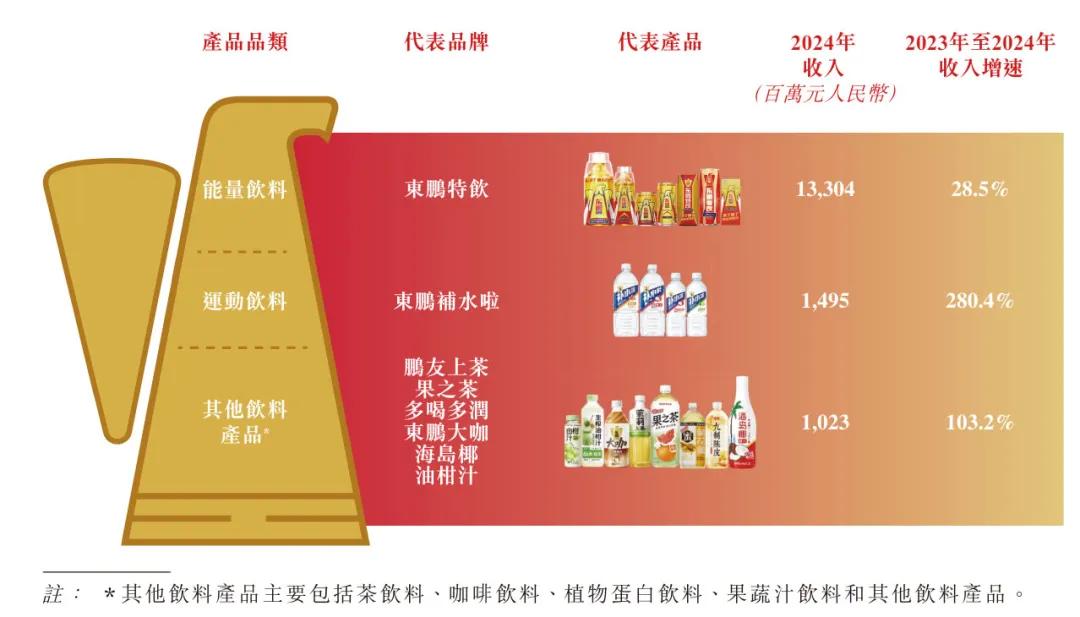
Group 1 - The core business of Dongpeng Beverage is the research, production, and sales of beverages, with a significant focus on energy drinks [1] - Dongpeng Beverage's main product, Dongpeng Special Drink, accounted for over 80% of the company's revenue in the past three years, with revenue contributions of 96.6%, 91.9%, and 84% from 2022 to 2024 respectively [1] - As of October 9, 2023, Dongpeng Beverage's stock price was reported at 301.51 yuan per share, with a total market capitalization of 156.79 billion yuan, reflecting a year-to-date increase of 23.81% [1] Group 2 - In the first half of 2025, Dongpeng Beverage reported an operating income of 10.737 billion yuan, representing a year-on-year growth of 36.37% [2] - The net profit attributable to the parent company for the same period was 2.375 billion yuan, showing a year-on-year increase of 37.22% [2]

两度递表,资本梦未灭,东鹏饮料为何在“金钱充裕”之下执意赴港?
3 6 Ke· 2025-10-09 15:24
Core Viewpoint - Dongpeng Beverage has re-applied for an H-share listing on the Hong Kong Stock Exchange, aiming for a dual listing in both A and H shares, following a previous unsuccessful attempt. The company, known for its flagship product "Dongpeng Special Drink," seeks to enhance its brand recognition and international presence through this listing [1][2]. Group 1: Company Background and Market Position - Dongpeng Beverage, established in 1994, is a leading player in China's functional beverage market, with its flagship product gaining nationwide popularity. The company successfully listed on the Shanghai Stock Exchange in May 2021, with its stock price soaring from an initial price of 46.27 yuan to 207 yuan by July 2021, and maintaining a market capitalization around 150 billion yuan [2][9]. - The company has previously attempted to internationalize its capital by planning to issue Global Depositary Receipts (GDR) in Switzerland, but this was halted due to tightening overseas regulatory requirements. Dongpeng is now focusing on the Hong Kong market, which is more accessible to domestic investors [2][6]. Group 2: Strategic Considerations for H-Share Listing - The H-share listing is seen as a strategic move to attract global investors and enhance brand recognition, facilitating future expansion into Southeast Asian markets. Dongpeng aims to replicate the success of international competitors like Red Bull and Monster through this listing [6][15]. - Despite appearing financially stable, with plans to utilize up to 11 billion yuan of idle funds for low-risk financial products, Dongpeng's capital structure shows room for improvement. The company has seen a significant increase in short-term borrowings and a rising debt-to-asset ratio, indicating potential financial optimization needs [6][9]. Group 3: Financial Performance - In 2024, Dongpeng reported a revenue of 15.83 billion yuan, a year-on-year increase of 40.6%, and a net profit of 3.33 billion yuan, up 63.1%. The growth trend continued into the first half of 2025, with revenues reaching 10.737 billion yuan, a 36.37% increase, and net profits of 2.375 billion yuan, a 37.22% rise [9][10]. Group 4: Challenges and Market Dynamics - Dongpeng faces challenges in maintaining growth as it relies heavily on its flagship product. The company has introduced a "1+6 multi-category strategy" to diversify its product offerings, but the profitability and market acceptance of new products remain to be tested [12][16]. - The competitive landscape in the functional beverage market is intensifying, with established brands like Red Bull and emerging competitors posing significant challenges. Dongpeng's market share has increased from 15% in 2021 to 26.3% in 2024, but it still faces the uphill task of displacing dominant players [16][17].
商标之争再起,加多宝激战王老吉海外
Bei Jing Shang Bao· 2025-10-09 13:01
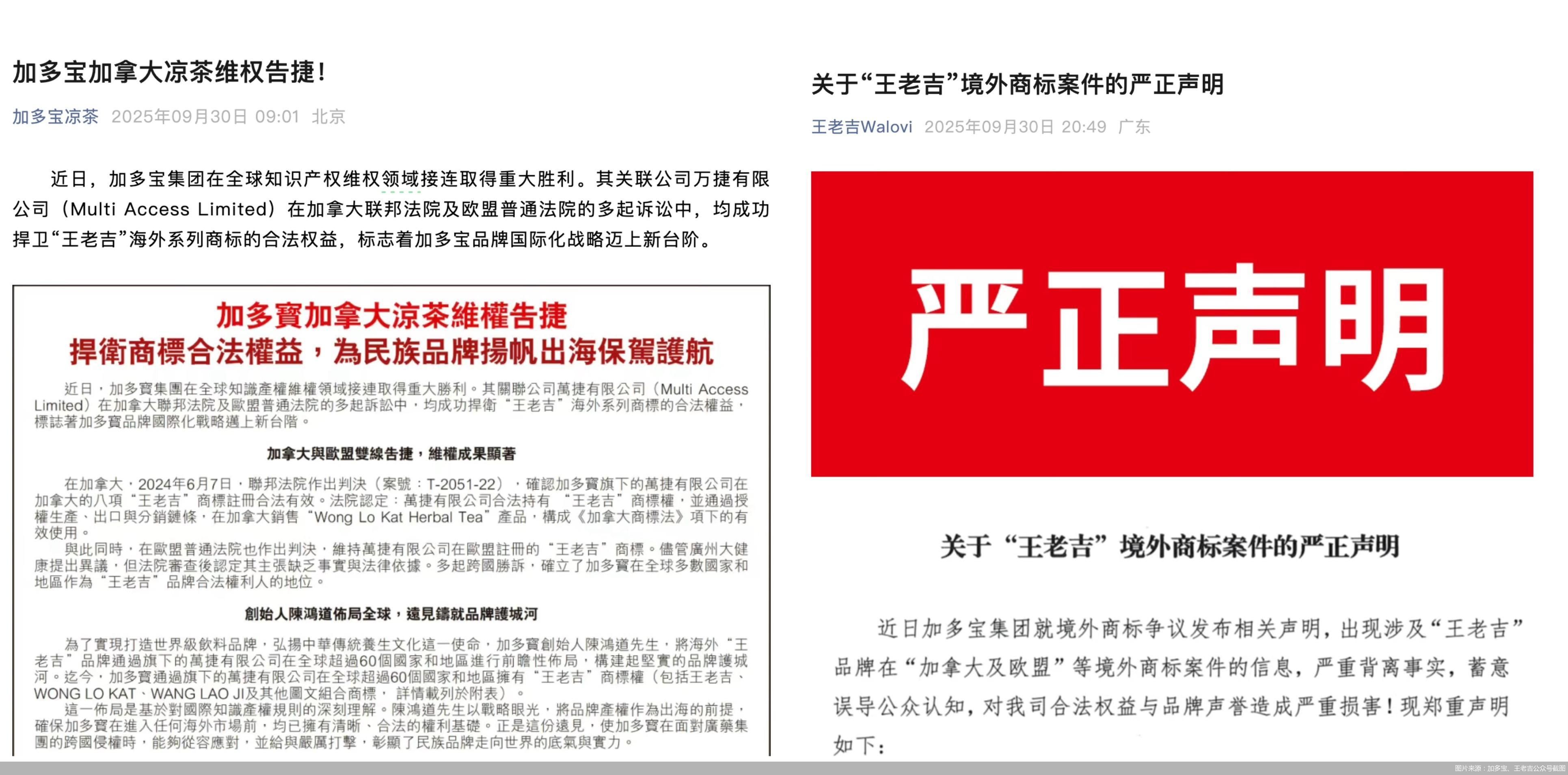
Core Viewpoint - The ongoing trademark dispute between Wanglaoji and Jia Duo Bao has intensified, particularly in international markets, as both companies assert their rights to the "Wanglaoji" brand amidst legal battles and public statements [1][5][9]. Trademark Dispute - Jia Duo Bao claims to hold valid "Wanglaoji" trademarks in 63 countries and regions, including North America, South America, Europe, Asia, Africa, and Oceania, and has successfully defended these trademarks in multiple lawsuits [5][7]. - Wanglaoji refutes Jia Duo Bao's claims, stating that their assertions of "infringement, counterfeiting, and unfair competition" are misinterpretations of trademark law, and emphasizes that the "Wanglaoji" trademark is owned by Guangzhou Baiyunshan Pharmaceutical Group [5][6]. Legal Proceedings - A recent ruling by the Guangdong High People's Court found Jia Duo Bao liable for infringement, ordering them to pay 317 million yuan in damages, which Jia Duo Bao plans to appeal [6][7]. - In Canada, a court confirmed the legality of Jia Duo Bao's trademark registrations, while Wanglaoji is actively challenging these registrations in various countries, with some successes reported [7][8]. Market Dynamics - The global plant-based beverage market is experiencing significant growth, with a compound annual growth rate of nearly 10% from 2019 to 2024, making it a key battleground for both brands [9]. - Wanglaoji holds a 46.33% market share in the plant beverage category in China, while Jia Duo Bao follows with 28.31% [10]. Financial Performance - Wanglaoji reported a revenue of 6.499 billion yuan and a net profit of 1.295 billion yuan in the first half of 2025, both showing double-digit growth [11].
娃哈哈董事会否认宗馥莉“被带走”传闻 宏盛元老严学峰下落成谜
Zhong Guo Jing Ying Bao· 2025-10-09 11:30
天眼查数据显示,严学峰在189家企业任职,在杭州娃哈哈集团、杭州娃哈哈非常可乐饮料等多家企业 担任核心成员或高管。 截至目前,宏盛集团以及娃哈哈集团未对严学峰的下落作出官方回应。 中经记者 孙吉正 北京报道 日前,娃哈哈集团董事会发布声明,否认了关于国庆期间港媒报道称"宗馥莉被带走"的传闻,称其属 于"假新闻"。 此前,有媒体报道称,国庆期间宏胜饮料集团生产中心总监严学峰因涉嫌违纪,被杭州市上城区纪律检 查委员会立案审查,立案通知书已经发送给娃哈哈集团党委。公开信息显示,作为宗馥莉控股的宏胜饮 料集团,严学峰多年来是宏胜饮料集团的核心人物之一。早在2007年,25岁的宗馥莉刚执掌宏胜饮料集 团时,严学峰就进入了宏盛集团管理层。 (编辑:孙吉正 审核:孙吉正 校对:颜京宁) ...
东鹏饮料冲刺港股:上半年营收107亿,林木勤之子林煜鹏套现20亿
3 6 Ke· 2025-10-09 11:16
Company Overview - Dongpeng Beverage Group Co., Ltd. has submitted its prospectus for an IPO on the Hong Kong Stock Exchange, with joint sponsors including Huatai International, Morgan Stanley, and UBS [1] - The company focuses on the functional beverage industry, with its flagship product "Dongpeng Special Drink" becoming a billion-yuan product in China [2][4] Financial Performance - For the fiscal year 2024, Dongpeng Beverage reported revenue of 15.83 billion RMB, a 40.62% increase from 11.26 billion RMB in the previous year [4] - The net profit for 2024 reached 3.36 billion RMB, up 63% from 2.04 billion RMB year-on-year, with a non-GAAP net profit of 3.26 billion RMB, reflecting a 74.48% increase [4][6] - In the first half of 2025, the company generated revenue of 10.74 billion RMB, a 36.37% increase from 7.87 billion RMB in the same period last year [6] Product Portfolio - Dongpeng Beverage's product range includes energy drinks, sports drinks, tea beverages, coffee drinks, plant protein drinks, and fruit and vegetable juices [2] Shareholding Structure - As of June 30, 2025, the major shareholders include Lin Muqin with 49.74%, Hong Kong Central Clearing Limited with 9.9%, and Lin Mugang and Lin Daiqi each holding 5.22% [10][12] - Lin Muqin's son, Lin Yupeng, has cashed out 2 billion RMB [7] Market Position - Dongpeng Beverage's marketing strategy mimics that of Red Bull, with the slogan "Tired, sleepy, drink Dongpeng Special Drink" [2]
宗馥莉被“带走”?知情人士回应→
第一财经· 2025-10-09 10:45
2025.10. 09 不久前的10月2日,据财新网报道,宗馥莉"心腹"严学峰被调查。报道称,娃哈哈集团的核心成员 严学峰因涉嫌违纪,被杭州市上城区纪律检查委员会立案审查,立案通知书已经发送给娃哈哈集团党 委。未经纪检委同意,娃哈哈集团不得批准严学峰出国、辞去公职,不得批准对其交流、晋升、奖 励、处分或者办理退休手续。严学峰现为宏胜饮料集团有限公司生产中心总监,是公司的核心高管之 一。工商信息显示,严学峰在与娃哈哈有关联的近190家公司中担任监事。 微信编辑 | 小羊 第 一 财 经 持 续 追 踪 财 经 热 点 。 若 您 掌 握 公 司 动 态 、 行 业 趋 势 、 金 融 事 件 等 有 价 值 的 线 索 , 欢 迎 提 供 。 专 用 邮 箱 : bianjibu@yicai.com (注:我们会对线索进行核实。您的隐私将严格保密。) 推荐阅读 300274突发!四高管提前终止减持 作者 | 第一财经 揭书宜 近日,继宗馥莉"心腹"严学峰被曝"被调查"的消息之后,杭州坊间传出宗馥莉被带走的消息。10月 9日,第一财经记者从一位接近娃哈哈的知情人士了解到,宗馥莉今日正常上班。 ...