Artificial Intelligence

Search documents
“春节档”AI又出王炸!智谱大涨26%,GLM Coding Plan涨价超30%,发布新一代旗舰模型GLM-5
Jin Rong Jie· 2026-02-12 03:27
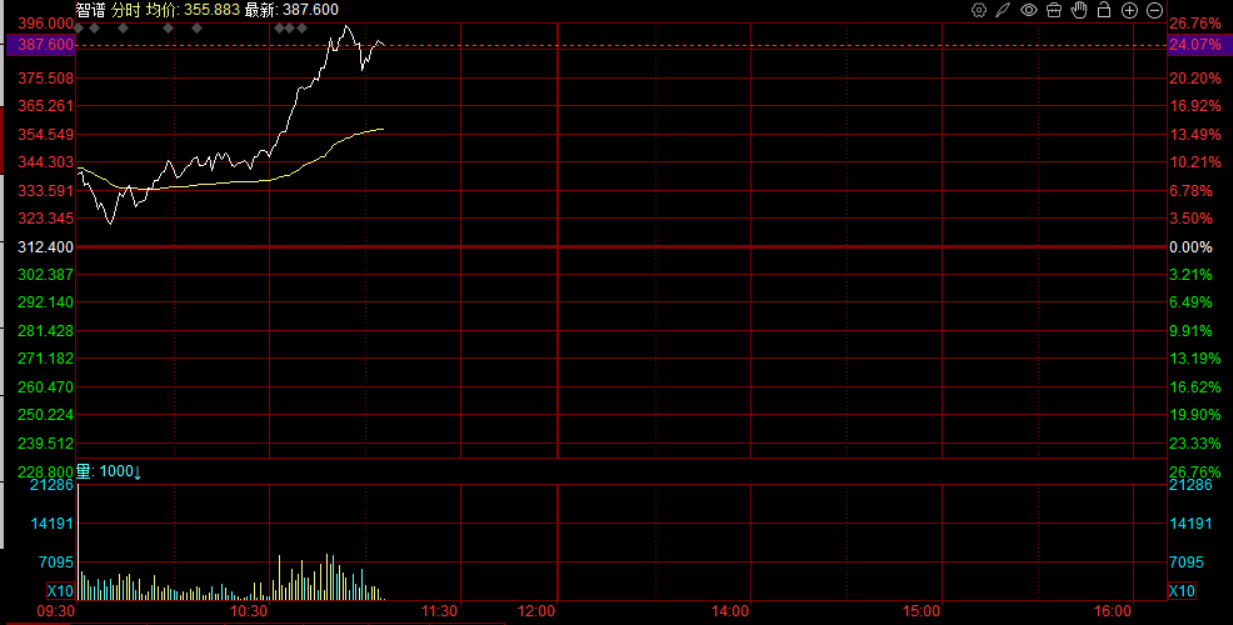
Group 1 - The core stock of large models, Zhiyu, saw a significant increase of over 26% in early trading, closing at 387.6 HKD, with a current rise of 24.07% [1] - Zhiyu announced a structural adjustment to the pricing system of its GLM Coding Plan, with an overall price increase of over 30% due to strong market demand and rapid growth in user scale and usage [1] - The price adjustment will take effect on February 12, 2026, and will include the cancellation of first-purchase discounts while retaining quarterly and annual subscription discounts [1] Group 2 - Zhiyu officially released its next-generation base model, GLM-5, which is considered the strongest open-source model in the era of intelligent engineering, marking a transition from "writing code snippets" to "completing system engineering" [6] - Other major tech companies, including ByteDance and Alibaba, are also advancing new model upgrades, with ByteDance recently launching the AI video generation model Seedance 2.0 and Alibaba planning to release its flagship AI model Qwen 3.5 [6] - The recent surge in model upgrades and the continuous launch of various AI applications are increasing the investment value of AI companies, attracting more attention from investors [6]

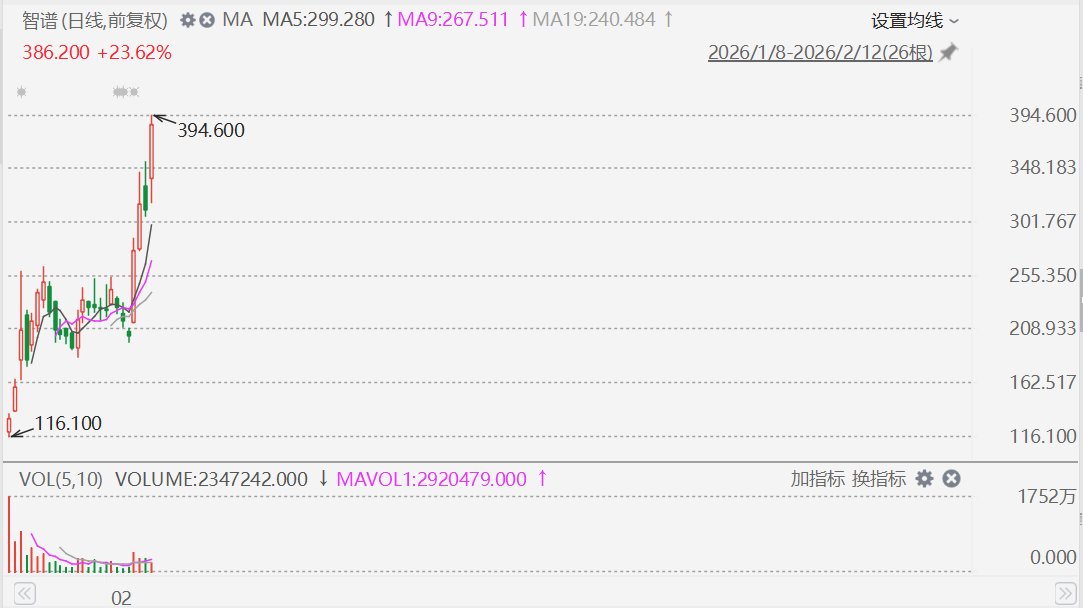
港股异动丨智谱飙升26%再创上市新高,市值突破1700亿港元
Ge Long Hui· 2026-02-12 03:14
另外,智谱于2月12日发布GLM Coding Plan价格调整函,因市场需求增长,用户规模与调用量提升,公司加大算力与模型优化投入,产品能力持续升级; 公司决定对套餐价格体系进行结构性调整,取消首购优惠,保留按季按年订阅优惠,套餐价格整体涨幅自30%起,已订阅用户价格保持不变。 | 智谱(日线,前复权) * 3 MA MA5:299.280 ↑ MA9:267.511 ↑ MA19:240.484 1 | | | | 设置均线~ | | | --- | --- | --- | --- | --- | --- | | | 386.200 +23.62% | | 2026/1/8-2026/2/12(26根) ★ | | | | | 400 章章 | | | | 394.600 | | | | 394.600 | | | | | | | | | | 348.183 | | | | | | | 301.767 | | | | | | | 255.350 | | | | | | | 208.933 | | | | | | | 162.517 | | | 116.100 | | | | 116.100 | | | | ...
早盘再度爆发,智谱股价4天大涨超77%
第一财经· 2026-02-12 03:09
| < W | 智谱(2513) | | | | | --- | --- | --- | --- | --- | | | 02-12 10:37:40 | | | | | | -82 361.000 额 5.68亿 股本 4.46亿 市盈" " | | | 万得 | | | | | | 20 | | | 48.600 15.56% 换 0.76% 市值 1609亿 市净" -24 | | | | | 分时 | 五日 日K 周K 月K | 中文 | | | | 叠加 | 均价:339.479 | | 图 成交 | | | 363-000- | ·· | | | | | | | | 卖9 363.600 -- (0) | | | | 菜8 363.400 | | | -- (0) | | | | | 卖7 363.200 -- (0) | | | | | | 卖6 363.000 600(6) | | | 312.400 | 0.00% | | 卖5 362.800 2200(3) | | | | | | 卖4 362.600 100(1) | | | | | | 卖3 362.400 1800(3) | | | ...

港股异动 | 智谱(02513)涨幅扩大逾26% 新一代旗舰模型GLM-5已与华为昇腾等多家主流国产芯片平台适配
智通财经网· 2026-02-12 03:08
值得一提的是,据智通财经报道,2月12日,智谱新发布的GLM-5已完成与华为昇腾、摩尔线程、寒武 纪、昆仑芯、沐曦、燧原、海光等主流国产芯片平台的深度推理适配与算子级优化,能够在国产算力集 群上实现高吞吐、低延迟的稳定运行。据报道,这背后的意义不止是一次工程适配,更关乎 AI算力供 应链的自主可控,叠加国产算力平台的可控供给,使得开源Agentic Engineering级生产力工具第一次具 备可大规模交付的现实条件。 智通财经APP获悉,智谱(02513)涨幅扩大逾26%,截至发稿,涨24.01%,报388港元,成交额9.25亿港 元。 消息面上,2月11日,智谱正式发布新一代旗舰模型GLM-5。在Coding与Agent能力上,GLM-5取得开源 SOTA表现,在真实编程场景的使用体感逼近Claude Opus4.5,擅长复杂系统工程与长程Agent任务。目 前,GLM-5模型已上线智谱开发平台BigModel.cn、Z.ai及智谱清言(App/网页端),可供用户体验。需要 注意的是,由于算力限制,当前仅Max用户套餐中包含GLM-5调用额度,官方表示将逐步扩大开放范 围。 ...
DeepSeek灰度测试新模型!科创人工智能ETF华夏(589010)高位盘整,优刻得涨停领涨
Mei Ri Jing Ji Xin Wen· 2026-02-12 03:05
Group 1 - The core viewpoint of the news highlights the performance of the Huaxia Sci-Tech Artificial Intelligence ETF (589010), which experienced a slight pullback after an initial surge, currently priced at 1.594 yuan, reflecting a 1.271% increase from the opening price [1] - Among the 30 constituent stocks tracked by the ETF, 19 stocks saw gains, with Yuke Technology leading with a 20% limit-up, while Sikan Technology experienced a decline of over 5% [1] - The trading volume of the ETF reached 52.52 million yuan, with a turnover rate of 1.98%, indicating stable liquidity and moderate trading activity [1] Group 2 - DeepSeek has launched a new model and initiated gray testing, enhancing its contextual capability from 128K Tokens to 1M Tokens, with the knowledge base updated to May 2025, improving context capacity, knowledge, capability, and user interaction [1] - Guolian Minsheng Securities notes that recent releases of new features or ecosystem integrations by various large models domestically and internationally are expected to lead a new wave of innovation in large models [1] - The transition to the Agent era is beginning to reshape the internet value chain, shifting focus from traditional traffic scale to business models that emphasize behavioral execution, capability invocation, governance control, and outcome-based payments [1][2]

当AI应用都在「撒钱」时,谁来扛住千亿交互背后的算力大考?
机器之心· 2026-02-12 03:00
机器之心发布 春节还未到,但各路 AI 应用的「战斗」号角已经吹响。 腾讯元宝先声夺人,豪掷 10 亿元现金红包;百度文心一言紧随其后,狂撒 5 亿元红包;字节跳动火山引擎则直接与春节流量大户春节联欢晚会「联名」;阿里 千问请客,诚邀广大网友喝奶茶,一度让服务器「崩溃」…… 但这还只是「前菜」,在大模型落地应用成为主流叙事的这一年,各大 AI 厂商或初创都在围绕谁将成为下一个「超级入口」狂奔。而在春节这一重要时间节 点,对于 AI 应用厂商来说,既是自我展示的好时机,也是接受网友检验的关键时刻,必须铆足了劲疯狂「秀肌肉」。 行业预测 数据显示 , 仅除夕当晚,主流 AI 应用的交互量可能突破千亿次,瞬时并发峰值或达 10 亿次 / 秒量级。 而每一次 AI 对话、每一帧图像生成、每一次实时交互,都在考验底层算力基础设施的弹性极限。 因此,对于大多数 AI 应用来说,「大考」之前需要思考一个重要命题: 当不确定性的流量高峰成为新常态,什么样的算力基础设施才能确保用户体验始终丝 滑? 有一家创业公司,在去年一场真实的「流量海啸」中,不仅稳稳接住了,还完成了一次漂亮的技术支撑。这个故事的主角,正是全球 3D 内容应 ...

智谱股价再创新高、市值超1700亿港元:GLM-5对齐Opus 4.5,七大国芯护航上线
IPO早知道· 2026-02-12 02:55
Core Viewpoint - The core viewpoint of the article emphasizes that model capability is the fundamental element determining long-term competitiveness in the AI industry [6][7]. Group 1: Company Performance and Model Launch - The company Zhiyu (2513.HK) saw its stock price rise over 25% upon the launch of its new model GLM-5, reaching a market capitalization of over 170 billion HKD [2]. - GLM-5 is recognized as the best open-source model in the "Agentic Engineering" era, showcasing significant advancements in coding and agent capabilities, achieving state-of-the-art (SOTA) performance in open-source benchmarks [2][10]. - During anonymous testing, GLM-5 gained attention from global developers, being rated as one of the "strongest anonymous models" [3]. Group 2: Technical Capabilities and Market Position - GLM-5 has achieved high scores in SWE-bench-Verified and Terminal Bench 2.0, with scores of 77.8 and 56.2 respectively, outperforming Gemini 3 Pro [2][10]. - The model's capabilities allow it to autonomously complete long-term planning and execution tasks with minimal human intervention, significantly surpassing its predecessor GLM-4.7 by over 20% on average [12]. - The model has been adapted for various domestic chip platforms, ensuring stable and efficient online services [5]. Group 3: Market Trends and Future Projections - According to a report by JPMorgan, the Chinese AI market is transitioning from a "hundred models battle" to a phase of structural integration, where survival depends on commercial viability and sustainable model iteration [7]. - JPMorgan forecasts a compound annual growth rate (CAGR) of 127% for Zhiyu's revenue from 2025 to 2030, with profitability expected by 2029, indicating significant growth potential [8]. - The strategic direction of Zhiyu, focusing on intelligent systems and developer infrastructure, aligns with global technological advancements, positioning the company favorably in the market [7].

一日9发,中国AI显露8个信号
Xin Lang Cai Jing· 2026-02-12 02:55
Core Insights - The rapid growth of AI in China is attributed to multiple factors including the AI China chain, AI China ring, industrial AI confidence, talent aggregation, capital increase, market application momentum, and policy encouragement [1][2][6] Group 1: AI Model Releases - On February 11, nine significant AI models and intelligent products were launched, including Deepseek's unnamed new model, Zhiyu Pony Alpha, Minimax Agent M2.5, iFLYTEK's Spark X2 model, and Ant Group's Ming Flash Omni 2.0 [1][6] - The release of models such as Wenxin 5.0, Qwen 3-Max-Thinking, and Kimi-2.5 indicates a speeding up of China's AI capabilities since the beginning of the year [2][7] Group 2: Competitive Landscape - The domestic technology competition structure is expected to be 2+4+3+N, while the user market structure will be (3+1)+6+N, favoring platforms with full-stack AI capabilities [3][8] - The emergence of takeover-type agents is anticipated to accelerate competition in the AI space, with products like OpenClaw setting new benchmarks [3][9] Group 3: Technological Advancements - Native multimodal and full-modal capabilities are becoming standard, with advancements in video generation expected to enhance usability [4][9] - The Kimi-2.5 Swarm model has achieved a significant token volume, indicating a shift towards multi-agent and swarm intelligence [5][9] Group 4: Code and Infrastructure - Code is becoming a critical area of focus, with companies like Qwen, DS, and ByteDance increasing their capabilities in code and ecosystem development [6][10] - The year is projected to be pivotal for humanoid robots, with advancements in intelligent migration and autonomous learning expected to develop the "brain" of robots by 2026 [7][10] Group 5: Resource Challenges - A potential shortage of computing power is anticipated due to the rapid acceleration of applications and the influx of millions of new users [8][10] - The demand for computing resources is expected to outpace supply, even with increased domestic capacity, leading to challenges in meeting the needs of various AI applications [10]
豆包大模型2.0将发布
财联社· 2026-02-12 02:50
Core Insights - ByteDance's Volcano Engine is set to release significant upgrades to its Doubao model on February 14, 2026, including Doubao Model 2.0, Seedance 2.0 for audio-video creation, and Seedream 5.0 Preview for image creation [1] Group 1: Doubao Model Upgrades - Doubao Model 2.0 will feature substantial enhancements in foundational model capabilities and enterprise-level agent functionalities [1] Group 2: Seedance Model Enhancements - The Seedance video generation model will achieve high usability for complex interactions and motion generation, rated at industry-best levels [1] - It will support comprehensive multimodal capabilities, accommodating audio, visual, and textual inputs [1] - The model will exhibit strong controllability with good instruction adherence and is tailored for film, advertising, and marketing scenarios, aligning output quality with industrial delivery standards [1] Group 3: Seedream Model Improvements - The Seedream image creation model will introduce real-time retrieval capabilities, allowing access to the latest knowledge and information for timely creative responses [1] - It will enhance world knowledge and multilingual capabilities, incorporating rich knowledge from science and humanities [1] - The model's understanding and generation performance will improve, enabling it to comprehend user intent through brief and vague text and image inputs, with advancements in subject consistency and text-image alignment [1]

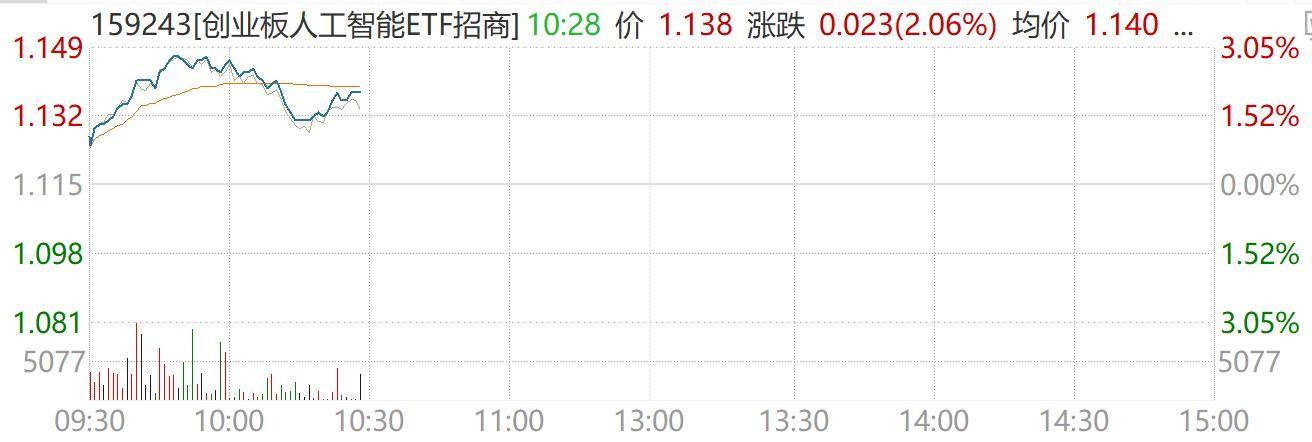
突发!百万Token上下文+Agent新模型深夜连发,创业板人工智能ETF(159243)放量涨超2%!
Sou Hu Cai Jing· 2026-02-12 02:46
Group 1 - The domestic large model field has seen significant updates, igniting market expectations for a new round of innovation in the AI industry chain [2] - DeepSeek has launched an update that supports a maximum context length of 1 million tokens, enabling the model to process long texts such as entire novels and complex documents, facilitating AI applications in high-value scenarios like financial analysis and legal review [3] - Zhiyu AI has released its flagship model GLM-5, achieving state-of-the-art capabilities in coding and agent functions, bringing its performance close to international leaders, indicating that domestic models are now competitive in execution capabilities [4] Group 2 - The release of new models is part of a concentrated launch window, with several companies including DeepSeek, Kimi, Alibaba, and Baidu unveiling new models, reflecting a shift in the internet value chain towards execution capabilities and new business models [5] - The increasing demand for computing power is supported by significant capital expenditures planned by major companies, with ByteDance planning 160 billion yuan for 2026 and Alibaba investing 380 billion yuan in AI infrastructure over three years [5] - The AI ETF tracking the entrepreneurial board AI index covers the entire AI industry chain, including hardware, software, and applications, with major holdings benefiting from the expansion of cloud vendor capital expenditures [6]