家居零售

Search documents
宜家宣布将关闭7家线下门店,涉及江苏2家
Yang Zi Wan Bao Wang· 2026-01-07 12:37
Core Viewpoint - IKEA China announced the closure of seven offline stores starting February 2, 2026, as part of its strategic adjustment in response to global economic uncertainties and changing consumer behaviors [1][2][5]. Group 1: Store Closures - The affected stores include locations in Shanghai Baoshan, Guangzhou Panyu, Tianjin Zhongbei, Nantong, Xuzhou, Ningbo, and Harbin [1][5]. - The Xuzhou store, which opened on October 26, 2018, was a popular destination for local consumers, featuring over 500 furniture displays and various services [1][2]. Group 2: Reasons for Closure - IKEA China cited unprecedented transformations in the retail industry due to global economic uncertainty and digitalization as key reasons for the store closures [2][4]. - The company is focusing on optimizing its business portfolio and channel layout to better meet customer needs [2][4]. Group 3: Future Strategy - Post-closure, consumers in the affected areas can still access IKEA products through various online platforms, including the IKEA website, app, and major e-commerce sites [2][5]. - IKEA plans to shift from large-scale expansion to targeted growth, with a focus on Beijing and Shenzhen, aiming to open over ten small stores in the next two years [2][5]. - The company emphasizes a commitment to sustainable growth and enhancing customer experience through localized branding and affordable home solutions [4][5].

宜家中国宣布关闭7家商场,受影响员工将获安置费
Guo Ji Jin Rong Bao· 2026-01-07 12:23
Core Viewpoint - IKEA China is undergoing a transformation focused on optimizing costs, improving efficiency, and reallocating resources, which includes the closure of seven physical stores starting February 2, 2026 [1][3]. Group 1: Store Closures - IKEA China will close seven stores, including locations in Shanghai, Guangzhou, Tianjin, Nantong, Xuzhou, Ningbo, and Harbin, as part of its strategic adjustment [1][3]. - After the closures, IKEA will still operate 34 stores in China, along with three digital channels and two flagship e-commerce stores [3]. Group 2: Customer Access - Customers in affected cities can continue to access IKEA products and services through other nearby stores, the IKEA website, the IKEA app, and major e-commerce platforms like Tmall and JD [3]. Group 3: Employee Support - IKEA China has committed to providing necessary support for affected employees, ensuring open communication and a fair, transparent process for comprehensive relocation assistance [3]. Group 4: Future Plans - IKEA China plans to enhance its multi-channel strategy by developing smaller stores closer to communities, with a focus on Beijing and Shenzhen, aiming to open over ten small stores in the next two years [4]. - Upcoming store openings include the Dongguan store in February 2026 and the Tongzhou store in Beijing in April 2026 [4]. - IKEA is also deepening its partnership with JD to pilot instant retail services in seven cities across China [4]. Group 5: Global Context - The store closures in China are part of a broader trend, as IKEA Japan announced the closure of two stores in Tokyo by early 2026, while maintaining the Shibuya store as a key location [6]. - IKEA has a strategic plan to invest over €5 billion by the fiscal year 2027 to open new stores and optimize existing ones across various markets [6]. - The company recently opened its first store in Auckland, New Zealand, as part of its global expansion strategy [6].

一次性关掉7家商场,宜家也开始“断舍离”了?
Guan Cha Zhe Wang· 2026-01-07 11:52
Core Viewpoint - IKEA China is undergoing a significant transformation by closing seven stores in a strategic move to optimize costs and improve efficiency, rather than due to poor performance of the stores [1][3]. Group 1: Store Closures - IKEA China announced the closure of seven stores, including locations in Shanghai, Guangzhou, Tianjin, Nantong, Xuzhou, Ningbo, and Harbin, effective February 2, 2026 [1]. - This marks a notable shift from previous years where store closures were limited, with only one store closed in March, July 2022, and July 2023 [1][2]. - The closures are part of a broader strategy to reassess the store layout in saturated markets, ensuring that consumers can still access services through other nearby stores and online channels [1]. Group 2: Strategic Shift - The closures reflect a strategic pivot from individual store adjustments to a more concentrated approach, driven by global economic uncertainties and changing consumer behaviors [3]. - IKEA plans to open over ten small-format stores in key markets like Beijing and Shenzhen within the next two years, starting with new locations in Dongguan and Tongzhou [3]. - The company is also enhancing its collaboration with JD.com to launch instant retail services in seven cities, aiming to meet consumer demand for more convenient delivery options [3]. Group 3: Cost Optimization - Closing underperforming stores is seen as a necessary step to optimize asset structure and reduce operational leverage, especially in the context of rising commercial real estate costs and changing foot traffic patterns [4][5]. - By eliminating "negative asset" stores, IKEA can redirect resources to higher-return core businesses [5]. - The focus on integrating online and offline channels is central to this transformation, as the company aims to adapt to the increasing reliance of Chinese consumers on online shopping [5].

中国最北端宜家即将闭店,东三省仅剩辽宁有宜家可逛,哈尔滨和长春网友表示不舍
Sou Hu Cai Jing· 2026-01-07 11:29
Core Insights - IKEA China announced the closure of seven offline locations, including the Shanghai Baoshan store and the Harbin store, effective February 2, 2026, following a comprehensive review of existing customer touchpoints [1][3][5] Group 1: Store Closures - The seven stores set to close include locations in Shanghai, Guangzhou, Tianjin, Nantong, Xuzhou, Ningbo, and Harbin, with Harbin being the northernmost IKEA store in mainland China [1][3][5] - After the closures, consumers in Northeast China will have to travel to Shenyang or Dalian for the nearest IKEA experience, as there are no other stores in Jilin province [5][7] Group 2: Future Strategy - IKEA China plans to shift from large-scale expansion to a more focused approach, emphasizing markets like Beijing and Shenzhen, with plans to open over ten smaller stores in the next two years [7] - Upcoming store openings include the Dongguan store in February 2026 and the Beijing Tongzhou store in April 2026, alongside continued investment in existing stores and enhanced online shopping options [7]
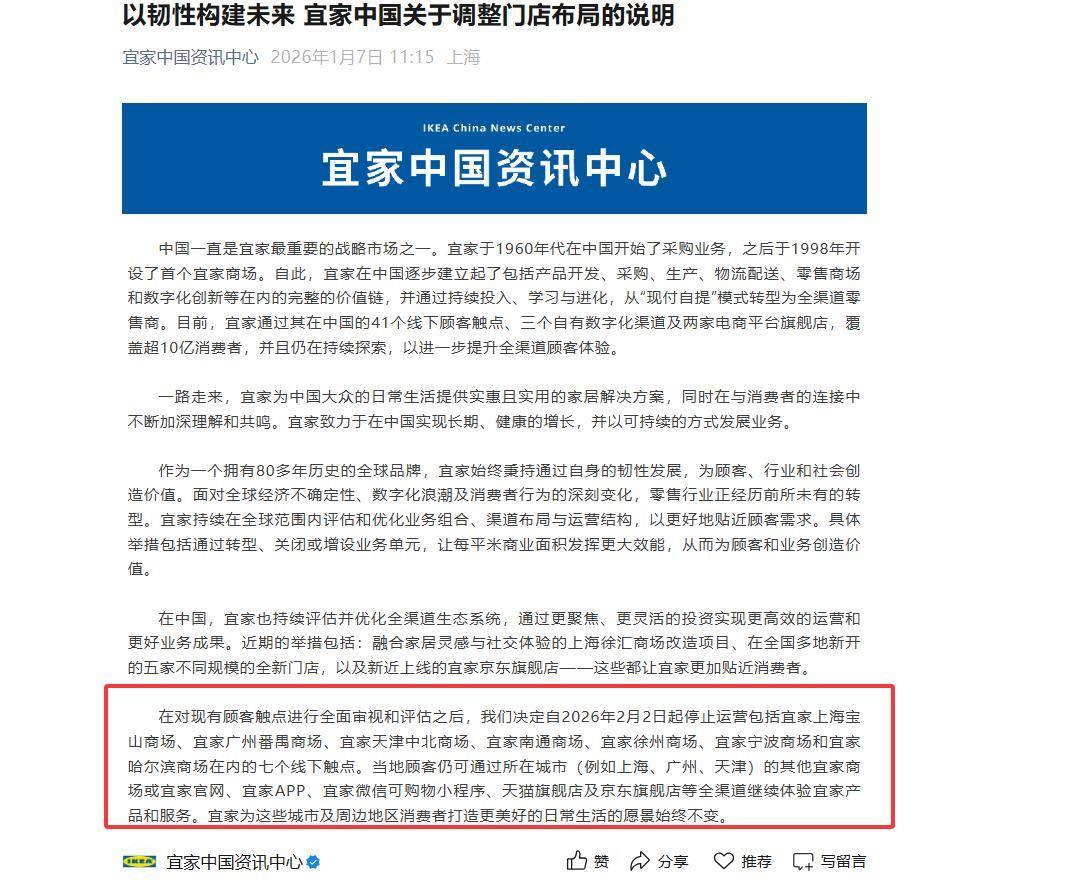
宜家中国战略大调整:关闭7家商场 转向“精准深耕”小型店与线上渠道
Xi Niu Cai Jing· 2026-01-07 11:25
Group 1 - The core point of the article is that IKEA China will officially close seven stores in various cities starting February 2, 2026, as part of a strategic shift in its operations [2][4] Group 2 - The closures will affect stores in Shanghai, Guangzhou, Tianjin, Nantong, Xuzhou, Ningbo, and Harbin, which are located in key regional markets across East, South, North, and Northeast China [4] - The closed stores are primarily newer establishments or those with poor market performance, indicating a reevaluation of store locations [4] - IKEA's traditional "suburban large store + self-driving shopping" model is facing challenges due to changing shopping habits among younger consumers [4] - Data shows that by 2024, the penetration rate of e-commerce in the home furnishing and building materials sector in China has exceeded 25%, with over 35% in first-tier cities [4] - Although IKEA China has established an online store, its online sales account for a lower proportion of total revenue compared to industry averages [4] Group 3 - IKEA China plans to focus on "precision cultivation" by opening smaller stores in first-tier cities like Beijing, Shanghai, and Shenzhen while enhancing online channel development [4] - This marks a fundamental shift in IKEA's strategy in China, moving from a broad market coverage model relying on large stores to a more precise city-based operational approach [4] Group 4 - The small store model presents new challenges to IKEA China's cost structure, as traditional large stores, despite high rents, integrate display, warehousing, and sales, simplifying the supply chain [4] - Smaller stores will require separating the warehousing and distribution centers from the urban delivery network, posing significant logistical challenges for IKEA in China [4]

宜家一口气关闭7家门店,不是一场意外
3 6 Ke· 2026-01-07 10:58
Core Viewpoint - IKEA China has officially announced the closure of seven stores, indicating a strategic shift in its operations within the Chinese market [1][2][15]. Group 1: Store Closures - IKEA China will close seven stores, including locations in Shanghai, Guangzhou, Tianjin, Nantong, Xuzhou, Ningbo, and Harbin, effective February 2, 2026 [1][2]. - This decision follows a comprehensive review of existing customer touchpoints and is part of a broader strategy to optimize its retail footprint in China [4][15]. - The closures are attributed to underperformance in profitability at these locations, reflecting the high operational costs associated with running IKEA stores [4][12]. Group 2: Market Context - The announcement has sparked significant media attention and public discussion, particularly among local communities affected by the closures [2][15]. - IKEA has faced increasing operational pressures in China, leading to a shift towards a low-price strategy, with over 550 low-priced products launched in the 2024 fiscal year [12][18]. - The changing economic landscape, particularly in the real estate sector, has impacted consumer behavior and preferences, contributing to IKEA's challenges in maintaining its market position [12][24]. Group 3: Future Strategy - Despite the closures, IKEA remains committed to the Chinese market, planning to invest 160 million RMB in 2026 to introduce over 150 new low-priced products [12][22]. - The company is exploring new formats, including smaller stores, to adapt to evolving consumer shopping behaviors and preferences [24][25]. - There is a recognition that while IKEA still holds significant brand influence, it must navigate a competitive landscape with emerging alternatives and changing consumer expectations [13][22].

重新配置资源 宜家于2月2日起关闭七家门店
Bei Jing Shang Bao· 2026-01-07 10:57
Core Insights - IKEA China will cease operations of seven stores, including locations in Shanghai, Guangzhou, Tianjin, Nantong, Xuzhou, Ningbo, and Harbin, starting February 2, 2026, as part of a strategic transformation to optimize costs and enhance efficiency [1][2] - The decision is not due to the inability to operate these stores but is a proactive measure to reallocate resources and adapt to the rapidly changing retail environment [1] - After the closure, IKEA will still maintain 34 physical customer touchpoints, three proprietary digital channels, and two flagship stores on e-commerce platforms, reaching over 1 billion consumers in China [1] Future Plans - IKEA aims to develop a more diverse and flexible omnichannel strategy by opening smaller stores closer to communities and enhancing online presence [2] - The company plans to open over ten small stores in key markets like Beijing and Shenzhen within the next two years, including the Dongguan store in February 2026 and the Tongzhou store in April 2026 [2] - IKEA is also deepening its partnership with JD.com to launch instant retail services in seven cities, addressing consumer demand for more convenient delivery options [2]
宜家广州番禺店,今明暂停营业
Nan Fang Du Shi Bao· 2026-01-07 10:07
今天(1月7日),宜家宣布将于2月初关闭中国7家线下门店,包括上海宝山、广州番禺等门店,引发热 议。7日上午,宜家官方回应南都·湾财社记者称,此次调整并非相关门店无法继续经营,而是从优化成 本和提高效率等"做出的主动转型"。 对于此次关闭的7家门店的众多员工,是否会给予补偿?宜家官方回应南都·湾财社记者称,会有员工补 偿,"将通过开放沟通和公平透明的流程,为每一位受影响的同事提供全面的安置支持。" 聚焦: 宜家关闭上海宝山、广州番禺等7家门店 《宜家中国关于调整门店布局的说明》提到,在对现有顾客触点进行全面审视和评估之后,决定自2026 年2月2日起停止运营包括宜家上海宝山商场、宜家广州番禺商场、宜家天津中北商场、宜家南通商场、 宜家徐州商场、宜家宁波商场和宜家哈尔滨商场在内的七个线下触点,"已确保同城或周边消费者可通 过其他门店及线上渠道继续获得服务。" 针对网络热议,1月7日,宜家官方回应南都·湾财社记者称,此次调整并非意味相关门店 "无法继续经 营",而是从优化成本、提升效率、重新配置资源所做出的主动转型。负责人坦称,面对快速变化的零 售环境,正持续评估并优化业务组合、渠道布局与运营结构。"此次7个线下 ...
红星美凯龙(01528):截至2025年12月31日公司经营74家自营商场
Xin Lang Cai Jing· 2026-01-07 09:57
Core Viewpoint - Red Star Macalline Group Corporation Limited is expanding its operational footprint with a total of 74 self-operated malls and 218 managed malls by December 31, 2025, alongside strategic partnerships and franchise operations [1] Group 1 - The company operates 74 self-operated malls [1] - The company manages 218 malls with varying levels of management depth [1] - The company has formed strategic partnerships to operate 7 home furnishing malls [1] Group 2 - The company has authorized 19 franchise home furnishing and building materials projects [1] - The total includes 345 home furnishing and building materials stores/industrial streets [1]

宜家宣布关闭7家门店,抢购要趁早!
Sou Hu Cai Jing· 2026-01-07 09:57
宜家宣布关 闭7家门店 今日(2026年1月7日),宜家中国抛出一则重磅消息:将于2月2日正式关闭上海宝山、广州番禺、天津 中北、南通、徐州、宁波和哈尔滨7家商场。此消息一出,迅速在多地引发消费者对清仓折扣、服务延 续以及闭店原因的集中讨论。 从闭店清单来看,此次涉及的7家线下商场分布广泛。其中,宁波店作为浙江省首家宜家商场,自2013 年开业以来,承载着不少本地市民的回忆,此次关闭引发了本地市民的怀旧情绪。不过,社交平台数据 显示,该店近年来客流持续低迷,经营状况或许早已不容乐观。 在停业节点方面,所有7家商场都将于2026年2月2日终止运营。值得一提的是,宁波、南通等部分商场 已于1月7日 - 8日暂停营业,原本计划9日恢复营业直至闭店日,但记者多次致电宁波店客服却未获回 应,这无疑给消费者增添了几分疑虑。 宜家作为全球知名的家居品牌,在中国市场一直拥有较高的知名度和庞大的消费群体。此次突然宣布关 闭7家门店,背后原因值得深思。是受市场环境变化、电商冲击,还是自身经营策略调整等因素影响? 目前尚无明确答案。而对于消费者来说,除了关心闭店原因,更在意的是闭店前能否享受到清仓折扣, 以及后续的服务能否得到保障 ...