基金管理

Search documents
泛亚微透股价跌5.03%,汇添富基金旗下1只基金重仓,持有120.96万股浮亏损失504.4万元
Xin Lang Cai Jing· 2025-10-14 06:17
Core Viewpoint - Pan-Asia Micro-Porous Technology Co., Ltd. experienced a 5.03% decline in stock price, trading at 78.67 CNY per share, with a market capitalization of 7.159 billion CNY as of October 14 [1] Company Overview - Pan-Asia Micro-Porous Technology, established on November 8, 1995, is located in Changzhou, Jiangsu Province, China. The company specializes in the research, production, and sales of expanded polytetrafluoroethylene (ePTFE) membranes and other micro-porous materials [1] - The revenue composition of the company includes: ePTFE micro-porous products (35.76%), CMD (14.94%), seals (13.74%), aerogels (11.07%), gas management products (9.18%), sound insulation products (6.63%), water-blocking membranes (5.01%), wiring harnesses (2.98%), and others (0.69%) [1] Shareholder Information - The top circulating shareholder of Pan-Asia Micro-Porous is a fund under Huatai-PineBridge, specifically the Huatai-PineBridge Growth Focus Mixed Fund (519068), which entered the top ten circulating shareholders in the second quarter with 1.2096 million shares, representing 1.33% of circulating shares [2] - The fund has a total asset size of 2.851 billion CNY and has achieved a year-to-date return of 20.37%, ranking 4429 out of 8162 in its category [2] Fund Performance - The fund manager of Huatai-PineBridge Growth Focus Mixed Fund is Chen Xiaoyang, who has been in the position for 3 years and 289 days. The fund's best return during this period was -31.44% [3] - The fund holds 1.2096 million shares of Pan-Asia Micro-Porous, accounting for 2.3% of the fund's net value, making it the fifth-largest holding [4]

福昕软件股价跌5.03%,富国基金旗下1只基金位居十大流通股东,持有202.78万股浮亏损失807.06万元
Xin Lang Cai Jing· 2025-10-14 03:26
Core Insights - Fujian Foxit Software Co., Ltd. experienced a 5.03% decline in stock price, trading at 75.15 CNY per share with a total market capitalization of 6.872 billion CNY as of October 14 [1] Company Overview - Fujian Foxit Software, established on September 29, 2001, and listed on September 8, 2020, specializes in the development, application, sales, and services of core PDF electronic document technologies [1] - The company's revenue composition includes: 88.17% from general document products and services, 10.63% from intelligent document processing platforms and applications, 1.08% from digital government products and services, and 0.11% from other supplementary services [1] Shareholder Information - The top circulating shareholder is a fund under the Fortune Fund, specifically the Fortune Emerging Industries Stock A/B (001048), which entered the top ten shareholders in the second quarter, holding 2.22% of circulating shares [2] - The fund has a current scale of 3.137 billion CNY and has achieved a year-to-date return of 63.53% [2] Fund Management - The fund manager for Fortune Emerging Industries Stock A/B is Sun Quan, who has been in the position for 3 years and 230 days, with a total fund asset size of 7.75 billion CNY [3] - During his tenure, the best fund return was 104.83%, while the worst was 35.18% [3]

广发中证卫星产业ETF成立 规模11.7亿元
Zhong Guo Jing Ji Wang· 2025-10-14 03:08
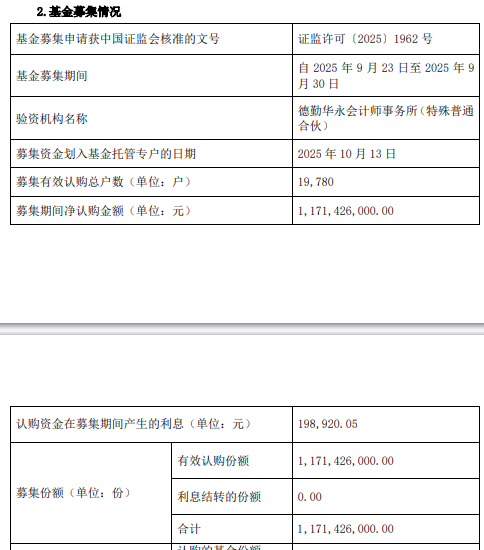
Core Viewpoint - The announcement from GF Fund regarding the establishment of the GF CSI Satellite Industry ETF indicates a successful fundraising period with a total net subscription amount of approximately 1.17 billion yuan, reflecting strong investor interest in the satellite industry [1][3]. Fundraising Details - The fundraising period for the GF CSI Satellite Industry ETF was from September 23, 2025, to September 30, 2025 [3]. - The total net subscription amount during the fundraising period was 1,171,426,000.00 yuan [3][5]. - The interest generated from the subscription funds during the fundraising period amounted to 198,920.05 yuan [1][5]. - The total number of effective subscription accounts reached 19,780 [3]. Fund Management - The fund manager, Lv Xin, has extensive experience managing various ETFs, including those focused on high dividend strategies and cloud computing [2]. - Lv Xin's management roles will commence on different dates in 2025, indicating a structured approach to fund management [2].

长城基金杨光:挑战传统资产配置方法的新思路
Sou Hu Cai Jing· 2025-10-14 01:16
Core Insights - The article discusses the evolution of asset pricing theories and the need for a new approach to asset allocation that goes beyond traditional models, emphasizing the importance of risk-adjusted returns and dynamic risk management [2][10][25] Group 1: Traditional Asset Pricing Theories - Traditional asset pricing theories, such as the Capital Asset Pricing Model (CAPM), are based on strict assumptions like market efficiency and rational investors, which fail to explain market anomalies like momentum and value effects [2][4] - The limitations of these traditional theories were highlighted during financial crises, revealing their inadequacies in tail risk management [2][4] Group 2: New Asset Allocation Approach - The new approach focuses on systematically and proactively enhancing the risk-adjusted returns of investment portfolios rather than merely seeking absolute returns [2][4] - This shift represents a comprehensive innovation in philosophy and methodology, aiming for long-term and stable risk-return profiles within clearly defined risk budgets [2][4] Group 3: Dynamic Correlation and Risk Management - The article emphasizes that asset correlations are dynamic and can change with market conditions, making fixed historical correlation-based frameworks risky during crises [7][10] - Understanding the underlying logic of correlation changes is crucial, as traditional low-correlation "free lunch" strategies may diminish in effectiveness during market turmoil [10][12] Group 4: Investment Framework and Strategies - The investment framework proposed by the company is a three-dimensional model that incorporates technological advancements, new productivity measures, and narrative-driven investing [13][20] - The investment process is modularized into pre-investment, during-investment, and post-investment phases, each with specific goals and quantifiable standards to ensure systematic and disciplined operations [14][15] Group 5: Multi-Asset Investment Strategy - The newly launched multi-asset fund aims to provide a robust alternative to traditional fixed-income products by incorporating low-correlation assets like A-shares, U.S. stocks, gold, and bonds [16][18] - Statistical analysis shows that the probability of all four asset classes declining simultaneously is only 1.61%, indicating the effectiveness of low-correlation diversification [16] Group 6: Future of Asset Pricing - The future of asset pricing is seen as a transition from historical data reliance to a focus on understanding technological trends, industry changes, and collective human behavior [25] - The article concludes that continuous questioning and reflection on traditional beliefs are essential for adapting to new paradigms in asset pricing and investment strategies [25]

长城基金杨光:挑战传统资产配置方法的新思路
点拾投资· 2025-10-14 00:46
Core Viewpoint - The article emphasizes the need for a paradigm shift in asset pricing and investment management, moving from traditional models to a more dynamic and adaptive approach that considers the non-linear relationships between assets and their roles within a portfolio [4][11][18]. Group 1: Asset Pricing Theory - Traditional asset pricing theories, such as the Capital Asset Pricing Model (CAPM), are based on strict assumptions of market efficiency and rational investors, which fail to explain market anomalies like momentum and value effects [4][12]. - The article argues that asset prices are influenced not only by their expected returns and risks but also by their roles in the overall investment portfolio and the dynamic relationships with other assets [4][11]. Group 2: Investment Strategy - The new investment philosophy focuses on systematically and proactively enhancing the risk-adjusted returns of investment portfolios rather than merely seeking absolute returns [4][11]. - The investment framework proposed is not about finding the "true value" of assets but about creating an adaptive system that can achieve stable growth across different market environments [7][16]. Group 3: Multi-Asset Allocation - The article discusses the importance of low correlation among assets in a multi-asset allocation strategy, which can significantly reduce the probability of negative monthly returns [22][23]. - A two-stage strategy combining CPPI (Constant Proportion Portfolio Insurance) and risk budgeting is suggested to enhance traditional methodologies and improve risk-adjusted returns [17][23]. Group 4: Market Dynamics - The article highlights that the correlation between assets is dynamic and can change with market conditions, which poses risks to traditional asset allocation frameworks that rely on historical data [12][15]. - The concept of "free lunch" in asset allocation, derived from low correlation, may diminish as market environments evolve, necessitating a deeper understanding of the underlying factors driving asset correlations [15][18]. Group 5: Future of Asset Pricing - The future of asset pricing is seen as a transition from a focus on historical data to an understanding of technological trends, industry changes, and collective human behavior [34]. - The new asset pricing framework is described as a three-dimensional investment model centered around technological advancement, new productive forces, and consensus-driven narratives [18][28].

前三季98%混基正收益 永赢科技智选混合发起涨193%
Zhong Guo Jing Ji Wang· 2025-10-13 23:15
Core Insights - In the first three quarters of this year, 98.2% of the 8,172 comparable mixed funds experienced an increase in net value, with only 142 funds showing a decline [1] - The top-performing mixed funds, primarily focused on technology investments, saw returns exceeding 130%, with Yongying Technology Smart Mixed Fund A and C leading at 194.49% and 193.09% respectively [1] - The mixed funds with significant returns are primarily investing in sectors such as cloud computing and AI, indicating a strong market trend towards technology-driven investments [1][3] Fund Performance - Yongying Technology Smart Mixed Fund A and C achieved year-to-date returns of 187.86% and 186.44%, respectively, since their establishment on October 30, 2024, with cumulative net values of 3.2643 and 3.2451 [1][2] - The fund's top ten holdings include companies like Xinyi Technology, Zhongji Xuchuang, and Tianfu Communication, reflecting a focus on the global cloud computing industry [1] - Another notable fund, the China Europe Digital Economy Mixed Fund A and C, reported returns of 140.86% and 139.79%, with a focus on six core AI sectors [3] Underperforming Funds - The fund with the largest decline was the GF Value Advantage Mixed Fund, which recorded a return of -15.37% for the year, with a cumulative net value of 1.2180 [4] - This fund is managed by Jin Wangmingxu, who has extensive experience in investment management [4] Fund Management - The current manager of Yongying Technology Smart Mixed Fund is Ren Jie, who has been with Yongying Fund Management since 2018 and has a background in TMT research [2] - The China Europe Digital Economy Mixed Fund is managed by Feng Ludan, who has been with the company since 2016 and has held various roles in research and investment [3]

【头条评论】 诺贝尔奖金:遗产界的理财产品天花板
Zheng Quan Shi Bao· 2025-10-13 21:36
Core Insights - The Nobel Prize fund, established from Alfred Nobel's estate, has evolved into a financial success story, managing to grow its assets significantly over time despite initial challenges [1][2][3] Fund Management Strategy - The Nobel Foundation initially adopted a conservative investment strategy focused on low-risk assets like government bonds and real estate, which led to a significant reduction in fund size due to inflation and market volatility [2] - A strategic shift occurred in 1953, where the fund management team recognized the need for higher returns and diversified investments into stocks, private equity, and international assets, resulting in over 50% of the fund's holdings being in equities today [2][3] Performance and Growth - The fund has demonstrated resilience during economic crises, effectively hedging against risks through early investments in gold and commodities, which protected its value during World War II and recent inflationary pressures [3] - The Nobel Prize amount has increased significantly, with the 2024 award reaching $1.15 million, a 72-fold increase since the first award in 1901, showcasing the fund's ability to grow its assets over time [3][4] Financial Discipline - The Nobel Foundation enforces a strict rule that annual expenditures cannot exceed 4.5% of the fund's growth, ensuring that the majority of profits are reinvested to sustain the fund's longevity [4] - This disciplined approach contrasts with many wealthy estates that deplete their resources quickly, highlighting the importance of prudent financial management in wealth preservation [4] Legacy and Impact - The Nobel Prize fund has not only rewarded significant contributions to humanity but has also become a testament to effective wealth management, demonstrating the power of compound interest and long-term investment strategies [5] - The fund's success raises awareness of the wealth gap, illustrating how effective estate management can lead to sustained financial growth, while many individuals struggle with financial stability [4][5]
A500ETF易方达(159361)今日净申购超3亿份,机构认为A股市场仍将“以我为主”
Mei Ri Jing Ji Xin Wen· 2025-10-13 14:01
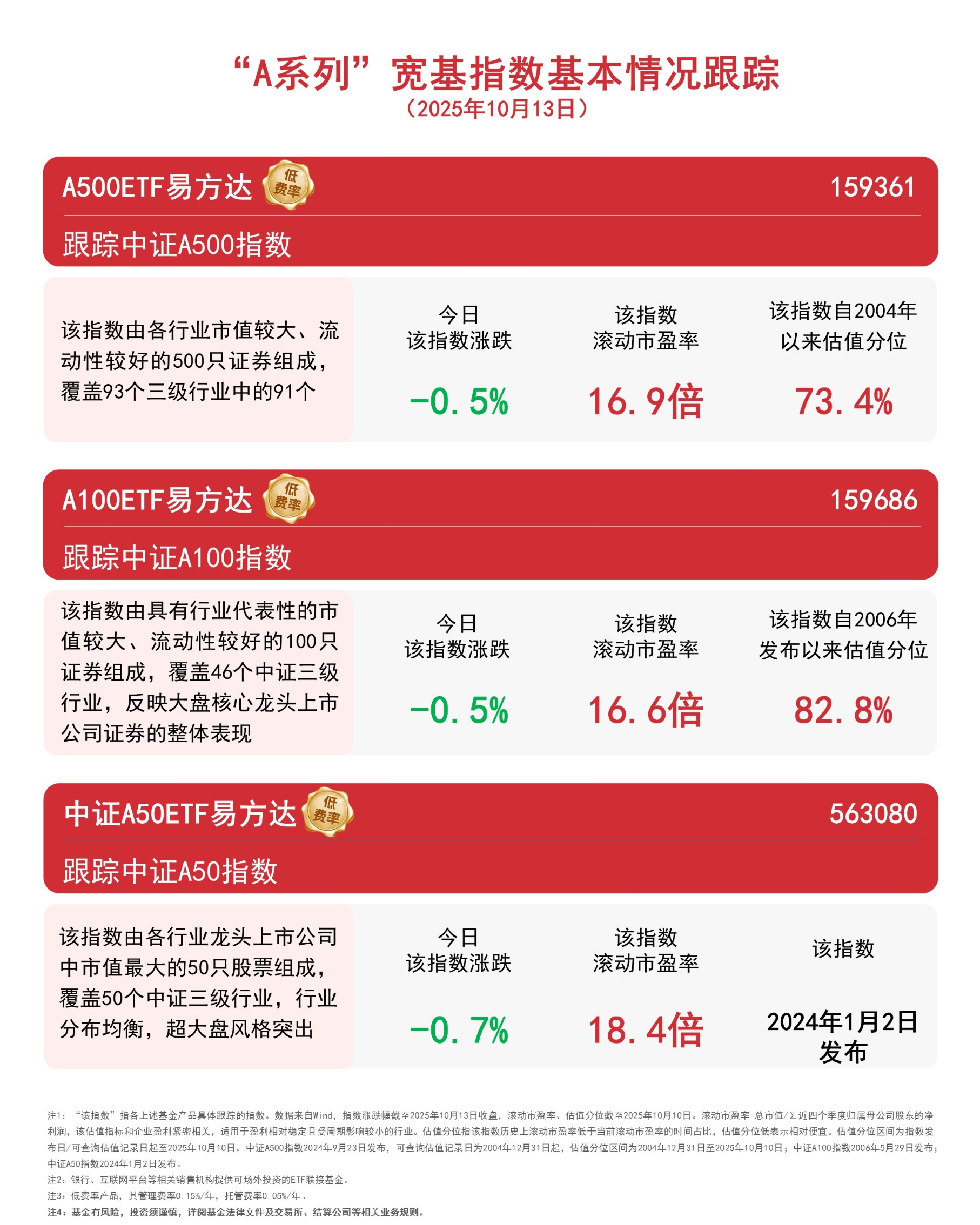
Group 1 - The core viewpoint of the article indicates that the A-share market is expected to remain focused on medium to long-term policy expectations, with a likelihood of not replicating the market performance seen on April 7 [1] - The China Galaxy Securities report suggests that the external environment's uncertainty is increasing, which may suppress market risk appetite and lead to greater market volatility due to profit-taking pressures [1] - The A500 index, which consists of 500 stocks with larger market capitalization and better liquidity, reflects the overall performance of representative companies across various industries in the A-share market [1] Group 2 - The A500 ETF by E Fund (159361) has a management fee rate of 0.15% per year, which is the lowest among ETFs, providing investors with a cost-effective way to invest in core A-share assets [1] - The A500 index covers 91 out of 93 sub-industries in the China Securities Index, indicating a balanced representation of the A-share market [1] - The overall liquidity in the market is expected to continue on a positive trend, which remains a core driving factor for the current market situation [1]

华夏、易方达出手,又有重要创新产品来了
Zhong Guo Ji Jin Bao· 2025-10-13 13:09
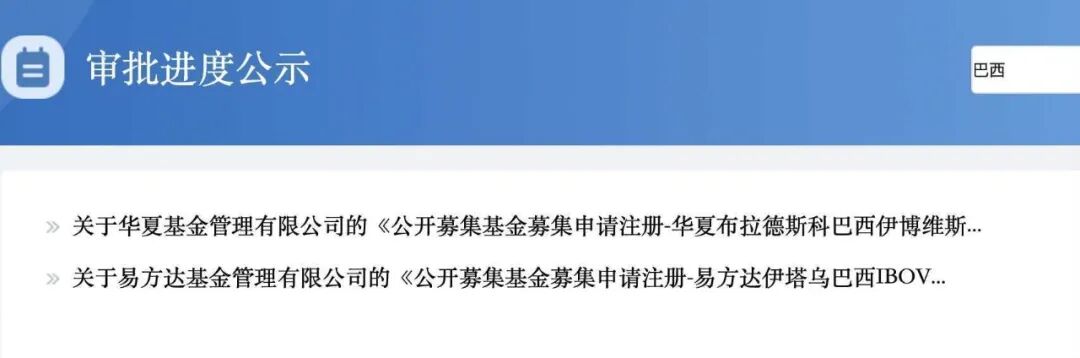
Core Insights - The China Securities Regulatory Commission has approved the applications for two Brazil-focused ETFs, marking a significant step in the interconnection between Chinese and Brazilian capital markets [1][4] - Brazilian capital markets are characterized as the largest and most influential financial system in Latin America, offering global investors opportunities to tap into its resource dividends and economic growth potential [2][3] Group 1: ETF Developments - China Asset Management has launched the "Hua Xia Bradesco Brazil Ibovespa ETF," while E Fund has introduced the "E Fund Itaú Brazil IBOVESPA ETF," facilitating easier access for investors to the Brazilian market [1] - The approval of these ETFs is seen as a continuation of previous collaborations, including the successful listing of the Bradesco Hua Xia ChiNext ETF in Brazil earlier this year [4] Group 2: Market Characteristics - Brazil's capital market is noted for its high growth potential and volatility, influenced by domestic fiscal policies, interest rate cycles, and political dynamics [2] - The Ibovespa index, a key indicator of the Brazilian economy, has shown a 12% annualized return over the past decade and a year-to-date return of 21.6% as of September [3] Group 3: Investment Opportunities - The Ibovespa index is heavily resource-oriented, comprising major global commodity players, which aligns its performance with international raw material prices and Chinese economic demand [3] - The Brazilian market is positioned as an important destination for global investors seeking diversified portfolios and high returns, with a low correlation to A-shares [2][3]
华夏、易方达出手!又有重要创新产品来了
Zhong Guo Ji Jin Bao· 2025-10-13 12:48
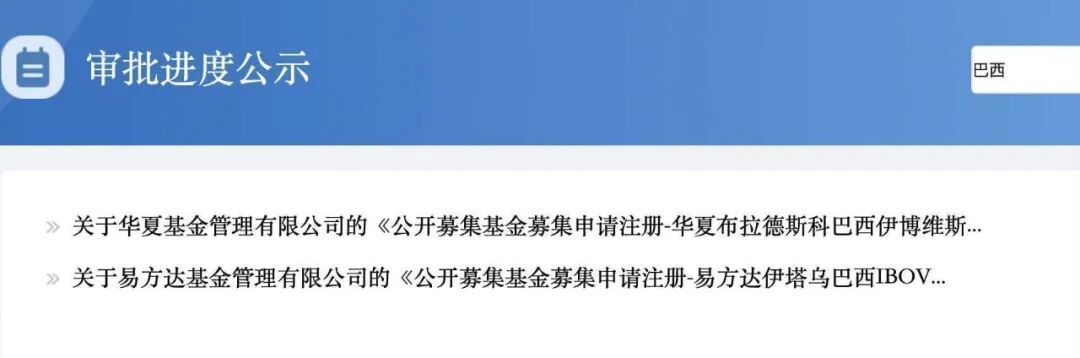
Core Insights - The approval of Brazilian ETFs by China Asset Management and E Fund marks a significant step in the interconnection of capital markets between China and Brazil, allowing investors to easily access the Brazilian market [1] Group 1: Brazilian Capital Market Overview - The Brazilian capital market is the largest and most influential financial system in Latin America, offering global investors opportunities to share in its resource dividends and economic growth potential, while also being affected by domestic fiscal policies, interest rate cycles, and political ecology [2] - Brazil is a key emerging market and a member of the BRICS nations, with a significant consumer market and ongoing recovery in domestic demand, alongside increasing digital penetration and growth potential in the service sector [2] - The Ibovespa index, as the most representative index of the Brazilian capital market, covers industries with comparative advantages such as mining and agriculture, with a high weight in financial and energy sectors [2] Group 2: Performance and Investment Potential - The Ibovespa index has shown a strong performance among emerging economies, reflecting Brazil's resilience as the largest economy in Latin America and its role as the "world's granary" [2] - The index has an annualized return of over 12% over the past decade, with a year-to-date return of 21.6% as of the end of September, indicating its ability to capture global capital flows into emerging markets [3] - The index's performance is closely linked to international commodity prices and Chinese economic demand, presenting significant growth potential amidst its volatility [3] Group 3: Previous Collaborations and Future Prospects - Prior collaborations between China and Brazil in capital market interconnectivity include the successful launch of the Bradesco ChinaAMC ChiNext ETF in May, which allows Brazilian investors to access the Chinese market [4] - The establishment of mutual ETF listings between China and Brazil enhances the recognition of these products among overseas investors and strengthens the influence of domestic capital markets [4] - China Asset Management has been a pioneer in domestic ETFs and is actively promoting the mutual connectivity of ETF products globally, having previously launched a mutual ETF project with Japan [4]