
风电

Search documents
大唐签约内蒙古科右前旗500MW风电项目开发协议
Xin Lang Cai Jing· 2025-10-18 13:52
在协议签署前,该事业部以国家"十五五"规划作为工作遵循,积极与科右前旗政府沟通协调,扎实做好 各项前期准备工作。该协议整体规划风电装机容量为50万千瓦,先期在科右前旗额尔格图镇开发兴牧风 电场二期25万千瓦风电项目,剩余风电资源将按照科右前旗政府风电发展规划要求,根据实际批复容量 分期建设。 风芒能源获悉,10月15日,大唐蒙东新能源事业部与兴安盟科尔沁右翼前旗人民政府成功签署50万千瓦 风电项目开发合作协议,双方将共同推进该项目申请指标及核准工作。 (来源:风芒能源) ...
财政部官宣,多个行业增值税优惠政策即将取消
第一财经· 2025-10-18 12:21
Core Viewpoint - The article discusses the recent adjustments to value-added tax (VAT) policies in China, particularly the cancellation and modification of tax incentives for various industries, including wind power, nuclear power, and financing leasing, as part of a broader fiscal reform initiative aimed at standardizing tax incentives and increasing government revenue [3][16]. Summary by Sections Wind Power - The VAT exemption policy for onshore wind power, which allowed a 50% VAT refund on self-produced electricity sales since July 1, 2015, will be abolished starting November 1, 2025 [4][5]. - In contrast, a 50% VAT refund policy for offshore wind power will be maintained from November 1, 2025, to December 31, 2027, indicating government support for the still-developing offshore wind sector [4][5]. Nuclear Power - The VAT policy that allowed a phased refund for nuclear power plants will be discontinued for new projects approved after November 1, 2025. Existing projects will continue to benefit from the previous tax incentives until a specified transition period [7][8]. - This change reflects the maturity of the nuclear power industry, suggesting it no longer requires special tax support to compete fairly with other energy sources [8]. Financing Leasing - The VAT refund policy for financing leasing businesses, which allowed refunds for VAT burdens exceeding 3%, will be abolished on November 1, 2025 [9][12]. - This policy change is part of a broader effort to streamline tax regulations and reduce the complexity of the VAT system [12]. Aircraft Maintenance and Other Industries - The VAT exemption for aircraft maintenance services, which allowed refunds for VAT burdens exceeding 6%, will also be eliminated starting November 1, 2025 [13][14]. - Additional tax incentives for diamond trading, new wall materials, and coalbed methane extraction will be canceled, indicating a comprehensive approach to tax reform across various sectors [14][15]. Fiscal Reform Context - The adjustments to tax incentives align with the directives from the 20th National Congress of the Communist Party of China, emphasizing the need for standardized tax policies and improved fiscal health [16]. - The article notes that the cancellation of these tax incentives could help increase government revenue, which has been under pressure due to economic challenges [16].


欧洲工厂停摆,中国手握稀土王牌,欧盟在沉默五天后决定与美国联手,对华展示其实力
Sou Hu Cai Jing· 2025-10-18 12:17
Core Insights - The implementation of new Chinese regulations on rare earth materials has led to significant disruptions in production for companies reliant on these resources, particularly in the automotive sector [1][7]. Supply Chain Vulnerabilities - The EU's dependency on China for rare earth materials is highlighted, with each electric vehicle requiring 1.5 kg of these materials, while China dominates the global refining market [2]. - The EU's steel tariff policy has inadvertently placed European steel companies in a vulnerable position, as they rely heavily on China for raw materials [2]. Regulatory and Standards Challenges - China's establishment of a comprehensive traceability system for rare earth materials has raised international concerns, with the European Parliament deeming it non-compliant with international trade rules [4]. - New Chinese regulations require foreign companies using Chinese rare earth technology to obtain licenses, causing delays in major projects for companies like Siemens and Tesla [7]. Industry Impact and Reactions - Internal reports from Volkswagen indicate severe losses at their Zwickau electric vehicle production site due to material shortages, compounded by Japanese suppliers halting exports due to reliance on Chinese raw materials [5]. - European companies are negotiating strict contracts with Chinese suppliers to secure minimum supply volumes, but Chinese firms are firm on not selling without export licenses [8]. Market Dynamics and Strategic Shifts - China's export structure for rare earths is shifting towards higher value-added products, while European companies face extended inventory turnover periods, leading some to implement reduced work schedules [9]. - The internal divisions within the EU regarding rare earth strategies hinder a unified response, with some countries seeking pragmatic cooperation while others attempt to barter agricultural products for rare earth quotas [11]. Future Industry Landscape - Continuous investment by China in rare earth separation technology and countermeasures is expected to create significant capacity bottlenecks for the European electric vehicle industry if current conditions persist [14]. - The ongoing competition over rare earth resources is reshaping global industry dynamics, with international companies adjusting strategies by establishing new production bases in Asia [12].

财政部官宣 多个行业增值税优惠政策即将取消
Di Yi Cai Jing· 2025-10-18 11:30
Group 1: Tax Policy Changes - The Ministry of Finance has accelerated the adjustment of tax incentives, specifically abolishing or modifying several VAT policies across various industries, including wind power, nuclear power, and financing leasing [1][8]. - Effective November 1, 2023, the VAT exemption policy for onshore wind power, which allowed a 50% immediate refund on VAT for electricity generated from wind, will be abolished. However, a similar policy for offshore wind power will be implemented from November 1, 2025, to December 31, 2027 [2][4]. - The VAT policy for nuclear power, which provided a phased refund system for 15 years, will also be discontinued for new projects approved after November 1, 2025. Existing projects will continue to benefit from the previous policy until their respective transition periods end [3][4]. Group 2: Specific Industry Impacts - The financing leasing sector will see the cancellation of the VAT refund policy for tax burdens exceeding 3%, effective November 1, 2023, impacting the cost structure for businesses in this area [5][6]. - The aircraft maintenance industry will lose its VAT refund policy for tax burdens exceeding 6%, effective November 1, 2023, which may increase operational costs for service providers [7]. - Other industries affected include diamond trading, new wall materials, and coalbed methane extraction, all of which will see the cancellation of their respective VAT incentives, further tightening the tax landscape for these sectors [7][8]. Group 3: Broader Economic Context - The cancellation of these tax incentives aligns with the government's broader fiscal reform agenda aimed at standardizing tax policies and increasing fiscal revenue amid economic challenges [8][9]. - In the first three quarters of the year, China's general public budget revenue increased by 0.5% year-on-year, while government fund budget revenue decreased by 0.5%, indicating a need for improved fiscal health [9].
财政部官宣,多个行业增值税优惠政策即将取消
Di Yi Cai Jing· 2025-10-18 11:25
Core Points - The recent tax reform focuses on standardizing tax incentives, accelerating the adjustment of VAT policies across various industries [1] - The Ministry of Finance, the General Administration of Customs, and the State Taxation Administration have announced the cancellation or adjustment of several VAT incentives [1] Wind Power Industry - The VAT exemption policy for onshore wind power, which allowed a 50% immediate refund since July 1, 2015, will be abolished starting November 1, 2023 [2] - From November 1, 2025, to December 31, 2027, a similar 50% immediate refund policy will be retained for offshore wind power [2] - The decision reflects the maturity and competitiveness of onshore wind technology, while offshore wind still requires support due to higher costs and challenges [2] Nuclear Power Industry - The VAT policy that allowed a phased refund for nuclear power plants will be phased out for new projects approved after November 1, 2025 [3][4] - Existing nuclear power plants will continue to benefit from the previous VAT refund policies until their respective deadlines [4] - This change indicates that nuclear power is now expected to compete on equal tax terms with other energy sources [4] Financing Leasing Industry - The VAT refund policy for financing leasing businesses, which applied to tax burdens exceeding 3%, will be abolished on November 1, 2023 [5][6] Aircraft Maintenance and Other Industries - The VAT exemption for aircraft maintenance services, which allowed refunds for tax burdens exceeding 6%, will be canceled [7] - Other industries affected include diamond trading, new wall materials, and coalbed methane extraction, with various VAT incentives being removed [7][8] Overall Tax Policy Context - The cancellation of these tax incentives aligns with the broader goal of standardizing tax policies and increasing fiscal revenue amid economic challenges [8] - In the first three quarters of the year, the general public budget revenue was 163.876 billion yuan, a 0.5% increase year-on-year, while expenditures grew by 3.1% [9]
菏泽郓城17.5万千瓦分散式风电项目正式开工
Xin Lang Cai Jing· 2025-10-18 10:32
10月17日,由山东高速集团投资建设的菏泽郓城17.5万千瓦分散式风电项目正式开工,进入场平实施阶 段。该项目由郓城陈坡、杨庄集、张营、黄泥岗、侯咽集、何仓6座分散式风电项目组成,装机总容量 17.5万千瓦,拟安装28台风机,建成后预计年发电量约4.4亿度,可节约标准煤约13.2万吨,减排二氧化 碳约31.5万吨。 ...
逾百亿投建海外风电基地 明阳智能资金压力何解?
Zhong Guo Jing Ying Bao· 2025-10-18 08:01
Core Viewpoint - Mingyang Smart Energy (601615.SH) announced a £1.5 billion (approximately RMB 14.21 billion) overseas investment plan to establish the UK's first integrated wind turbine manufacturing base in Scotland, aiming to address the "increased revenue without increased profit" dilemma in the domestic wind power market [1][3][4]. Group 1: Investment Plan - The manufacturing base in Scotland will be developed in three phases, with the first phase focusing on advanced wind turbine nacelle and blade manufacturing, expected to commence production by the end of 2028 [1]. - The second phase will expand production lines to accelerate the scale production of floating wind technology, while the third phase will include the production of control systems, electronic devices, and other key components, ultimately forming a complete industry chain ecosystem [1][2]. Group 2: Market Context - The European offshore wind market is experiencing a new installation boom, with Scotland being a key testing ground for floating wind technology due to its deep-sea resources [2]. - The European market offers higher price levels, and the UK provides additional income support through policies like the "Clean Industrial Bonus," allowing eligible companies to receive CFD contract subsidies [2][4]. Group 3: Financial Performance - Mingyang Smart Energy's net profit has been declining since 2023, with a significant drop from RMB 3.445 billion in 2022 to RMB 346 million in 2024. In the first half of 2025, revenue increased by 45.33% to RMB 17.143 billion, but net profit decreased by 7.68% year-on-year [4][5]. - The company's gross margin fell from 19.99% in 2022 to 8.1% in 2024, although it rebounded to 12.12% in the first half of 2025, remaining at a historically low level [5][6]. Group 4: Debt and Cash Flow Concerns - As of mid-2025, Mingyang Smart Energy's total liabilities reached RMB 635.13 billion, with an increasing debt-to-asset ratio from 58.85% at the end of 2022 to 69.93% by mid-2025 [6][7]. - The company has reported negative operating cash flow for three consecutive years, indicating challenges in self-sustaining its operations, which may exacerbate short-term financial pressures due to the large initial investment required for the overseas project [8][9].

风机产能出海到欧洲!明阳智能豪掷142亿元英国建厂
Hua Xia Shi Bao· 2025-10-18 01:16
Core Viewpoint - Chinese wind power companies are increasingly seeking opportunities in the European market, with Mingyang Smart Energy planning to establish a comprehensive wind turbine manufacturing base in Scotland, representing a significant investment of £1.5 billion (approximately ¥14.21 billion) [1][4]. Investment Strategy - Mingyang Smart Energy's investment will occur in three phases: 1. Construction of advanced wind turbine nacelle and blade manufacturing facilities, aiming for initial production by the end of 2028 [2]. 2. Expansion of production lines to accelerate the scale production of floating wind technology in the UK [2]. 3. Further expansion into the production of control systems, electronic devices, and other key components [2]. Market Potential - The UK wind power market shows strong performance, with a cumulative installed capacity of approximately 16GW for both onshore and offshore wind by the end of 2024, leading Europe in offshore capacity [5]. - The UK government has set ambitious targets for offshore wind capacity, aiming for 43-50GW by 2030, with plans to quadruple offshore wind installations [5][6]. Challenges and Barriers - Entering the European market presents challenges, including stringent local requirements for operational wind turbines and data accumulation before negotiations with local buyers can commence [7]. - Mingyang Smart Energy's investment will increase financial risks, as it is the largest external investment since the company's listing, with a current cash position of ¥10.87 billion and a debt ratio of 69.93% [8][10]. Financial Performance - Despite a 45.33% year-on-year increase in revenue to ¥17.14 billion, the company reported a net profit decline of 7.68% to ¥610 million due to time lags in reflecting bidding prices in financial results [9]. - The company anticipates a recovery in profitability as industry conditions improve, with a noted increase in wind turbine bidding prices [9]. Regulatory Considerations - The investment plan requires approvals from various governmental bodies, including the UK government and Chinese regulatory authorities, introducing uncertainty regarding the project's execution [10].
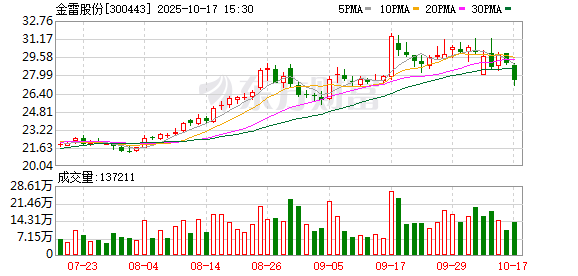
金雷股份:公司在东营投建的海上风电核心部件数字化制造项目正处于产能爬坡阶段
Zheng Quan Ri Bao· 2025-10-17 14:13
Core Insights - The company has launched a digital manufacturing project for offshore wind power core components in Dongying, which began production in the second half of 2023 and is currently in the capacity ramp-up phase [2] - The project is designed to meet the demand for offshore wind power and has the production capacity for large offshore wind castings up to 30MW [2] - The company leverages its long-standing expertise in wind power main shafts, quality, and customer advantages, combined with advanced equipment, to establish a unique competitive edge in offshore wind shaft products [2] - The company has developed overseas orders in the casting field, including clients such as Siemens Gamesa [2]

金雷股份:公司全资子公司金雷重装投建的海上风电核心部件数字化制造项目产能正在有序释放
Zheng Quan Ri Bao· 2025-10-17 14:13
Core Viewpoint - Jinlei Co., Ltd. has commenced production of its digital manufacturing project for core components of offshore wind power in the second half of 2023, with significant capacity growth expected by 2025 [2] Group 1: Production and Capacity - The digital manufacturing project by Jinlei Heavy Industry is fully operational and is expected to achieve an effective capacity of approximately 80,000 to 100,000 tons by 2025, representing a growth of over 160% compared to 2024 [2] - The current release of production capacity is progressing in an orderly manner [2] Group 2: Material Costs and Financial Outlook - Raw material prices are currently lower than the levels seen in 2024, which is anticipated to positively impact the operating performance of Jinlei Heavy Industry in 2025 compared to 2024 [2]