
数据产业

Search documents
“为优质数据买单”拓展广阔空间
Jing Ji Ri Bao· 2025-09-05 22:06
Core Insights - The development of the data industry is a crucial measure for deepening the market-oriented allocation of data elements and constructing a digital economy centered around data [1] - The 2025 China International Big Data Industry Expo attracted investments totaling 46.336 billion yuan, highlighting the growing interest in data and computing industries [1] - By the end of this year, the added value of the digital economy is expected to reach approximately 49 trillion yuan, accounting for about 35% of GDP, with the core industries of the digital economy achieving their "14th Five-Year Plan" targets ahead of schedule [1] Group 1: Data Infrastructure Development - The national data infrastructure is gradually forming a new type of infrastructure system aimed at releasing the value of data elements, supported by networks and computing power [2] - Eight national hub nodes have been established, with a computing power scale of 620,000 PFlops, accounting for about 80% of the national total [2] - Guizhou's computing power has exceeded 92,000 PFlops, with large and super-large scales accounting for about 60%, forming three trillion-level industrial clusters [2] Group 2: Trusted Data Space - The Trusted Data Space is a new type of data circulation infrastructure that connects multiple parties based on consensus rules, enabling data resource sharing [2] - The National Data Bureau has released the "Trusted Data Space Development Action Plan (2024-2028)" to promote the exploration of various data space scenarios and mechanisms [2] Group 3: Data Utilization and Applications - The data industry is seen as essential for developing new productive forces and fostering new growth drivers, with big data playing a significant role across various sectors [5] - The "Data Element X Action" has been implemented to promote public data utilization and key scenario construction, resulting in over 14,000 products and services developed from meteorological data alone [6] Group 4: Artificial Intelligence and Data Quality - The demand for high-quality data has surged due to the rapid development of artificial intelligence, which is now shifting focus from model-centric to data-centric approaches [8] - The National Data Bureau has initiated a pilot program for high-quality data set construction, with 140 data sets selected from 335 applications, covering 18 key fields [8][9] - As of June this year, over 35,000 high-quality data sets have been established nationwide, totaling over 400 PB [9]
长沙5园区拟入选湖南省首批数据产业集聚区
Chang Sha Wan Bao· 2025-09-04 03:27
Core Viewpoint - Hunan Province has announced the first batch of data industry agglomeration areas, with 13 parks selected, highlighting Changsha's leading position in the province's data industry development and contributing to the "Digital Changsha" initiative [1] Group 1: Overview of Selected Parks - Five parks in Changsha have been selected, accounting for nearly 40% of the total, showcasing the city's strong data industry foundation and innovation capabilities [1][2] - The selected parks are expected to enter a new phase of "clustered, high-quality" development [1] Group 2: Individual Park Highlights - Xiangjiang New Area leverages its dense academic and research resources to form ten specialized industrial chains, integrating production, learning, research, and application [3] - Malanshan Video Cultural and Creative Industry Park focuses on "culture + technology," excelling in ultra-high-definition video, digital publishing, and animation games, setting industry benchmarks [4] - Changsha Economic Development Zone builds on its engineering machinery and automotive manufacturing base, utilizing the province's first "5G + Industrial Internet" pilot area to enhance data collaboration and digital transformation [5] - Tianxin Economic Development Zone aims to create a central data market hub, gathering a trading platform, two computing power centers, eight data centers, and over 6,000 related enterprises, forming a comprehensive digital economy ecosystem [6] - Wangcheng Economic Development Zone focuses on smart terminal industries, leveraging the Zengtong Cloud Valley data center to enhance data collection, computing support, and application scenarios [7] Group 3: Future Development Plans - Changsha plans to leverage the establishment of data industry agglomeration areas to enhance industrial planning, data supply, talent cultivation, and scenario openness [7] - The city aims to strengthen collaboration among the parks, promote cross-park and cross-field data flow, and build the "Changsha Data Industry Cluster" brand [7] - The initiative is expected to accelerate the integration of digital economy and real economy, positioning data as a key driver for high-quality urban development [7]
国资央企竞相布局数据要素新赛道
Zhong Guo Zheng Quan Bao· 2025-09-03 22:35
Core Insights - The establishment of Beijing Data Group marks a significant step in the rapid development of China's data factor market, with over 100 data groups formed nationwide [1][5] - Central enterprises are leading the charge in the digital technology sector, with nearly 500 digital technology companies established this year, reflecting a growing enthusiasm for data utilization [2][5] - Local data groups are also emerging, with notable formations in Beijing, Hubei, and Sichuan, each aiming to create unique data ecosystems [3][4] Group 1: Central Enterprises - Central enterprises have established around 500 digital technology companies, with approximately 66% of industry leaders having purchased data, indicating a rising interest in data development [2] - Significant achievements include the creation of over 800TB of public data by three major telecom operators, with annual data service calls exceeding 100 billion [2] - Central enterprises are positioning themselves as high-quality data resource aggregators and builders of high-standard data infrastructure [2] Group 2: Local Data Groups - Local data groups are being formed in various regions, such as Beijing Data Group with a registered capital of 30 billion yuan and Hubei Data Group with 50 billion yuan [3][4] - Sichuan Data Group was established with a registered capital of 20 billion yuan, showcasing the regional commitment to data infrastructure [3] - The focus of these local groups includes public infrastructure investment and the development of trusted data spaces [3] Group 3: Market Potential and Development - The data factor market in China is projected to exceed 200 billion yuan this year, highlighting its vast potential and growth opportunities [6] - The National Data Bureau is working on enhancing data management mechanisms within state-owned enterprises to facilitate digital transformation [6] - Experts emphasize the importance of leveraging digital assets to drive innovation across industries and improve overall productivity [6]
记者观察:供给过剩、场景缺失,海量数据如何突破供需脱节困局?|一探
Di Yi Cai Jing· 2025-09-03 01:19
Group 1 - The core viewpoint is that the acceleration of marketization in the data element sector is supported by both policy and technological advancements, but the "lack of scenarios" remains a key bottleneck for industry development [1] - Industry experts at the 2025 China International Big Data Industry Expo emphasized that data itself is not an asset; it must be integrated into scenarios and solve real problems to be transformed into true value [1] - By creating replicable cases, promoting co-creation of technology and business, and building a secure and trustworthy environment, the value of existing data can be activated, leading to the emergence of new scenarios and business models [1] Group 2 - The future consensus is that "scenario-driven" approaches will transform data from "dormant resources" into "flowing value," which will genuinely support industrial upgrades and improve people's livelihoods [1]

江苏南京:攀高逐新,数据推动经济加“数”前行
Nan Jing Ri Bao· 2025-09-02 23:37
Core Insights - The article highlights the rapid development of Nanjing's "Smart City" with over 1,800 data-driven enterprises, showcasing the vibrant growth of the digital economy in the region [1][13][11] - The integration of data and AI is emphasized as a key driver for unlocking data value, particularly in healthcare and public health sectors [9][10][12] Group 1: Data Economy Development - Nanjing's "Smart City" has attracted major industry players like Su Meida and ChinaSoft International, reflecting a strong digital economy cluster [1][11] - The city aims to establish itself as a data element industry hub, with plans to cultivate 1,000 data enterprises and achieve an annual growth rate of over 20% in the data industry by 2027 [14][15] - The establishment of the Jiangsu Provincial Public Data Authorized Operation Ecological Incubation Center marks a significant step in promoting efficient data circulation and fostering a billion-level data industry ecosystem [15] Group 2: Healthcare Innovations - The Nanjing Hanwei Public Health Research Institute is utilizing data to identify biomarkers for esophageal cancer, aiming to enhance personalized treatment plans [9][10] - The institute's smart disease control management platform has covered 7 million people and provided over 10,000 risk alerts, showcasing the potential of data in public health [10][9] - The development of a digital chronic disease management platform and an AI early warning model demonstrates the innovative applications of data in healthcare [10][12] Group 3: Infrastructure and Collaboration - The establishment of a traffic logistics data space by Jiangsu Data Group aims to reduce regional logistics costs by approximately 15% through data integration [11][12] - The "Smart Logistics Service Platform" developed by Jiangsu Linghao Network Technology has served over 40,000 manufacturing enterprises, significantly lowering logistics costs by around 2 billion yuan [12] - Collaborative efforts with major tech companies like Huawei are fostering innovation in digital economy development, enhancing the ecosystem for data-driven enterprises [12][11]


焦点访谈丨从智慧城市到数字乡村 “十四五”数字中国建设交出亮眼成绩单
Yang Shi Xin Wen Ke Hu Duan· 2025-09-01 23:26
Core Insights - The "14th Five-Year Plan" period has seen a rapid transformation from networking to digitalization and then to intelligence, with national-level strategic projects like "eight national computing power hub nodes and ten national data center clusters" representing China's digital infrastructure development [2] - By the end of June this year, China's total computing power ranked second globally, and the number of artificial intelligence patents accounted for 60% of the global total [2] - Digital technology is being integrated into various aspects of life and production, demonstrating significant potential in improving people's livelihoods and enhancing governance efficiency [3] Digital Infrastructure and Data Flow - Good digital infrastructure alone is insufficient; accelerating data circulation and promoting data as a factor of production are essential to unlock the value of data [5] - Data has become a strategic core resource in the digital economy era, empowering various industries to upgrade and transform [5] Case Study: Smart Fisheries - In Zhanjiang, Guangdong, traditional fishing practices are being transformed by data-driven smart aquaculture, leading to a 20%-40% reduction in feed conversion ratios, over 10% increase in fish weight gain, and a 60% reduction in labor costs, resulting in over 30% improvement in economic benefits [7] Data Industry Growth - The data industry in China is rapidly developing, with the number of data enterprises expected to exceed 400,000 by 2024, and the industry scale reaching 5.86 trillion yuan, a 117% increase compared to the end of the "13th Five-Year Plan" [9] Enhancements in Public Services - Digitalization has significantly improved the accessibility and equity of public services, with remote medical services benefiting many patients [9][11] - The establishment of remote medical systems has enabled collaboration between local hospitals and top-tier hospitals, enhancing patient care and optimizing resource allocation [11] Digital Health Services - During the "14th Five-Year Plan" period, internet hospitals in China served over 100 million people, and cross-province medical settlements benefited 560 million people [13] - China has built the world's largest and most resource-rich national smart education platform, with 1.07 billion people using electronic social security cards, making public services more accessible and efficient [13]

焦点访谈|数字浪潮奔涌 “十四五”我国数字化发展迈上新台阶
Yang Shi Wang· 2025-09-01 13:13
Group 1 - Digital technology is rapidly integrating into various aspects of production and life, showcasing its potential in improving people's livelihoods and governance efficiency during the "14th Five-Year Plan" period [1] - The information revolution is transitioning from networking to digitalization and then to intelligence, with national-level strategic projects like "eight national computing power hub nodes" and "ten national data center clusters" representing new digital infrastructure [1] - As of June 2023, China's total computing power ranks second globally, and the number of artificial intelligence patents accounts for 60% of the global total [1] Group 2 - Efficient social development through digital technology requires not only good digital infrastructure but also accelerated data circulation and the realization of data as a core strategic resource [3] - The fishing industry in Zhanjiang, Guangdong, is experiencing qualitative changes driven by data, with the "Hengyi No. 1" deep-sea farming platform exemplifying a highly automated and intelligent approach [3] Group 3 - Data-driven smart aquaculture shows significant advantages over traditional methods, including a 20%-40% reduction in feed conversion ratio, over 10% increase in fish weight gain, and a 60% reduction in labor costs, leading to over 30% improvement in economic benefits [5] - The data industry in China is rapidly developing, with over 400,000 data companies expected by 2024 and an industry scale reaching 5.86 trillion yuan, a 117% increase compared to the end of the "13th Five-Year Plan" [5] Group 4 - Digital construction during the "14th Five-Year Plan" not only empowers production but also significantly enhances the accessibility and equity of public services, as evidenced by the convenience of telemedicine [5][7] - The collaboration between local hospitals and major hospitals through telemedicine has resulted in personalized treatment plans and improved patient outcomes, benefiting patients, local hospitals, and the government [7] - During the "14th Five-Year Plan," internet hospitals served over 100 million people, and cross-province medical settlements benefited 560 million people, establishing China as a leader in smart education and digital public services [7]
多地发布新政发力挖掘公共数据价值
Zheng Quan Ri Bao· 2025-08-29 16:17
Core Viewpoint - The development and utilization of public data resources is a crucial initiative for promoting the digital economy, with various regions in China implementing new policies to explore and maximize the value of public data [1][2][3]. Group 1: Policy Initiatives - Multiple regions, including Beijing, Shanghai, Shanxi, Zhejiang, and Xinjiang, have introduced new policies regarding public data resources since the third quarter [1]. - For instance, Xinjiang's Digital Development Bureau released the "Implementation Rules for Public Data Resource Registration (Trial)" on August 21 [1]. - The initiatives aim to standardize public data resource registration, enhance data quality, and create unified data infrastructure [1]. Group 2: Expert Insights - Experts believe that the development and utilization of public data resources is a systematic project involving institutional construction, pricing formation, and revenue distribution [1]. - The need for significant investment in public data resource development is emphasized, along with the importance of clarifying application scenarios to improve resource allocation efficiency [1][2]. Group 3: Authorization and Operational Models - The authorization and operation of public data resources are key components in advancing their development [3]. - The central government has provided clear guidelines for authorization models, including overall authorization, sector-specific authorization, and scenario-based authorization [3][4]. - Each model has distinct advantages and should be selected based on local conditions to better support industrial upgrades and economic development [4]. Group 4: Future Directions - There is a call for further optimization of public data products and service quality, as well as the exploration of effective revenue distribution mechanisms [4]. - The application of authorized public data resources has already shown benefits in areas such as precision medicine, low-altitude inspection, and smart agricultural construction [4].
首批可信数据空间试点情况如何?报告:带动近7万家生态主体
Nan Fang Du Shi Bao· 2025-08-29 09:04
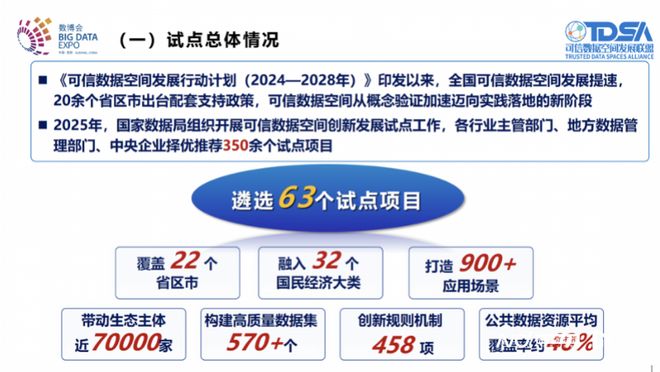
Core Viewpoint - The development of trusted data spaces in China is accelerating from conceptual validation to practical implementation, supported by over 20 provinces and cities with relevant policies [1] Group 1: Development and Implementation - The 2025 China International Big Data Industry Expo opened in Guiyang, where the "Trusted Data Space Innovation Development Report (2025)" was released, outlining the current state and future paths for trusted data spaces in China [1] - The National Data Bureau issued the "Trusted Data Space Development Action Plan (2024-2028)" in November last year, aiming to establish over 100 trusted data spaces by 2028, with breakthroughs in operations, technology, ecology, standards, and security [1] Group 2: Pilot Projects and Applications - In 2025, the National Data Bureau will initiate pilot projects for trusted data spaces, with 63 projects identified, expanding into over 900 application scenarios across 32 major industries, potentially involving nearly 70,000 market entities [2] - The report indicates that among the nearly 70,000 market entities, 37% are data resource companies, 38.3% are data application companies, and 6.4% are data service companies, with 18.3% providing data security, technology, and infrastructure services [4] Group 3: Innovations and Highlights - Two major innovations include the establishment of specialized operational companies by state-owned enterprises and industry leaders, and the emergence of new data service companies focusing on data hosting, brokerage, and certification [4] - A significant highlight is the promotion of data resource openness in key sectors, facilitating AI development, with over 570 high-quality datasets created in 14 fields such as satellite remote sensing and automotive, providing essential data for AI model training [4][5] Group 4: Challenges and Future Directions - The report notes that while trusted data spaces are in their early development stages, challenges remain, including establishing a market-oriented long-term operational mechanism, overcoming data sharing barriers, and ensuring interconnectivity among data spaces [5]
2025中国国际大数据产业博览会“数据产业创新发展主题交流活动”成功举办
Zheng Quan Shi Bao Wang· 2025-08-29 07:45
Core Insights - The event "Data Industry Innovation Development Theme Exchange Activity" was successfully held in Guiyang on August 28, 2025, highlighting the importance of cultivating the data industry for the growth of the digital economy and the development of new productive forces [1] Group 1: Industry Development - The National Data Bureau emphasizes that nurturing the data industry is crucial for enhancing the digital economy and developing new productive forces [1] - China possesses favorable conditions for industry development in areas such as foundational capabilities, application scenarios, and the construction of high-quality data sets [1] - Future efforts will focus on the marketization and valuation of data elements, improving data resource supply capabilities, and optimizing the layout of the data industry [1] Group 2: Research Outcomes - The event also released significant research findings, including the "Data Industry Map (2025)" and the "Trusted Data Space Innovation Development Report (2025)" [1]