
Autonomous Driving

Search documents
萝卜快跑服务次数全球第一,李彦宏称无人车将成全新移动生活空间
Sou Hu Cai Jing· 2025-11-13 03:06
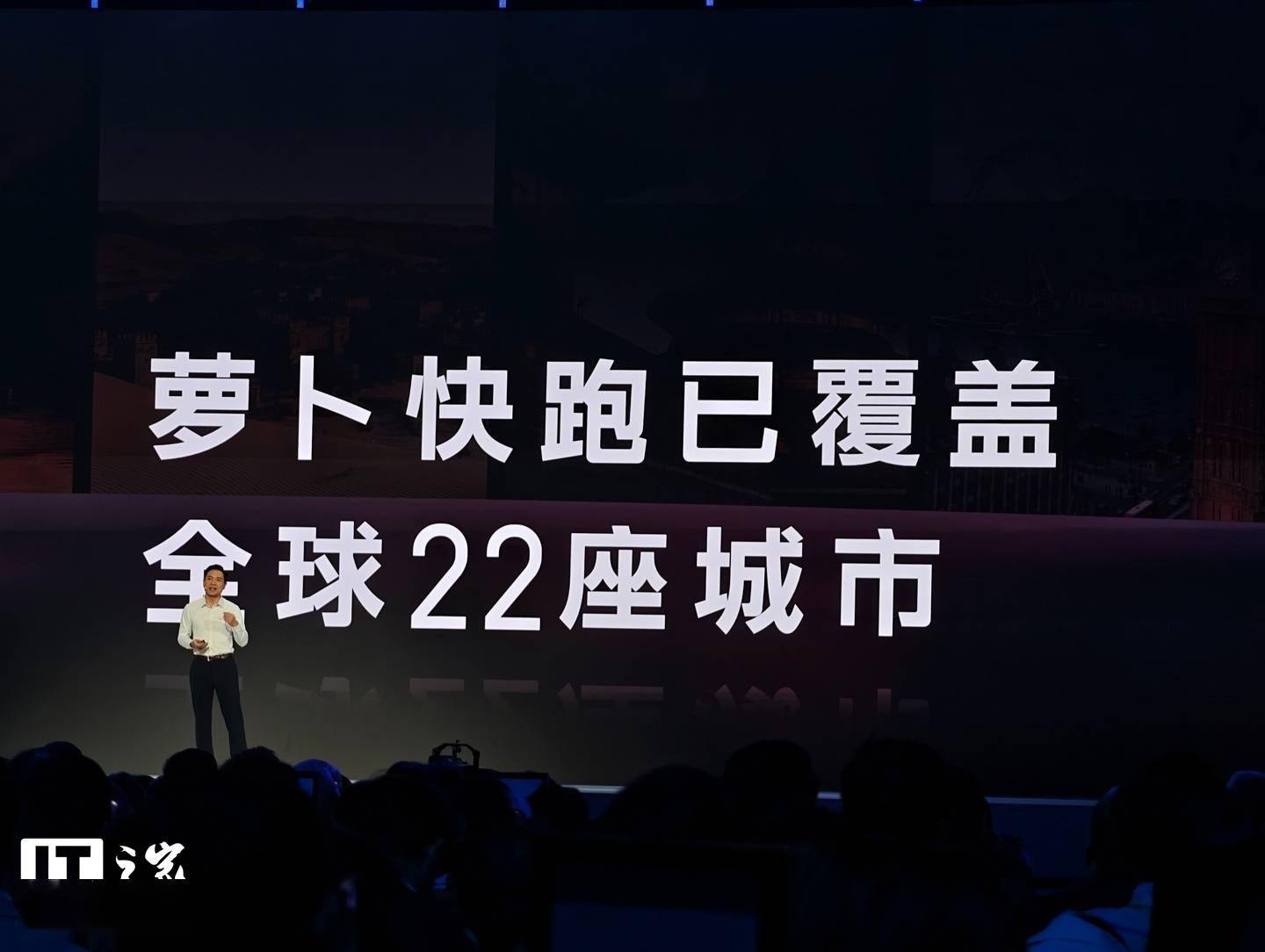
Core Insights - The core viewpoint of the article is that autonomous driving is bringing disruptive changes to urban life, affecting transportation, mobility, and even the entire social ecosystem [1]. Group 1: Industry Impact - According to Baidu's founder, Li Yanhong, autonomous driving will transform not only transportation but also the social ecology [1]. - Research data from investment firm ARK indicates that by 2030, the cost of robotaxi services in the U.S. could drop to approximately $0.25 per mile, leading to a 5 to 7 times increase in ride-hailing demand [1]. Group 2: Company Performance - The latest data shows that the autonomous ride-hailing service, "萝卜快跑" (LuoBo Kuaipao), has surpassed 250,000 fully autonomous orders per week, with total global ride-hailing services exceeding 17 million [1]. - The service operates in 22 cities worldwide, with fully autonomous driving mileage exceeding 140 million kilometers and total autonomous driving mileage surpassing 240 million kilometers [1].


萝卜快跑服务次数全球第一!李彦宏:无人车将成全新移动生活空间
Xin Lang Ke Ji· 2025-11-13 02:44
Group 1 - Baidu founder Li Yanhong stated that autonomous driving is bringing disruptive changes to urban life, affecting transportation, mobility, and even the entire social ecosystem [1] - According to research data from investment firm ARK, by 2030, the cost of robotaxi in the U.S. is expected to drop to approximately $0.25 per mile, leading to a 5 to 7 times increase in ride-hailing demand [1] - Li emphasized that when ride-hailing becomes sufficiently cheap and convenient, demand will be stimulated, and autonomous vehicles will create a new mobile living space with numerous possibilities [1] Group 2 - Latest data shows that the number of fully autonomous orders for "萝卜快跑" has exceeded 250,000 per week, with total global ride-hailing services surpassing 17 million, making it the global leader [3] - The service covers 22 cities worldwide, with fully autonomous driving mileage exceeding 140 million kilometers and total autonomous driving mileage surpassing 240 million kilometers [3]
Waymo taps Google exec for CFO seat
Yahoo Finance· 2025-11-12 15:22
Core Insights - Waymo, owned by Alphabet, is launching driverless ride-hailing services on highways in the San Francisco Bay area, Phoenix, and Los Angeles, marking a significant milestone for U.S. robotaxi providers [4] - The company's "Other Bets" segment, which includes autonomous transportation services, reported revenues of $344 million in Q3, a decrease from $388 million in the same period last year [5] Company Developments - Waymo has appointed Steve Fieler as its new CFO, effective December 1, succeeding Elisa de Martel, who is stepping down after three years [7] - Fieler brings nearly three decades of financial experience, including roles at Google and as CFO of HP, which is expected to support Waymo's growth ambitions [6][7]
WeRide to Announce Third Quarter 2025 Financial Results on November 24, 2025
Globenewswire· 2025-11-12 10:00
Core Viewpoint - WeRide Inc. is set to release its third quarter 2025 financial results on November 24, 2025, before the U.S. market opens [1] Group 1: Earnings Call Details - The management team will host an earnings conference call at 8:00 AM U.S. Eastern Time on November 24, 2025 [2] - Participants must register online in advance to receive dial-in numbers and a unique access PIN for the conference call [2] Group 2: Company Overview - WeRide is a global leader in the autonomous driving industry and the first publicly traded Robotaxi company [4] - The company's autonomous vehicles have been tested or operated in over 30 cities across 11 countries [4] - WeRide is the first technology company to receive autonomous driving permits in seven markets: China, the UAE, Singapore, France, Saudi Arabia, Belgium, and the U.S. [4] - The WeRide One platform offers autonomous driving products and services from Level 2 to Level 4, catering to mobility, logistics, and sanitation needs [4] - WeRide has been recognized in Fortune's 2025 Change the World and 2025 Future 50 lists [4]


港中文中稿ICCV'25的自驾自适应快慢双系工作统AdaDrive
自动驾驶之心· 2025-11-12 00:04
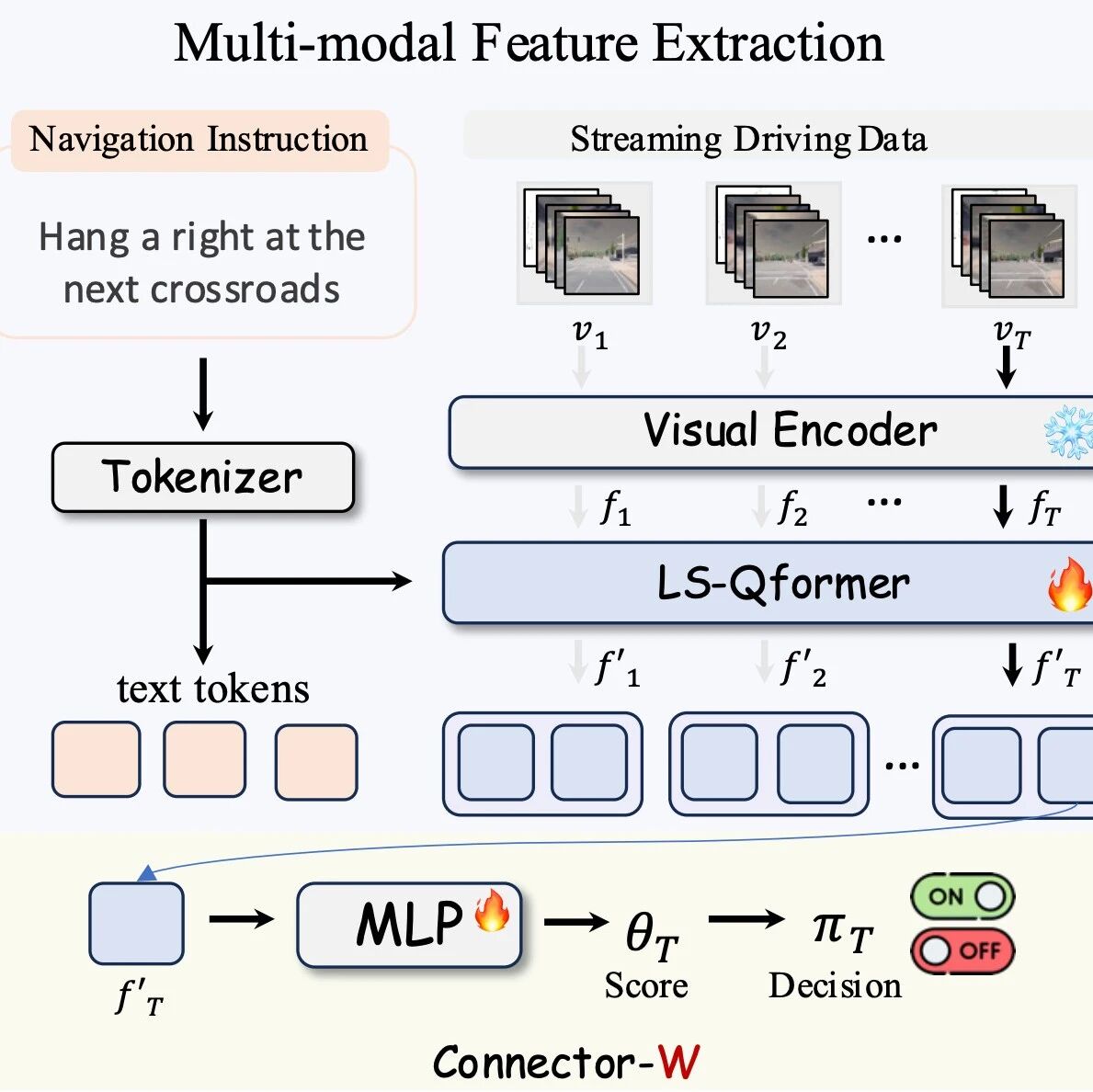
Core Viewpoint - The article discusses the introduction of AdaDrive, an adaptive slow-fast framework for integrating large language models (LLMs) into autonomous driving systems, aiming to balance high reasoning capabilities with real-time performance [2][3][4]. Background Review - Autonomous driving has been a research focus in academia and industry, with the emergence of LLMs enhancing cognitive reasoning and decision-making capabilities in driving systems. Early methods like LMDrive and AD-H faced challenges with memory overhead and latency, particularly in dynamic driving environments [4][7]. AdaDrive Algorithm Overview - AdaDrive is proposed as a next-generation framework that employs a fast-slow system paradigm, balancing high-frequency low-latency tasks with low-frequency high-reasoning tasks. It dynamically determines when to activate LLMs and adjusts their contribution based on scene complexity and prediction confidence [8][10][15]. Key Innovations - The framework introduces two key innovations: adaptive LLM activation, which learns the optimal activation timing through a novel loss function, and dynamic LLM contribution adjustment, which uses confidence-driven strategies to modulate LLM influence [8][9][21]. Experimental Results - AdaDrive demonstrated superior performance in the LangAuto benchmark, achieving driving scores of 80.9% and 70.6% in short-distance tasks, significantly outperforming the second-best method by 12.9% and 16.3% respectively [31][32]. - The method also showed advantages in inference time and memory costs due to its adaptive architecture and custom memory buffer, reducing computational overhead while enhancing driving performance [33]. Conclusion - The research highlights the potential of LLM-based language-guided autonomous driving technology, focusing on optimal activation timing and effective utilization strategies. AdaDrive's adaptive architecture and efficient memory management strategies significantly improve both effectiveness and efficiency compared to existing methods [43].
从目前的信息来看,端到端的落地上限应该很高......
自动驾驶之心· 2025-11-12 00:04
Core Insights - The article highlights significant developments in the autonomous driving industry, particularly the performance of Horizon HSD and the advancements in Xiaopeng's VLA2.0, indicating a shift towards end-to-end production models [1][3]. Group 1: Industry Developments - Horizon HSD's performance has exceeded expectations, marking a return to the industry's focus on one-stage end-to-end production, which has a high potential ceiling [1]. - Xiaopeng's VLA2.0, which integrates visual and language inputs, reinforces the notion that value-added (VA) capabilities are central to autonomous driving technology [1]. Group 2: Educational Initiatives - The article discusses a new course titled "Practical Class for End-to-End Production," aimed at sharing production experiences in autonomous driving, focusing on various methodologies including one-stage and two-stage frameworks, reinforcement learning, and trajectory optimization [3][8]. - The course is limited to 40 participants, emphasizing a targeted approach to skill development in the industry [3][5]. Group 3: Course Structure - The course consists of eight chapters covering topics such as end-to-end task overview, two-stage and one-stage algorithm frameworks, navigation information applications, reinforcement learning algorithms, trajectory output optimization, fallback solutions, and production experience sharing [8][9][10][11][12][13][14][15]. - Each chapter is designed to build upon the previous one, providing a comprehensive understanding of the end-to-end production process in autonomous driving [16]. Group 4: Target Audience and Requirements - The course is aimed at advanced learners with a background in autonomous driving algorithms, reinforcement learning, and programming skills, although it is also accessible to those with less experience [16][17]. - Participants are required to have a GPU with recommended specifications and a foundational understanding of relevant mathematical concepts [17].

文远知行_首次覆盖文远知行 - H,评级 “买入”_高风险
2025-11-11 06:06
WeRide (WRD.O/0800.HK) Conference Call Summary Company Overview - **Company**: WeRide - **Ticker**: 0800.HK (H-share), WRD.O (ADR) - **Founded**: 2017 - **Industry**: Autonomous Driving - **Global Presence**: Operations in over 30 cities across 11 countries, with permits in seven markets including China, Saudi Arabia, UAE, Singapore, France, Belgium, and the US [16][21] Key Points Coverage Initiation - **Rating**: Initiated coverage on WeRide-H with a Buy/High Risk rating - **Target Price**: HKD39.6 for H-share and US$15.3 for ADR, adjusted from US$18.2 due to share dilution from H-share listing [1][4] Market Forecast - **Robotaxi Market Growth**: - Fleet size expected to grow from 3.8k units in 2025 to 538k units in 2030 and 2.3 million units in 2035 - CAGR of 169% from 2025 to 2030 and 34% from 2030 to 2035 - Total addressable market for robotaxis in China projected to reach US$15 billion in 2030 and US$68 billion in 2035, with a CAGR of 229% from 2025 to 2030 [2] Cost Reduction - **Vehicle Cost**: Anticipated decline in full vehicle cost per Robotaxi to US$32.4k in 2030 and US$28.2k in 2035, with a CAGR of -6% from 2025 to 2030 and -3% from 2030 to 2035 [2] Major Milestones - **Expansion**: Launched Robotaxi and Robobus pilots in Ras Al Khaimah, UAE, marking the third emirate of operation [3][10] Financial Projections - **EPS Forecast**: Updated EPS forecast for 2025-27E to Rmb -4.44/-3.89/-2.82, down from Rmb -5.34/-4.68/-3.39 due to share dilution [4] - **Free Cash Flow**: Expected outflow of Rmb1.58 billion in 2025, Rmb1.16 billion in 2026, and Rmb1.14 billion in 2027, with potential refinancing needed in 2027 [9] Valuation Metrics - **Valuation Methodology**: DCF valuation with a WACC of 17.1% and a terminal growth rate of 2% - **Target Price Implications**: Implies 13x 2027E PS and 1.3x 2030E PS/9.0x 2030E PE, with current trading around 8x 2027E PS and 0.8x 2030E PS/5.6x 2030E PE [4][18] Investment Strategy - **High-margin Overseas Business**: Significant milestones achieved overseas, with partnerships with Uber and Grab to accelerate deployment of L4 robotaxis [17][22] - **Cost Advantages**: Latest robotaxi model GXR priced at USD 40k with advanced computing power of 2,000 TOPS, expected fleet size of 1k units by end-2025 [17][22] Risks - **High Risk Rating**: Due to loss-making status and uncertainties in robotaxi development - **Key Risks**: Include technological challenges, business model uncertainty, safety concerns, competition, regulatory risks, cash shortages, and limited operating history [19][24] Conclusion - WeRide is positioned as a leader in the autonomous driving sector with significant growth potential in the robotaxi market, supported by strategic partnerships and cost advantages. However, the company faces substantial risks that could impact its future performance.
港股异动 | 百度集团-SW(09888)现涨超4% 萝卜快跑宣布获阿布扎比全无人商业化运营许可
智通财经网· 2025-11-11 01:38
Core Viewpoint - Baidu Group's stock has seen an increase of over 4%, currently trading at 130.4 HKD, with a transaction volume of 245 million HKD, following the announcement of significant developments in the autonomous vehicle sector by its partner,萝卜快跑 [1] Group 1: Company Developments - 萝卜快跑 has received the first batch of fully autonomous commercial operation licenses from the Abu Dhabi Integrated Transport Centre (ITC), marking a key advancement in its global strategy [1] - Since entering the Abu Dhabi market in March, 萝卜快跑 has formed a strategic partnership with AutoGo to deploy sixth-generation autonomous vehicles in specific areas, aiming for full autonomous operation by 2026 [1] - The collaboration aims to create the largest fleet of autonomous vehicles in Abu Dhabi, enhancing urban traffic efficiency and reducing carbon emissions, contributing to the city's smart city goals [1] Group 2: Operational Metrics - As of October 31, 萝卜快跑 has surpassed 250,000 weekly orders, all of which are fully autonomous [1] - The total number of global orders serviced by 萝卜快跑 has exceeded 17 million [1]
在地平线搞自动驾驶的这三年
自动驾驶之心· 2025-11-11 00:00
Core Viewpoint - The article discusses the transition from autonomous driving to embodied intelligence, highlighting the differences in challenges and solutions between the two fields. It emphasizes the importance of documenting past experiences in autonomous driving, despite the focus shifting to embodied intelligence. Research Areas Summary - The main research areas include 3D fusion perception, trajectory prediction, end-to-end motion planning, sensor simulation, traffic flow simulation, and foundational models for intelligent driving. These areas are interconnected and aim to build a comprehensive autonomous driving algorithm system [2][5]. 1. Sparse4D Series: Multi-Sensor Fusion Perception Framework - The Sparse4D series aims to improve perception performance by utilizing sparse queries and projection sampling from multi-view images, avoiding the computational costs associated with BEV (Bird's Eye View) methods. Sparse4D v1 introduced deformable aggregation for sparse fusion, while v2 improved temporal fusion complexity from O(T) to O(1) [6][9]. Sparse4D v3 further enhanced detection and tracking capabilities, achieving top rankings in camera-only detection and tracking leaderboards [11][13]. 2. SparseDrive: End-to-End Planning Attempt - SparseDrive integrates online mapping and motion planning, achieving five tasks: detection, tracking, mapping, prediction, and planning. It raises concerns about the simplicity of its planning decoder and the need for closed-loop performance evaluation [13][15]. 3. EDA & UniMM: Trajectory Prediction and Traffic Flow Simulation - EDA (Evolving and Distinct Anchors) addresses the core issue of anchor and sample allocation in trajectory prediction, enhancing model convergence. UniMM unifies existing traffic simulation models and proposes a general algorithm framework, addressing key performance factors [16][20]. 4. DriveCamSim: Sensor Simulation - DriveCamSim focuses on creating a highly controllable sensor simulation system to evaluate autonomous driving models efficiently. It emphasizes the need for a simulation system that can accurately reflect model performance without relying solely on real-world testing [22][24]. 5. LATR: Foundational Model for Intelligent Driving - LATR aims to build a robust foundational model for intelligent driving using large datasets and parameters. It employs a masking strategy for unsupervised training and integrates multiple tasks into a unified framework, demonstrating effective performance [26][27]. Conclusion and Outlook - The seven modules collectively form the core link of the autonomous driving system, indicating a correct technological path. The article suggests that the future focus should be on efficient evaluation systems and the potential of reinforcement learning to enhance model performance [30][31].
Grab:6000万美元投资Vay,或增至4.1亿美元
Sou Hu Cai Jing· 2025-11-10 13:17
Group 1 - Grab is investing $60 million in remote driving service company Vay to enhance its presence in the autonomous vehicle technology sector [1] - The investment could increase to $410 million within a year if Vay meets certain milestones, pending regulatory approval, with the transaction expected to be completed in Q4 [1] - Vay's service model operates between traditional taxis and fully autonomous vehicles, where a remote operator controls the vehicle until it reaches the customer, who then takes over driving [1] Group 2 - Grab is not the only ride-hailing platform preparing for the future of autonomous driving, as its U.S. counterparts Uber and Lyft are also collaborating with technology suppliers and fleet operators for global deployment [1]
