
农药

Search documents
贝斯美:2025年度业绩预告
Zheng Quan Ri Bao· 2026-01-15 13:39
Group 1 - The company, Beishimei, announced an expected net profit attributable to shareholders for the year 2025 ranging from 23.68 million to 34.06 million yuan, compared to a loss of 32.86 million yuan in the same period last year, indicating a growth of 172.05% to 203.64% year-on-year [2]

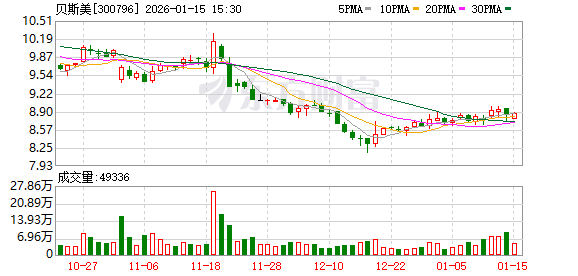
贝斯美2025年归母净利润预计逾2368万元 前期研发与渠道布局成效释放
Quan Jing Wang· 2026-01-15 12:16
Core Viewpoint - Beishimei (300796) forecasts a significant increase in net profit for the fiscal year 2025, driven by strategic focus on innovation and operational efficiency [1] Financial Performance - The company expects a net profit attributable to shareholders between 23.68 million and 34.06 million yuan, representing a year-on-year growth of 172.05% to 203.64% [1] - The forecasted net profit excluding non-recurring items is projected to be between 19.06 million and 27.37 million yuan, with a year-on-year increase of 152.89% to 175.95% [1] Strategic Initiatives - Beishimei emphasizes its commitment to "industry focus, technological innovation, environmental safety, and standardized operations" as core principles [1] - The company is implementing a "strong chain, extended chain" strategy to optimize and upgrade its product structure [1] - Previous investments in new product development and international trade channels are beginning to yield positive results, particularly in trade-related product profitability [1] Industry Context - The "14th Five-Year Plan" for the national pesticide industry supports the development of efficient, low-risk new chemical pesticides and promotes biological pesticides [1] - Beishimei is leveraging its technological advantages and comprehensive environmental upgrades to meet the rising demand for green chemicals [1] Future Outlook - The company plans to continue enhancing operational efficiency through refined management practices and innovation-driven growth strategies [2]
中农联合:农药市场产品价格受多种因素共同影响
Zheng Quan Ri Bao Wang· 2026-01-15 09:42
Core Viewpoint - The company, Zhongnong United (003042), emphasizes its integrated production capabilities in pesticide manufacturing, highlighting its competitive position in the market for new neonicotinoid pesticide products [1] Group 1: Company Overview - Zhongnong United is an integrated pesticide production enterprise with a strong focus on the research, production, and sales of new neonicotinoid pesticide products [1] - The company has accumulated rich experience in the production and sales of key pesticide raw materials, including imidacloprid, acetamiprid, abamectin, and thiamethoxam, which rank among the top in domestic production and sales [1] Group 2: Market Dynamics - The pesticide market is influenced by various factors, including demand, supply, and competition, which affect product pricing [1] - In response to intense market competition, the company plans to focus on its core business, strengthen operational management, and actively explore market opportunities [1] Group 3: Strategic Initiatives - The company aims to flexibly adjust its sales strategies and deepen efforts in cost reduction and efficiency enhancement [1] - The goal is to improve core competitiveness and operational performance in the face of market challenges [1]
草甘膦概念涨2.29%,主力资金净流入这些股
Zheng Quan Shi Bao Wang· 2026-01-15 09:13
Core Viewpoint - The glyphosate concept sector has seen a 2.29% increase, ranking fifth among concept sectors, with 16 stocks rising, including Jiangshan Co., which hit the daily limit, and others like Lier Chemical and Hebang Bio showing significant gains [1][2]. Group 1: Sector Performance - The glyphosate concept sector experienced a 2.29% increase, placing it fifth among all concept sectors for the day [1][2]. - Notable stocks within the glyphosate sector include Jiangshan Co. (up 9.99%), Lier Chemical (up 6.42%), and Hebang Bio (up 3.21%) [1][3]. Group 2: Capital Flow - The glyphosate concept sector attracted a net inflow of 329 million yuan, with 11 stocks receiving net inflows, and five stocks exceeding 10 million yuan in net inflow [2][3]. - Hebang Bio led the sector with a net inflow of 147 million yuan, followed by Jiangshan Co. (108 million yuan) and Nuofushin (47 million yuan) [2][3]. Group 3: Capital Inflow Ratios - The top stocks by net inflow ratio include Nuofushin (15.76%), Hebang Bio (15.07%), and Jiangshan Co. (14.39%) [3][4]. - The trading turnover rates for these stocks were 3.34% for Nuofushin, 4.93% for Hebang Bio, and 7.07% for Jiangshan Co. [3][4].


润丰股份:公司97%以上的营收来自于海外市场
Mei Ri Jing Ji Xin Wen· 2026-01-15 07:53
Core Viewpoint - The recent strengthening of the RMB has a significant impact on the company's financial expenses related to exchange gains and losses, primarily due to its high revenue dependence on overseas markets [1]. Group 1: Company Financial Impact - Over 97% of the company's revenue comes from overseas markets, making it sensitive to exchange rate fluctuations [1]. - The specific impact on the company's financial data is influenced not only by the RMB's exchange rate changes but also by the exchange rate movements in the countries where its major overseas subsidiaries operate [1].
农药退税新政或推动“反内卷”,有望提振价格长期加速转型
Guotou Securities· 2026-01-15 07:08
Investment Rating - The industry investment rating is "Outperform the Market - A" and the rating is maintained [5]. Core Insights - The new pesticide export tax rebate policy is expected to drive a "reverse involution" in the industry, potentially boosting prices and accelerating long-term transformation [1]. - The cancellation of the export tax rebate for certain pesticide products will increase export costs, leading companies to have a strong willingness to maintain prices [2]. - The policy aims to accelerate the elimination of low-quality production capacity and guide the industry towards a high-quality development direction by shifting the export structure from raw materials to formulations [3]. Summary by Sections Short-term Outlook - The upcoming spring farming season and the cancellation of the export tax rebate will provide dual support for pesticide prices, as companies may increase prices to maintain profitability [2]. Long-term Outlook - The domestic pesticide industry is experiencing high growth in investment and new projects, with an expected increase in production capacity of approximately 1.4 million tons per year from 2021 to 2024 [3]. - The policy is expected to improve capacity utilization rates, which are currently low at 66% compared to the national average for large-scale industries [3]. Industry Performance - The industry has shown strong relative performance with a 1-month return of 8.2%, a 3-month return of 10.1%, and a 12-month return of 26.1% [8].
农药行业“一证一品”新政落地,落后产能出清,龙头股集体走强引领行情
Jin Rong Jie· 2026-01-15 06:21
Core Viewpoint - The agricultural pesticide sector is experiencing a significant upward trend driven by multiple favorable factors, including policy incentives, the upcoming spring farming season, and a recovery in global market demand [1][2]. Group 1: Policy Changes - The "One Certificate, One Product" policy will be fully implemented on January 1, 2026, aiming to eliminate the long-standing issues of "one pesticide with multiple names" and "certificate borrowing" in the industry [1]. - This policy is expected to compel companies to shift focus from "labeling" to "research and development," fostering competition based on technology, quality, and service, thereby promoting high-quality industry development [1]. Group 2: Export Tax Adjustments - The cancellation of export tax rebates for certain pesticide raw materials starting April 1, 2026, is anticipated to pressure profit margins for related companies in the short term [2]. - However, this adjustment may accelerate the elimination of outdated production capacity and encourage companies to transition to high-end products, enhancing product value [2]. - In 2024, China's pesticide formulation export value reached 61.36 billion, surpassing raw material exports for the first time, with a share of 54.12% [2]. Group 3: Demand Dynamics - The upcoming spring farming season is expected to release strong demand for pesticides, with an estimated 3.8 billion acres of crops affected by pests, leading to direct economic losses exceeding 42 billion [3]. - The industry has maintained an operating rate of over 80% for the past eight months, with inventory levels at their lowest since the beginning of 2024, indicating a favorable supply-demand balance [3]. Group 4: Benefiting Industries - The pesticide intermediate sector is likely to benefit from the rising demand for pesticide raw materials, with companies like Lianhua Technology expected to see performance growth due to stable demand from downstream clients [4]. - The phosphorus chemical industry will also benefit, as the recovery in pesticide demand will increase the consumption of upstream raw materials like phosphate rock and phosphoric acid [4]. - The integration of precision agriculture and the pesticide industry is expected to drive growth in the plant protection service and smart pesticide machinery sectors, with significant increases in the adoption of precision application equipment projected [5].


农药股逆势拉升 江山股份触及涨停
Mei Ri Jing Ji Xin Wen· 2026-01-15 05:45
每经AI快讯,1月15日午后,农药股逆势拉升,江山股份(600389)触及涨停,联化科技(002250)、 利尔化学(002258)、钱江生化(600796)、广信股份(603599)、苏利股份(603585)跟涨。 ...
国信证券晨会纪要-20260115
Guoxin Securities· 2026-01-15 01:02
Macro and Strategy - The US December CPI data shows overall CPI at 2.7% year-on-year, with core CPI at 2.6%, indicating a stabilization in inflation [7] - China's December export growth was 6.6% year-on-year, with imports growing by 5.7%, resulting in a trade surplus of $114.14 billion [7] Industry and Company - The semiconductor industry is experiencing unexpected prosperity, with price increases across multiple segments and anticipated growth in AI glasses [3][7] - The chemical industry is facing challenges due to the cancellation of export tax rebates for certain pesticides, which may accelerate the exit of outdated production capacity [3][15] - The media sector is seeing a restructuring of traffic and content service ecosystems driven by AI applications, indicating a new growth cycle [3][19] - The mechanical industry is optimistic about growth opportunities in humanoid robots, AI infrastructure, and commercial aerospace sectors [3][28] Semiconductor Industry Insights - The semiconductor sector has seen a 3.82% increase in the Shanghai Composite Index, with electronic stocks rising by 7.74% [7] - AI-driven demand is pushing prices up in upstream electronic components, with significant shortages in storage and high-end PCB supply chains [7] - The CES 2026 showcased advancements in AR glasses, indicating a trend towards enhanced communication and computing capabilities in smart glasses [9] Chemical Industry Insights - The cancellation of export tax rebates for certain pesticides is expected to squeeze profit margins for companies like grass ammonium glyphosate, potentially leading to price increases in the short term [15][16] - The pesticide formulation export value is projected to rise, as the market shifts towards higher-value products [16] Media Industry Insights - The media sector's performance in December lagged behind the market, with a 1.60% decline in the media index [17] - The number of game licenses issued in December reached a record high, indicating a robust pipeline for new game releases [17][19] - The AI application in media is expected to enhance overall sector valuations, with a focus on AI marketing and content creation [20] Mechanical Industry Insights - The mechanical industry index rose by 8.59% in December, outperforming the Shanghai Composite Index [25] - The sales of excavators in December increased by 19.2% year-on-year, indicating strong demand in the construction sector [25] - The focus on humanoid robots and AI infrastructure is expected to drive long-term investment opportunities in the mechanical sector [28][34] Investment Recommendations - Recommended stocks in the semiconductor sector include companies like SMIC, Aojie Technology, and Demei Li [13] - In the media sector, companies such as Giant Network and Bilibili are highlighted for their growth potential [20] - The mechanical sector suggests focusing on companies involved in humanoid robots and AI infrastructure, such as Flywheel and Weichuan Technology [28][35]
股市必读:江山股份(600389)1月14日主力资金净流出467.04万元,占总成交额2.11%
Sou Hu Cai Jing· 2026-01-14 19:01
Summary of Key Points Core Viewpoint - Jiangshan Co., Ltd. is in the process of issuing convertible bonds to raise up to 1.2 billion yuan for various projects, including green herbicides and chiral pesticide upgrades, with the application already accepted by the Shanghai Stock Exchange [2][3]. Group 1: Trading Information - As of January 14, 2026, Jiangshan Co., Ltd. closed at 22.93 yuan, down 0.95%, with a turnover rate of 2.22%, trading volume of 95,800 shares, and a total transaction value of 221 million yuan [1]. - On the same day, the net outflow of main funds was 4.67 million yuan, accounting for 2.11% of the total transaction value, while speculative funds saw a net inflow of 9.58 million yuan, representing 4.33% of the total transaction value [2][4]. Group 2: Company Announcements - Shenwan Hongyuan Securities issued a sponsorship letter confirming that Jiangshan Co., Ltd. meets the conditions for issuing and listing convertible bonds, with average distributable profits over the last three years sufficient to cover one year of bond interest [2]. - Beijing Wei Heng Law Firm provided a legal opinion affirming the company's eligibility to issue bonds in compliance with relevant laws and regulations, pending approval from the Shanghai Stock Exchange and registration with the China Securities Regulatory Commission [2]. - The prospectus for the convertible bond issuance indicates that the total amount raised will not exceed 1.2 billion yuan, aimed at funding new projects and supplementing working capital, with the company's credit rating and bond rating both at AA+ [2].