
Internet

Search documents
阿里巴巴-重塑高德地图业务-Revamping Amap Business
2025-09-15 01:49
Summary of Alibaba Group Holding (BABA) Conference Call Company Overview - **Company**: Alibaba Group Holding (BABA) - **Industry**: China Internet and Other Services - **Market Cap**: US$349.385 billion - **Current Stock Price**: US$147.10 (as of September 9, 2025) - **Price Target**: US$165.00, representing a 12% upside potential Key Points Industry Dynamics - **Competition**: The on-demand competition is extending to in-store services, posing risks for Meituan, which may face further margin pressure [1][5] - **Market Positioning**: Alibaba is positioned ahead of PDD, Meituan, and JD in the local services segment [1] Amap Business Revamp - **AI Integration**: Alibaba announced the rollout of AI-driven rankings for restaurants, hotels, and attractions on Amap, similar to Meituan's Dianping, covering 1.6 million businesses across 300 cities [2] - **User Engagement**: Amap has close to 200 million daily active users (DAU), indicating strong user engagement [3] - **Investment Commitment**: Alibaba committed to invest Rmb1 billion in incentives to drive traffic to Amap and promote in-store services [2] Financial Performance and Projections - **Local Services Growth**: Alibaba's local services segment has shown aggressive expansion, with a 25% year-over-year growth in monthly active customers (MAC) in August [4] - **Profitability Outlook**: The company aims to reduce user engagement losses by half in 1-2 months and expects quick commerce (QC) to contribute 2-3% to compound monthly revenue (CMR) growth [4] - **Long-term Goals**: Alibaba targets Rmb1 trillion in incremental gross merchandise volume (GMV) from QC over the next three years [4] Implications for Competitors - **Meituan's Earnings Pressure**: The entry of Alibaba into in-store services is expected to create near-term earnings pressure for Meituan, with a projected operating loss of Rmb10 billion in Q3 [5] - **Profitability Adjustments**: Long-term profitability estimates for Meituan's in-store services have been lowered from 2.5% to 2% due to intensified competition [5] Stock Recommendations - **Preferred Stock Picks**: Within the e-commerce sector, the preferred ranking is BABA > PDD > Meituan > JD, with BABA noted for its cloud growth acceleration and sustained double-digit CMR [6] Financial Metrics - **Earnings Per Share (EPS)**: Projected EPS for FY25 is Rmb53.59, with a decline expected in FY26 to Rmb50.05 [8] - **Revenue Projections**: Expected revenue for FY25 is Rmb996 billion, increasing to Rmb1,204 billion by FY28 [8] - **Valuation Metrics**: Current P/E ratio is 17.8, with an EV/EBITDA of 9.1 [8] Additional Insights - **Market Sentiment**: The overall industry view is considered attractive, with Alibaba's stock rated overweight [8] - **Risks**: Potential risks include intensified competition, regulatory scrutiny, and macroeconomic conditions affecting consumer sentiment [15][12] This summary encapsulates the critical insights from the conference call regarding Alibaba's strategic initiatives, competitive landscape, financial outlook, and market positioning.

中国人工智能核心技术手册 -人工智能技术创新、应用与受益者-China AI Frontier (H_A)_ China AI Backbone Handbook_ AI Tech Innovations, Applications, Beneficiaries
2025-09-15 01:49
Summary of Key Points from the Conference Call Industry Overview - **Industry Focus**: The report centers on the AI industry in China, particularly advancements in AI chips, data centers, public clouds, and software applications. It highlights the expected growth of AI as a new driver for various industries over the next 5-10 years [1][2][3]. AI Chips - **Market Growth**: The AI accelerator market in China is projected to grow from **US$18.5 billion in 2024** to **US$78 billion in 2027**, representing a **CAGR of 61%**. Key drivers include high demand from hyper-scalers like Alibaba and supportive government policies [2][14]. - **Localization Rate**: The localization rate of AI accelerators in China is expected to rise from **43% in 2024** to **83% in 2027** [2][15]. Data Centers - **Capacity Growth**: China's total data center capacity is forecasted to grow from **4.2 GW in 2017** to **22.0 GW in 2024**, with a **CAGR of 27%**. Total server capital expenditure is expected to reach **RMB 518 billion in 2027** [3][23]. - **Demand Dynamics**: The total data center demand is projected to increase to **27.1 GW by 2027**, with an expected **25% CAGR** from 2024 to 2027. The utilization rate is anticipated to improve from **64% in 2024** to **67% in 2027** [3][24][25]. AI Models and Applications - **User Adoption**: In 2024, **249 million users** (17.7% of the population) in China are expected to utilize generative AI tools, primarily for Q&A and text processing [4][42]. - **Market Expansion**: The GenAI software market is projected to grow at a **40% CAGR**, reaching **US$9.8 billion by 2029** [4][48]. Key Stock Picks - **Semiconductors**: Companies like Montage and Horizon Robotics are highlighted for their roles in AI chip production [5][53]. - **Data Centers**: VNET and GDS are identified as leading data center operators benefiting from the AI demand [5][53]. - **Software**: Kingdee, Meitu, and Kingsoft Corp are noted for their AI-driven software solutions [5][53]. - **Public Cloud**: Alibaba and Kingsoft Cloud are expected to leverage AI for growth in cloud services [5][54]. Additional Insights - **AI Infrastructure Investment**: Alibaba is committing **RMB 380 billion** over three years to enhance its AI capabilities across various sectors [54][56]. - **Competitive Landscape**: Domestic AI chip manufacturers are narrowing the performance gap with global leaders like Nvidia, indicating a competitive shift in the market [21][38]. - **Emerging Opportunities**: New hardware developments, such as AI glasses and toys, are seen as potential growth areas, although they are still in early stages [42]. Conclusion The report emphasizes the rapid advancements and growth potential within China's AI sector, driven by increasing demand for AI technologies across various industries, significant investments in infrastructure, and a competitive landscape that is evolving quickly.


为解决AI污染问题,互联网行业要开始“查成分”
3 6 Ke· 2025-09-14 23:33
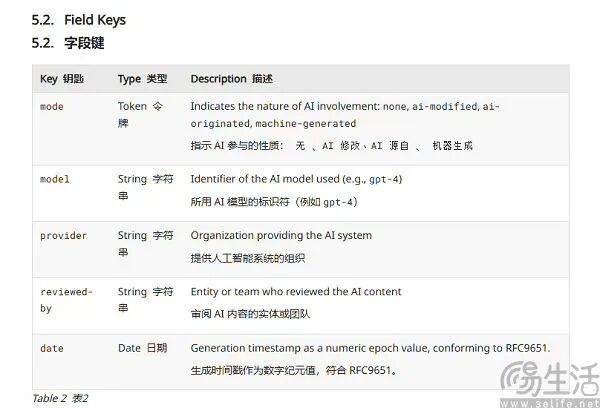
Core Viewpoint - The Internet Engineering Task Force (IETF) has proposed the "AI Content Disclosure Header" draft to address the challenge of distinguishing between AI-generated and human-generated content on the internet, aiming to mitigate the spread of false information generated by AI systems [1][3][11]. Group 1: IETF's Proposal - The IETF's draft aims to introduce machine-readable AI content markers in HTTP responses to indicate the nature of AI involvement in content generation [2][13]. - The proposed markers include details such as the AI model used, the organization providing the AI system, the reviewing entity, and the generation timestamp [2][13]. Group 2: Challenges in AI Content - A significant issue in the AI field is the circular referencing of false content by different AI products, leading to the phenomenon of "making falsehoods true" and disrupting the internet content ecosystem [3][11]. - AI hallucinations, where AI generates plausible but incorrect information, pose a challenge, as AI models rely on probabilistic predictions rather than factual accuracy [6][11]. Group 3: Implications of AI Content - The interdependence of AI systems can create a closed loop of misinformation, where false content is perpetuated across different platforms, ultimately affecting users [9][11]. - The IETF's initiative seeks to prevent the recycling of AI-generated false content into the internet, thereby avoiding a negative feedback loop of "garbage in, garbage out" in AI training data [11][13].

Witkoff Sold $120 Million Stake in His Company, Disclosure Shows
Yahoo Finance· 2025-09-14 15:52
Core Points - Steve Witkoff sold an interest in his real estate management company for $120 million to avoid potential conflicts of interest [1][3] - The financial disclosure indicates Witkoff's assets are valued at least $350 million, with several holdings exceeding $50 million [4][3] - Witkoff's portfolio includes residential and commercial real estate, stakes in various tech companies, and digital assets [5] Group 1: Financial Disclosure - The financial disclosure was submitted in August and indicates Witkoff's official start date as June 30 [2] - The document does not confirm approval from ethics officials at the White House [2] - Witkoff's holdings include upscale properties in major cities such as Los Angeles, Miami Beach, and New York City [3] Group 2: Asset Valuation - Witkoff's assets include residential real estate in Southampton, New York, and a cash account at a US bank [4] - Other significant holdings include a stake in SpaceX, shares in Cisco Systems, Reddit, and Uber [5] - Witkoff received $34 million in distributions from a holding company that includes various real estate developments and World Liberty Financial [6]
AI时代入口竞争的巨变:从场景心智到角色心智
Tai Mei Ti A P P· 2025-09-14 12:31
Group 1: Core Concepts - The core competition in the internet era is centered around "scene mentality," where companies that dominate high-frequency scenarios can establish entry advantages [1] - In the AI era, the competition shifts from "scene mentality" to "role mentality," where the focus is on becoming a trusted role that can cover multiple scenarios [2][3] Group 2: Consumer Side (ToC) - AI assistants are expected to replace fragmented scenario-based applications, allowing users to perform various tasks through a single role, enhancing personalization and emotional connection [4] - The emotional aspect of role mentality creates a stronger barrier compared to scene mentality, as users are more likely to develop dependency on an AI assistant [4] Group 3: Business Side (ToB) - In enterprise services, AI is evolving from single-point tools to fulfilling specific roles within organizations, enhancing operational efficiency [5][6] - AI enterprise assistants can automate various tasks across departments, becoming central figures in organizational processes [6][7] Group 4: Role of Digital Employees and Virtual Executives - Repetitive tasks are increasingly being replaced by digital employees, which can continuously learn and improve efficiency [8][11] - Virtual executives, such as AI CMO and AI CFO, are emerging as integral parts of organizations, assisting in strategic decision-making and operational management [8][11] Group 5: Business Implications of Role Mentality - The value of role mentality lies in its ability to facilitate cross-scenario migration and establish trust barriers, making it crucial for companies to create a strong role positioning in the minds of users and enterprises [9][10]
Prediction: The Path Is Finally Clear For These 2 Technology Giants to Surpass $4 Trillion Valuations
The Motley Fool· 2025-09-14 10:00
Core Insights - The article discusses the potential for Alphabet and Apple to reach $4 trillion valuations, driven by their advancements in artificial intelligence and recent favorable legal developments [3][9][16] Company Developments - Nvidia has seen its market cap increase from around $300 billion to over $4 trillion, primarily due to investments in artificial intelligence [2] - Alphabet faced legal challenges regarding its monopoly in internet search but received a lenient ruling that allows it to continue revenue-sharing deals, including with Apple [5][7] - Apple benefits significantly from Alphabet's revenue-sharing arrangement, receiving over $20 billion annually for making Google the default search engine on its devices [6] Financial Performance - Alphabet's cloud business reported a 32% increase in sales in the most recent quarter, with an operating margin of 21% [11] - Revenue from Google Search grew by 12% last quarter, indicating strong engagement and monetization despite the rise of AI chatbots [14] Future Prospects - Both companies are exploring deeper partnerships, with discussions about Apple using Alphabet's Gemini LLM for AI features in iOS and Siri [12][13] - Apple is currently 16% short of the $4 trillion market cap, while Alphabet is about 38% away from that benchmark [15][16] - Alphabet's growth will be supported by improvements in search engagement, cloud margins, and opportunities in AI and quantum computing [16]


科研学术,现在可以百度AI一下了
量子位· 2025-09-14 07:30
Core Viewpoint - Baidu Academic is transforming into a comprehensive "Research platform" that covers the entire lifecycle of academic papers, from searching and reading to creating and editing, aiming to become the first one-stop AI academic platform in the industry [1][2][29]. Group 1: Features of the New Platform - The platform will include AI academic search, AI literature summarization, AI reading, and paper mapping, enhancing the efficiency of literature collection and research [1][3][7]. - Users can input keywords to find relevant literature, and utilize AI Q&A for summarization, significantly reducing time spent switching between different PDFs [9][10]. - The literature mapping feature allows users to visualize classic literature, research hotspots, and development trajectories in their field within minutes [10][12]. Group 2: Reading and Writing Support - The literature summarization function supports batch uploading of up to 100 files, generating structured summaries in 30 seconds, enabling researchers to grasp core content quickly [13][14]. - The AI reading feature can accurately restore the layout of foreign language literature and provide automatic translations for a smoother reading experience [15][16]. - The writing phase includes a topic recommendation function that suggests valuable innovative research directions based on existing literature [16][19]. Group 3: Academic Resource Integration - Baidu Academic has partnered with professional data analysis platforms like SPSSPRO, allowing for a seamless process from data acquisition to analysis and result presentation [22][23]. - As of now, Baidu Academic has indexed 690 million literature resources, leading globally, with a daily update of over 420,000 documents and a Chinese literature coverage rate of 97% [31][34]. - The platform aims to lower research barriers and enhance academic content dissemination by covering all professional fields classified by the Ministry of Education [33][34]. Group 4: Academic Community Engagement - Baidu Academic has created profiles for 4.2 million scholars, including renowned academicians, facilitating information exchange within the academic community [36][38]. - The vision of upgrading the "academic foundation" to a "global academic ecosystem engine" is becoming increasingly feasible as the academic ecosystem continues to improve [38][40].


Rolling Stone, Billboard owner Penske sues Google over AI overviews
Reuters· 2025-09-14 02:51
Core Viewpoint - The owner of Rolling Stone, Billboard, and Variety has filed a lawsuit against Google, claiming that the technology company's AI-generated summaries utilize its journalism without permission and negatively impact traffic to its websites [1] Group 1 - The lawsuit alleges that Google's AI summaries are infringing on the rights of the journalism owned by the plaintiff [1] - The complaint highlights a reduction in website traffic as a consequence of Google's AI practices [1]

纪事|38年前的今天,中国向国外发出了第一封电子邮件
Bei Jing Ri Bao Ke Hu Duan· 2025-09-14 01:35
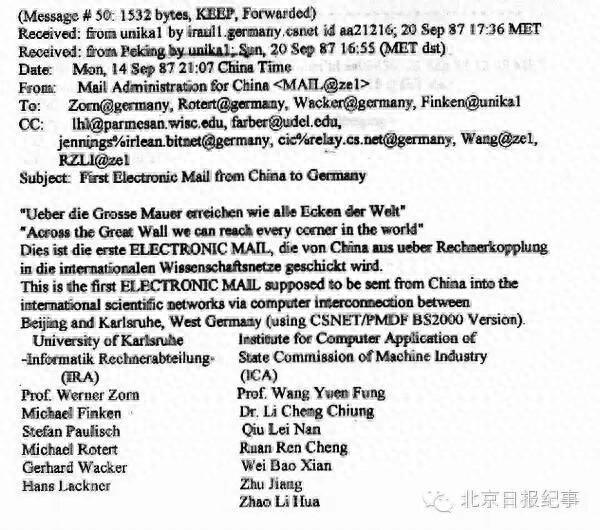
Core Points - The article discusses the historical significance of China's first email sent to Germany in 1987, marking the beginning of China's journey into the internet era [1][2][4] - It highlights the challenges faced by Chinese scientists in establishing international internet connections and the eventual success in connecting to the global network [5][16][26] Group 1: Historical Context - The first email sent from China contained the message "Across the Great Wall we can reach every corner in the world," symbolizing China's entry into the international scientific community [2][4] - The project to establish an international internet channel began in 1985, driven by the urgent need for Chinese researchers to share their work globally [5][10] Group 2: Key Figures and Collaborations - Wang Yunfeng, a researcher at the Chinese Academy of Sciences, played a crucial role in initiating the project and sought collaboration with German professor Werner Zorn, known as the "father of the internet" in Germany [7][8] - Financial support was secured through a special grant from the governor of Baden-Württemberg, which allowed the project to progress significantly [9][10] Group 3: Technical Developments - The successful modification of the host operating system and resolution of software issues between China and Germany took 11 days, leading to the first successful email transmission [11][12] - The email was delayed due to a minor programming error, which was eventually resolved, allowing the email to be sent successfully [12] Group 4: Challenges and Costs - The initial usage of the international email channel was low due to high costs, with each email costing hundreds to thousands of yuan, making it unaffordable for many researchers [15] - The connection established was not directly to the Internet backbone, leading to additional costs and complications in email transmission [15][16] Group 5: Progress Towards Full Internet Access - By 1994, after extensive negotiations, China successfully connected to the Internet backbone, becoming the 77th country to do so [26][21] - The establishment of the ".CN" domain was a significant milestone, allowing China to have its own internet identity [32][27] Group 6: Commercialization and Expansion - The late 1990s saw the emergence of internet companies in China, with figures like Ma Yun (Jack Ma) founding Alibaba and others establishing significant online platforms [34][48] - The reduction in internet access costs in 1997 led to a rapid increase in internet users, marking the beginning of widespread internet adoption in China [46][47]


Rolling Stone Publisher Sues Google Over AI Summaries
WSJ· 2025-09-13 19:52
Core Point - The publisher claims that artificial intelligence-generated answers are infringing on its content, leading to a decline in traffic and revenue for its websites [1] Group 1 - The publisher alleges that AI-generated content is directly stealing its original content [1] - There has been a noticeable reduction in website traffic attributed to the rise of AI-generated answers [1] - The revenue for the publisher's sites has decreased as a result of the traffic decline [1]