
可可

Search documents
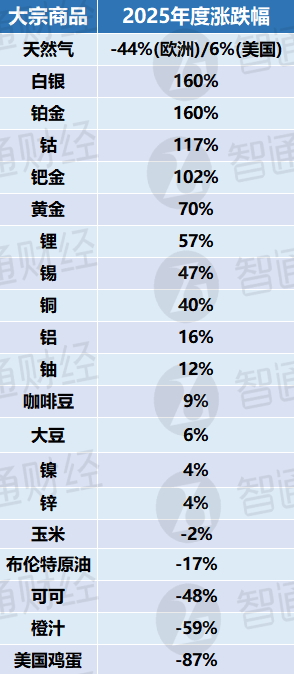
年终盘点之大宗商品:能源疲软,贵金属“疯牛”!2026年“淘金热”行情转向有色?
智通财经网· 2025-12-29 14:22
Key Insights - The global commodity market in 2025 shows a clear divergence, with energy and agricultural prices declining while precious metals (like gold and silver) and industrial metals (like copper) continue to rise and reach new highs. This situation is influenced by changes in global demand, geopolitical tensions, monetary policy adjustments, and the development of the new energy industry. This divergence is expected to persist into 2026, with energy prices anticipated to further decline due to oversupply, while precious metal prices are projected to continue rising [1]. Energy - The global crude oil market in 2025 experienced significant volatility, with Brent crude prices fluctuating between $60 and $70 per barrel by year-end. Geopolitical tensions and policy changes were key drivers of price movements, with prices peaking at $83 per barrel early in the year due to U.S. sanctions on Russia [3][5]. - In the second half of 2025, the market shifted from being geopolitically driven to one characterized by oversupply and weak demand, leading to a downward trend in oil prices. OPEC+ adjusted its strategy from production cuts to phased increases, while U.S. production reached historical highs, resulting in rapid inventory accumulation [5][6]. - For 2026, the oil market is expected to face severe oversupply pressures, with Brent crude prices projected to drop further. Analysts predict a price range of $56 to $60 per barrel, with some forecasts suggesting a potential dip to $51 per barrel in early 2026 [7]. Natural Gas - The global natural gas market in 2025 showed a "high then low" pattern, with prices initially rising due to cold weather and geopolitical factors but later declining as new U.S. production came online and demand slowed in Asia [8][10]. - In 2026, the market is expected to transition from a "tight balance" to "periodic oversupply," driven by increased LNG production from the U.S., Qatar, and Canada. Despite ample supply, demand is projected to rise by 2%, providing some price support [10]. Uranium - The uranium market in 2025 transitioned from "de-bubbling" to "structural support," with prices rebounding from a low of approximately $63 per pound to around $81-83 per pound by year-end. This was driven by renewed demand from nuclear power and AI data centers [11][13]. - For 2026, expectations are for uranium prices to accelerate upward, with forecasts suggesting prices could reach $91 per pound, with some estimates as high as $135 per pound due to increasing demand and supply constraints [14]. Precious Metals - Precious metals experienced a "historic rally" in 2025, with gold prices rising approximately 70% and silver prices soaring over 160%. This was fueled by central bank purchases, ETF inflows, and a low-interest-rate environment [15][17]. - For 2026, major financial institutions predict continued bullish trends for gold, with average prices expected to range from $4,500 to $5,000 per ounce, driven by central bank strategies and concerns over U.S. dollar credit [18][19]. Industrial Metals - The industrial metals market in 2025 was characterized by extreme differentiation, with copper prices reaching historical highs due to demand from AI data centers and global grid upgrades. Copper prices exceeded $12,700 per ton [21]. - In 2026, copper and tin are expected to remain strong, with copper potentially reaching $15,000 per ton, while tin prices may rise to $44,000 per ton due to ongoing supply constraints [28]. Agricultural Products - Cocoa prices fell significantly in 2025 after reaching a peak in 2024, while coffee prices exhibited a high-level fluctuation, with expectations for a return to balance in 2026 as supply improves [25][27]. - For 2026, cocoa is expected to see a surplus of about 150,000 tons, leading to price declines, while coffee prices are projected to drop significantly due to increased production in Brazil and Colombia [29][32].

加纳公共采购体系存在严重腐败风险
Shang Wu Bu Wang Zhan· 2025-11-12 15:15
Core Insights - The IMF report highlights severe systemic corruption issues within Ghana's public procurement system [1] - Companies often need to pay substantial "extra payments" to secure government contracts, fostering a shadow economy around public spending [1] - Over the past 20 years, approximately $358 million in judgment debts have arisen due to this corruption [1] Corruption and Accountability - The ruling party and its affiliates manipulate state institutions for rent-seeking purposes, leading to scandals involving misappropriation of public funds in various sectors, including youth employment agencies and education funds [1] - There is a notable lack of accountability in prosecuting corruption cases involving political figures, which undermines the credibility of the country's anti-corruption mechanisms [1] Sector-Specific Risks - The natural resources sector, particularly oil, mining, and cocoa industries, faces significant revenue loss risks due to weak regulatory frameworks [1]
科特迪瓦与加纳收成前景承压 可可价格重拾涨势
智通财经网· 2025-09-12 12:51
Group 1 - Cocoa futures prices are experiencing upward momentum due to dry weather threatening the next season's production, exacerbating an already tight global supply chain [1] - The most active cocoa futures contract in London rose by 1.3% to £5,264 per ton, with a weekly increase of approximately 1.7%, marking a strong rebound from a one-month low [1] - Severe drought conditions persist in nearly one-third of Côte d'Ivoire, the world's largest cocoa producer, while over half of Ghana is facing extreme drought [1] Group 2 - Cocoa futures prices reached historical highs in 2024, with London/New York prices surging to approximately $10,000–$13,000 per ton, reflecting a 280% increase by April 2024 compared to the beginning of the year [2] - The cocoa industry is facing supply challenges due to El Niño, ongoing drought, and diseases like CSSVD, with expectations of a 10% decline in West African production for the 2025/26 season [2] - Major chocolate manufacturers like Hershey and Lindt have announced double-digit price increases since 2024, indicating that high cocoa prices will likely persist for some time [2]
哥伦比亚2025年第一季度巧克力产业增长10.94%
Shang Wu Bu Wang Zhan· 2025-08-28 15:33
Group 1 - The cocoa, chocolate, and candy processing industry in Colombia experienced a year-on-year growth of 10.94% in the first quarter of 2025 [1] - As of April 2025, there are a total of 1,015 companies engaged in cocoa, chocolate, and candy processing in Colombia [1] - A significant majority, 94.5%, of these companies are classified as micro-enterprises [1]
世界银行警告称加纳可可局债务严重威胁加可可产业发展
Shang Wu Bu Wang Zhan· 2025-08-15 16:01
Core Viewpoint - The World Bank warns that the financial instability of the Ghana Cocoa Board poses a serious threat to the development of the cocoa industry in Ghana, which is a crucial export sector for the country [1] Group 1: Financial Challenges - The World Bank's report highlights ongoing operational and financial challenges within the Ghana Cocoa Board that could jeopardize cocoa's role as a key export [1] - Despite global cocoa prices reaching historical highs, cocoa production in Ghana remains weak, indicating a disconnect between market prices and local production capabilities [1] Group 2: Debt and Supplier Payments - The Ghana Cocoa Board is reported to owe significant amounts to suppliers, exacerbating the financial strain on the cocoa industry [1] - The failure to address these debts could lead to broader economic repercussions for Ghana, given cocoa's importance for foreign exchange earnings and rural income [1] Group 3: Recommendations for Improvement - The report calls for the Ghana Cocoa Board to focus on its core cocoa production activities, reduce non-core financial expenditures, and streamline operations to enhance efficiency and financial health [1]