
塑料及塑料制品

Search documents
山东道恩高分子材料股份有限公司 关于为子公司提供担保的进展公告
Zhong Guo Zheng Quan Bao - Zhong Zheng Wang· 2025-10-19 06:25
Core Viewpoint - The company plans to provide a total guarantee amount of up to RMB 132,300 million for its subsidiaries and sub-subsidiaries for the year 2025, with specific limits based on their debt-to-asset ratios [2] Group 1: Guarantee Overview - The company will provide guarantees not exceeding RMB 113,300 million for subsidiaries with a debt-to-asset ratio of 70% or higher, and up to RMB 19,000 million for those with a ratio below 70% [2] - The guarantee period will last from the date of approval at the 2024 annual general meeting until the 2025 annual general meeting [2] - The total guarantee amount can be used cyclically within the effective period, with the actual external guarantee balance not exceeding RMB 132,300 million at any point [2] Group 2: Guarantee Progress - On October 16, 2025, the company signed a maximum guarantee contract with Zheshang Bank for a guarantee amount not exceeding RMB 50 million for its subsidiary Qingdao Runxing Plastic New Materials Co., Ltd [3] - The guarantee covers all costs related to the main contract, including principal, interest, penalties, and legal fees [3][4] - The guarantee period extends three years from the expiration of the debtor's obligation under the main contract [5] Group 3: Cumulative External Guarantees - As of the announcement date, the total external guarantees provided by the company and its subsidiaries amount to RMB 81,050 million, representing 25.98% of the latest audited net assets attributable to shareholders [6] - There are no overdue guarantees or guarantees involved in litigation, nor any losses incurred due to guarantee-related judgments [6]

山东道恩为子公司提供5000万担保,累计担保8亿余元
Xin Lang Cai Jing· 2025-10-17 08:19
Core Viewpoint - Shandong Daon High Polymer Materials Co., Ltd. announced a guarantee progress report, indicating plans to provide a total guarantee amount not exceeding 1.323 billion yuan for its subsidiaries and sub-subsidiaries by 2025 [1] Group 1: Guarantee Details - On October 16, the company signed a maximum guarantee contract with Zheshang Bank Qingdao Branch, providing a maximum guarantee of 50 million yuan for its subsidiary Qingdao Runxing Plastic New Materials Co., Ltd. [1] - The guarantee covers principal, interest, and other fees, with a guarantee period of three years from the expiration of the debtor's debt performance period as stipulated in the main contract [1] - The main debt period is from October 16, 2025, to October 16, 2026 [1] Group 2: Current Guarantee Status - As of the announcement date, the total external guarantees provided by the company and its subsidiaries amount to 810.5 million yuan, which accounts for 25.98% of the most recent audited net assets attributable to shareholders of the listed company [1] - There are no overdue or abnormal guarantee situations reported [1]
长江期货聚烯烃周报-20250922
Chang Jiang Qi Huo· 2025-09-22 09:03
1. Report Industry Investment Rating - No relevant content provided 2. Core Viewpoints - The polyolefin market is experiencing intense supply - demand competition and is expected to trade in a range. The LL main contract is expected to oscillate between 7200 - 7500, and the PP main contract between 6900 - 7200, with the LP spread expected to widen [5]. - The plastics market has alleviated supply - demand contradictions and has strong bottom support [7]. - The PP market faces significant long - term pressure and is expected to be weakly volatile in the short term [44]. 3. Summary by Directory 3.1 Polyolefin Market - **Market Changes**: On September 19, the L main contract closed at 7169 yuan/ton, and the PP main contract at 6914 yuan/ton, with an LP spread of 255 yuan/ton. LDPE, HDPE, and LLDPE prices showed slight declines. LLDPE South China basis and PP basis both contracted, while their 9 - 1 month spreads widened [5]. - **Fundamental Changes** - **Supply**: China's polyethylene production start - up rate was 80.36%, up 2.32 percentage points, with a weekly output of 63.10 tons, up 2.97%. The PP petrochemical enterprise start - up rate was 74.90%, down 1.93 percentage points. PP pellet output decreased by 2.51% weekly, while PP powder output increased by 2.44% [5]. - **Demand**: The overall domestic agricultural film start - up rate was 26.75%, up 2.63%. The average downstream start - up rate was 51.45%, up 0.59 [5]. - **Inventory**: Plastic enterprise social inventory was 54.66 tons, down 1.37 tons, or 2.45%. Polypropylene domestic inventory was 55.06 tons, down 4.26% [5]. 3.2 Plastics Market - **Weekly Market Review**: On September 19, the plastics main contract closed at 7169 yuan/ton, with LDPE, HDPE, and LLDPE prices showing slight declines. LLDPE South China basis contracted, and the 9 - 1 month spread widened [8]. - **Key Data Tracking** - **Month - Spread**: The 1 - 5, 5 - 9, and 9 - 1 month spreads of plastics had different changes on September 19 compared to September 12 [16]. - **Spot Price**: Different regions and varieties of plastics had different price changes on September 19 [17][18]. - **Cost**: WTI crude oil was at 62.36 dollars/barrel, up 0.24 dollars/barrel, and Brent crude oil was at 66.05 dollars/barrel, down 0.83 dollars/barrel. Anthracite in the Yangtze River port was priced at 1060 yuan/ton, up 10 yuan/ton [20]. - **Profit**: Oil - based PE profit was - 312 yuan/ton, down 92 yuan/ton, and coal - based PE profit was 868 yuan/ton, down 63 yuan/ton [24]. - **Supply**: China's polyethylene production start - up rate was 80.36%, up 2.32 percentage points, with a weekly output of 63.10 tons, up 2.97%. The maintenance loss was 12.52 tons, down 2.10 tons [29]. - **2025 Production Plan**: Multiple enterprises have new production capacity coming on - stream in 2025, with a total planned capacity of 613 [31]. - **Maintenance Statistics**: Many enterprises' production lines are under maintenance, with some having undetermined restart times [32]. - **Demand**: The domestic agricultural film, PE packaging film, and PE pipe start - up rates all increased [33]. - **Downstream Production Ratio**: The linear film production ratio was the highest at 31.9%, and the low - pressure pipe ratio deviated significantly from the annual average [37]. - **Inventory**: Plastic enterprise social inventory was 54.66 tons, down 1.37 tons, or 2.45% [39]. - **Warehouse Receipts**: As of September 19, the polyethylene warehouse receipt quantity was 12736 lots, up 211 lots [42]. 3.3 PP Market - **Weekly Market Review**: On September 19, the PP main contract closed at 6914 yuan/ton, up 1 yuan/ton [45]. - **Key Data Tracking** - **Downstream Spot Price**: Different PP products and related products had different price changes on September 19 [48][49]. - **Basis**: On September 19, the PP spot price was 7020 yuan/ton, down 0.73%. The PP basis was 106 yuan/ton, down 88 yuan, and the 9 - 1 month spread was 14 yuan/ton, up 140 yuan [51]. - **Month - Spread**: The 1 - 5, 5 - 9, and 9 - 1 month spreads of PP had different changes on September 19 compared to September 12 [60]. - **Cost**: WTI crude oil was at 62.36 dollars/barrel, up 0.24 dollars/barrel, and Brent crude oil was at 66.05 dollars/barrel, down 0.83 dollars/barrel. Anthracite in the Yangtze River port was priced at 1060 yuan/ton, up 10 yuan/ton [62]. - **Profit**: Oil - based PP profit was - 435.85 yuan/ton, down 113.68 yuan/ton, and coal - based PP profit was 444.40 yuan/ton, down 45.80 yuan/ton [66]. - **Supply**: China's PP petrochemical enterprise start - up rate was 74.90%, down 1.93 percentage points. PP pellet output was 76.70 tons, down 2.51% weekly, and PP powder output was 6.14 tons, up 2.44% [69]. - **Maintenance Statistics**: Many enterprises' production lines are under maintenance, with some having undetermined restart times [72]. - **Demand**: The average downstream start - up rate was 51.45%, up 0.59. The plastic weaving, BOPP, injection molding, and pipe start - up rates had different changes [74]. - **Import - Export Profit**: The PP import profit was - 480.06 dollars/ton, up 20.80 dollars/ton, and the export profit was - 3.69 dollars/ton, down 0.09 dollars/ton [81]. - **Inventory**: Polypropylene domestic inventory was 55.06 tons, down 4.26%. The two - oil inventory increased by 1.63%, the trader inventory decreased by 7.06%, and the port inventory increased by 4.92% [84]. - **Warehouse Receipts**: On September 19, the PP warehouse receipt quantity was 13499 lots, down 207 lots [91].
金发科技(600143):1H25业绩同比高增 前沿布局有望贡献新增长
Xin Lang Cai Jing· 2025-08-27 12:28
Core Insights - The company reported a significant increase in revenue and net profit for the first half of 2025, with total revenue reaching 31.636 billion yuan, up 35.50% year-on-year, and net profit attributable to shareholders at 585 million yuan, up 54.12% [1] - The company has successfully expanded its global presence with new production facilities in Vietnam, Spain, and Indonesia, enhancing its competitive edge and market influence [2] - The company is actively investing in advanced technology sectors, developing innovative materials for high-speed data transmission and applications in AI servers and robotics [3] Financial Performance - In 1H25, the company achieved total revenue of 31.636 billion yuan, a year-on-year increase of 35.50%, and a net profit of 585 million yuan, up 54.12% [1] - In Q2 2025, the company reported revenue of 15.970 billion yuan, a 24.41% increase year-on-year, and a net profit of 339 million yuan, up 22.61% [1] - The sales volume for modified plastics, green petrochemicals, and new materials reached 1.309 million tons, 826,000 tons, and 129,000 tons respectively, with year-on-year growth of 19.7%, 51.8%, and 31.4% [1] Business Segments - The modified plastics segment generated revenue of 16.47 billion yuan, up 18.6% year-on-year, while the green petrochemicals and new materials segments achieved revenues of 5.96 billion yuan and 1.99 billion yuan, up 49.2% and 28.2% respectively [1] - The company’s overseas business saw a significant increase in finished product sales, reaching 161,000 tons, a year-on-year growth of 33.17% [2] Technological Advancements - The company is focusing on cutting-edge technology, developing halogen-free flame-retardant semi-aromatic polyamide for high-speed data transmission in cooling servers, achieving speeds of 12,800 MT/s [3] - New low dielectric constant and low loss LCP materials are being developed for AI server applications, with transmission rates reaching 224 Gbps [3] - The company has initiated several projects for specialty polyamide production, with plans for significant capacity increases by 2026 [3]

金发科技,多个材料大突破,“爆款”大涨98.9%!
DT新材料· 2025-08-25 16:05
Core Viewpoint - The company Jinfa Technology reported a record high revenue of 31.636 billion yuan in the first half of 2025, a year-on-year increase of 35.50%, with a net profit of 585 million yuan, up 54.12% year-on-year, driven by growth in modified plastics and overseas business expansion [2][3]. Financial Performance - Revenue for the first half of 2025 reached 31.636 billion yuan, compared to 23.347 billion yuan in the same period last year, marking a 35.50% increase [3]. - Total profit for the period was approximately 597 million yuan, up 15.26% from the previous year [3]. - Net profit attributable to shareholders was 585 million yuan, a 54.12% increase year-on-year [3]. - The net cash flow from operating activities decreased by 28.06% to approximately 1.003 billion yuan [3]. - The company's net assets increased by 1.42% to approximately 18.217 billion yuan [3]. Product Performance - Modified plastics saw a sales volume of 130.88 million tons, a year-on-year increase of 19.74%, with a target to exceed 3 million tons for the year [3]. - The sales volume of green petrochemical products reached 43.81 million tons, with a revenue of 5.962 billion yuan, up 49.23% year-on-year [5]. - New materials segment achieved a sales volume of 12.85 million tons, a growth of 31.39% [6]. Market Segmentation - Automotive materials sales reached 560,300 tons, a 21.54% increase year-on-year, with overseas sales growing over 50% [4]. - Home appliance materials sales were 255,000 tons, up 19.55% year-on-year [4]. - Electronic and electrical materials sales reached 205,700 tons, a 17.54% increase, with new high-performance materials gaining recognition [4]. Regional Performance - Ningbo Jinfa reported revenue of 3.76 billion yuan, a 43.17% increase, with polypropylene sales of 419,300 tons, up 14% [9]. - Liaoning Jinfa achieved revenue of 3.722 billion yuan, a 46.48% increase, with ABS product sales of 243,600 tons, up 40.65% [9]. Innovation and Development - The company is developing new materials such as halogen-free flame-retardant semi-aromatic polyamide and low dielectric constant LCP for high-frequency applications [7]. - A new production line for LCP films has been established, with ongoing validation from leading clients in the high-frequency flexible circuit board sector [7]. - The company plans to launch several new projects, including a 15,000 tons/year LCP synthetic resin project and a 40,000 tons/year transparent polyamide project [7].


研判2025!中国茂金属聚乙烯生产工艺、发展背景、产业链、供需现状、竞争格局及发展趋势分析:进口依赖度超90%,未来国产化替代空间巨大[图]
Chan Ye Xin Xi Wang· 2025-08-08 01:36
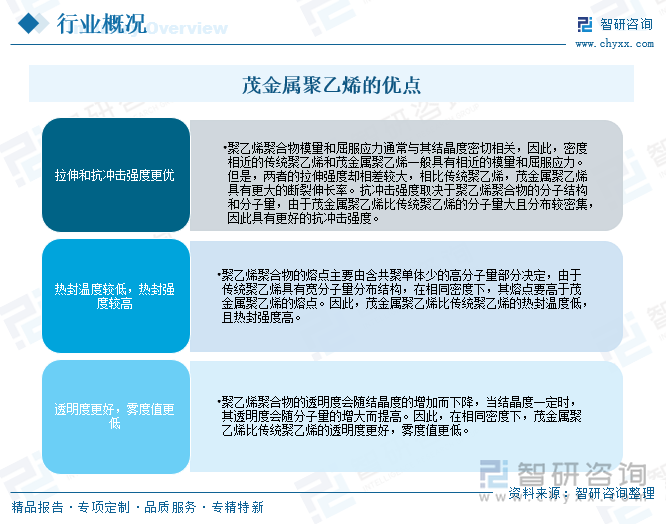
Overview - Metallocene polyethylene (mPE) is recognized for its narrow molecular weight distribution, regular molecular structure, high mechanical strength, excellent optical properties, and good processing stability, earning it the nickname "soft gold" in the polyolefin sector [1][16] - The demand for high-performance materials, particularly in packaging, agricultural films, and pipes, has been increasing in China due to economic growth and rising living standards. The apparent consumption of mPE in China is projected to reach approximately 3 million tons in 2024, with imports hitting 2.72 million tons, resulting in a high import dependency of 90.67% [1][16] Industry Background - The production of mPE is supported by national policies aimed at developing new materials, with the "Production of Metallocene Polyethylene and Other Special Polyolefins" listed as a key development area in the "Industrial Structure Adjustment Directory (2024)" [8] - Continuous advancements in production technology and catalyst development have allowed domestic companies to narrow the gap with international standards [8] Industry Chain - The upstream of the mPE industry includes suppliers of raw materials like ethylene and propylene, as well as suppliers of catalysts, antioxidants, stabilizers, and production equipment. The midstream involves the production and processing of mPE, while the downstream encompasses various application markets, including food packaging films, stretch films, and pipes [12] Consumption Structure - Food packaging films represent the largest consumption market for mPE in China, accounting for 29.4% of total consumption, followed by stretch films and greenhouse films at approximately 19% and 18.6%, respectively [14] Competitive Landscape - The mPE production technology is complex, and China has historically relied heavily on imports. Major suppliers include ExxonMobil (40% market share), Dow Chemical (30%), and Mitsui Chemicals (13%) [18] - Domestic producers include Sinopec, PetroChina, and Shenyang Chemical, with a projected total production of about 350,000 tons in 2024. Sinopec is expected to account for 30% and PetroChina for 65% of this production [20] - There are currently seven mPE projects under construction in China, with a combined designed capacity exceeding 3.7 million tons, which is expected to alter the domestic supply landscape and reduce import dependency [20] Development Trends - The number of mPE projects under construction indicates a future increase in production capacity, which will help reduce import reliance and enhance domestic competitiveness. The industry is also moving towards green production and recycling, with a focus on energy conservation and sustainable product design [22]


瑞丰高材(300243) - 300243瑞丰高材投资者关系管理信息20250606
2025-06-06 10:42
Group 1: Business Overview - The company operates in four major business segments: polyester materials, new energy materials, synthetic biological materials, and plastic additives [2][3]. - Polyester materials include biodegradable products and special polyesters (PETG/PCTG), with significant sales growth expected [2][3]. - The engineering plastic additives segment is projected to achieve revenue of over 1 billion CNY in 2024, with a year-on-year growth rate exceeding 200% [4]. Group 2: Engineering Plastic Additives - The rapid growth of the engineering plastic additives business is attributed to high demand in industries such as automotive, electronics, and communications [4]. - The company has a production capacity of 20,000 tons and plans to expand to 60,000 tons to meet increasing market demand [4]. Group 3: New Energy Materials - The new energy materials segment includes black phosphorus and battery binder materials, with plans for a ton-level pilot production line expected to be operational in Q3 2025 [3][6]. - Black phosphorus has a theoretical capacity seven times that of graphite, making it a promising material for battery applications [7]. Group 4: Challenges and Innovations - The company faces challenges in the low-cost industrialization of black phosphorus due to the need for high-temperature and high-pressure conditions [6]. - The company has developed proprietary technologies that enhance the efficiency and yield of black phosphorus production, positioning it for successful industrialization [6]. Group 5: Market Applications - Black phosphorus can be used in various applications, including high-performance battery anodes and specialized flame retardants [7][8]. - The company is actively pursuing collaborations with downstream applications in new energy and other sectors [8]. Group 6: Risk Considerations - There are potential risks associated with the progress of new business areas, and investors are advised to review the company's periodic reports for detailed risk factors [8].

研判2025!中国聚乙烯行业产能、进出口情况及价格分析:产能扩张与高端技术瓶颈并存,市场供需僵局下成本压力凸显[图]
Chan Ye Xin Xi Wang· 2025-06-01 01:14
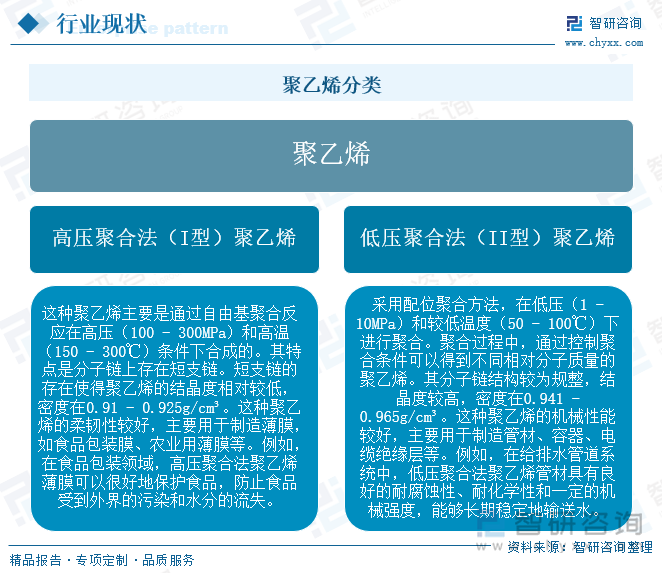
Industry Overview - The polyethylene industry in China is transitioning from "scale expansion" to "quality improvement," with a production capacity of 34.31 million tons per year in 2024, representing a year-on-year growth of 5.86% [1][10] - Demand for polyethylene continues to grow in traditional sectors such as packaging, construction, and agriculture, particularly driven by the expansion of e-commerce logistics [1][10] - The diversification of technological routes is leading to an increased share of light hydrocarbon-based polyethylene production due to cost advantages, while coal-to-olefin projects are shifting towards high-end production under policy constraints [1][10] Industry Development History - The development of the polyethylene industry in China has gone through four stages: initial stage (1950s-1970s), rapid development (1980s-2000s), high-speed growth (2001-2010), and structural adjustment and upgrading (2011-present) [4][5][6] - The industry saw significant technological upgrades in the 1980s and 1990s, with the introduction of advanced equipment from Japan and Germany [4] - The entry into the WTO in 2001 led to a surge in exports and the establishment of foreign enterprises in China, further expanding production capacity [5] Industry Chain - The upstream of the polyethylene industry includes raw materials and production equipment, primarily ethylene sourced from crude oil cracking, natural gas, and coal [8] - The midstream involves the manufacturing of polyethylene, while the downstream applications span packaging, construction materials, agricultural films, and more [8] Current Industry Status - The polyethylene market is currently characterized by "high supply, high inventory, and weak demand," with a main settlement price of 7,157.2 yuan per ton as of April 25, 2025 [14] - Despite a year-on-year increase in production capacity, supply has been temporarily tightened due to maintenance of production facilities [14] - The import volume of polyethylene has increased by 6.35% to 363.71 thousand tons, indicating strong domestic demand despite high reliance on imports [12][14] Key Companies' Performance - China Petrochemical Corporation (Sinopec) leads the market with a polyethylene production capacity of 9.02 million tons per year, having developed high-end products that break international monopolies [18] - China National Petroleum Corporation (CNPC) has a capacity of 6.6 million tons per year, focusing on high-end polyethylene products and achieving significant sales growth [20] - The competitive landscape is marked by low market concentration, with state-owned enterprises dominating high-end markets while private enterprises like Zhejiang Petrochemical are rapidly emerging [16][18] Industry Development Trends - The polyethylene industry is expected to continue expanding capacity while optimizing its structure, focusing on high-end product development to meet increasing market demands [22] - Technological innovation and green development are becoming mainstream, with advancements in catalysts and production processes aimed at improving efficiency and reducing costs [23][24] - Market demand is diversifying, with applications expanding into new sectors such as electric vehicles and photovoltaics, prompting companies to enhance product development and international market strategies [25]
金发科技股份有限公司
Shang Hai Zheng Quan Bao· 2025-04-21 20:27
Group 1 - The company emphasizes the importance of using simple, liquid, and low-risk foreign exchange derivatives for hedging against currency fluctuations [1][2] - The company has established management systems for futures and derivatives trading, detailing organizational structure, responsibilities, and risk management [1][3] - The company aims to mitigate adverse impacts from raw material price and exchange rate fluctuations through hedging operations in futures and derivatives markets [3][27] Group 2 - The company will hold its 2024 annual shareholders' meeting on May 20, 2025, with both on-site and online voting options available [5][6] - The meeting will take place at the company's administrative building in Guangzhou, and shareholders must register to attend [7][15] - The company has outlined the voting procedures for various types of shareholders, including those participating through margin trading and the Shanghai-Hong Kong Stock Connect [8][10] Group 3 - The company has announced a provision for asset impairment and recognition of fair value changes for non-current financial assets, totaling a reduction in profit of 614.25 million yuan for the year 2024 [19][27] - The impairment provisions include amounts for receivables, inventory, fixed assets, and goodwill, reflecting a cautious approach to financial reporting [19][21][26] - The company has confirmed fair value losses for non-current financial assets amounting to 38.12 million yuan, indicating a need for careful asset management [20][27] Group 4 - The company has implemented a change in accounting policy in accordance with the Ministry of Finance's new guidelines, which will not significantly impact its financial results [29][30] - The new accounting policy, effective from January 1, 2024, relates to the measurement of investment properties and quality assurance guarantees [31][32] Group 5 - The company has reported its fourth-quarter operational data for 2024, including production and sales figures for modified plastics, green petrochemicals, and new materials [34][38] - The sales volume for modified plastics reached 699,300 tons, while green petrochemical products and new materials also showed significant sales figures [34][39] - The company has noted no other significant operational impacts during the reporting period [38][39]